Bạn đang tìm Đề thi HSG Tiếng Anh 9 tỉnh Hà Tĩnh năm 2025–2026? Ngày 13/1, Sở GD&ĐT Hà Tĩnh đã tổ chức kỳ thi học sinh giỏi lớp 9 với sự tham gia của 1.891 học sinh toàn tỉnh. Tại đây, Tài liệu diệu kỳ cập nhật nhanh bộ đề thi chính thức môn Tiếng Anh, kèm đáp án chuẩn và file nghe Listening để thầy cô, phụ huynh và học sinh tiện tải về ôn luyện.
HSG tỉnh lớp 9 Hà Tĩnh 2025–2026 – 120 phút – 4 phần – 65 câu + 1 essay
A. Listening (25 câu)
• True/False (8)
• Điền từ (10)
• Trắc nghiệm (7)
B. Grammar & Lexical (25 câu)
• Trắc nghiệm ngữ pháp/từ vựng (15)
• Word formation (5)
• Collocation (5)
C. Reading (40 câu)
• Cloze test (10)
• Điền 1 từ (10)
• Heading + Matching (10)
• Đọc hiểu trắc nghiệm (10)
D. Writing
• Viết lại câu (5)
• Key word transformation (5)
• Essay 200 từ: AI chatbot
Cảm ơn bạn đã theo dõi. Chúc các em ôn thi tốt và chạm tới giải cao trong kỳ thi sắp tới.
Đáp án chính thức của Sở GD&ĐT Hà Tĩnh
SECTION I: LISTENING
Part 1
1. T
2. T
3. T
4. F
5. F
6. F
7. T
8. T
Part 2
9. coastal
10. oil
11. protein
12. overfishing
13. food chain
14. currents
15. unharnessed
16. rubbish
17. coral reefs
18. floating plastics
Part 3
19. B
20. D
21. B
22. B
23. A
24. C
25. D
________________________________________
SECTION II: GRAMMAR AND LEXICAL ITEMS
Part 1
1. B
2. A
3. C
4. C
5. B
6. A
7. D
8. B
9. D
10. A
11. A
12. C
13. C
14. B
15. D
Part 2
16. autobiography
17. seemingly
18. resourceful
19. unlawful
20. materialises / materializes
Part 3
21. smell a rat
22. taking the plunge
23. draw the line
24. hit the ceiling
25. missed the boat
________________________________________
SECTION III: READING
Part 1
1. D
2. A
3. C
4. A
5. D
6. A
7. B
8. C
9. D
10. A
Part 2
11. something / things
12. for
13. is
14. between
15. proved
16. basis
17. have
18. not
19. be
20. due / about / going
Part 3
21. iii
22. ii
23. iv
24. D
25. A
26. C
27. D
28. C
29. C
30. A
Part 4
31. B
32. A
33. D
34. A
35. C
36. D
37. A
38. D
39. C
40. C
________________________________________
SECTION IV: WRITING
Part 1
1. The basic model costs half as much as the (price of the) luxury model/one.
OR The basic model costs half (of) the price of the luxury model/one.
2. Such was the success of the advertising campaign that the product sold out within a week.
OR Such was the advertising campaign’s success that the product sold out within a week.
3. On her own admission, she was rather selfish.
4. We have booked five rooms, only two of which have air conditioning.
5. I can’t make head nor tail of this document.
Part 2
6. If it had not (hadn’t) been for Emma’s help, I don’t think I’d have completed this project.
7. Although Tom was invited to the wedding, he didn’t put in an appearance.
8. Steven was made redundant when the factory closed.
9. Luke ruled out the possibility of (his/him) ever going to university.
10. When things get tough, try to look on the bright side and don’t give up.
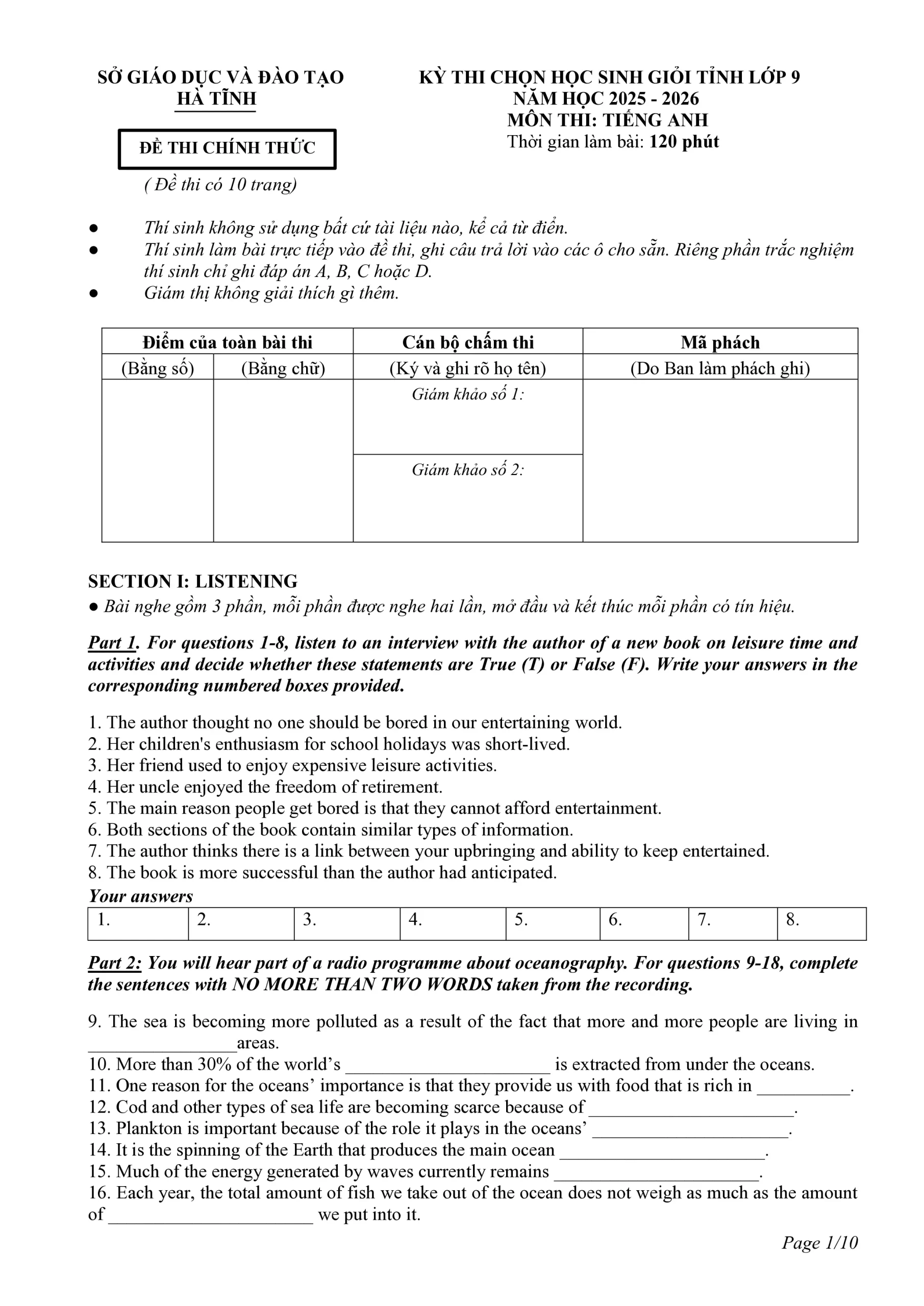
SỞ GIÁO DỤC VÀ ĐÀO TẠO KỲ THI CHỌN HỌC SINH GIỎI TỈNH LỚP 9
HÀ TĨNH NĂM HỌC 2025 - 2026
MÔN THI: TIẾNG ANH
Thời gian làm bài: 120 phút
( Đề thi có 10 trang)
● Thí sinh không sử dụng bất cứ tài liệu nào, kể cả từ điển.
● Thí sinh làm bài trực tiếp vào đề thi, ghi câu trả lời vào các ô cho sẵn. Riêng phần trắc nghiệm
thí sinh chỉ ghi đáp án A, B, C hoặc D.
● Giám thị không giải thích gì thêm.
Điểm của toàn bài thi Cán bộ chấm thi Mã phách
(Bằng số) (Bằng chữ) (Ký và ghi rõ họ tên) (Do Ban làm phách ghi)
Giám khảo số 1:
Giám khảo số 2:
SECTION I: LISTENING
● Bài nghe gồm 3 phần, mỗi phần được nghe hai lần, mở đầu và kết thúc mỗi phần có tín hiệu.
Part 1. For questions 1-8, listen to an interview with the author of a new book on leisure time and activities and decide whether these statements are True (T) or False (F). Write your answers in the corresponding numbered boxes provided.
1. The author thought no one should be bored in our entertaining world.
2. Her children's enthusiasm for school holidays was short-lived.
3. Her friend used to enjoy expensive leisure activities.
4. Her uncle enjoyed the freedom of retirement.
5. The main reason people get bored is that they cannot afford entertainment.
6. Both sections of the book contain similar types of information.
7. The author thinks there is a link between your upbringing and ability to keep entertained.
8. The book is more successful than the author had anticipated.
Your answers
1. 2. 3. 4. 5. 6. 7. 8.
Part 2: You will hear part of a radio programme about oceanography. For questions 9-18, complete the sentences with NO MORE THAN TWO WORDS taken from the recording.
9. The sea is becoming more polluted as a result of the fact that more and more people are living in ________________areas.
10. More than 30% of the world’s ______________________ is extracted from under the oceans.
11. One reason for the oceans’ importance is that they provide us with food that is rich in __________.
12. Cod and other types of sea life are becoming scarce because of ______________________.
13. Plankton is important because of the role it plays in the oceans’ _____________________.
14. It is the spinning of the Earth that produces the main ocean ______________________.
15. Much of the energy generated by waves currently remains ______________________.
16. Each year, the total amount of fish we take out of the ocean does not weigh as much as the amount of ______________________ we put into it.
17. The fact that the world’s oceans are getting warmer is a direct threat to ______________________.
18. __________________ and other pollutants are also doing considerable damage to marine wildlife.
Your answers:
9. 14.
10. 15.
11. 16.
12. 17.
13. 18.
Part 3: For questions 19-25, listen to an interview in which two people, Dana Singleton and Joe Fahey, talk about transport and choose the correct answer A, B, C or D which fits best according to what you hear. Write your answers in the corresponding numbered boxes provided.
19. What does Dana say about her reason for joining the Accident Prevention Board?
A. She did it after being involved in an accident herself.
B. She felt strongly about what they were doing.
C. She was close to someone who had been an accident victim.
D. She felt pressure from people she worked with.
20. The interviewer mistakenly believes that the number of serious road accidents ___________.
A. has recently overtaken the number of accidents on public transport
B. is presently at an all-time high
C. is a direct result of more aggressive drivers on the roads
D. has risen in proportion to the number of cars on the roads
21. According to the statistics Dana quotes, there were more serious accidents per year________.
A. before 1926 B. between 1926 and 1970 C. between 1970 and 1990 D. after 1990
22. According to Joe, what partly makes public transport an appealing and viable choice?
A. The reduced quality of life . B. The insignificant effect on the environment.
C. The increase in carbon footprint. D. The recorded high number of accidents.
23. Which of the following facts about public transport does Joe not state?
A. Public transport has a relatively poor safety record.
B. People sometimes feel intimidated when using public transport.
C. The high cost of public transport puts a number of people off.
D. Most complaints are about unreliable services.
24. According to Joe, public transport would improve if the government__________.
A. improved the road network B. made it free to travel by bus
C. re-allocated public spending D. banned certain cars from roads
25. What best sums up Dana’s and Joe’s opinions on driverless cars?
A. Joe feels more strongly that they could help the situation.
B. Dana disagrees with Joe that they are the transport of the future.
C. They share the same views on introducing them gradually.
D. They agree that the poor infrastructure will cancel out any benefit.
Your answers:
19. 20. 21. 22. 23. 24. 25.
SECTION II: GRAMMAR AND LEXICAL ITEMS
Part 1: Choose the correct word or phrase to complete each sentence. Write your answers A, B, C or D in the numbered boxes.
1. The salary of a bus driver is much higher __________.
A. to compare with a teacher B. than that of a teacher
C. than a teacher D. than the teacher is
2. Although the workshop I attended was interesting, I would _______ up for something more creative.
A. sooner have signed B. rather be signing C. prefer it to sign D. like having signed
3. John: “Do you mind if I use your dictionary ?”. Mary: “___________________”.
A. I’m afraid not B. Without doubt C. No, feel free D. Straight ahead
4. Amanda has never been good at maths, but she manages to ______ modern languages very quickly.
A. take up B. keep up C. pick up D. draw up
5. ___________, he remained optimistic.
A. Badly as he was wounded B. Badly wounded as he was
C. Though badly wounded he was D. As he was badly wounded
6. If, before becoming a writer, I ________ five years in the Andes, I would consider his narrative improbable.
A. hadn’t spent B. wouldn’t spend C. didn’t spend D. couldn’t spend
7. My mother was ________ ill last summer but, fortunately, is now making a slow but steady recovery.
A. deeply B. fatally C. definitely D. critically
8. Mike __________ the news at school, but you should call and tell him – just in case.
A. should have heard B. could have heard
C. shouldn’t have heard D. musn’t have heard
9. During exploration, problems that we can’t solve on our own can arise, ________?
A. do they B. don’t they C. can they D. can’t they
10. My parents ________ until the small hours when I got home late last night.
A. gave me the third degree B. caught me off guard
C. held sway over me D. cut me some slack
11. ________ rainforests are being cut down at an alarming rate, it is crucial we take steps to protect what remains.
A. Given that B. Akin to C. Prior to D. As for
12. The solicitor advised his client to _________ not guilty to all charges.
A. condone B. blame C. plead D. convict
13. Sports photographers today can ________ in a single dramatic moment the real emotions of the participants.
A. seize B. grasp C. capture D. secure
14. The trouble with socializing with colleagues is that they usually end up talking ________.
A. sense B. shop C. back D. safe
15. There was only _________ evidence; nobody actually saw the man take anything.
A. extenuating B. diminished C. suspended D. circumstantial
Your answers:
1. 2. 3. 4. 5. 6. 7. 8.
9. 10. 11. 12. 13. 14. 15.
Part 2: Use the word given in bold to form a word that fits in the text. Write your answers in the answer box below.
Papillon: a 'must' read
Everyone likes a good 'jail-break' story. One of my favourites is the narrative contained in the best-selling (16. biography)_________ Papillon by a Frenchman named Henri Charrière about his incredible escape from the notorious penal colony known as Devil’s Island. In this remarkable book, Charrière weaves his tale of (17. seem)_________ endless determination and resilience in the face of great conflict and confrontation.
The book spans more than a decade, with the opening chapters focusing on Charrière’s early career in 1930s France as a (18. resource)_________ safecracker. The book takes a turn when Charrière is arrested for the murder of another criminal – an offence which carries with it a sentence of life imprisonment.
Charrière is found guilty and, as punishment is sent to French Guiana to serve his sentence. Along the way he meets another convict called Louis Dega who makes an (19. law) _________ living as an embezzler and forger. Dega hires Charrière as a bodyguard, but as the tale unfolds, their relationship as employer and employee (20. material)_________ into one of deepest friendship and loyalty. Papillon is a bit of a tome at over 500 pages, but the time you invest in reading it will, I assure you, be well worth it.
Your answers:
16. 17. 18. 19. 20.
Part 3: Match the words in column A with their strongest collocates in column B and then use the full phrases to fill in the gaps in the sentences below, using the correct form of the matched phrases. Write the answers in the numbered boxes.
draw
miss
smell
hit
take a rat
the ceiling
the line
the plunge
the boat
21. I didn’t suspect anything at first, but when I noticed her going through the office drawers, I began to ____________.
22. They’re finally _____________ and getting married.
23. I swear quite a lot but I _______________ at saying certain words.
24. Dad will _____________ when he finds out I’ve left school.
25. You should have sent your application earlier now you've _______________.
Your answers:
21. 24.
22. 25.
23
SECTION III: READING
Part 1: Read the following passage and decide which answer A, B, C or D best fits each gap. Write your answers in the numbered boxes.
SELF-HEALING CONCRETE
Approximately 10 billion tons of concrete are produced around the world annually. Unfortunately, however widely used this building material may be, the (1)_________is that cracks will form in the structure at some time in the future. (2)________, the USA spends billions of dollars a year on repairing this kind of damage to bridges. Self-repairing concrete may well be the (3)________ to both saving money and significantly (4)________ the lifespan of buildings.
One company has developed a kind of self-healing concrete by inserting bacteria spores into the concrete mix. What happens is that whenever a crack forms, moisture enters, which activates the spores causing the bacteria to multiply (5)________. During this process, a (6) ________ of two chemicals in the concrete - calcium and nitrate - is (7)_______ by the microorganisms into limestone, and it is this material which repairs the cracks in (8)________. Self-healing concrete was developed with a (9)_______ to reducing the amount of costly maintenance usually required to stop a building eventually falling into (10)_______. Its use could also save older structures from being knocked down.
1. A. prospect B. conclusion C. vision D. likelihood
2. A. Indeed B. However C. In contrast D. Notwithstanding
3. A. door B. opening C. key D. possibility
4. A. extending B. swelling C. broadening D. expanding
5. A. highly B. heavily C. densely D. rapidly
6. A. combination B. harmony C. feature D. number
7. A. restored B. converted C. implemented D. renovated
8. A. mention B. legion C. question D. tension
9. A. glance B. look C. chance D. view
10. A. disrepair B. slums C. sprawl D. demolition
Your answers:
1. 2. 3. 4. 5. 6. 7. 8. 9. 10.
Part 2: Fill in the gap with ONE suitable word. Write the answers in the numbered boxes.
Forest Kindergarten: a Different Option
As the new school year begins, many parents will be looking for (11)_________ different for their pre-school children. A popular choice for many will be the forest kindergarten. It’s a kind of pre-school which, although it has been in existence (12) _________ some years now, (13) ________ slowly becoming a more and more popular choice. Forest kindergarten caters for children (14)________ the ages of three and six and involves them learning in a natural environment primarily outdoors.
This educational experience has (15)________ to be extremely effective. Activities include role play, climbing trees and exploring the forest. On a regular (16)________, the children take things found outside to make pictures, to learn counting skills and to play memory games. By the time children are ready to go to primary school, they will (17) ________ learnt many different skills through their experiences outdoors.
What about the teachers? They assume the role of supervisors or assistants, (18)________ leaders, and they care for, educate and stimulate the children. It is expected that, in the future, more and more parents will (19) ________ sending their children to forest kindergartens. Children who are (20) _________ to start pre-school will definitely benefit from this unique learning environment.
Your answers:
11. 12. 13. 14. 15.
16. 17. 18. 19. 20.
Part 3: The reading passage has three sections, A-C. Read the passage and do the tasks that follow.
The House of the Future, Then and Now.
A. The term “home of tomorrow” first came into usage in the 1920s to describe the “ideal house for future living” (Corn and Horrigan, 1984, p.62). It quickly emerged as a cultural symbol for the American obsession with the single-family dwelling. In the 1930s and 1940s, advertisers and promoters picked up the concept, and a number of full-scale homes of tomorrow travelled through fairs and department stores. It was in this same era that American consumer culture was consolidated. In the 1920s, there were three competing conceptions of the home of the future. The first, indebted to modernist architecture, depicted the home of tomorrow as a futuristic architectural structure. The second conception was that of the mass-produced, prefabricated house, a dwelling potentially available to every North American. These first two failed to capture the imagination and the dollars of industrialists or of the public, but the third image of the home of the future did. From World War II until the present, the evolving story of the home of the future is a story of “the house as a wonderland of gadgets” (Horrigan, 1986, p.154).
B. In the 1950s, the home of the future was represented in and by one room: the kitchen. Appliance manufacturers, advertisers and women’s magazines teamed up to surround women with images of the technology of tomorrow that would “automate” their lives, and automation became a synonym for reduced domestic labor. In 1958, one author predicted “Combustion freezers and electric ovens may someday reduce the job of preparing meals to a push-button operation (Ross, 1958, pp.197-8). ‘Before long there will also be self-propelled carpet and floor sweepers, automatic ironers that can fold and stack clothing, laundro-matic units that will wash and dry clothes even as these hang in the closet, dishwashers capable of washing and drying dinnerware and storing it in the cupboard, and many additional push-button marvels’ (Ross, 1958, p.200). The postwar faith in and fascination with science is very apparent in future predictions made in the 1950s. The magazine Popular Mechanics did a special feature in February in 1950 entitled, ‘Miracles You’ll See in the Next Fifty Years’ ‘Housewives in 50 years may wash dirty dishes - right down the drain! Cheap plastic would melt in hot water’. They also predicted that the housewife of the future would clean her house by simply turning the hose on everything. Furnishings, rugs, draperies and unscratchable floors would all be made of synthetic fabric or waterproof plastic. After the water had run down a drain in the middle of the floor (later concealed by a rug of synthetic fibre) you would turn on a blast of hot air and dry everything. The overriding message of the 1950s vision of the house of the future is that one can access the wonders of the future through the purchase of domestic technology today. In an October 1957 issue of Life magazine, the built-in appliances from Westinghouse reflect the ‘shape of tomorrow’. ‘Put them in your home - suddenly you are living in the future’. As Corn and Horrigan (1984) noted ‘by focusing on improving technology…the future becomes strictly a matter of things, their invention, improvement, and acquisition’(p.11).
C. The broader social context continued to be reflected in the 1970s home of the future, but now the trend was to look backwards for the future, back to a proud pioneer heritage. In stark contrast to the 1950s ‘old fashioned’ is no longer used in a pejorative way; it is seen as a cherished value. Over the 1970s, North American experienced certain erosion of trust in science and technology and there was less utopian speculation about the technologically produced future. The previous unproblematic link between technology, the future and progress was being questioned (Corn, 1986). From the space- age metals of the 1960s where every object had an electrical cord, we find a return to the traditional. Ideal homes featured wood inside and out, and an increased emphasis on windows. Domestic technologies were not featured as prominently, and the modernist or ultra-modernist designs of a few years earlier were all but gone. The use of wood combined with the use of windows, worked to blur the line between outside and inside, bringing the outside into inner or domestic space. We also see the influence of the Green movement, such as in the deployment of technology for solar-heated homes. The energy crisis was making itself felt, reflecting fears about a future not quite as rosy as that predicted by Popular Mechanics in 1950. Whereas in the 1960s The General Electric Company was exhorting consumers to ‘Live Electrically’ in the 1970s, the Edison Electric Company found it necessary to address the energy crisis directly in their advertisements.
Choose the correct heading for each section from the list of headings below.
Write the correct number i-v in the answer box 21-23 below.
List of headings
i. The multipurpose home of tomorrow
ii. Housework declines in the house of the future
iii. Mixed success for visions of the future
iv. The future lies in the past
v. A change of structure in the home of tomorrow.
21. Section A_____________.
22. Section B_____________.
23. Section C_____________.
Look at the following list of statements (questions 24-30)
Match each statement or prediction with the correct time period, A-D.
Write the correct letter, A-D in the answer box 24-30.
NB you may use any letter more than once.
List of time periods
A. 1920s
B. 1930s and 1940s
C. 1950s
D. 1970s
24. There was a loss of faith in automation ____________
25. Advertisers believed that houses would be made in a factory____________
26. One writer envisaged furniture being made from fully washable materials____________
27. There was an increased awareness of the environment____________
28. There was a link between our interest in the future and increased consumerism____________
29. One magazine predicted that disposable plates would be used____________
30. A new expression for “the perfect home” was introduced____________
Your answers:
21. 22. 23. 24. 25. 26. 27. 28. 29. 30.
Part 4: Read the passage and choose the best answer A, B, C or D for each question. Write your answers in the answer box below.
The craft of perfumery has an ancient and global heritage. The art flourished in Ancient Rome, where the emperors were said to bathe in scent. After the fall of Rome, much of the knowledge was lost, but survived in Islamic civilizations in the Middle Ages. Arab and Persian pharmacists developed essential oils from the aromatic plants of the Indian peninsula. They developed the processes of distillation and suspension in alcohol, which allowed for smaller amounts of raw materials to be used than in the ancient process, by which flower petals were soaked in warm oil. This knowledge was carried back to European monasteries during the Crusades.
At first, the use of fragrances was primarily associated with healing. Aromatic alcoholic waters were ingested as well as used externally. Fragrances were used to purify the air, both for spiritual and health purposes. During the Black Death, the bubonic plague was thought to have resulted from a bad odour which could be averted by inhaling pleasant fragrances such as cinnamon. The Black Death led to an aversion to using water for washing, and so perfume was commonly used as a cleaning agent.
Later on, the craft of perfume re-entered Europe, and was centred in Venice, chiefly because it was an important trade route and a centre for glass-making. Having such materials at hand was essential for the distillation process. In the late seventeenth century, trade soared in France, when Louis XIV brought in policies of protectionism and patronage which stimulated the purchase of luxury goods. Here, perfumery was the preserve of glove makers. The link arose since the tanning of leather required putrid substances. Consequently, the gloves were scented before they were sold and worn. A glove and perfume makers’ guild had existed here since 1190. Entering it required 7 years of formal training under a master perfumer.
The trade in perfume flourished during the reign of Louis XV, as the master glove and-perfume makers, particularly those trading in Paris, received patronage from the royal court, where it is said that a different perfume was used each week. The perfumers diversified into other cosmetics including soaps, powders, white face paints and hair dyes. They were not the sole sellers of beauty products. Mercers, spicers, vinegar-makers and wig-makers were all cashing in on the popularity of perfumed products. Even simple shopkeepers were coming up with their own concoctions to sell.
During the eighteenth century, more modern, capitalist perfume industry began to emerge, particularly in Britain where there was a flourishing consumer society. In France, the revolution initially disrupted the perfume trade due to its association with aristocracy, however, it regained momentum later as a wider range of markets were sought both in the domestic and overseas markets. The guild system was abolished in 1791, allowing new high-end perfumery shops to open in Paris. Perfume became less associated with health in 1810 with a Napoleonic ordinance which required perfumers to declare the ingredients of all products for internal consumption. Unwilling to divulge their secrets, traders concentrated on products for external use. Napoleon affected the industry in other ways too. With French ports blockaded by the British during the Napoleonic wars, the London perfumers were able to dominate the markets for some time.
One of the significant changes in the nineteenth century was the idea of branding. Until then, trademarks had had little significance in the perfumery where goods were consumed locally, although they had a long history in other industries. One of the pioneers in this field was Rimmel who was nationalized as a British citizen in 1857. He took advantage of the spread of railroads to reach customers in wider markets. To do this, he built a brand which conveyed prestige and quality, and were worth paying a premium for. He recognised the role of design in enhancing the value of his products, hiring a French lithographer to create the labels for his perfume bottles.
Luxury fragrances were strongly associated with the affluent and prestigious cities of London and Paris. Perfumers elsewhere tended to supply cheaper products and knock-offs of the London and Paris brands. The United States perfume industry, which developed around the docks in New York where French oils were being imported, began in this way. Many American firms were founded by immigrants, such as William Colgate, who arrived in 1806. At this time, Colgate was chiefly known as a perfumery. Its Cashmere Bouquet brand had 625 perfume varieties in the early 20th century.
31. The purpose of the text is to__________________.
A. compare the perfumes from different countries
B. describe the history of perfume making
C. describe the problems faced by perfumers
D. explain the different uses of perfume over time
32. Which of the following is NOT true about perfume making in Islamic countries?
A. They created perfume by soaking flower petals in oil.
B. They dominated perfume making after the fall of the Roman Empire.
C. They took raw materials for their perfumes from India.
D. They created a technique which required fewer plant materials.
33. Why does the writer include this sentence in paragraph 2?
During the Black Death, the bubonic plague was thought to have resulted from a bad odour which could be averted by inhaling pleasant fragrances such as cinnamon.
A. To explain why washing was not popular during the Black Death.
B. To show how improper use of perfume caused widespread disease.
C. To illustrate how perfumes used to be ingested to treat disease.
D. To give an example of how fragrances were used for health purposes.
34. What does putrid mean in paragraph 3?
A. bad-smelling B. softening C. fragrant D. numerous
35. Why did the perfume industry develop in Paris?
A. Because it was an important trade route.
B. Because of the rise in the glove-making industry.
C. Because of the introduction of new trade laws.
D. Because of a new fashion in scented gloves.
36. Which of the following people most influenced the decline of perfumes as medicine?
A. Louis XIV B. Louis XV C. Rimmel D. Napoleon
37. How did the French Revolution affect the Parisian perfume industry?
A. The industry declined then rose again.
B. The industry collapsed and took a long time to recover.
C. The industry was greatly boosted.
D. The industry lost most of its overseas customers.
38. London came to lead the perfume industry because_____________________.
A. the French Revolution meant that there were fewer customers in France.
B. Napoleon’s new laws affected the profitability of perfume-making.
C. the production of perfume ceased during the Napoleonic wars.
D. the French were unable to export perfumes for a period of time.
39. What is implied about the New York perfume industry?
A. It was the fastest-growing perfume industry in the world at that time.
B. It was primarily developed by immigrants arriving from France.
C. It copied luxury fragrances and sold them cheaply.
D. There was a wider range of fragrances available here than elsewhere.
40. Which city is being described in this sentence?
“The perfume industry developed here because the city produced materials and equipment necessary for perfume production.”
A. Paris B. London C. Venice D. New York
Your answers:
31. 32. 33. 34. 35. 36. 37. 38. 39. 40.
SECTION IV: WRITING
Part 1. Rewrite each of the following sentences using the suggested words so that its meaning stays the same. Write each answer in the space provided.
1. The price of the luxury model is twice that of the basic model.
The basic model costs half ______________________________________________________.
2. The advertising campaign was so successful that the product sold out within a week.
Such was ____________________________________________________________________.
3. She herself admitted to being rather selfish.
On her______________________________________________________________________.
4. Only two out of the five rooms we have booked have air conditioning.
We have booked five rooms,____________________________________________________.
5. I don’t understand one word of this document
I can’t make head_____________________________________________________________.
Part 2. Complete the second sentence so that it has the same meaning to the first printed, using the word given in CAPITAL. Do not change the word given. You must use between THREE and SIX words. Write each answer in the space provided.
6. Without the help Emma gave me, I don’t think I’d have completed this project. (BEEN)
If it _________________________________ help, I don’t think I’d have completed this project.
7. Tom was invited to the wedding, but he didn’t turn up. ( APPEARANCE)
Although Tom was invited to the wedding, he __________________¬¬¬¬____________________ .
8. Steven lost his job when the factory closed. (REDUNDANT)
Steven ___________________________________________________when the factory closed.
9. Luke made it clear that there is no chance he will ever go to university. (RULED)
Luke ____________________________________________________ ever going to university.
10. When things get tough, try to be optimistic and don’t give up. (SIDE)
When things get tough, try to_______________________________________and don’t give up.
Part 3: Write an essay of 200 words on the following topic:
The A.I chatbot has transformed the way students get access to information, but it has also created numerous problems.
What are the most serious issues associated with the A.I chatbot and what solutions can you suggest?
Give reasons for your answer and include any relevant examples from your own knowledge or experience.
- THE END -