Sáng 20/1, Sở GD&ĐT Bắc Ninh tổ chức Kỳ thi chọn học sinh giỏi cấp tỉnh lớp 9 và lớp 12 năm học 2025-2026 với hơn 6.600 thí sinh tham dự. Trong đó, khối THCS có 2.510 học sinh dự thi ở nhiều môn, bao gồm Tiếng Anh lớp 9. Đây là kỳ thi đầu tiên sau sáp nhập tỉnh, đánh dấu nhiều đổi mới trong công tác bồi dưỡng học sinh giỏi. Nếu bạn đang tìm Đề HSG Tiếng Anh 9 tỉnh Bắc Ninh 2025-2026 có đáp án, dưới đây là bản tổng hợp cấu trúc đề thi chi tiết. Bạn cũng có thể tải miễn phí file PDF, Word và file nghe để luyện tập hiệu quả tại nhà.
Theo Nghị quyết số 202/2025/QH15, tỉnh Bắc Ninh và tỉnh Bắc Giang được hợp nhất thành tỉnh Bắc Ninh mới, có hiệu lực từ ngày 01/07/2025.
A. Listening (4.0 pts): Note completion (5 câu) – Multiple choice (5 câu) – Summary completion (10 câu)
B. Lexico and Grammar (4.0 pts): Multiple choice (20 câu) – Word formation (10 câu) – Error identification (5 câu)
C. Reading (7.0 pts): Open cloze (5 câu) – Guided cloze (10 câu) – Reading comprehension (10 câu) – Matching headings & Summary (10 câu)
D. Writing (5.0 pts): Sentence transformation (7 câu) – Key word transformation (8 câu) – Essay writing (1 bài)
Đừng chỉ xem cấu trúc đề! Hãy tải ngay Đề HSG Tiếng Anh 9 Bắc Ninh 2025-2026 có đáp án và bắt đầu buổi luyện đề đầu tiên ngay hôm nay.
Đáp án
PART A. LISTENING
I.
1. mountain
2. 1.25
3. 60
4. panniers
5. lock
II.
1. C
2. B
3. B
4. A
5. D
III.
1. game consoles
2. developer
3. computer graphics
4. book covers
5. user interfaces
6. Star City
7. narrative
8. level of difficulty
9. vision
10. dedication
PART B. LEXICO & GRAMMAR
I.
1. D
2. D
3. D
4. D
5. A
6. C
7. D
8. A
9. A
10. C
11. B
12. C
13. A
14. C
15. B
16. D
17. A
18. B
19. A
20. A
II.
1. comparatively
2. open-minded
3. anxiety
4. occupations
5. beneficial
6. disorder
7. downsize
8. imperceptibly
9. absentees
10. generic
III.
1. is → does
2. from → to
3. second → second most
4. alter → vary
5. much → many
PART C. READING
I.
1. once
2. by
3. crack
4. high
5. shortages
II.
1. D
2. B
3. C
4. D
5. C
6. A
7. B
8. B
9. B
10. C
III.
1. C
2. B
3. B
4. C
5. D
6. D
7. B
8. A
9. D
10. A
IV.
1. vii
2. v
3. ix
4. i
5. iv
6. iii
7. funds available
8. positive outcomes
9. philosophical malaise
10. controlled experiments
PART D: WRITING
I.
1. At no time had he discussed such matters with his friend in holy orders.
2. There was an increase in health care costs from £1.9 billion in 2000 to £4 billion in 2001.
3. It is not until the end of the month that the photographs will be on exhibition.
4. The bank has yet to respond to our letter.
5. The newcomers should have been given some instructions to do the tasks.
6. The house is believed to have been built in 1973.
7. The content of the film bears no resemblance to what actually happened.
II.
1. criticised Bill for leaving
2. set her heart on winning
3. difficulty (in) coming to terms
4. decision has been made
5. is attributed to a fifteenth-century author
6. hangs in the balance
7. going through the motions
8. promoted on the strength of
III. Essay Writing
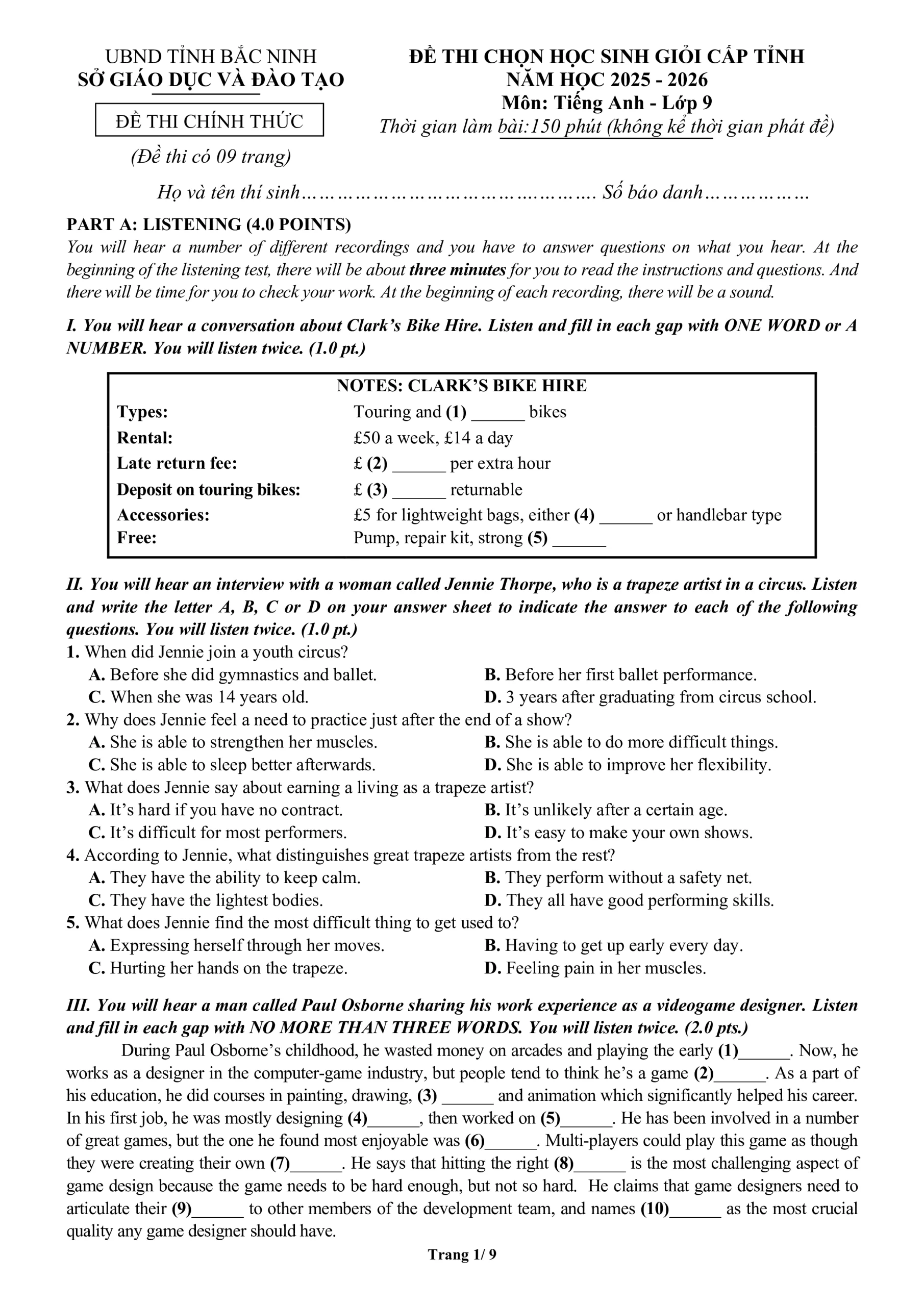
UBND TỈNH BẮC NINH
SỞ GIÁO DỤC VÀ ĐÀO TẠO
(Đề thi có 09 trang)
ĐỀ THI CHỌN HỌC SINH GIỎI CẤP TỈNH
NĂM HỌC 2025 - 2026
Môn: Tiếng Anh - Lớp 9
Thời gian làm bài:150 phút (không kể thời gian phát đề)
Họ và tên thí sinh………………………………….………. Số báo danh………………
PART A: LISTENING (4.0 POINTS)
You will hear a number of different recordings and you have to answer questions on what you hear. At the beginning of the listening test, there will be about three minutes for you to read the instructions and questions. And there will be time for you to check your work. At the beginning of each recording, there will be a sound.
I. You will hear a conversation about Clark’s Bike Hire. Listen and fill in each gap with ONE WORD or A NUMBER. You will listen twice. (1.0 pt.)
NOTES: CLARK’S BIKE HIRE
Types: Touring and (1) ______ bikes
Rental: £50 a week, £14 a day
Late return fee: £ (2) ______ per extra hour
Deposit on touring bikes: £ (3) ______ returnable
Accessories:
Free: £5 for lightweight bags, either (4) ______ or handlebar type
Pump, repair kit, strong (5) ______
II. You will hear an interview with a woman called Jennie Thorpe, who is a trapeze artist in a circus. Listen and write the letter A, B, C or D on your answer sheet to indicate the answer to each of the following questions. You will listen twice. (1.0 pt.)
1. When did Jennie join a youth circus?
A. Before she did gymnastics and ballet. B. Before her first ballet performance.
C. When she was 14 years old. D. 3 years after graduating from circus school.
2. Why does Jennie feel a need to practice just after the end of a show?
A. She is able to strengthen her muscles. B. She is able to do more difficult things.
C. She is able to sleep better afterwards. D. She is able to improve her flexibility.
3. What does Jennie say about earning a living as a trapeze artist?
A. It’s hard if you have no contract. B. It’s unlikely after a certain age.
C. It’s difficult for most performers. D. It’s easy to make your own shows.
4. According to Jennie, what distinguishes great trapeze artists from the rest?
A. They have the ability to keep calm. B. They perform without a safety net.
C. They have the lightest bodies. D. They all have good performing skills.
5. What does Jennie find the most difficult thing to get used to?
A. Expressing herself through her moves. B. Having to get up early every day.
C. Hurting her hands on the trapeze. D. Feeling pain in her muscles.
III. You will hear a man called Paul Osborne sharing his work experience as a videogame designer. Listen and fill in each gap with NO MORE THAN THREE WORDS. You will listen twice. (2.0 pts.)
During Paul Osborne’s childhood, he wasted money on arcades and playing the early (1)______. Now, he works as a designer in the computer-game industry, but people tend to think he’s a game (2)______. As a part of his education, he did courses in painting, drawing, (3) ______ and animation which significantly helped his career. In his first job, he was mostly designing (4)______, then worked on (5)______. He has been involved in a number of great games, but the one he found most enjoyable was (6)______. Multi-players could play this game as though they were creating their own (7)______. He says that hitting the right (8)______ is the most challenging aspect of game design because the game needs to be hard enough, but not so hard. He claims that game designers need to articulate their (9)______ to other members of the development team, and names (10)______ as the most crucial quality any game designer should have.
PART B: LEXICO AND GRAMMAR (4.0 POINTS)
I. Write the letter A, B, C or D on your answer sheet to indicate the answer to each of the following questions. (2.0 pts.)
1. The city ______ at one time prosperous, for it enjoyed a high level of civilization.
A. shouldn’t have been B. needn’t have been C. could have been D. must have been
2. ______ highly appreciated in the literary world, this novel is disregarded by most of the public.
A. Although is B. Despite C. Even though D. Although
3. It was on my last birthday ______ me this beautiful dress.
A. that my parents buy B. when my parents bought
C. when my parents buy D. that my parents bought
4. Don’t take ______ seriously since he has a habit of blowing his own trumpet.
A. what does he say to you B. that everything he says to you
C. that he says to you D. whatever he says to you
5. It is my advice that Josh ______ the leader of the team.
A. not be elected B. not to elect C. shouldn’t elect D. is not elected
6. Your ______, no matter how small, can be of great importance to our campaign to help the poor.
A. intention B. determination C. contribution D. devotion
7. Mike looks tired recently as he has been burning the ______ at both ends to meet the deadline of the school project.
A. light B. incense C. stick D. candle
8. Life in the country is not as quiet and ______ as people often think. There are, in fact, a lot of things to see and do.
A. uneventful B. unpopular C. unproductive D. unwelcome
9. To prevent cross-contamination, do not put cooked food in the container which has contained ______ food because the bacteria could be transferred.
A. raw B. rough C. rude D. ripe
10. Brenden is talking to James in the classroom.
Brenden: “Do you mind if I turn on the fan? It’s so hot in here.”
James: “______”
A. Yes, I am feeling hot, too. B. No, please don’t.
C. Not at all. D. I’d rather you hadn’t.
11. The particles are ______ almost invisible.
A. too small as to be B. so small as to be
C. as small as to be D. so small as for being
12. Often celebrated for their vivid portrayal of nature, ______.
A. countless readers are inspired by the writings of John Muir
B. it was John Muir’s writings that inspired countless readers
C. John Muir’s writings inspire countless readers
D. John Muir inspired countless readers through his writings
13. I don’t think there is any milk left in the fridge, ______?
A. is there B. isn’t there C. do I D. don’t I
14. Despite having argued constantly, both parties decided to ______ and join hands to solve the crisis.
A. cut a fine figure B. strike an attitude
C. bury their differences D. keep their heads down
15. We’ve decided to stay at this hotel just because it ______ a spectacular view of the whole village at the foot of the cliff.
A. allows B. affords C. enables D. empowers
16. Her actions contrasted ______ with her promises, which made her friends upset.
A. thoroughly B. fully C. highly D. strikingly
17. The kids are really looking forward to ______ on the trip to the beach tomorrow.
A. setting out B. putting away C. putting by D. setting aside
18. Have you finished collecting the ______ you need to make a new dress for your mother?
A. substance B. material C. chemical D. matter
19. Besides ______ about 40,000 homes, the worst natural disaster in memory destroyed countless businesses and jobs.
A. annihilating B. repudiating C. confiscating D. eliminating
20. Linda is inviting Jenny for a dinner out.
- Linda: “Do you feel like going somewhere for dinner, Jenny?”
- Jenny: “______ I have to work late tonight.”
A. Can I take a rain check? B. Are you having too much on your plate?
C. Thanks, that sounds lovely! D. Sure. My treat this time!
II. Complete the sentence in each of the following questions by giving the correct form of the given word. (1.0 pt.)
1. We are a/an ________ wealthy country, but our resources are getting exhausted. (COMPARE)
2. My parents are ________, liberal and understanding to the extent that I probably could never match. (MIND)
3. I knew I had to give a speech, but the thought filled me with ________. (ANXIOUS)
4. It is widely known that people in manual ________ are at high risk of experiencing poverty. (OCCUPY)
5. There is no convincing reason for believing that adopting this policy would have a/an ________ effect on economic performance. (BENEFIT)
6. After two years of therapy, Duane was finally able to conquer his eating ________. (ORDER)
7. As a consequence of the economic crisis, a number of businesses had to ________. (SIZE)
8. In some places in the North Pole, the daylight fades almost ________ into night during winter months. (PERCEIVE)
9. Last month, the majority of schools in this district had 6% or more of their pupils as unauthorized ________. (ABSENCE)
10. Electronic Publishing is a/an ________ term for the distribution of information which is stored, transmitted and reproduced electronically. (GENERAL)
III. There are FIVE mistakes in this paragraph. Identify the mistakes and give the corrections on your answer sheet. (1.0 pt.)
LINE VIRTUAL DOCTORS
1
2
3
4
5
6
7
8
9
10
11
12
13
14
15 Clare Harrison rarely falls ill and hates going to the doctor’s when she is. Therefore, when she recently came out in a painful rash down one side of her body, she emailed her symptoms, which also included a mild fever, from e-doc, the Internet medical service. Two hours later, she was diagnosed as having shingles (Herpes Zoster) by her online doctor, who prescribed a special cleansing solution for the rash and analgesics to help relieve the pain. Health advice is now the second popular topic that people search for on the Internet, and online medical consultation is big business. Sites alter enormously in what they offer, with services ranging from the equivalent of a medical agony aunt to a live chat with a doctor. They are clearly meeting a demand from people who are too busy or too embarrassed to discuss their medical complaint with their doctors. Dr. Ron Zeronis came up with the idea for e-doc when he contracted a dangerous form of malaria whilst travelling in a remote part of Africa. With only very basic medical facilities, Dr. Zeronis resolved immediately to launch his site and provide a service for others who found themselves in a similar situation. Not all practitioners, however, are in favour of sites such as e-doc; much point to the potential dangers of online medical advice, particularly in the case of more serious illnesses.
PART C: READING (7.0 POINTS)
I. Read the text below and fill in each gap with ONE suitable word. (1.0 pt.)
DNA BARCODING
Thanks to a technique known as ‘DNA barcoding’, scientists believe they can put an end to food fraud (1) ______ and for all. The principle behind DNA barcoding is as follows: all species can be identified by their unique genetic material. Thus, (2) ______ taking and analysing a sample of DNA from a food product, scientists can unequivocally identify the species it came from. Countries around the world are now using DNA barcoding to (3) ______ down on food fraud. In the USA alone, as much as 25% of all fish imports are estimated to be fraudulently labeled. For certain species, such as red snapper, fraud runs as (4) ______ as 75%. There is big incentive for fish suppliers to cheat. First, only 2% of fish in the US market is inspected so the chances are good they will get away with the deception. Second, over-fishing, coupled with a growing consumer demand, has created seafood (5) ______. Typically, fraud rests in the area of cheaper seafood being labeled as more expensive species. Importers will go to great lengths to cut and dye their fillets to look like the fish they’re trying to imitate.
II. Read the following passage and write the letter A, B, C, or D on your answer sheet to indicate the option that best fits each of the numbered blanks. (2.0 pts.)
The expression AI slop has recently emerged as a way of describing the growth amount of poor-quality digital (1)______ that circulates online. It originally described machine-generated posts (2)______ quickly and in large quantities by artificial intelligence with little human involvement. Users now use it more broadly to criticize anything that feels soulless or meaningless. Mentions of slop grew rapidly in 2025 as more people expressed frustration with repetitive, meaningless material that (3)______ content produced with care and creativity.
The rapid spread of AI slop reflects a wider transformation in online culture, (4)______ algorithms increasingly reward constant output rather than thoughtful production. As a result, many users report feelings of exhaustion and dissatisfaction when (5)______ feeds dominated by formulaic posts. Creative professionals, in particular, have expressed strong (6)______ to content that seems automated and emotionally empty, arguing that it undermines honest expression and artistic effort.
For businesses and brands, the rise of AI slop (7)______ a serious challenge. While artificial intelligence can improve efficiency, careless reliance on it risks damaging credibility and (8)______ trust. Experts, (9)______, recommend careful evaluation of whether content offers insight, relevance, or originality before (10)______. Clear communication about how AI tools are used and where human judgment remains essential can help maintain authenticity.
1. A. transmission B. imagery C. channel D. content
2. A. were created B. created C. creating D. which create
3. A. overburdens B. underpins C. overshadows D. underscores
4. A. whom B. who C. which D. where
5. A. grappling with B. stumbling over C. scrolling through D. scrambling for
6. A. resistance B. commitment C. prejudice D. disapproval
7. A. withstands B. presents C. addresses D. relishes
8. A. spectator B. consumer C. audience D. customer
9. A. nonetheless B. therefore C. however D. though
10. A. circulation B. production C. publication D. introduction
III. Read the following passage and write the letter A, B, C, or D on your answer sheet to indicate the best answer to each of the following questions. (2.0 pts.)
Anthropology distinguishes itself from the other social sciences by its greater emphasis on fieldwork as the source of new knowledge. The aim of such studies is to develop as intimate an understanding as possible of the phenomena investigated. Although the length of field studies varies from a few weeks to years, it is generally agreed that anthropologists should stay in the field long enough for their presence to be considered ‘natural’ by the permanent residents. [I]
Realistically, however, anthropologists may never reach this status. [II] If they speak the local language at all, they do so with a strange accent and flawed grammar. They ask tactless questions and inadvertently break rules regarding how things are usually done. Arguably this could be an interesting starting point for research, though it is rarely exploited. Otherwise, anthropologists take on the role of the “superior expert”, in which case they are treated with deference and respect, only coming into contact with the most high-ranking members of the society. Anthropologists with this role may never witness the gamut of practices which take place in all levels of the society. [III]
No matter which role one takes on, anthropologists generally find fieldwork extremely demanding. [IV] Anthropological texts may read like an exciting journey of exploration, but rarely is this so. Long periods of time spent in the field are generally characterized by boredom, illness and frustration. Anthropologists in the field encounter unfamiliar climates, strange food and low standards of hygiene. It is often particularly trying for researchers with middle-class, European backgrounds to adapt to societies where being alone is considered pitiful. It takes a dedicated individual to conduct research which is not in some way influenced by these personal discomforts.
Nonetheless, fieldwork requires the researcher to spend as much as possible in local life. A range of research methodologies can be utilized to extract information. These can be classified as emic or etic. A native’s point of view of his own lifestyle is emic, while the analytical perspective of the outsider is etic. While emic descriptions are considered more desirable nowadays, they are difficult to attain, even if the researcher does his utmost to reproduce the facts from the natives’ point of view. More often than not, aspects of the researcher’s own culture, perspective and literary style seep into the narrative. Moreover, research generally involves translations from one language to another and from speech into writing. In doing this, the meaning of utterances is changed. The only truly emic descriptions can be those given by the natives themselves in their own vernacular.
The least invasive type of research methodology is observation. Here, the researcher studies the group and records findings without intruding too much on their privacy. This is not to say, however, that the presence of the research will have minimal impact on the findings. An example was Richard Borshay Lee, who, in studying local groups in the Kalahari refused to provide the people with food so as not to taint his research, leading to an inevitable hostility towards the researcher which would not otherwise have been present.
A variant on the observation technique, participant observation requires that the anthropologist not only observes the culture, but participates in it too. It allows for deeper immersion into the culture studied, hence a deeper understanding of it. By developing a deeper rapport with the people of the culture, it is hoped they will open up and divulge more about their culture and way of life than can simply be observed. Participant observation is still an imperfect methodology, however, since populations may adjust their behavior around the researcher, knowing that they are the subject of research.
The participatory approach was conceived in an attempt to produce as emic a perspective as possible. The process involves not just the gathering of information from local people, but involves them in the interpretation of the findings. That is, rather than the researcher getting actively involved in the processes within the local community, the process is turned on its head. The local community is actively involved in the research process.
1. Which of the following can be the title of the passage?
A. A Brief Introduction to the History of Anthropology
B. Possible Effects of Anthropological Fieldwork on Local Communities
C. Anthropological Fieldwork Methodologies and Their Problems
D. Key Steps to Undertake Anthropological Fieldwork
2. Where in the passage does the following sentence best fit?
Their foreign mannerisms make them appear clownish, and so they are treated with curiosity and amusement.
A. [I] B. [II] C. [III] D. [IV]
3. The word inadvertently in paragraph 2 mostly means _______.
A. deliberately B. accidentally C. abruptly D. completely
4. The word those in paragraph 4 refers to ______.
A. analytical perspectives of outsiders B. natives’ points of view
C. emic descriptions D. translations from speech into writing
5. According to the passage, the most difficult aspect for Western researchers is that ______.
A. their privacy being violated
B. extreme weather patterns
C. frustration caused by long stay in the field
D. doing research without interfering in the natives’ life
6. Why is the example of the Richard Borshay Lee given in paragraph 5?
A. To demonstrate that observation is an ineffective method of gathering data.
B. To highlight why it is important that researchers minimize their impact on a community.
C. To show the dangers of researchers trying to lessen their impact on a community.
D. To show how a researcher’s choice of methodology can influence the validity of his findings.
7. In emic descriptions, ______.
A. researchers manipulate the locals’ points of view
B. the narrative of the research may be subjective
C. researchers records findings without intruding on locals’ privacy
D. the natives are involved in the interpretation of the findings
8. According to passage, participatory approach ______.
A. attempts to reduce etic accounts of a culture to a minimum
B. does not require a researcher to be present
C. aims to involve the researchers in both information gathering and analysis
D. gets researchers actively involved in the interpretation of the findings
9. Which of the following is NOT mentioned as a problem encountered by anthropologists carrying out fieldwork?
A. They have to get accustomed to an unfamiliar living condition.
B. The fieldworkers’ emotions and moods prejudice the research.
C. Locals tend to behave unnaturally with the presence of researchers.
D. They face great problems in interpreting anthropological texts.
10. Which of the following can be inferred from the passage?
A. Anthropologists’ presence may never be considered “natural” by the natives.
B. Observation research allows researchers to connect with the locals while supporting them.
C. Participant observation worsens the problem of research subjects adjusting their behaviors.
D. Anthropologists do not study the language and culture of the region before their arrival.
IV. Read the text and do the tasks that follow. (2.0 pts.)
TRY IT AND SEE
In the social sciences, it is often supposed that there can be no such thing as a controlled experiment. Think again.
A. In the scientific pecking order, social scientists are usually looked down on by their peers in the natural sciences. Natural scientists do experiments to test their theories or, if they cannot, they try to look for natural phenomena that can act in lieu of experiments. Social scientists, it is widely thought, do not subject their own hypotheses to any such rigorous treatment. Worse, they peddle their untested hypotheses to governments and try to get them turned into policies.
B. Governments require sellers of new medicines to demonstrate their safety and effectiveness. The accepted gold standard of evidence is a randomized control trial, in which a new drug is compared with the best existing therapy (or with a placebo, if no treatment is available). Patients are assigned to one arm or the other of such a study at random, ensuring that the only difference between the two groups is the new treatment. The best studies also ensure that neither patient nor physician knows which patient is allocated to which therapy. Drug trials must also include enough patients to make it unlikely that chance alone may determine the result.
C. But few education programs or social initiatives are evaluated in carefully conducted studies prior to their introduction. A case in point is the ‘whole-language’ approach to reading, which swept much of the English-speaking world in the 1970s and 1980s. The whole-language theory holds that children learn to read best by absorbing contextual clues from texts, not by breaking individual words into their component parts and reassembling them (a method known as phonics). Unfortunately, the educational theorists who pushed the whole-language notion so successfully did not wait for evidence from controlled randomized trials before advancing their claims. Had they done so, they might have concluded, as did an analysis of 52 randomized studies carried out by the US National Reading Panel in 2000, that effective reading instruction requires phonics.
D. To avoid the widespread adoption of misguided ideas, the sensible thing is to experiment first and make policy later. This is the idea behind a trial of restorative justice which is taking place in the English courts. The experiment will include criminals who plead guilty to robbery. Those who agree to participate will be assigned randomly either to sentencing as normal or to participation in a conference in which the offender comes face-to-face with his victim and discusses how he may make emotional and material restitution. The purpose of trial is to assess whether such restorative justice limits re-offending. If it does, it might be adopted more widely.
E. The idea of experimental evidence is not quite as new to the social sciences as sneering natural scientists might believe. In fact, randomized trials and systematic reviews of evidence were introduced into the social sciences long before they became common in medicine. An apparent example of random allocation is a study carried out in 1927 of how to persuade people to vote in elections. And randomized trials in social work were begun in the 1930s and 1940s. But enthusiasm later waned. This loss of interest can be attributed, at least in part, to the fact that early experiments produced little evidence of positive outcomes. Others suggest that much of the opposition to experimental evaluation stems from a common philosophical malaise among social scientists, who doubt the validity of the natural sciences, and therefore reject the potential of knowledge derived from controlled experiments. A more pragmatic factor limiting the growth of evidence-based education and social services may be the limitations on the funds available for research.
F. Nevertheless, some 11,000 experimental studies are known in the social sciences (compared with over 250,000 in the medical literature). Randomized trials have been used to evaluate the effectiveness of driver-education programs, job-training schemes, classroom size, psychological counseling for post-traumatic stress disorder and increased investment in public housing. And where they are carried out, they seem to have a healthy dampening effect on, otherwise, rosy interpretations of the observations.
G. The problem for policymakers is often not too few data, but what to make of multiple and conflicting studies. This is where a body called the Campbell Collaboration comes into its own. This independent non-profit organization is designed to evaluate existing studies, in a process known as a systematic review. This means attempting to identify every relevant trial of a given question (including studies that have never been published), choosing the best ones using clearly defined criteria for quality, and combining the results in a statistically valid way. An equivalent body, the Cochrane Collaboration, has produced more than 1,004 such reviews in medical fields. The hope is that rigorous review standards will allow Campbell, like Cochrane, to become a trusted and authoritative source of information.
For questions 1-6, choose the correct headings for paragraphs B-F from the list of headings below. Write the correct number, i-ix.
List of Headings:
i. Why some early social science methods lost popularity
ii. The cost implications of research
iii. Looking ahead to an unbiased assessment of research
iv. A range of social issues that have been usefully studied
v. An example of a poor decision that was made too quickly
vi. What happens when the figures are wrong
vii. One area of research that is rigorously carried out
viii. The changing nature of medical trials
ix. An investigative study that may lead to a new system
x. Why some scientists’ theories are considered second-rate
Example: Paragraph A Answer: x
1. _______ Paragraph B
2. _______ Paragraph C
3. _______ Paragraph D
4. _______ Paragraph E
5. _______ Paragraph F
6. _______ Paragraph G
For questions 7-10, complete the summary below by filling NO MORE THAN TWO WORDS from the passage in each answer.
Loss of Interest
There are several reasons why experimental evidence is dismissed. The most significant cause may be the lack of the (7)________ for conducting studies. Besides, an insufficient number of (8)________ might be the culprit behind the reduction in enthusiasm for early experiments. There also exists a (9)________ in experts about whether the natural sciences are valid, which leads them to have a low opinion of information obtained from (10)________.
PART D: WRITING (5.0 POINTS)
I. Finish each of the following sentences in such a way that means the same as the original one. (1.4 pts.)
1. He had never discussed such matters with his friend in holy orders.
At no time
2. Health care costs increased from £1.9 billion in 2000 to £4 billion in 2001.
There was
3. The photographs will not be on exhibition by the end of the month.
It is not until
4. The bank hasn’t responded to our letter yet.
The bank has yet
5. It was wrong of them not to give the newcomers any instructions to do the tasks.
The newcomers
6. People believe that the house was built in 1973.
The house
7. The content of the film is completely different from what actually happened.
The content of the film bears
II. Complete the second sentence so that it has the same meaning to the first printed, using the word in capital. Do not change the given word in any way. Use BETWEEN THREE AND SIX words. (1.6 pts.)
1. “You were so careless to leave the door open all night”, she said to Bill. (CRITICISED)
She _________________________________________________________ the door open all night.
2. She is determined to win this dancing competition. (HEART)
She has ____________________________________________________ this dancing competition.
3. It is hard for her to get used to the fact that she has lost her job. (TERMS)
She has difficulty _______________________________________the fact that she has lost her job.
4. The school hasn’t decided when to organise the ball. (DECISION)
No _____________________________________________ the school on when to organise the ball.
5. People believe the novel was written by a fifteenth century author. (ATTRIBUTED)
The novel ________________________________________________________________ author.
6. No one is certain about the fate of the flood victims. (BALANCE)
The fate of the flood victims ________________________________________________________.
7. He says he has been investigating my complaint, but I feel he has little interest. (MOTIONS)
He says he has been investigating my complaint, but I feel he is just _________________________.
8. His dedication to the job helped him get promotion. (STRENGTH)
He was _____________________________________________________ his dedication to the job.
III. Essay Writing (2.0 pts.)
Some people think that teenagers tend to be leading a less healthy life. To what extent do you agree or disagree?
Write an essay of about 250 words to express your opinion.
====== HẾT ======
- Thí sinh không được sử dụng tài liệu.
- Giám thị không giải thích gì thêm.