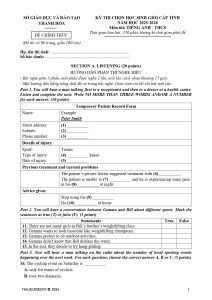
Vào ngày 03/12/2024, Sở GD&ĐT Quảng Bình đã tổ chức kỳ thi chọn học sinh giỏi cấp tỉnh năm học 2024–2025 dành cho học sinh lớp 12 THPT. Để hỗ trợ các bạn học sinh ôn luyện hiệu quả và cung cấp nguồn tài liệu giảng dạy chất lượng cho quý thầy cô, Tài liệu diệu kỳ xin gửi đến trọn bộ Đề thi HSG Tiếng Anh 12 Quảng Bình 2024-2025 kèm đáp án chính thức. Đặc biệt, tài liệu được cung cấp dưới dạng File Word dễ dàng chỉnh sửa cùng File Audio (Nghe) đầy đủ.
Đề HSG Tiếng Anh 12 Quảng Bình 2024-2025 – 150 phút – 6 trang – 4 phần – 90 câu
A. Listening (20 điểm)
• Part 1 (MCQ): 5 câu – 5 điểm
• Part 2 (True/False): 5 câu – 5 điểm
• Part 3 (Note completion): 10 câu – 10 điểm
B. Language (30 điểm)
• Pronunciation: 3 câu – 3 điểm
• Stress: 2 câu – 2 điểm
• MCQ Grammar/Vocab: 10 câu – 10 điểm
• Error correction: 5 câu – 5 điểm
• Word form: 5 câu – 5 điểm
• Phrasal verbs: 5 câu – 5 điểm
C. Reading (30 điểm)
• Cloze test (MCQ): 10 câu – 10 điểm
• Open cloze: 10 câu – 10 điểm
• Reading comprehension (MCQ): 5 câu – 5 điểm
• Matching headings: 5 câu – 5 điểm
D. Writing (20 điểm)
• Sentence transformation: 5 câu – 5 điểm
• Word transformation: 5 câu – 5 điểm
• Essay: 1 bài – 10 điểm
Quý thầy cô và các em học sinh có thể tải ngay trọn bộ tài liệu miễn phí tại các liên kết dưới đây để phục vụ cho công tác giảng dạy và tự học:
Đừng quên theo dõi trang để cập nhật thêm nhiều đề thi chất lượng mỗi ngày nhé!
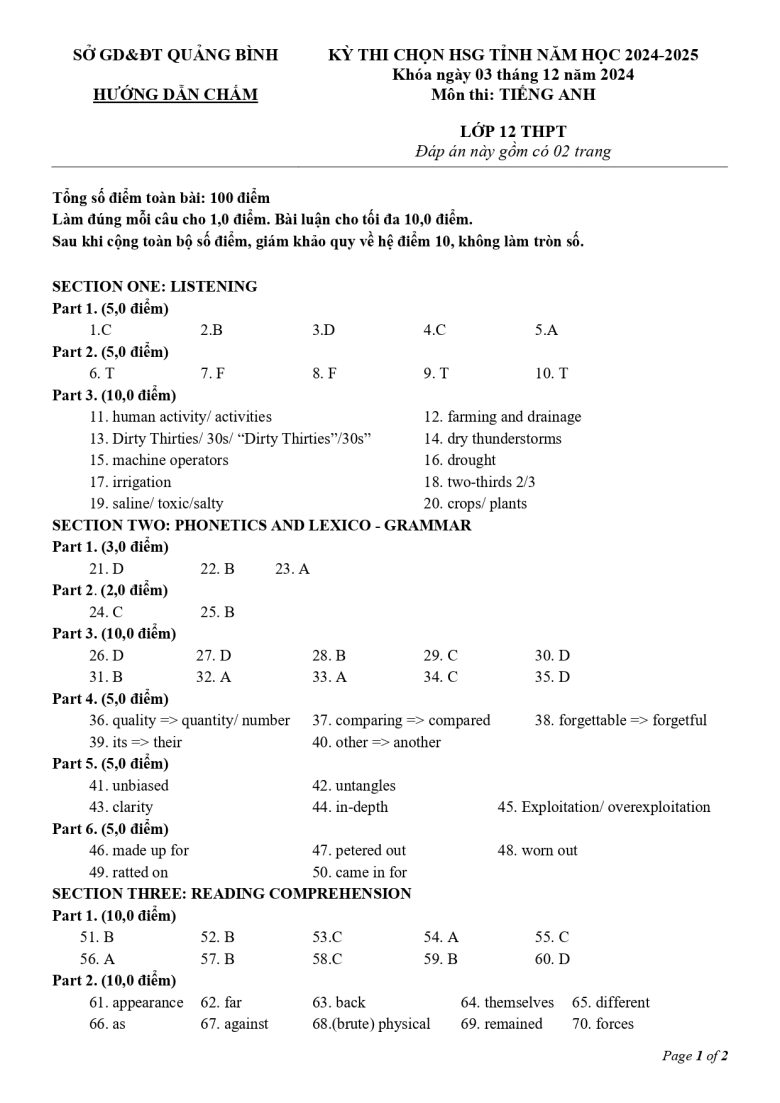
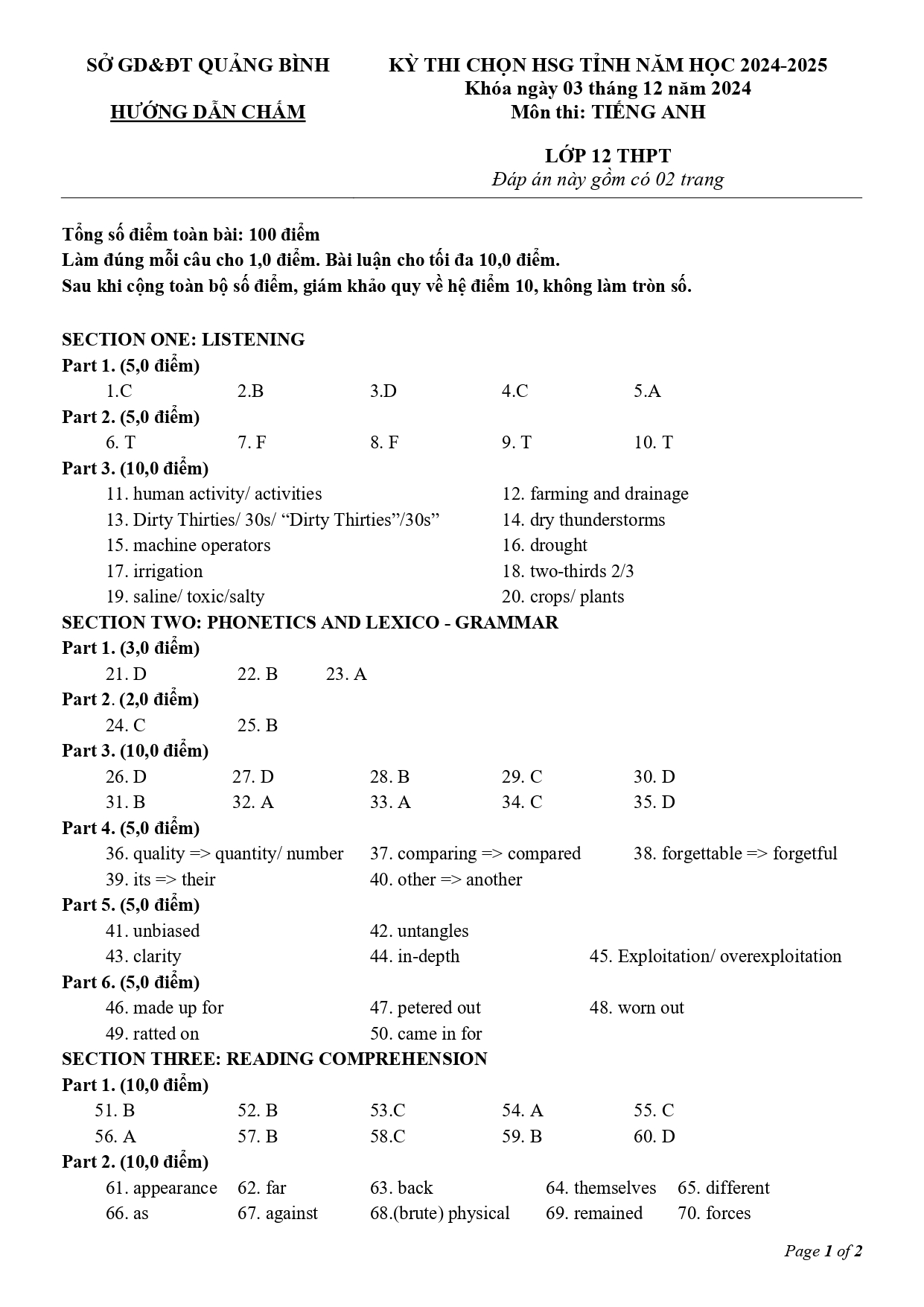
Đáp án chính thức
SỞ GD&ĐT QUẢNG BÌNH
HƯỚNG DẪN CHẤM
KỲ THI CHỌN HSG TỈNH NĂM HỌC 2024–2025
Khóa ngày 03/12/2024
Môn: TIẾNG ANH – LỚP 12 THPT
> Đáp án gồm: 02 trang
---
Tổng điểm
* Tổng số điểm toàn bài: 100 điểm
* Mỗi câu đúng: 1,0 điểm
* Bài luận: tối đa 10,0 điểm
* Sau khi chấm xong, quy về thang điểm 10 (không làm tròn)
---
SECTION ONE: LISTENING
Part 1 (5,0 điểm)
1. C 2. B 3. D 4. C 5. A
Part 2 (5,0 điểm)
6. T 7. F 8. F 9. T 10. T
Part 3 (10,0 điểm)
11. human activity/ activities
12. farming and drainage
13. Dirty Thirties / 30s / “Dirty Thirties” / “30s”
14. dry thunderstorms
15. machine operators
16. drought
17. irrigation
18. two-thirds / 2/3
19. saline / toxic / salty
20. crops / plants
---
SECTION TWO: PHONETICS & LEXICO-GRAMMAR
Part 1 (3,0 điểm)
21. D 22. B 23. A
Part 2 (2,0 điểm)
24. C 25. B
Part 3 (10,0 điểm)
26. D 27. D 28. B 29. C 30. D
27. B 32. A 33. A 34. C 35. D
Part 4 (5,0 điểm)
36. quality → quantity / number
37. comparing → compared
38. forgettable → forgetful
39. its → their
40. other → another
Part 5 (5,0 điểm)
41. unbiased
42. untangles
43. clarity
44. in-depth
45. exploitation / overexploitation
Part 6 (5,0 điểm)
46. made up for
47. petered out
48. worn out
49. ratted on
50. came in for
---
SECTION THREE: READING COMPREHENSION
Part 1 (10,0 điểm)
51. B 52. B 53. C 54. A 55. C
52. A 57. B 58. C 59. B 60. D
Part 2 (10,0 điểm)
61. appearance
62. far
63. back
64. themselves
65. different
66. as
67. against
68. (brute) physical
69. remained
70. forces
Part 3 (5,0 điểm)
71. B 72. A 73. C 74. D 75. A
Part 4 (5,0 điểm)
76. iv 77. vi 78. i 79. v 80. viii
---
SECTION FOUR: WRITING
Part 1 (5,0 điểm)
81. He swore he was nowhere near her house on the night it was broken into.
82. Is there any possibility/ likelihood that Sally will come to us for Christmas?
83. On no account should the house be left unlocked.
84. It looks as if/ though he is running away from your fierce dog.
85. That takes me back to the time (when) I climbed to the top of Mount Fuji.
Part 2 (5,0 điểm)
86. I couldn't pin Julie down to a definite answer.
87. You may not like the rules, but you have to toe the line to avoid trouble.
88. Local residents expressed their disapproval of the new traffic scheme.
89. I am in my mom’s/ mother's bad books/ black books because she heard me swearing.
90. I don't like to make snap decisions/ a snap decision on important things.
---
Part 3 (10,0 điểm) – Essay
Chấm theo tiêu chí:
1. Content: 35%
2. Organization & presentation: 30%
3. Language: 30%
4. Handwriting, punctuation & spelling: 5%
---
------ THE END ------
SỞ GD&ĐT QUẢNG BÌNH
ĐỀ CHÍNH THỨC KỲ THI CHỌN HSG TỈNH NĂM HỌC 2024-2025
Khóa ngày 03 tháng 12 năm 2024
Môn thi: TIẾNG ANH
SỐ BÁO DANH:…………… LỚP 12 THPT
Thời gian: 150 phút (không kể thời gian giao đề)
Đề gồm có 06 trang.
Lưu ý:
• Thí sinh làm bài vào tờ giấy thi.
• Thí sinh không được sử dụng tài liệu, kể cả từ điển.
SECTION ONE: LISTENING
Hướng dẫn phần thi nghe hiểu
• Bài nghe gồm 3 phần; mỗi phần được nghe 2 lần, mỗi lần cách nhau 15 giây; mở đầu mỗi phần nghe có tín hiệu. Mở đầu và kết thúc bài nghe có tín hiệu nhạc.
Part 1. For questions 1-5, you will hear part of a psychologist being interviewed about friendship. Choose the answer (A, B, C or D) which fits best according to what you hear. (5pts)
1. From three to five years old, children ________.
A. are happy to play alone B. prefer to be with their family
C. have rather selfish relationships D. have little idea of ownership
2. From age five to eight or ten, children ________.
A. change their friends more often B. decide who they want to be friends with
C. admire people who don’t keep to rules D. learn to be tolerant of their friends
3. According to Sarah Browne, adolescents ________.
A. may be closer to their friends than to their parents
B. develop an interest in friends of the opposite sex
C. choose friends with similar personalities to themselves
D. want friends who are dependable
4. Young married couple ________.
A. tend to focus on their children B. often lose touch with their friends
C. make close friends less easily D. need fewer friends than single people
5. In middle or old age people generally prefer ________.
A. to stay in touch with old friends B. to see younger friends more often
C. to have friends who live nearby D. to spend more time with their friends
Part 2. You will hear an interview in which a deep-sea map-maker called Sally Gordon and a marine biologist called Mark Tomkins are talking about making maps of the ocean floor. For questions 6-10, decide whether the statement is TRUE (T) or FALSE (F). (5pts)
6. Sally felt excited at the prospect of making further discoveries when she had completed her first mapping expedition.
7. Mark compares the ocean floor to the planets to emphasize how it is overexploited.
8. Sally feels optimistic about attitudes towards deep-sea exploration.
9. When talking about the territorial ambitions of some island nations, Mark reveals his concern about the potential consequences.
10. Sally and Mark predict that future developments in deep-sea exploration result in a change in human behaviour.
Part 3. For questions 11-20, listen to a lecture about dust storms and supply the blanks with the missing information. Write NO MORE THAN THREE WORDS AND/OR NUMBERS taken from the recording for each answer in the space provided. (10pts)
Main focus of lecture: the impact of (11) _________ on the occurrence of dust storms.
• Two main types of impact:
A) break up ground surface, e.g. off-road vehicle use
B) remove protective plants, e.g. (12) __________________
Name of area Details
USA ‘dust bowl’ Caused by mismanagement of farmland
Decade renamed the (13) _____________
West Africa Steady rise in dust storms over 20-year period
Arizona Worst dust clouds arise from (14) _____________
Dust deposits are hazardous to (15) ___________
Sahara Increased wind erosion has occurred along with long-term (16) ___________
Drying-up of Aral Sea
Intensive (17) _____________ in Central Asian Republics
Drop in water in major tributaries
Total volume of water in lake reduced by (18) ________________
Increase in wind-blown material
Lake has become more (19) _______________
Serious effects on (20) ______________nearby
SECTION TWO: PHONETICS AND LEXICO - GRAMMAR
Part 1. For questions 21-23, pick up the word whose underlined part is pronounced differently from the others. (3pts)
21. A. apathy B. unanimous C. catalyst D. attorney
22. A. associate B. sociable C. ancient D. ancestor
23. A. watered B. crooked C. contaminated D. sacred
Part 2. For questions 24-25, choose the word whose main stress is placed differently from the others in each group. (2pts)
24. A. dormitory B. category C. priority D. ordinary
25. A. environment B. mystery C. contribute D. terrific
Part 3. For questions 26-35, choose the correct answer A, B, C, or D to each of the following questions. (10pts)
26. She awoke with an _____ sense of foreboding which she could find no reason for.
A. intelligible B. intensive C. indelible D. intangible
27. Remember to appreciate what your friends do for you. You shouldn't take them________.
A. as a rule B. as usual C. out of habit D. for granted
28. Don’t trust what you hear on the grapevine. It’s best to hear it straight from the ________ mouth so you know it’s true.
A. dog’s B. horse’s C. camel’s D. cat’s
29. Widely reproduced in magazines and books, ________.
A. Ansel Adams depicted the Western wilderness in his photographs.
B. the Western wilderness was depicted in the photographs of Ansel Adams.
C. Ansel Adam’s photographs depicted the Western wilderness.
D. it was through his photographs that Ansel Adams depicted the Western wilderness.
30. Beneath the streets of a modern city ________ of walls, columns, cables, pipes, and tunnels required to satisfy the needs of its inhabitants.
A. where exists B. the network’s existence
C. the existing network D. exists the network
31. Psychologists have found that the number of social contacts we have ________ only reason for loneliness.
A. are not the B. is not the C. are not an D. is not an
32. The door hinges had all been oiled to stop them ________.
A. squeaking B. screeching C. shrieking D. squealing
33. John has a monthly bank ________ sent to him so that he knows how much there is in his account.
A. statement B. overdraft C. cheque D. balance
34. Though badly damaged by fire, the palace was eventually ________ to its original splendour.
A. repaired B. renewed C. restored D. renovated
35. I have English classes ________ day – Mondays, Wednesdays and Fridays.
A. each other B. this and the other C. all other D. every other
Part 4. For questions 36-40, each of the following sentences contains ONE mistake. FIND and CORRECT it. (5pts)
36. Assembly lines are useful for producing a large quality of identical products.
37. Comparing with other countries, Libya spends a high percentage of income on education.
38. I’m becoming increasingly forgettable. Last week I locked myself out of the house twice.
39. Musical comedies, as an American form of entertainment, often take its subjects from America’s present or past.
40. The steak was really underdone so I sent it back with instructions to cook it for other five minutes.
Part 5. For questions 41-45, supply the correct form of each word given in brackets. (5pts)
THE WORLD TODAY
One way to stay abreast of and have intelligent opinion on global issues is by reading The World Today. By doing this you will receive a regular and (41. BIAS) ___________ briefing on the people and events that shape our world. Each week, this publication (42. TANGLE) ___________ the important issues through concise, informative and challenging articles. The most complex subjects are presented with (43. CLEAR) ___________, so you will acquire an (44. DEEP) ___________ and focused knowledge of countries, industries and topics of worldwide concern. The World Today is unsurpassed for the quality of its reporting. Regular feature articles examine a range of contentious issues, from international trade wars to the (45. EXPLOIT) __________ of refugees.
Part 6. For questions 46-50, complete each sentence with a suitable form of one of the phrasal verbs in the box. Use each one ONCE only. There is an extra one that you do not need to use. (5pts)
rat on come in for make out for peter out make up for wear out
46. What Jay lacked in experience, he _______ in enthusiasm.
47. When the funds finally ________, they had to abandon the scheme.
48. Kim was completely______ after jogging in the hot sun all afternoon; she had little energy left.
49. That he was using unscrupulous research methods only came out because his assistant _______ him to the press.
50. The finance minister_____ a lot of criticism after he raised interest rates by 2%, but he defended himself vigorously.
SECTION THREE: READING COMPREHENSION
Part 1. For questions 51-60, read the following passage and choose the answer A, B, C or D which best fits each gap. (10pts)
Public opinion polls show that crime is (51) _____ as one of the most serious problems of many societies. Yet, penetrating studies have revealed that the amount of violent crime is (52) _____. Our peculiar awareness and fear is largely brought about by the great attention it is (53) _____ in the mass media and also because of violent crime being a popular theme for television series and films.
Among all crimes, murder makes the (54) _____ and there is little doubt that homicides still continue to be a (55) _____ question in a number of countries. The various causes of severe crime are being constantly (56) _____ and innumerable reasons for it are being pointed out. Among these are unemployment, drug (57) _____, inadequate police enforcement, ineffective courts, racial discrimination, television and the general decline in social values.
An acknowledged fact is that this is mainly poverty that (58) _____ crime. Individuals incapable of securing for themselves and their families the rudimentary means of living unavoidably (59) _____ to stealing, burgling or committing other offences. We may try to explain crime on different (60) _____ - cultural, economic, psychological, but criminologists are still far from detecting the exact source of violent offences as the direct link between these particular factors isn’t possible to specify.
51. A. believed B. viewed C. alleged D. thought
52. A. outspoken B. overestimated C. presupposed D. upgraded
53. A. granted B. awarded C. devoted D. entrusted
54. A. headlines B. titles C. captions D. broadcast
55. A. lasting B. obstructing C. nagging D. contending
56. A. debated B. conversed C. conflicted D. articulated
57. A. escalation B. abuse C. maltreatment D. disuse
58. A. rears B. nurtures C. breeds D. urges
59. A. turn B. take C. gear D. bring
60. A. motives B. arguments C. reasons D. grounds
Part 2. For questions 61-70, read the text below and think of the word which best fits each gap. Use only ONE word in each gap. (10pts)
Both women and men, it seems, have always had a fascination for changing their (61) ________ with the aid of paints, powders, dyes and other artificial devices. The use of cosmetics, (62) ________ from being a product of civilisation, originates from an inherent human desire for self-decoration. As far (63) ________ as 100,000 years ago, man is believed to have painted his body, and at a later period the people of the Stone Age probably decorated (64) ________ in a similar fashion. However, the original motivation for prehistoric man’s use of paint was (65) ________ from that which inspired civilised cultures to adopt cosmetics (66) ________ a way of enhancing or creating beauty.
Prehistoric man must have been conscious that he was a weak animal struggling (67) ________ a hostile environment. He had to develop his own tools for hunting because Nature had not provided him with sharp teeth or claws or the overwhelming (68) ________ strength of the wild beasts which roamed the ancient world. He decorated his skin with the markings of the most powerful animals because he believed that by representing their physical characteristics on his own body he acquired some of their power. But his fear of wild beasts (69) ________ as a constantly disturbing and inexplicable phenomenon, and inspired in primitive man the belief that mysterious (70) ________ which he was able neither to understand nor control were at work around him.
Part 3. Read the text below and choose the best answer A, B, C, or D for the questions 71-75. (5pts)
THE FUTURE OF NEWSPAPERS
Anybody who says they can reliably forecast the future of newspapers is either a liar or a fool. Look at the raw figures, and newspapers seem doomed. Since 2000, the circulation of most UK national dailies has fallen by between a third and a half. The authoritative Pew Research Center in the USA reports that newspapers are now the main source of news for only 26 percent of US citizens as against 45 percent in 2001. There is no shortage of prophets who confidently predict that the last printed newspaper will be safely buried within 15 years at most.
Yet one of the few reliable facts of history is that old media have a habit of surviving. An over-exuberant New York journalist announced in 1935 that books and theatre ‘have had their day’ and the daily newspaper would become ‘the greatest organ of social life’. Theatre dully withstood not only the newspaper, but also cinema and then television. Radio has flourished in the TV age; cinema, in turn, has held its own against videos and DVDs. Even vinyl records have made a comeback, with online sales up 745 percent since 2008.
Newspapers themselves were once new media, although it took several centuries before they became the dominant medium for news. This was not solely because producing up-to-date news for a large readership over a wide area became praticable and economic only in the mid-19th century, with the steam press, the railway and the telegraph. Equally important was the emergence of the idea that everything around us is in constant movement and we need to be updated on its condition at regular intervals - a concept quite alien in the medieval times and probably also to most people in the early modern area. Now, we expect change. To our medieval ancestors, however, the only realities were the passing of the seasons, punctuated by catastrophes such as famine, flood or disease that they had no reliable means of anticipating. Life, as the writer Alain de Botton puts it, was ‘ineluctably cyclical’ and ‘the most important truths were recurring’.
Journalism as a full-time trade from which you could hope to make a living hardly existed before the 19th century. Even then, there was no obvious reason why most people needed news on a regular basis, whether daily or weekly. In some respects, regularity of newspaper publication and rigidity of format was, and remains, a burden. Online news readers can dip in and out according to how they perceive the urgency of events. Increasingly sophisticated search engines and algorithms allow us to personalise the news to our own priorities and interests. When important stories break, internet news providers can post minute-by-minute updates. Error, misconception and foolish speculation can be connected or modified almost constantly. There are no space restrictions to prevent narrative or analysis, and documents or events cited in news stories can often be accessed in full. All this is a world away from the straitjacket of newspaper publication. Yet few if any providers seem alive to the new medium’s capacity for spreading understanding and enlightenment.
Instead, the anxiety is always to be first with the news, to maximise reader comments, to create heat and sound and fury and thus add to the sense of confusion. In the medieval world what news there was usually exchanged amid the babble of the market place or the tarven, where truth competed with rumour, mishearing and misunderstanding. In some respects, it is to that world that we seem to be returning. Newspapers have never been very good- or not as good as they ought to be- at telling us how the world works. Perhaps they now face extinction. Or perhaps , as the internet merely adds to what de Botton discribes as our sense that we live in ‘ an improvable and fundamentally chaotic universe’, they will discover that they and they alone can guide us to wisdom and understanding.
71. In the first paragragh, the writer is presenting _________.
A. his interpretation of a current trend
B. evidence that supports a widespread view
C. his prediction on the future of print journalism
D. reasons for the decline in newspaper readership
72. What point is the writer making in the second paragraph?
A. Existing media are not necessarily replaced by new ones.
B. The best media technologies tend to be the most long-lasting.
C. Public enthusiasm for new types of media is often unpredictable.
D. It is inevitable that most media technologies will have a limited life.
73. Which phrase in the second paragraph has the same meaning as ‘held its own against’?
A. ‘had their day’ B. ‘flourished’ C. ‘withstood’ D. ‘made a comeback’
74. In the third paragraph, the writer stresses the importance of __________.
A. the competition between newspapers and more established media
B. certain key19th- century advances in mechanisation
C. the challenges of news distribution in the pre-industrial era
D. a shift in people’s attitudes towards the outside world
75. What does the writer suggest is the main advantage of online news sites?
A. the flexibility of the medium B. the accuracy of the reporting
C. the ease of access for their users D. the breadth of their potential readership
Part 4. The reading passage has six paragraphs, A–F. For questions 76-80, choose the correct heading for paragraphs B–F from the list of headings below. Write the correct number, i – viii. (5pts)
List of Headings
i Effects of irrigation on sedimentation
ii The danger of flooding the Cairo area
iii Causing pollution in the Mediterranean
iv Interrupting a natural process
v The threat to food production
vi Less valuable sediment than before
vii Egypt's disappearing coastline
viii Looking at the long-term impact Example: Paragraph A: vii
76. Paragraph B: _______
77. Paragraph C: _______
78. Paragraph D: _______
79. Paragraph E: _______
80. Paragraph F: _______
Alarming Environmental Problem of a Delta
A. The fertile land of the Nile delta is being eroded along Egypt's Mediterranean coast at an astounding rate. Formerly, land scoured away from the coastline by the currents of the Mediterranean Sea used to be replaced by sediment brought down to the delta by the River Nile, but this is no longer happening.
B. People have blamed this on the two large dams at Aswan in the south of Egypt, which hold back virtually all of the sediment that used to flow down the river. It used to flow freely, carrying huge quantities of sediment north from Africa's interior to be deposited on the Nile delta in 7,000 years. Annual flooding brought in new, nutrient-rich soil to the delta region, replacing what had been washed away by the sea, and dispensing with the need for fertilizers in Egypt's richest food-growing area. But when the Aswan dams were constructed in the 20th century to provide electricity and irrigation, and to protect the huge population centre of Cairo and its surrounding areas from annual flooding and drought, not passing down to the delta, most of the sediment with its natural fertilizer accumulated up above the dam in the southern, upstream half of Lake Nasser.
C. Now, however, there turns out to be more to the story. It appears that the sediment-free water emerging from the dams picks up silt and sand as it erodes the river bed and banks on the 800-kilometre trip to Cairo. Daniel Jean Stanley of the Smithsonian Institute noticed that water samples taken in Cairo before the river enters the delta indicated that the river sometimes carries more than 850 grams of sediment per cubic meter of water - almost half of what before the dams were built. 'The significance of this didn't strike me until after I had read 50 or 60 studies,' says Stanley. There is still a lot of sediment coming into the delta, but virtually no sediment comes out into the Mediterranean to replenish the Coastline.'
D. Most of the Nile water is diverted into more than 10,000 kilometers of irrigation canals and only a small proportion reaches the sea directly through the rivers in the delta. The water in the irrigation canals is still or very slow-moving, thus cannot carry sediment, he explains. The sediment sinks to the bottom and then is added to fields by farmers or pumped with the water into the four large freshwater lagoons that are located near the outer edges of the delta. So very little of it actually reaches the coastline to replace what is being washed away by the Mediterranean currents.
E. The farms and fishing and aquaculture account for much of Egypt's food supply. But by the time the sediment has come to rest in the fields and lagoons it is laden with municipal, industrial and agricultural waste from the Cairo region. 'Pollutants are building up faster and faster' says Stanley. Based on his investigations of sediment from the delta lagoons, Frederic Siegel of George Washington University concurs. ‘In Manzalah Lagoon, for example, the increase in mercury, lead, etc., coincided with the building of the High Dam at Aswan, the availability of cheap electricity, and major power-based industries development’ he says. Since then mercury concentration has increased significantly. Lead from engines using leaded fuels and from other industrial sources has also increased dramatically. These can easily enter the food chain, affecting the productivity of Fishing and Farming. Another problem is agricultural wastes including fertilizers in the lagoons can upset the ecology of the area with serious effects on the fishing industry.
F. According to Siegel, international environmental organizations are beginning to pay loser attention to the region, partly because of the problems of the Nile delta, but principally because they fear the impact this situation could have on the whole Mediterranean coastal ecosystem. But there are no easy solutions. In the immediate future, Stanley believes that one solution would be to make artificial floods to flush out the delta waterways as natural floods did. He says, however, though this is an easier said than done matter, an alternative process such as desalination may have to be used to increase the amount of water available.
SECTION FOUR: WRITING
Part 1. Complete each of the following sentences in such a way that it means exactly the same as the sentence printed before it. (5pts)
81. He swore he was a long way from her house on the night it was broken into.
=> He swore he was nowhere __________________________________
82. Do you think Sally will be able to come to us for Christmas?
=> Is there any______________________________________________
83. The house shouldn’t be left unlocked for any reason
=> On no___________________________________________________
84. He appears to be running away from your fierce dog.
=> It looks _________________________________________________
85. That reminds me of the time I climbed to the top of Mount Fuji.
=> That takes _______________________________________________
Part 2. Complete the second sentence so that it has a similar meaning to the first sen¬tence, using the word given. DO NOT CHANGE THE WORD GIVEN. You must use between TWO and FIVE words, including the word given. (5pts)
86. I couldn't make Julie give a definite answer. (PIN)
=> I couldn't __________________________________ a definite answer.
87. You may not like the school rules, but you have to obey to avoid trouble. (TOE)
=> You may not like the rules, but you have to _________ to avoid trouble.
88. Local residents said they were against the new traffic scheme. (DISAPPROVAL)
=> Local residents ___________ the new traffic scheme.
89. My mom’s not happy with me at all because she heard me swearing. (BOOKS)
=> I am in _________________________ because she heard me swearing.
90. I like to take my time to decide, not rush important things. (SNAP)
=> I don't like to _______________________________on important things.
Part 3. Essay writing. (10pts)
Young people’s behavior is often influenced by others in the same age group. Some argue that peer pressure is important for personal growth, while other people feel that it has distinct disadvantages.
Discuss both views and state your opinion. Write about 250 words.
------THE END ------