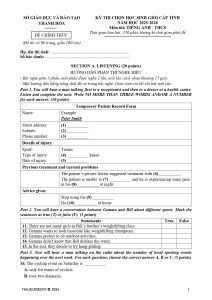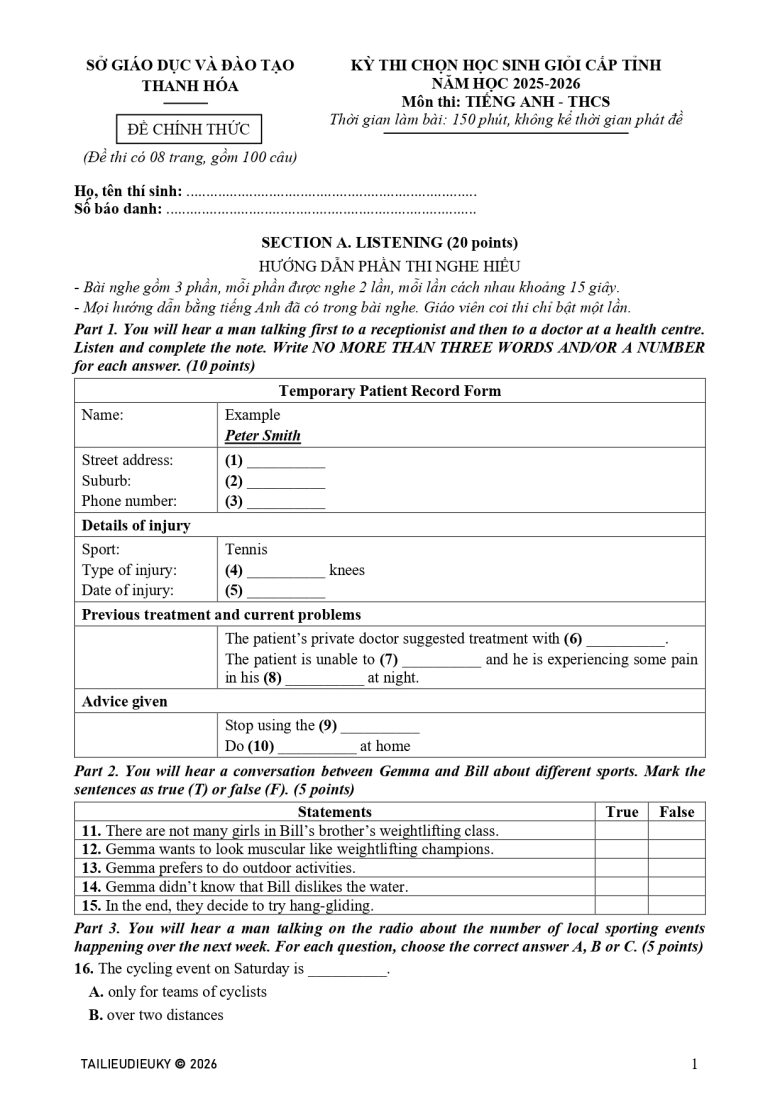
Năm học 2026–2027, THPT Chuyên Hà Tĩnh tuyển 455 học sinh vào 13 lớp chuyên, gồm 2 lớp chuyên Toán, 2 lớp chuyên Tiếng Anh và 9 lớp chuyên các môn còn lại. Dưới đây là đề thi Chuyên Anh Hà Tĩnh 2026–2027 có đáp án chính thức, kèm đầy đủ file nghe (Listening) và transcript, giúp thí sinh đối chiếu kết quả cũng như tham khảo để ôn luyện cho các kỳ thi chuyên Anh những năm tiếp theo.
• Thời gian: 150 phút (13 trang)
• Cấu trúc: 4 phần, tổng 20 điểm
I. Listening (5 điểm)
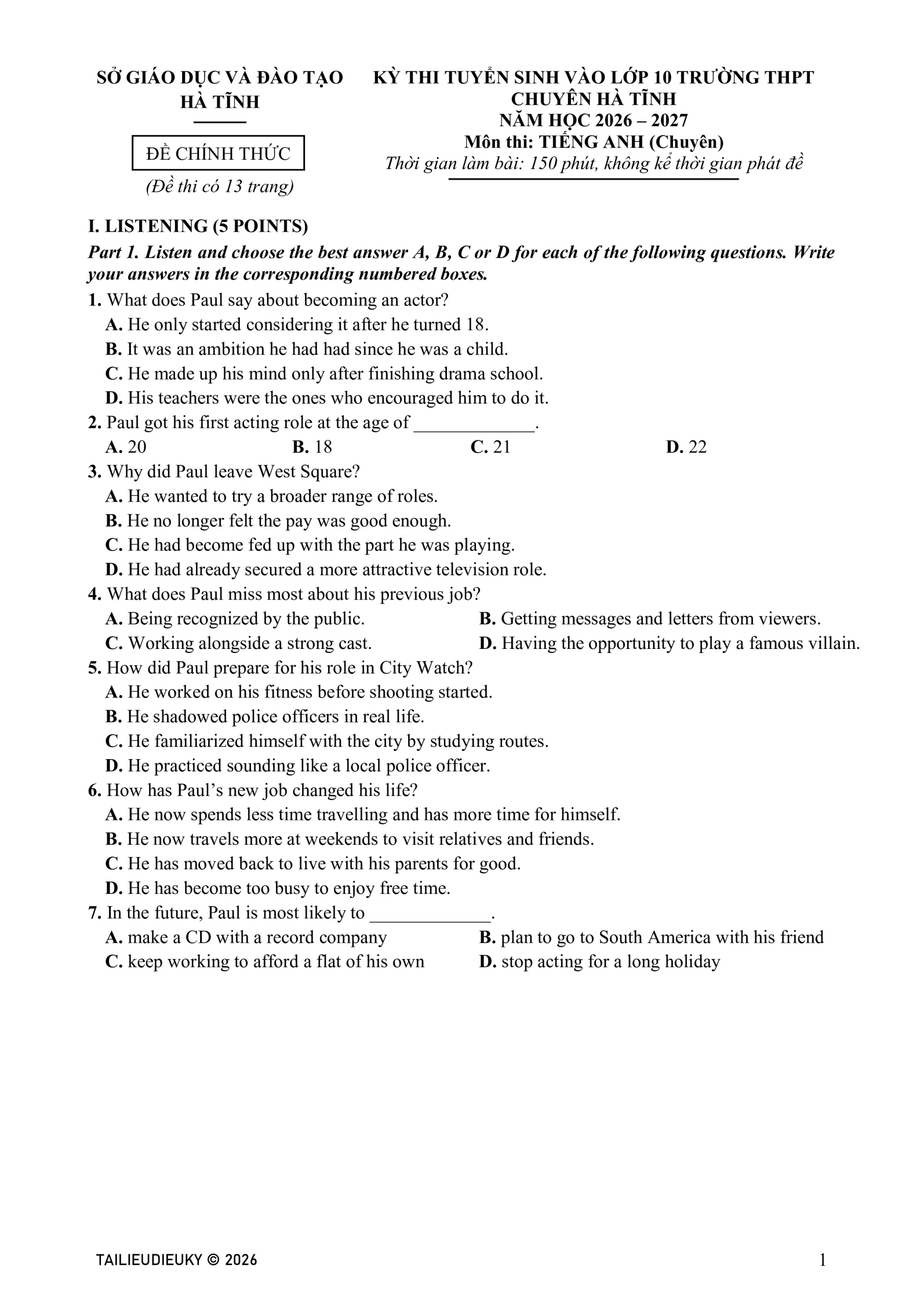
• Part 1 (7 câu): Phỏng vấn diễn viên Paul Davis.
• Part 2 (10 câu): Điền từ vào sơ đồ.
• Part 3 (8 câu): Thảo luận về trách nhiệm bảo vệ môi trường.
II. Grammar & Lexical Items (5 điểm)
• 20 câu trắc nghiệm ngữ pháp, từ vựng, thành ngữ.
• 10 câu Word Formation.
• 10 câu Collocations.
III. Reading (5 điểm)
• Cloze test về lịch sử báo chí.
• Điền từ về an sinh xã hội Mỹ.
• Đọc hiểu "Brain Rot" (ghép tiêu đề, T/F/NG).
• Đọc hiểu về loài ngựa (suy luận, từ vựng, ý chính).
IV. Writing (5 điểm)
• 5 câu viết lại câu.
• 5 câu viết lại câu dùng từ cho trước.
• Bài luận ~250 từ: Học sinh cần học cách đặt câu hỏi, không chỉ trả lời câu hỏi.
Nếu đang chuẩn bị cho kỳ thi vào lớp 10 chuyên Anh, bạn nên dành thời gian làm trọn bộ đề, tự chấm theo đáp án và phân tích kỹ những câu còn sai. Việc luyện tập với các đề thi chính thức như đề Chuyên Anh Hà Tĩnh 2026–2027 sẽ giúp nâng cao kỹ năng và làm quen với cấu trúc đề thi thực tế.
Đáp án chính thức
I. LISTENING: 0,2 x 25 = 5đ
Part 1
1. B
2. D
3. A
4. C
5. B
6. A
7. C
Part 2
8. notifications
9. productive
10. distraction
11. video(s)
12. notice
13. stress
14. disarray
15. dissolve
16. concentration
17. equanimity
Part 3
18. Ann
19. Ann
20. Brian
21. Chloe
22. Brian
23. Chloe
24. Brian
25. Chloe
II. GRAMMAR AND LEXICAL ITEMS: 0,125 x 40 = 5đ
Part 1
1. A
2. D
3. C
4. D
5. D
6. C
7. B
8. D
9. D
10. A
11. C
12. A
13. B
14. A
15. C
16. B
17. C
18. A
19. D
20. C
Part 2
21. essential
22. mediators
23. stability
24. underlying
25. absolutely
26. rebellious
27. feeling
28. outlooks
29. weakened
30. traditional
Part 3
31. identity theft
32. safety protocol
33. warranty claim
34. market volatility
35. communication breakdown
36. subject to approval
37. fit for purpose
38. prone to overheating
39. capable of recovery
40. consistent with the contract
III. READING: 0,125 x 40 = 5đ
Part 1
1. A
2. B
3. C
4. D
5. B
6. A
7. C
8. D
9. A
10. B
Part 2
11. their/the
12. pace/speed
13. view
14. for
15. should
16. assistance
17. until/till
18. enough
19. up
20. being
Part 3
Headings
21. ii
22. vii
23. iv
24. i
True / False / Not Given
25. FALSE
26. TRUE
27. FALSE
28. TRUE
29. FALSE
30. NOT GIVEN
Part 4
31. C
32. A
33. A
34. B
35. C
36. D
37. D
38. B
39. C
40. B
IV. WRITING (5 POINTS)
Part 1 · 0,2 x 5 = 1đ
1. It was such a moving / so moving a film that she couldn’t stop herself from shedding tears.
2. I regret not studying / having studied hard enough to pass the final exam.
3. You shouldn’t have allowed / permitted your 9-year-old son to ride an electric bike.
4. No sooner had I finished my speech than the audience broke into applause.
5. The red T-shirt is a third of the cost/price of this one/T-shirt.
Part 2 · 0,2 x 5 = 1đ
6. Jimmy came up with the best solution.
7. The film’s music was what made the strongest/greatest/most impression on me.
8. You had better keep it/this under your hat, but I’m going to throw a party for my mother’s fiftieth birthday.
9. You will have to turn over a new leaf if you want to succeed.
10. The orphanage left no stone unturned in their attempt to find the boy’s parents.
Part 3 · Essay Writing: 3đ
As part of their study, students should learn not only how to answer questions but also how to question answers.
To what extent do you agree with this idea?
Give reasons for your answer and include any relevant examples from your own knowledge or experience. Write about 250 words.
Task Response (25%): fully addresses all parts of the task, presents a fully developed position in answer to the question with relevant, fully extended and well supported ideas.
Coherence and Cohesion (25%): links information and ideas logically, uses a range of cohesive devices appropriately, presents a clear central topic within each paragraph.
Lexical Resources (25%): uses a wide range of vocabulary fluently and flexibly, uses some uncommon lexical items, produces rare errors in spelling and/or word formation.
Grammar/Structures (25%): Uses a wide range of structures accurately and flexibly with few errors or inappropriateness.
SỞ GIÁO DỤC VÀ ĐÀO TẠO
HÀ TĨNH
(Đề thi có 13 trang) KỲ THI TUYỂN SINH VÀO LỚP 10 TRƯỜNG THPT CHUYÊN HÀ TĨNH
NĂM HỌC 2026 – 2027
Môn thi: TIẾNG ANH (Chuyên)
Thời gian làm bài: 150 phút, không kể thời gian phát đề
I. LISTENING (5 POINTS)
Part 1. Listen and choose the best answer A, B, C or D for each of the following questions. Write your answers in the corresponding numbered boxes.
1. What does Paul say about becoming an actor?
A. He only started considering it after he turned 18.
B. It was an ambition he had had since he was a child.
C. He made up his mind only after finishing drama school.
D. His teachers were the ones who encouraged him to do it.
2. Paul got his first acting role at the age of _____________.
A. 20 B. 18 C. 21 D. 22
3. Why did Paul leave West Square?
A. He wanted to try a broader range of roles.
B. He no longer felt the pay was good enough.
C. He had become fed up with the part he was playing.
D. He had already secured a more attractive television role.
4. What does Paul miss most about his previous job?
A. Being recognized by the public. B. Getting messages and letters from viewers.
C. Working alongside a strong cast. D. Having the opportunity to play a famous villain.
5. How did Paul prepare for his role in City Watch?
A. He worked on his fitness before shooting started.
B. He shadowed police officers in real life.
C. He familiarized himself with the city by studying routes.
D. He practiced sounding like a local police officer.
6. How has Paul’s new job changed his life?
A. He now spends less time travelling and has more time for himself.
B. He now travels more at weekends to visit relatives and friends.
C. He has moved back to live with his parents for good.
D. He has become too busy to enjoy free time.
7. In the future, Paul is most likely to _____________.
A. make a CD with a record company B. plan to go to South America with his friend
C. keep working to afford a flat of his own D. stop acting for a long holiday
Part 2. Listen and complete the flow chart below. Write ONE WORD ONLY for each answer. Write your answers in the corresponding numbered boxes.
Part 3. You will hear a conversation among three high school students: Ann, Brian and Chloe. Listen and decide who (Ann, Brian, or Chloe) each of the following statements belongs to. You may use each name more than once. Write your answers in the corresponding numbered boxes.
18. Habits can shape responsibility through personal small activities like carrying a reusable water bottle or bringing your own shopping bag.
19. Environmental responsibility should become part of everyday school culture rather than remain an occasional activity.
20. Personal actions are valuable, but major institutions must not avoid responsibility for environmental damage.
21. Many environmental campaigns in schools look effective on the surface but do not lead to long¬term behavioral change.
22. Whether individual effort alone can solve a large-scale problem is still a question.
23. Environmental action in some schools is mainly symbolic or temporary.
24. Students are often more motivated when they take environmental action together as a group.
25. Real changes can happen when people stop giving questions and take part in real activities.
II. GRAMMAR AND LEXICAL ITEMS (5 POINTS)
Part 1. Choose the word or phrase that best completes each sentence. Write your answer A, B, C or D in the corresponding numbered boxes.
1. Weather _____________, we will start tomorrow.
A. permitting B. permits C. will permit D. is permitting
2. John’s father bought him a(n) _____________ bike as a birthday gift.
A. blue Japanese expensive B. expensive Japanese blue
C. Japanese expensive blue D. expensive blue Japanese
3. Let’s not decide yet where to stop on the journey – we’ll just play it by _____________ and see how we feel.
A. lip B. eye C. ear D. hand
4. This museum is known _____________ since the 20th century.
A. to be building B. having been built C. to build D. to have been built
5. It is wrongly believed that natural resources will never be used _____________.
A. off B. out C. away D. up
6. I don’t suppose he will be a good leader, _____________?
A. do I B. will I C. will he D. doesn’t he
7. This morning, I awoke with an _____________ sense of foreboding which I could find no reason for.
A. intelligible B. intangible C. intensive D. indelible
8. The firm went bankrupt and their shares became _____________.
A. priceless B. unworthy C. invaluable D. worthless
9. Most whole milk undergoes homogenization, _____________ hot milk is pumped through valves to break up and permanently disperse the fat globules.
A. which is a process B. a process C. which process D. a process in which
10. One way to let off _____________ after a stressful day is to take some vigorous exercise.
A. steam B. tension C. cloud D. sweat
11. It _____________ my mind yesterday that you must be a bit short of staff – Shall I send someone to help out?
A. took B. had C. crossed D. washed
12. _____________ in this national park has declined from a few thousand to a few hundred for the past ten years.
A. The number of tigers B. For a number of tigers
C. A number of tigers D. That the number of tigers
13. My mother _____________ most of her time to taking care of my family.
A. assigns B. devotes C. allocates D. distributes
14. You gave me some useful advice. _____________, I couldn’t have finished my report.
A. Otherwise B. However C. Moreover D. Therefore
15. The film lasted every three hours with _____________ of 15 minutes between part one and part two.
A. a pause B. an interruption C. an interval D. a stop
16. _____________ he works, he cannot earn enough to support his growing children.
A. How hard B. However hard C. No matter hard D. So hard as
17. I’d rather you _____________ a noise last night; I couldn’t concentrate on my work.
A. wouldn’t make B. didn’t make C. hadn’t made D. haven’t made
18. I may look half asleep, but I can assure you I am _____________ awake.
A. wide B. well C. full D. broad
19. Sarah and I _____________ reserved the room in the same hotel. She was very surprised to see me there.
A. practically B. intentionally C. deliberately D. coincidentally
20. Searching for one man in this city is like looking for a _____________.
A. salt of the earth B. sand in the desert C. needle in a haystack D. drop in the ocean
Part 2. Write the correct FORM of each capital word in the following passage. Write your answers in the corresponding numbered boxes.
The role of grandparents in children’s upbringing
The word grandparents is descriptive of the unique dual parenting role that this generation assume. It emphasises the (21. ESSENCE) _____________ part they play in family life. With a wealth of old world experience behind them, and with the unique ability to metamorphose from advisers or (22. MEDIATE) _____________ into listeners or friends, they can offer support and (23. STABLE) _____________ in an ever-changing world.
The (24. UNDERLIE) _____________ sense of responsibility that goes with this is tremendous. Grandparents perform a balancing act between the needs of their adult children and those of their grandchildren. This role is varied. It is imperial at times, muted at others. It goes underground whenever required, but it is solid and (25. ABSOLUTE) _____________ dependable.
Grandparents often bridge the gap between parents and their children. (26. REBEL) _____________ children who are trying to find their feet are almost always at loggerheads with their parents. The role of grandparents can be very important provided they act as impartial judges and are able to convey this (27. FEEL) _____________ to both parties. Grandchildren prefer to listen to their grandparents rather than their parents, who often find themselves up against a brick wall.
One important thing, which seems to be missing in the lives of children today, is a sense of family, values, beliefs and principles. This is where the grandparents step in. However, instilling beliefs and values is not as easy as it was fifty or sixty years ago. Then, no questions were asked and there was an implicit sense of trust. With changing times and changing (28. LOOK) _____________, children have started to question the validity of everything around them. Globalisation has eroded their sense of belonging and (29. WEAK) _____________ identification with their roots. Science and technology force them to doubt every (30. TRADITION) _____________ belief. It’s grandparents who can teach them to appreciate cultural traditions and inform their moral development.
Part 3. Match the words in column A with their strongest collocates in column B and then use the full phrases to fill the gaps in the sentences below. Use each item ONCE only. Write your answers in the corresponding numbered boxes.
A B
prone of recovery
consistent theft
fit to approval
identity protocol
market claim
warranty to overheating
communication with the contract
safety volatility
capable for purpose
subject breakdown
31. After clicking a fake link, he discovered that his bank account had been drained - a classic case of _____________.
32. Before entering the chemical storage area, all staff must follow the _____________ and sign the logbook.
33. The device stopped working within two weeks, so she filed a _____________ with the manufacturer.
34. Because of recent events, investors have become cautious about _____________ in emerging markets.
35. The delay was caused not by lack of effort but by a _____________ between departments.
36. The scholarship is _____________ by the selection committee, so meeting the criteria does not guarantee an award.
37. The supplier promised “high performance”, but the parts were not _____________ for industrial use.
38. If the laptop is _____________, check whether the fan is blocked and stop using it immediately.
39. After the shock, he seemed calm in public, but still _____________ with proper support.
40. Your cancellation request is only valid if it is _____________, especially the notice period clause.
III. READING (5 POINTS)
Part 1. Read the following text and decide which answer A, B, C, or D best fits each gap. Write your answers in the corresponding numbered boxes.
The newspaper has been a part of our daily life for several centuries. They have been a way for the public to be informed of important events that are occurring around the world. Newspapers have (1) _____________ dramatic changes over the course of history. Some of the earliest newspapers date (2) _____________ to Ancient Rome where important announcements were carved in stone tablets and placed in highly populated areas where citizens could be informed of the announcements. The biggest change was printing them on (3) _____________ and use of the printing machine. By automating the production of the newspaper, the number of papers available to the public greatly increased, while making it (4) _____________ for people to purchase one. These developments led to a boom in the newspaper industry where several different newspapers started to appear in major cities, and morning, afternoon and evening editions went to (5) _____________ in large numbers. These papers gave readers news, weather, sports and other features that informed and entertained them.
However, newspaper costs continued to rise and the number of newspaper (6) __________ continued to fall. This led to a vast reduction in the number of newspapers and newspaper editions in every market. In addition, with the (7) _____________ in the users of technology, the public no longer needed the newspaper for its source of information. In (8) _____________ of the paper, people started to take other media such as radio, television and the Internet as an information source. In recent years, newspapers and other media have (9) _____________ to the changing technology environment by starting to offer online editions to cater to the needs of the public. In the future, the trend towards more electronic delivery of the news will continue with more emphasis on the Internet, social media and other electronic delivery methods. However, while the method of delivery is changing, the newspaper and the industry still have a (10) _____________ in the world.
1. A. undergone B. undertaken C. underachieved D. understated
2. A. forward B. back C. from D. toward
3. A. padding B. upholstery C. newsprint D. blotter
4. A. luxurious B. exclusive C. fancy D. affordable
5. A. shelf B. press C. client D. bureau
6. A. subscribers B. biographers C. editors D. browsers
7. A. contraction B. alternation C. explosion D. deflation
8. A. turn B. swap C. refill D. lieu
9. A. adapted B. adopted C. traded D. bartered
10. A. bound B. niche C. leap D. hassle
Part 2. Read the text below and think of the word which best fits each gap. Use only ONE word in each gap. Write your answers in the corresponding numbered boxes.
Traditionally in America, helping the poor was a matter for private charities or local government. Arriving immigrants depended mainly on predecessors from (11) _____________ homeland to help them start a new life. In the late 19th and early 20th centuries, several European nations instituted public – welfare programs. But such a movement was slow to take hold in the United States because the rapid (12) _____________ of industrialization and the ready availability of farmland seemed to confirm the points of (13) _____________ that anyone who was willing to work could find a job.
Most of the programs started during the Depression era were temporary relief measures, but one of the programs - Social Security - has become an American institution. Paid (14) _____________ by deduction from the paychecks of working people, Social Security ensures that retired persons (15) _____________ get a modest monthly income, provides people with unemployment insurance, disability insurance, and comes to their (16) _____________. Social Security payments to retired persons can start at age 62, but many wait (17) _____________ age 65, when the payments are slightly higher. Recently, there has been concern that the Social Security fund may not have (18) _____________ money to fulfill its obligations in the 21st century, when the population of elderly Americans is expected to increase dramatically. Policy makers have proposed various ways to make (19) _____________ the anticipated deficit, but a long- term solution is still (20) _____________ debated.
Part 3. Read the text and do the tasks that follow. Write your answers in the corresponding numbered boxes.
Brain Rot
A. A teenager opens a phone while waiting for the kettle to boil and promises to watch just one short video. A few minutes later, the water is cold, the homework has not begun, and ten unrelated clips have already passed across the screen. None of them was particularly memorable, yet together they created a strange mental fog. This experience is now often described online as “brain rot” - a phrase that sounds humorous at first, but points to a serious concern about how constant low-value stimulation may shape the way young people think, feel, and focus.
B. The expression does not refer to a medical diagnosis, nor does it mean that a person’s intelligence is literally disappearing. Instead, it is a cultural shorthand for the dull, restless, overloaded state that can follow hours of consuming fragmented, repetitive, or trivial content. In that state, the mind is not empty; it is crowded. Thoughts feel jumpy rather than clear. Silence becomes uncomfortable. Even when a teenager wants to concentrate, the brain seems to keep asking for one more tiny burst of novelty.
C. One reason this pattern is so difficult to resist is that digital platforms rarely provide stimulation in a steady, predictable form. They rely on interruption, surprise, and rapid contrast. A user may encounter a joke, then a beauty tip, then a conspiracy theory, then a heartbreaking story, all within a single minute. Because the next post might be funnier, stranger, or more emotionally intense than the last, the brain remains alert. This constant state of anticipation keeps attention hooked, even when the overall experience is unsatisfying.
D. Teenagers are especially exposed to this pattern, not because they are careless, but because adolescence is a period when identity, belonging, and curiosity matter enormously. Young people are naturally more attentive to trends, peer approval, and social signals. At the same time, the parts of the brain responsible for long-term planning and self-regulation are still developing. This means that a teenager trying to revise for an exam is not simply choosing between study and entertainment. They are negotiating with a digital system built to feel immediate, personal, and difficult to leave.
E. The academic consequences are easy to underestimate. Brain rot does not usually make students forget everything they know, but it can weaken the habits required for demanding learning. When the mind becomes used to constant novelty, slower forms of thought begin to feel unusually heavy. Reading a dense passage, solving a multi-step problem, or drafting a careful essay may seem less rewarding than they once did, not because these activities have changed, but because the student’s tolerance for delay and effort has been reduced. In other words, the issue is not only distraction; it is a shrinking appetite for sustained attention.
F. The emotional effects can be just as important. Many teenagers report feeling both overstimulated and strangely flat after long periods online. They have consumed dozens of images and opinions, yet feel less satisfied, not more. Some begin to treat every topic ironically, as if seriousness itself were embarrassing. Others compare their ordinary lives with endlessly edited versions of other people’s success, beauty, or confidence. Over time, this can produce a mix of envy, numbness, insecurity, and low-level exhaustion that is difficult to name but hard to ignore.
G. Still, it would be simplistic to blame every online habit for this problem. Not all entertainment is mindless, and not every hour on a screen is wasted. Teenagers also use digital spaces to learn, create, organize, and stay connected. The danger appears when passive consumption starts replacing richer forms of engagement - reading for depth, speaking face to face, making something original, or even allowing boredom to exist for a while. Brain rot, then, is less about technology itself than about imbalance.
H. The most realistic solutions are usually small rather than dramatic. Deleting every app may sound impressive, but many students benefit more from introducing friction into their habits. Turning off non-essential notifications, moving social apps off the home screen, setting a fixed moment to check messages, or keeping the phone out of reach while studying can all reduce automatic use. Equally important is rebuilding tolerance for slower experiences. The first ten minutes of reading or revising may feel uncomfortable after weeks of fragmented scrolling, but that discomfort is not failure. It is evidence that attention is being trained again.
I. In the end, brain rot is not merely a trendy insult about internet culture. It reflects a deeper struggle over what deserves our attention and how easily that attention can be manipulated. For teenagers growing up in an economy built around clicks, swipes, and endless refreshes, protecting the mind may require more than willpower. It may require deliberate habits, critical awareness, and the courage to choose depth when the world keeps offering speed.
Questions 21 - 24: Choose the correct heading for each paragraph from the list of headings below. Write the correct number, i - viii.
i. Restoring control by making impulsive use less convenient
ii. A popular label for a mind that feels crowded and restless
iii. Why adolescents are more susceptible to this pattern
iv. The hidden cost to deep learning and mental stamina
v. A small habit that quietly consumes more time than expected
vi. Online enjoyment should not be treated as the enemy
vii. Why unpredictability keeps users engaged
viii. A broader lesson about defending attention in modern life
21. Paragraph B: _____________
22. Paragraph C: _____________
23. Paragraph E: _____________
24. Paragraph H: _____________
Questions 25 - 30: Do the following statements agree with the information given in the reading passage? Write TRUE (T), FALSE (F) or NOT GIVEN (NG).
25. The passage presents brain rot as an officially recognized psychological disorder.
26. The writer suggests that online feeds are compelling partly because users cannot reliably predict what will appear next.
27. According to the passage, teenagers mainly struggle with brain rot because they usually have more homework than adults.
28. The text indicates that frequent exposure to rapid, low-value content may reduce a student’s willingness to persist with demanding tasks.
29. The writer argues that enjoyable online content should be eliminated completely if students want to improve their focus.
30. The passage states that schools have already introduced compulsory lessons to teach students how to avoid brain rot.
Part 4. Read the following passage and choose the option A, B, C, or D that best answers each of the questions. Write your answers in the corresponding numbered boxes.
When the Lunar New Year turns toward the Year of the Horse, many people instinctively associate it with energy, freedom, and restless ambition. The horse, in popular imagination, is a creature of movement and vitality, embodying both independence and charisma. Yet this familiar image, though appealing, captures only a fraction of the horse’s true significance. The horse is not merely a symbol of speed or spirit; it is one of the few animals that has fundamentally shaped the trajectory of human civilization.
What makes the horse particularly fascinating, especially in a year such as Bính Ngọ, is its unique position between myth and reality. Unlike purely mythical creatures, the horse has lived alongside humans for thousands of years, occupying both practical and symbolic roles. It has pulled ploughs, carried messengers, transported goods, and enabled military campaigns. In doing so, it did not simply escort human progress - it actively transformed it. Entire trade networks expanded because of the horse, and political power was often determined by mobility, which horses made possible.
One of the lesser-known facts about horses is that, despite their strength and imposing presence, they are biologically prey animals. This may seem counterintuitive, as horses are often perceived as powerful and dominant. However, their evolutionary survival depended not on aggression but on heightened awareness and rapid escape. This explains their extraordinary sensitivity. Horses can detect subtle changes in human body language, tone, and emotional state. Long before a person speaks, a horse may already “read” their tension or calmness.
This sensitivity has shaped the way horses appear in literature and folklore. They are frequently depicted not merely as tools but as perceptive companions. Unlike animals that are portrayed as blindly loyal or entirely independent, horses occupy a middle ground. They respond, interpret, and adapt. Skilled riders often emphasize that working with a horse requires communication rather than control. True horsemanship is not about domination but about mutual understanding.
[A] From an evolutionary perspective, the modern horse is the result of a long and complex transformation. Its earliest ancestors were small, forest-dwelling creatures, quite unlike the large, fast animals we recognize today. Over millions of years, as environments changed, horses adapted by developing longer limbs, stronger bodies, and a single hoof that enabled efficient movement across open landscapes. Speed became a defining characteristic, not as a luxury, but as a necessity for survival.The domestication of horses marked a turning point in human history. Once humans learned not only to tame but also to breed and train horses, the impact was profound. Travel became faster, communication more efficient, and warfare more dynamic. Armies gained mobility, and trade routes expanded dramatically. In many ways, the horse reduced distances between communities, making the world more interconnected long before modern technology existed. [B]
Yet the symbolic meaning of the horse often goes beyond its practical contributions. Humans have long associated horses with freedom, even though most horses have lived under human control. This apparent contradiction reveals something deeper about human psychology. The horse represents not literal freedom, but the idea of untamed energy - the sense that something essential cannot be entirely subdued. A galloping horse appears to embody motion itself, as if vitality were made visible.
This symbolic power is reflected in art and culture. Artists across centuries have struggled to capture the dynamic movement of horses. Before the invention of photography, depicting motion was a significant artistic challenge, and the horse became a central subject for this exploration. Equestrian statues, in particular, attempt to freeze a moment of motion, presenting strength and balance in a static form. Yet even in stillness, the horse seems to resist immobility.
Another often overlooked aspect of horses is their social intelligence. Horses live in structured groups where communication is subtle but effective. They use body language, posture, and movement to establish relationships and maintain order. Leadership within a herd is not always based on strength alone; calmness and experience can be equally important. This complexity challenges the stereotype of horses as purely instinctive or impulsive animals.
In modern contexts, horses continue to play meaningful roles beyond their traditional uses. One notable example is their application in therapeutic settings. Horses are used to support individuals with physical disabilities, emotional difficulties, and developmental conditions. The rhythmic movement of a horse can assist in physical rehabilitation, while its sensitivity to human emotions creates opportunities for psychological engagement. Because horses respond so directly to human behavior, they provide immediate feedback, making them valuable partners in certain forms of therapy.
[C] Although machines have replaced horses in many practical functions, their symbolic and emotional significance remains strong. We still use expressions like “horsepower” and continue to admire the grace and strength associated with them. The horse persists in language, art, and cultural imagination, even in an age dominated by technology.Ultimately, the Year of the Horse invites a deeper reflection on what this animal truly represents. Beyond speed and strength, the horse embodies a balance between power and sensitivity, independence and cooperation. Its historical importance lies not only in what it did for humanity, but also in how it shaped human perception of movement, of freedom, and of connection.
Thus, while zodiac traditions may present the horse in simplified terms, the reality is far more complex. The horse is not merely a symbol we have created; it is a living being whose characteristics have influenced human history in profound ways. Its enduring fascination lies in this dual identity -both real and symbolic, both practical and poetic. [D]
31. What is the primary purpose of the passage?
A. To describe the physical characteristics of horses and their evolution.
B. To argue that horses are superior to other zodiac animals in terms of reflection.
C. To explore the multifaceted significance of horses beyond common stereotypes.
D. To explain how horses are used in modern therapeutic practices.
32. The word escort in paragraph 2 is closest in meaning to _____________.
A. accompany B. supervise C. externalize D. enslave
33. According to the passage, what was the horse’s main survival strategy in its early evolution?
A. Using vigilance and rapid absconding
B. Relying on group hunting techniques
C. Adapting to aquatic environments
D. Developing strong defensive weapons like claws and fangs
34. What can be inferred about the relationship between humans and horses?
A. Humans completely controlled horses.
B. The relationship involved both control and cooperation.
C. Horses were only used in farming and transporting goods.
D. Horses were rarely used outside war.
35. The word subtle in paragraph 9 is closest in meaning to _____________.
A. blatant B. discernible C. indistinct D. legible
36. The word they in paragraph 10 refers to _____________.
A. settings B. disabilities C. opportunities D. horses
37. What best describes the author’s attitude?
A. Neutral and scientific B. Critical
C. Indifferent D. Appreciative and analytical
38. Which best summarizes the passage?
A. Horses symbolize both speed and spirit during human civilization.
B. Horses represent a complex mix of symbolism, history, and sensitivity.
C. Horses evolved from small animals into strong ones over millions of years.
D. Horses play crucial roles in farming, transportation and military today.
39. Where in the passage (bracketing [A], [B], [C], [D]) does the following sentence best fit?
“In this sense, the horse’s legacy is not confined to the past but continues to evolve in unexpected ways.”
A. [A] B. [B] C. [C] D. [D]
40. What does the author imply about zodiac symbols?
A. They are meaningless. B. They oversimplify reality.
C. They are completely accurate. D. They should be replaced.
IV. WRITING (5 POINTS)
Part 1. Finish each of the following sentences in such a way that it means exactly the same as the sentence before it.
1. The film was so moving that she couldn’t stop herself from shedding tears.
It was ________________________________________________________________________
2. If only I had studied hard enough to pass the final exam.
I regret _______________________________________________________________________
3. It was careless of you to allow your 9-year-old son to ride an electric bike.
You shouldn’t __________________________________________________________________
4. As soon as I finished my speech, the audience broke into applause.
No sooner _____________________________________________________________________
5. This T-shirt is three times as expensive as the red one.
The red T-shirt is a ______________________________________________________________
Part 2. Use the word given in CAPITAL and make any necessary additions to write a new sentence in such a way that it is as similar as possible in meaning to the original sentence. Do NOT change the form of the given word. You must use between THREE and SIX words, including the word given.
6. The best solution was thought of by Jimmy. (CAME)
Jimmy ________________________________________________________________ solution.
7. It was the film’s music that impressed me most. (IMPRESSION)
The film’s music was what _____________________________________________________ me.
8. Please don’t tell anyone but I’m going to throw a party for my mother’s fiftieth birthday. (HAT)
You had ____________________, but I’m going to throw a party for my mother’s fiftieth birthday.
9. Your attitude will have to change if you want to succeed. (LEAF)
You will have to ______________________________________________ if you want to succeed.
10. Every possible effort was made by the orphanage to find the boy’s parents. (STONE)
The orphanage left ________________________________ their attempt to find the boy’s parents.
Part 3. ESSAY WRITING
As part of their study, students should learn not only how to answer questions but also how to question answers.
To what extent do you agree with this idea?
Give reasons for your answer and include any relevant examples from your own knowledge or experience. Write about 250 words.
---------- THE END ----------