Vừa qua ngày 10/12/2024, Sở Giáo dục và Đào tạo Điện Biên đã tổ chức kỳ thi chọn học sinh giỏi cấp tỉnh THPT năm học 2024–2025, trong đó môn Tiếng Anh 12 là một trong những môn thi quan trọng và thu hút sự quan tâm lớn từ học sinh toàn tỉnh. Tại bài viết này, tailieudieuky.com cập nhật miễn phí Đề HSG Tiếng Anh 12 Điện Biên 2024–2025 kèm đáp án chính thức, bao gồm cả file nghe giúp học sinh luyện kỹ năng Listening hiệu quả, bám sát cấu trúc đề thi thật.
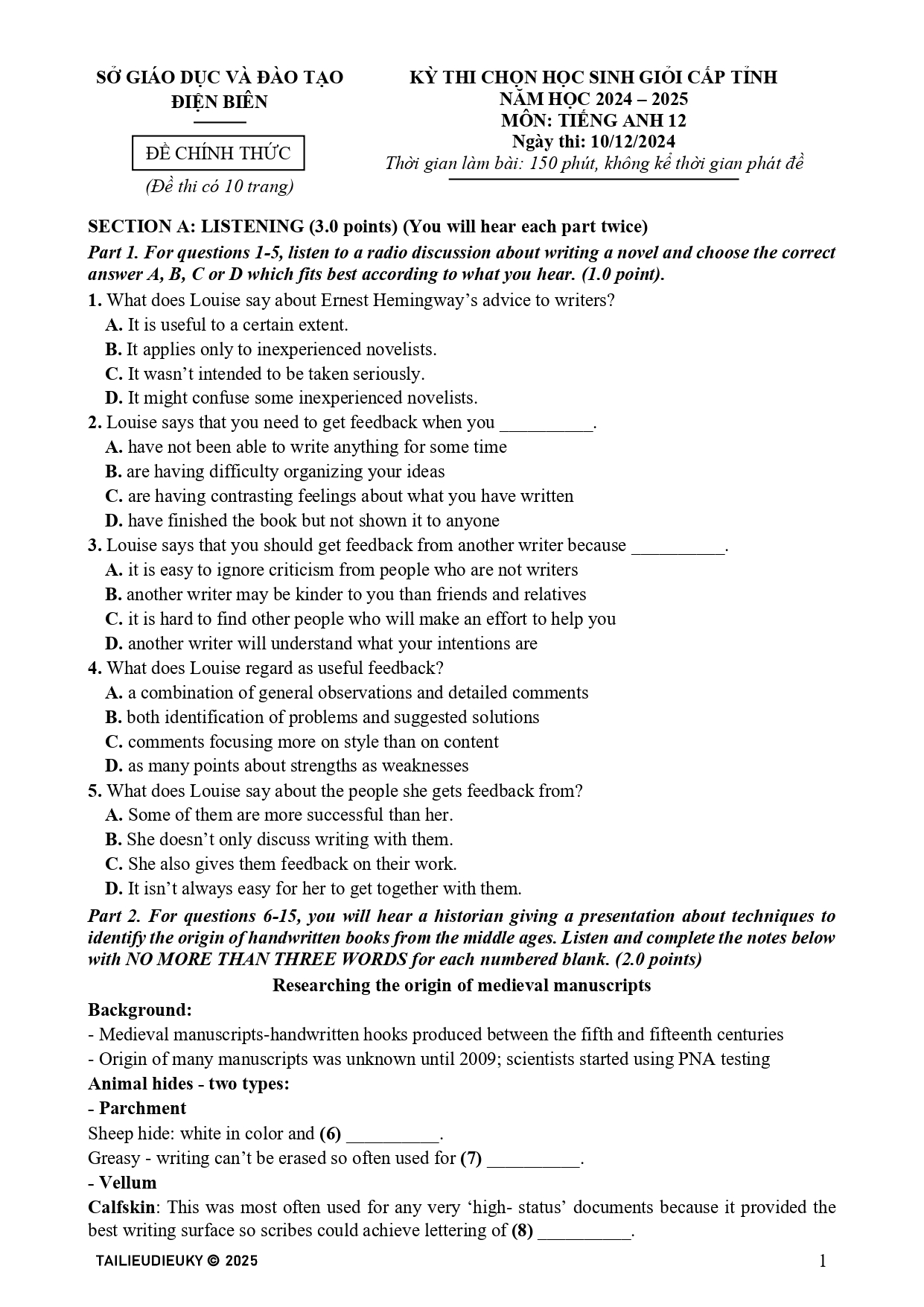
Đề HSG Tiếng Anh 12 Điện Biên 2024–2025 – 150 phút – 10 trang – 6 phần – 85 câu
A: Listening (3.0 điểm) – Multiple choice (5 câu) – Note completion (10 câu)
B: Phonology (2.0 điểm) – Pronunciation (5 câu) – Stress pattern (5 câu)
C: Vocabulary & Expressions (3.0 điểm) – MCQ
vocab/communication/synonym/antonym (20 câu) – Word form (10 câu)
D: Grammar & Structures (4.0 điểm) – MCQ grammar (15 câu) – Error
identification (5 câu) – Prepositions/particles (6 câu) – Verb forms (7 câu)
E: Reading (5.0 điểm) – Gap-fill (10 câu) – Short passage MCQ (10 câu) –
Reading comprehension (10 câu) – Matching headings (5 câu)
F: Writing (3.0 điểm) – Sentence transformation (5 câu) – Word transformation
(5 câu) – Essay writing (200–250 words) (1 bài)
Chúc các bạn ôn tập tốt và đạt kết quả cao trong các kỳ thi sắp tới! 🚀
Đáp án chính thức chuẩn
ĐÁP ÁN – HƯỚNG DẪN CHẤM
KỲ THI HỌC SINH GIỎI CẤP TỈNH – TIẾNG ANH 12
SỞ GD&ĐT ĐIỆN BIÊN | NĂM HỌC 2024–2025
________________________________________
SECTION A: LISTENING (3.0 points)
Part 1 (Questions 1–5)
Radio discussion about writing a novel.
1. A
2. C
3. D
4. B
5. C
________________________________________
Part 2 (Questions 6–15)
Lecture about identifying origin of medieval handwritten books.
6. (very) thin
7. court documents
8. high quality
9. buried
10. uniform thickness
11. bleached / whitened
12. dialect
13. baseline
14. evolution
15. trade routes
________________________________________
SECTION B: PHONOLOGY (2.0 points)
I. Pronunciation (1.0 point)
1. B
2. C
3. A
4. D
5. D
II. Stress pattern (1.0 point)
6. C
7. B
8. A
9. B
10. D
________________________________________
SECTION C: VOCABULARY & EXPRESSIONS (3.0 points)
I. Multiple choice (2.0 points)
1. A 2. B 3. D 4. C 5. A
2. B 7. D 8. B 9. A 10. A
3. D 12. B 13. A 14. C 15. C
4. A 17. C 18. B 19. B 20. A
________________________________________
II. Word formation (1.0 point)
21. handle
22. resistance
23. alternatively
24. unskilled
25. reinforced
26. leadership
27. worrying
28. technophobes
29. instability
30. counter-productive
________________________________________
SECTION D: GRAMMAR & STRUCTURES (4.0 points)
I. Multiple choice (1.5 points)
1. A 2. A 3. C 4. C 5. B
2. B 7. C 8. A 9. D 10. C
3. C 12. C 13. B 14. D 15. A
________________________________________
II. Error identification (0.5 point)
16. C
17. A
18. C
19. B
20. A
________________________________________
III. Prepositions / particles (0.6 point)
21. by
22. with
23. down
24. without
25. up to
26. on
________________________________________
IV. Verb forms (1.4 points)
27. to be discussed
28. should have looked
29. should be given / be given
30. written
31–32. spoke – wouldn’t be studying
31. would probably cost
________________________________________
SECTION E: READING (5.0 points)
I. Gap filling (1.0 point)
1. our
2. which
3. on
4. but
5. deal / face / cope
6. instead
7. exploit / use / utilize
8. themselves
9. create
10. realize / know
________________________________________
II. Multiple choice (1.0 point)
11. C
12. D
13. B
14. C
15. A
16. D
17. C
18. C
19. A
20. B
________________________________________
III. Reading comprehension (2.0 points)
21. A
22. C
23. A
24. B
25. C
26. B
27. B
28. D
29. D
30. A
________________________________________
IV. Headings matching (1.0 point)
31. v
32. iii
33. vii
34. i
35. vi
________________________________________
SECTION F: WRITING (3.0 points)
________________________________________
I. Sentence transformation (0.5 point)
1. Only when the editor had checked all the facts did he publish the article.
2. Whether it rains or shines, I am going to the English class tomorrow morning.
3. The moment I decided to get up and dance, the band stopped playing.
4. The director was not on good terms with the chief accountant.
5. There is little likelihood that John will accept her as his stepmother.
________________________________________
II. Sentence rewriting (1.0 point)
6. I hope I am not causing you any inconvenience by phoning you so late.
7. You ought to have thought more carefully before you decided.
8. Mary is not in the habit of sleeping after meals.
9. When you called, I had been working for ten hours.
10. If Marc hadn’t taken up politics, he might have made a name for himself as an art historian.
________________________________________
III. Essay (1.5 points)
Topic:
Nowadays, many schools and universities prioritize students with international English certificates. Is this policy positive or negative?
Scoring criteria:
1. Organization (0.3 pts)
• Clear introduction
• Logical structure (introduction – body – conclusion)
• Smooth transitions
2. Idea development (0.3 pts)
• Ideas presented logically
• Adequate explanation and examples
3. Language use (0.3 pts)
• Appropriate vocabulary
• Academic style
• Good cohesion (linking words)
4. Content (0.3 pts)
• Persuasive argument
• Relevant examples and reasoning
• Meets word requirement (±5%)
5. Grammar & mechanics (0.3 pts)
• Correct grammar structures
• Proper punctuation
• Spelling accuracy
• Repeated spelling mistakes counted once
________________________________________
✔ TOTAL: 10.0 POINTS
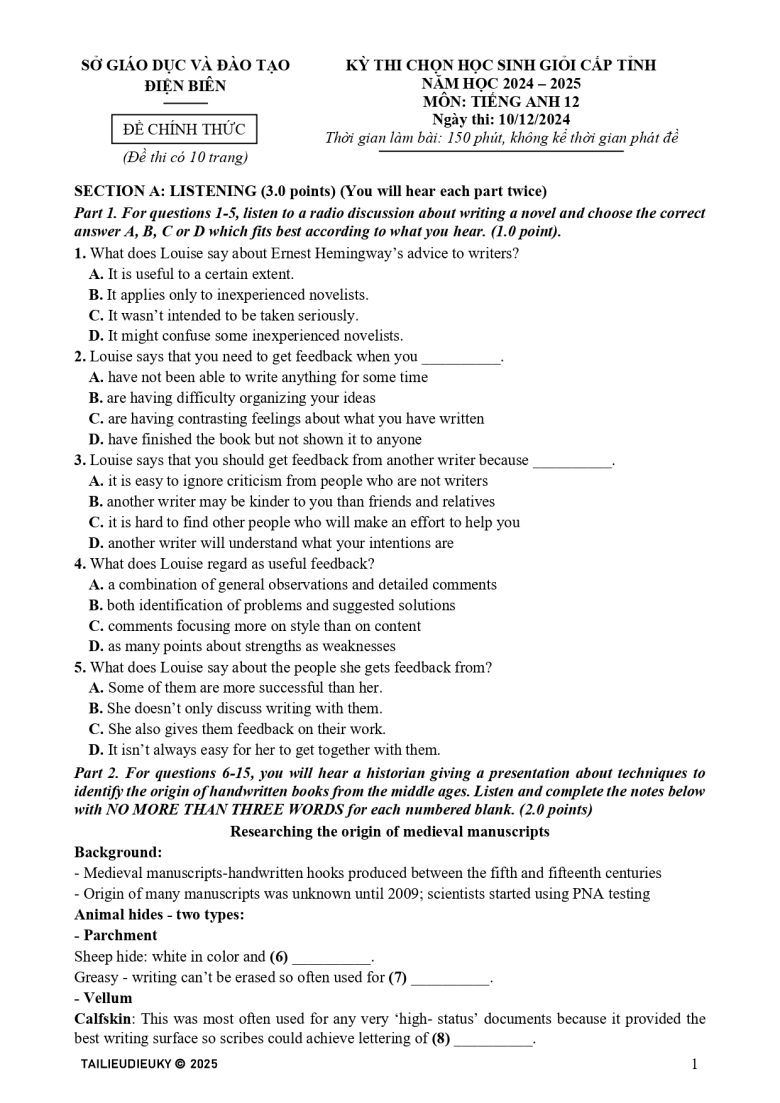
SỞ GIÁO DỤC VÀ ĐÀO TẠO
ĐIỆN BIÊN
(Đề thi có 10 trang) KỲ THI CHỌN HỌC SINH GIỎI CẤP TỈNH
NĂM HỌC 2024 – 2025
MÔN: TIẾNG ANH 12
Ngày thi: 10/12/2024
Thời gian làm bài: 150 phút, không kể thời gian phát đề
SECTION A: LISTENING (3.0 points) (You will hear each part twice)
Part 1. For questions 1-5, listen to a radio discussion about writing a novel and choose the correct answer A, B, C or D which fits best according to what you hear. (1.0 point).
1. What does Louise say about Ernest Hemingway’s advice to writers?
A. It is useful to a certain extent.
B. It applies only to inexperienced novelists.
C. It wasn’t intended to be taken seriously.
D. It might confuse some inexperienced novelists.
2. Louise says that you need to get feedback when you __________.
A. have not been able to write anything for some time
B. are having difficulty organizing your ideas
C. are having contrasting feelings about what you have written
D. have finished the book but not shown it to anyone
3. Louise says that you should get feedback from another writer because __________.
A. it is easy to ignore criticism from people who are not writers
B. another writer may be kinder to you than friends and relatives
C. it is hard to find other people who will make an effort to help you
D. another writer will understand what your intentions are
4. What does Louise regard as useful feedback?
A. a combination of general observations and detailed comments
B. both identification of problems and suggested solutions
C. comments focusing more on style than on content
D. as many points about strengths as weaknesses
5. What does Louise say about the people she gets feedback from?
A. Some of them are more successful than her.
B. She doesn’t only discuss writing with them.
C. She also gives them feedback on their work.
D. It isn’t always easy for her to get together with them.
Part 2. For questions 6-15, you will hear a historian giving a presentation about techniques to identify the origin of handwritten books from the middle ages. Listen and complete the notes below with NO MORE THAN THREE WORDS for each numbered blank. (2.0 points)
Researching the origin of medieval manuscripts
Background:
- Medieval manuscripts-handwritten hooks produced between the fifth and fifteenth centuries
- Origin of many manuscripts was unknown until 2009; scientists started using PNA testing
Animal hides - two types:
- Parchment
Sheep hide: white in color and (6) __________.
Greasy - writing can’t be erased so often used for (7) __________.
- Vellum
Calfskin: This was most often used for any very ‘high- status’ documents because it provided the best writing surface so scribes could achieve lettering of (8) __________.
Preparation of hides:
- Treated in large barrels or vats of lime.
But if lime wasn’t available, then the hides were (9) __________.
- Stretched tight on a frame
- Scraped to create (10) __________.
- Vellum was (11) __________ for correct colour
Genetic testing - finding origins
- Previously-analyzed handwriting and (12) __________ used by the writer
- Now- using genetic data from “known manuscripts” to create a (13) “__________”
Uses of new data:
- Gives information on individual books
- Shows the (14) __________ of the book manufacturing.
- Helps establish (15) __________ were in operation during the whole millennium.
SECTION B: PHONOLOGY (2.0 points)
I. Circle the letter A, B, C, or D to indicate the word whose underlined part is pronounced differently from that of the others. (1,0 point)
1. A. decreased B. mended C. fixed D. faced
2. A. practice B. particular C. initiate D. sophisticate
3. A. ecosystem B. knowledge C. technology D. commodity
4. A. undermine B. hotline C. valentine D. famine
5. A. message B. privilege C. college D. massage
II. Circle the letter A, B, C, or D to indicate the word that has different stress pattern in each line. (1,0 point)
6. A. answer B. wonder C. prefer D. progress
7. A. express B. effort C. employ D. reduce
8. A. instrument B. attraction C. advantage D. continue
9. A. conservative B. undetectable C. inhabitant D. progressively
10. A. superstitious B. hypersensitive C. argumentative D. imaginative
SECTION C: VOCABULARY AND EXPRESSIONS (3.0 points)
I. Choose and circle the word or phrase which best completes each sentence. (2.0 points)
1. Jenny is talking to Tim.
- Jenny: “So how are things at school, Tim?
- Tim: “__________”
A. Oh, pretty good, actually. B. Well, I can’t agree with you.
C. It’s my pleasure. D. I was not very good at it.
2. Hoa and Hien are at the school gate.
- Hoa “Are you coming to the concert with us tonight?”
- Hien: “I’d love to, but I already have other plans. __________?”
A. Can I make a reservation B. Can I have a raincheck
C. May we come earlier D. May I give a thumbs-up
3. The town’s multicultural environment has helped __________ a sense of community among its residents.
A. stifle B. avoid C. isolate D. encourage
4. Slums are urban areas that are __________ populated with substandard housing and very poor living conditions.
A. thinly B. thickly C. heavily D. crowdedly
5. The young entrepreneur has made a __________ in the field of sustainable technology.
A. breakthrough B. fortue C. scandal D. deal
6. Thanks to the help of the teacher, she is __________ encouraging progress in Math.
A. doing B. making C. checking D. stopping
7. We __________ friends even after we grew up and left home.
A. became B. made C. struck up D. remained
8. Don’t __________ to conclusions, we don’t yet know all the relevant facts.
A. hurry B. jump C. go D. run
9. As cities continue to expand, the influx of __________ has significantly impacted local economies, leading to both opportunities and challenges in urban planning.
A. immigrants B. residents C. migrants D. commuters
10. I think you have to __________ that he’s a good deal younger and less experienced than the rest of us.
A. take into account B. give way to C. make up for D. run out of
11. Aware that his pension will be small, he __________ a part of his salary for his old age.
A. sets apart B. puts apart C. puts up D. sets aside
12. The kind of exercise you can do depends on your __________ of fitness.
A. stage B. level C. step D. phase
13. The extra payments are a __________ for most single mothers.
A. lifeline B. lifeguard C. lifeboat D. lifebelt
14. She __________ when the teacher made her speak in front of the whole class.
A. was caught red-handed B. went as red as beetroot
C. turned bright red D. painted the town red
15. The full horror of the war only hit __________ when we started seeing the television pictures of it.
A. base B. down C. home D. back
16. It’s essential to __________ the hard work and dedication of volunteers who __________ important community events.
A. appreciate/ celebrate B. admire/ captivate
C. appreciate/ trend D. experience/ culture shock
Circle the letter A, B, C, or D to indicate the word(s) CLOSEST in meaning to the underlined word(s) in each of the following questions.
17. If you understand a matter thoroughly, that means you understand it.
A. hardly B. scarcely C. completely D. badly
18. When her schoolwork got to be too much, Pam had a tendency to procrastinate, which always put her further behind.
A. dedicate herself wholeheartedly B. put off until a later time
C. quit what is being done D. make a greater effort
Circle the letter A, B, C, or D to indicate the word(s) OPPOSITE in meaning to the underlined word(s) in each of the following questions.
19. In mountainous areas, it’s important to replenish stocks before the winter comes.
A. exchange B. empty C. refill D. repeat
20. Sorry, I can’t come to your party. I am snowed under with work at the moment.
A. free from B. busy with C. relaxed about D. interested in
II. Give the correct form of the words on the right to fill in each of the following sentences. (1.0 point)
21. The opposing point of view is that young local people feel angry when they can’t get a job and in order to __________ the change in their environment. (HAND)
22. During the __________ war against foreign invaders, the people of Vietnam showed remarkable resilience and unity in their fight for independence. (RESIST)
23. The agency will make travel arrangements for you, or __________, you can organize your own transport. (ALTER)
24. __________ workers are often overworked and underpaid in many industries. (SKILL)
25. The President’s successful visit abroad has __________ his country’s position in the world. (FORCE)
26. A __________ is a company that has permission to sell a particular product. (LEADER)
27. If there is one thing that is likely to be __________ for first-time parents, it is a young child’s eating problems. (WORRY)
28. Like many other __________ of her age, my grandmother dreads to use hi-tech gears. (TECHNICAL)
29. A city that grows without these structures in place is at high risk for poverty and __________. (STABLE)
30. Improved safety measures in cars can be __________ as they encourage people to drive faster. (PRODUCT)
SECTION D: GRAMMAR AND STRUCTURES (4.0 points)
I. Choose and circle the word or phrase that best completes each sentence. (1.5 points)
1. The architect designed a __________ building in the heart of the city.
A. nice huge concrete B. huge nice concrete
C. concrete nice huge D. concrete huge nice
2. The monk insisted that the tourists __________ the temple until they had removed their shoes.
A. not enter B. not entering C. not to enter D. to not enter
3. The small, __________ farms of New England, were not appropriate for the Midwest.
A. self-support B. they supported themselves
C. self-supporting D. supporting themselves
4. The more people work from home, __________ they contribute to reducing air pollution.
A. less B. the less C. the more D. more
5. __________, he was determined to continue to climb up the mountain.
A. However tired was she B. Tired as he might feel
C. As he might feel tired D. He felt very tired though
6. Some people prefer to work in teams, while __________ enjoy working alone.
A. other B. others C. another D. the other
7. They’ll be able to walk across the river __________.
A. if the ice will be thick enough B. unless the ice is thick enough
C. if the ice is thick enough D. when the ice will be thick enough
8. By the time you receive this letter, I __________ for England.
A. will have left B. have left C. would have left D. will leave
9. One of the most effective ways of getting ahead in life __________.
A. you work hard and regularly B. having invested in personal relationships
C. know how to solve problems quickly D. is to be a trustworthy person
10. Upon returning from the class, __________.
A. a letter was found in the mail box B. a letter was in the mail box
C. he found a letter from the mail box D. the mail box had a letter in it
11. There’s __________ Katy Winters on the phone for you; she says she’s from __________ Waterstones bookshop.
A. ∅ - the B. ∅ - ∅ C. a - ∅ D. a - the
12. In such a plight __________ that we had no choice but to radio for help.
A. we found ourselves B. we ourselves found
C. did we find ourselves D. did we ourselves find
13. Of all the factors affecting agricultural yields, the weather is the one __________ the most.
A. that farmers influence B. that influences farmers
C. why farmers influence it D. it influences farmers
14. They __________ the play last night as they went to a football match instead.
A. couldn’t see B. might have seen C. mustn’t have seen D. can’t have seen
15. He said he had not discussed the matter with her. __________, he had not even contacted her.
A. Furthermore B. Nevertheless C. However D. Whereas
II. Each sentence contains one error marked A, B, C or D. Identify by circling the letter you choose. (0.5 points)
16. Mrs. Stevens, along (A) with her cousins (B) from New Mexico, (C) are planning (D) to attend the festivities.
17. (A) Unlikely some other (B) countries, it’s not a lack (C) of cultural diversity that poses a challenge, it’s the integration of different (D) cultures.
18. All nations (A) may have to make fundamental changes (B) in their economic, political, and the (C) technological institutions if they are (D) to preserve the environment.
19. People (A) suppose that the (B) adventure of ChatGPT will have negative impacts (C) on how college students write essays.
20. If everyone (A) does a big contribution to (B) environmental protection, our homes (C) will become much (D) more beautiful.
III. Fill in each blank with ONE suitable PREPOSITION/ PARTICLE to complete each sentence. (0.6 points)
21. You know I will always stand __________ you if you are in trouble.
22. Many people identify __________ the challenges that young professionals face when starting their careers.
23. Good parents don’t put their children __________, they give them constructive criticism which helps them to become better people.
24. A true melting pot cannot thrive __________ accepting and integrating diverse cultures, as they are key to its growth and identity.
25. For me, the film didn’t live __________ all the enthusiastic publicity it received.
26. It’s no wonder the children were disappointed because first their father promised to take them to the cinema and then he went back __________ his word.
IV. Give the correct form of the verbs in brackets to complete each sentence. (1.4 points)
27. One of the most important urbanization issues (discuss) __________ at the last meeting has already been approved.
28. John had no idea what to do. He (look) __________ for a solution when his colleagues offered to help.
29. The government suggested that small businesses (give) __________ the best conditions and encouragement to develop.
30. Despite their normal cylindrical form, some of the documents (write) __________ on silk were folded into rectangles.
31-32. I wish everybody (speak) __________ the same language all over the world. Then we (not/study) __________ so hard to learn English now.
33. He began by describing the route and went on to tell us what the trip (probably/ cost) __________.
SECTION E: READING (5.0 points)
I. Read the passage and fill in each numbered gap with ONE suitable word (1.0 point).
Are you looking forward to another busy week? You should be according to some experts. They argue that the stress encountered in (1) __________ daily lives is not only good for us but essential to survival. They say that the response to stress, (2) __________ creates a chemical called adrenalin, helps the mind and body to act quickly in emergencies. Animals and human beings use it to meet the hostile conditions that exist (3) __________ the planet.
The pressure of everyday life is unavoidable, (4) __________ many experts consider the current strategies we use to (5) __________ with them to be inadequate and often dangerous. They believe that (6) __________ of trying to manage our response to stress by means of drugs or relaxation techniques, we must actually (7) __________ stress. Apparently, research shows that people, who create conditions of stress for (8) __________ by doing exciting and risky sports or looking for challenges, cope much better with life’s problems. Activities of this type have been shown to (9) __________ a lot of emotion; people may actually cry or feel extremely uncomfortable. But there is a point at which they (10) __________ they have succeeded and know that it was a positive experience.
II. Read the passage and choose the best answer. Write your answers A, B, C, or D in the corresponding numbered boxes (1.0 point).
CULTURE SHOCK
Culture shock can go beyond language and customs, (11) __________ to gestures in different countries. What may be considered a perfectly normal gesture in one culture could be offensive in (12) __________. Some gestures could be widely understood in different countries. For example, the thumbs up is a sign of approval or agreement in many countries. However, it is thought to be rude in some nations, such as Iran and Greece. Another example is the OK sign. In the USA and many other countries, the common OK sign (13) __________ by forming a circle with the thumb and index finger. Nonetheless, this gesture can carry negative meanings or be seen as an (14) __________ in Brazil, Turkey and France. In some Asian countries, like Japan or South Korea, bowing is a common gesture to show respect, gratitude or apology. The depth and duration of the bow send different messages. (15) __________, for someone unfamiliar with this custom, understanding how to bow in a specific situation and what it means can be a problem. Generally, the eyebrow raises express surprise or confusion. (16) __________ in some countries, such as Thailand.
When faced with cultural differences in gestures, individuals may (17) __________ culture shock, feeling confused, embarrassed or ashamed. Therefore, people should be highly aware of cultural differences (18) __________. First, you should do your research before travelling. Learn about the culture and customs of the country. Second, be observant. Pay attention to the local gestures when you are in a new place. Finally, ask questions if you are (19) __________ of the meaning.
By being mindful of cultural diversities, you can avoid (20) __________ offending anyone and have a more enjoyable and respectful experience overseas.
11. A. extend B. extensive C. extending D. extended
12. A. the others B. the other C. one another D. another
13. A. is taken B. is made C. is thought D. is appeared
14. A. politeness B. rudeness C. insult D. admiration
15. A. However B. Therefore C. Moreover D. In addition
16. A. Therefore, it is likely to be rude
C. To be considered rude B. While it was thought to be resemble
D. However, it is considered rude
17. A. feel B. study C. experience D. overcome
18. A. which interact with others from different backgrounds
B. from interacting with others from different backgrounds
C. before interacting with others from different backgrounds
D. interacting with others from different backgrounds
19. A. unsure B. unable C. ensure D. capable
20. A. perfectly B. accidentally C. purposely D. actually
III. Read the passage below and choose the best answer (A, B, C, or D) to each of the following questions. (2.0 points)
The Creators of Grammar
No student of a foreign language needs to be told that grammar is complex. By changing word sequences and adding a range of auxiliary verbs and suffixes, we are able to communicate tiny variations in meaning. We can turn a statement into a question, state whether an action has taken place or is soon to take place, and perform many other word tricks to convey subtle differences in meaning. Nor is this complexity inherent to the English language. All languages, even those of so-called “primitive” tribes have clever grammatical components. The Cherokee pronoun system, for example, can distinguish between “you and I”, “several other people and I” and “you, another person and I”. In English, all these meanings are summed up in the one, crude pronoun “we”. Grammar is universal and plays a part in every language, no matter how widespread it is. So the question that has baffled many linguists is - who created grammar?
At first, it would appear that this question is impossible to answer. To find out how grammar is created, someone needs to be present at the time of a language’s creation, documenting its emergence. Many historical linguists are able to trace modern complex languages back to earlier languages, but in order to answer the question of how complex languages are actually formed, the researcher needs to observe how languages are started from scratch. Amazingly, however, this is possible.
Some of the most recent languages evolved due to the Atlantic slave trade. At that time, slaves from a number of different ethnicities were forced to work together under colonizer’s rule. Since they had no opportunity to learn each other’s languages, they developed a make-shift language called a pidgin. Pidgins are strings of words copied from the language of the landowner. They have little in the way of grammar, and in many cases, it is difficult for a listener to deduce when an event happened, and who did what to whom. [A] Speakers need to use circumlocution to make their meaning understood. [B] Interestingly, however, all it takes for a pidgin to become a complex language is for a group of children to be exposed to it at the time when they learn their mother tongue. [C] Slave children did not simply copy the strings of words uttered by their elders, they adapted their words to create a new, expressive language. [D] Complex grammar systems that emerge from pidgins are termed creoles, and they are invented by children.
Further evidence of this can be seen in studying sign languages for the deaf. Sign languages are not simply series of gestures; they utilize the same grammatical machinery that is found in spoken languages. Moreover, there are many different languages used worldwide. The creation of one such language was documented quite recently in Nicaragua. Previously, all deaf people were isolated from each other, but in 1979 a new government introduced schools for the deaf. Although children were taught speech and lip reading in the classroom, in the playgrounds they began to invent their own sign system, using the gestures that they used at home. It was basically a pidgin. Each child used the signs differently, and there was no consistent grammar. However, children who joined the school later, when this inventive sign system was already around, developed a quite different sign language. Although it was based on the signs of the older children, the younger children’s language was more fluid and compact, and it utilized a large range of grammatical devices to clarify meaning. What is more, all the children used the signs in the same way. A new creole was born.
Some linguists believe that many of the world’s most established languages were creoles at first. The English past tense -ed ending may have evolved from the verb “do”. “It ended” may once have been “It end-did”. Therefore, it would appear that even the most widespread languages were partly created by children. Children appear to have innate grammatical machinery in their brains, which springs to life when they are first trying to make sense of the world around them. Their minds can serve to create logical, complex structures, even when there is no grammar present for them to copy.
(https://yogamasterauto.blogspot.com/2018/03/task-1-reading-comprehension-part-1.html)
21. In paragraph 1, why does the writer include information about the Cherokee language?
A. To show how simple, traditional cultures can have complicated grammar structures.
B. To show how English grammar differs from Cherokee grammar.
C. To prove that complex grammar structures were invented by the Cherokees.
D. To demonstrate how difficult it is to learn the Cherokee language.
22. Which sentence is CLOSEST in meaning to the highlighted sentence?
Grammar is universal and plays a part in every language, no matter how widespread it is.
A. Some languages include a lot of grammar, whereas other languages contain a little.
B. The grammar of all languages is the same, no matter where the languages evolved.
C. All languages, whether they are spoken by a few people or a lot of people, contain grammar.
D. Languages which contain a lot of grammar are more common than languages that contain a little.
23. The phrase from scratch in paragraph 2 is CLOSEST in meaning to __________.
A. from the very beginning B. in simple cultures
C. by copying something else D. by using written information
24. What can be inferred about the slaves’ pidgin language?
A. It contained complex grammar.
B. It was difficult to understand, even among slaves.
C. It was based on many different languages.
D. It was created by the landowners.
25. In paragraph 3, where can the following sentence be placed?
It included standardized word orders and grammatical markers that existed in neither the pidgin language nor the language of the colonizers.
A. [B] B. [C] C. [D] D. [A]
26. The word make-shift in paragraph 3 is CLOSEST in meaning to __________.
A. complicated and expressive B. simple and temporary
C. extensive and diverse D. private and personal
27. All the following sentences about Nicaraguan sign language are true EXCEPT __________.
A. The language has been created since 1979.
B. The language is based on speech and lip reading.
C. The language incorporates signs that children used at home.
D. The language was perfected by younger children.
28. The word consistent in paragraph 4 could best be replaced by __________.
A. natural B. predictable C. imaginable D. uniform
29. All of the following are features of the new Nicaraguan sign language EXCEPT __________.
A. The hand movements were smoother and smaller.
B. All children used the same gestures to show meaning.
C. The meaning was clearer than the previous sign language.
D. New gestures were created for everyday objects and activities.
30. Which idea is presented in the final paragraph?
A. English was probably once a creole.
B. The English past tense system is inaccurate.
C. Linguists have proven that English was created by children.
D. Children say English past tenses differently from adults.
IV. Read the information below and answer Question 31-35. (1.0 point).
Choose the correct heading for sections A-E. There are THREE extra headings that you do not need to use. Write your answers in the spaces provided.
List of Headings
i. New developments in sunglasses lenses
ii. The use of sunglasses in early courts
iii. How the physical shape of early sunglasses developed
iv. The introduction of sidepieces on sunglasses
v. The origins and early history of sunglasses
vi. Ways in which sunglasses have become trendy
vii. The arrival of modern sunglasses
viii. Advertising campaigns for sunglasses
31. Paragraph A: __________
32. Paragraph B: __________
33. Paragraph C: __________
34. Paragraph D: __________
35. Paragraph E: __________
THE HISTORY OF A COOL IMAGE
A. __________ The history of sunglasses can be traced back to ancient Rome around the year AD 60, where the Emperor Nero is said to have watched gladiator fights whilst holding up polished emerald-green gems to his eyes, thus reducing the effect of the sun’s glare. The very first actual recorded evidence of the use of sunglasses can be found from a painting by Tomaso da Modena in Italy, 1352, showing a person wearing sunglasses. Earlier, around the twelfth century in China, sunglasses were worn by court judges, not to protect their eyes from the sun, but in order to conceal any expressions in their eyes as it was important to keep their thoughts and opinions secret until the end of each trial. These were flat panes of quartz that had been polished smooth and then smoked to give their tint. It was not until 1430 that prescription glasses were first developed in Italy to correct vision, and these early rudimentary spectacles soon found their way to China, where they were again tinted by smoke to be used by the judges. The frames were carved out of either ivory or tortoiseshell, and some were quite ornate. During the 17th century, prescription glasses were being used in England to help elderly long-sighted people to see better. The Spectacle Makers Company was founded in England, which started manufacturing prescription glasses for the public and whose motto was “A Blessing to the Aged”.
B. __________ The development of sunglasses, however, remained static until the work of James Ayscough, who was known for his work on microscopes in London around 1750. He experimented with blue and green tinted lenses, believing they could help with certain vision problems. These were not sunglasses, however, as he was not concerned with protecting the eyes from the sun’s rays. Prescription spectacles continued to be developed over the next few decades, especially regarding the design of the spectacle frames and how to get them to sit comfortably on the nose. The frames were made from leather, bone, ivory, tortoiseshell and metal, and were simply propped or balanced on the nose. The early arms or sidepieces of the frames first appeared as strips of ribbon that looped around the backs of the ears. Rather than loops, the Chinese added ceramic weights to the ends of the ribbons which dangled down behind the tops of the ears. Solid sidepieces finally arrived in 1730, invented by Edward Scarlett.
C. __________ Sunglasses, as we know them today, were first introduced by Sam Foster in America, 1929. These were the first sunglasses designed specifically to protect people’s eyes from the harmful sun’s rays. He founded the Foster Grant Company, and sold the first pair of Foster Grant sunglasses on the boardwalk by the beaches in Atlantic City, New Jersey. These were the first mass-produced sunglasses, and from this year onwards, sunglasses really began to take off.
D. __________ In 1936, Edwin H Land patented the Polaroid filter for making polarized sunglasses. This type of tint reduces glare reflected from surfaces, such as water. Later in that same year, Ray-Ban took the design of pilots’ sunglasses further by producing the aviator style sunglasses that we know today, using this recently invented polarized lens technology. The edge of the frame characteristically drooped away at the edges by the cheeks in a sort of tear drop shape, to give a full all-round protection to the pilots’ eyes, who regularly had to glance down towards the aircraft’s instrument panel. The polarized lens reduced the glare from light reflected off the instrument panel. Pilots were given these sunglasses free of charge, but in 1937 the general public were allowed to purchase this aviator-style model that “banned” the sun’s rays as Ray-Ban sunglasses.
E. __________ In 1960, Foster Grant started a big advertising campaign to promote sunglasses, and pretty soon famous film stars and pop stars started wearing sunglasses as part of their image. The public began to adopt this new fashion of wearing sunglasses, not just to protect their eyes from bright light, but also as a way of looking good. Today, sunglasses are continuing to be improved with efficient UV blocking tints, cutting out all the harmful ultra-violet light. Various colored tints are now available and, of course, the frame styles are very varied and exciting. Now you can really make a statement with your fashion sunglasses, transforming your image or creating a new one. Designer sunglasses have certainly come a long way in just a few years, and now not only protect our eyes from the harmful sun’s rays, but are also an important fashion accessory - and it all started nearly 2,000 years ago with the Roman Emperor Nero!.
SECTION F: WRITING (3.0 points)
I. Finish each of the following sentences in such a way that it means the same as the sentence printed before it. (0,5 points)
1. The editor delayed publishing the article until he had checked all the facts.
Only when ____________________________________________________________________
2. I am going to the English class tomorrow morning, come rain or shine.
Whether ______________________________________________________________________
3. My decision to get up and dance coincided with the band’s decision to stop playing.
The moment ___________________________________________________________________
4. The director and the chief accountant did not get on well.
The director was not on ___________________________________________________________
5. It isn’t very likely that John will accept her as his step mother.
There is _______________________________________________________________________
II. Finish each of the following sentences in such a way that it has a similar meaning to the original sentence. Use the word given and other words as necessary. Do not change the form of the given word. (1.0 point)
6. I hope it’s not inconvenient for me to phone you so late. (CAUSING)
I hope I am ____________________________________________________ phoning you so late.
7. You didn’t think carefully enough before you decided. (OUGHT)
You __________________________________________________ carefully before you decided.
8. Marry is not accustomed to sleeping after meals. (HABIT)
Marry is not __________________________________________________________ after meals.
9. I started working at eight and I was still working at six in the evening, when you called. (BEEN)
When you called, _______________________________________________________ ten hours.
10. If Marc hadn’t taken up politics, he might have become a famous art historian. (NAME)
If Marc hadn’t taken up politics, he _____________________________________ an art historian.
III. Writing essay (1,5 points)
Write an essay about 200-250 words on the following topic:
“Nowadays, many high schools and universities prioritize students having international English language certificates. Is it a positive or negative policy?”
What is your opinion? Give reasons for your answer and include any relevant examples from your own knowledge or experience.
---------- THE END ----------