Kỳ thi chọn HSG THCS cấp tỉnh Ninh Bình năm học 2025-2026 được tổ chức với quy mô lớn, có 430 trường THCS và 6.518 thí sinh tham gia; đối tượng dự thi là học sinh lớp 8 và lớp 9. Tài liệu diệu kỳ cập nhật đầy đủ (file word) đề thi & đáp án chính thức môn Tiếng Anh vừa thi ngày 10/03/2026.
Khối 8 thi 3 môn: Toán, Ngữ văn, Tiếng Anh; khối 9 thi 9 môn gồm Toán, KHTN (Lý, Hóa, Sinh), Tin học, Ngữ văn, Lịch sử & Địa lí và Tiếng Anh. Môn Tiếng Anh ở cả hai khối đều có phần thi nói. Sở GD&ĐT Ninh Bình (sau sáp nhập Nam Định, Hà Nam) hiện quản lý hơn 953.000 học sinh và 1.617 trường.
Mời các thầy cô và các em học sinh tham khảo cấu trúc đề thi, tải file word miễn phí và đối chiếu đáp án chi tiết ngay dưới đây!

🎧 Listening (4.0đ – 20 câu)
• Part 1: Điền từ (10 câu)
• Part 2: Nối ý (5 câu)
• Part 3: Trắc nghiệm (5 câu)
📚 Language (4.0đ – 20 câu)
• Part 1: Trắc nghiệm (10 câu)
• Part 2: Word form (5 câu)
• Part 3: Sửa lỗi (5 câu)
📖 Reading (5.0đ – 20 câu)
• Part 1: Điền từ (5 câu)
• Part 2: Trắc nghiệm (10 câu)
• Part 3: Matching + True/False (10 câu)
✍️ Writing (5.0đ – 2 bài)
• Email (~120–150 từ)
• Essay (~200–250 từ)
🗣️ Speaking (2.0đ)
Tổng: ~60 câu + 2 bài viết + 1 phần thi Speaking
📌 Đừng quên chia sẻ bài viết này cho bạn bè và đồng nghiệp nếu bạn thấy hữu ích nhé! Theo dõi trang [Tài liệu diệu kỳ] để cập nhật các bộ đề thi HSG các tỉnh thành mới nhất năm học 2025-2026.
Đáp án chính thức của Sở GD&ĐT tỉnh Ninh Bình
SỞ GIÁO DỤC VÀ ĐÀO TẠO
TỈNH NINH BÌNH
HƯỚNG DẪN CHẤM PHẦN THI VIẾT
ĐỀ THI CHỌN HỌC SINH GIỎI THCS CẤP TỈNH
NĂM HỌC 2025 - 2026
Môn: Tiếng Anh - Lớp 9
Ngày thi: 10/03/2026
Thời gian làm bài: 150 phút, không kể thời gian phát đề
• Total mark: 18.0
• The mark given is based on the following scheme.
SECTION A. LISTENING (4.0 points) – 0.2 points for one correct answer
I. Complete the notes below with ONE WORD AND/OR A NUMBER taken from the recording for each answer. (2.0 points)
1. cliffs
2. habitats
3. identify
4. damaged
5. tide
6. seals
7. waterproof
8. experts
9. 10 a.m.
10. 40
II) You will hear five different people talking about the way they study. Choose from the list (A–F) which of the opinions each speaker expresses. (1.0 point)
1. E
2. C
3. D
4. B
5. F
III) You will hear a short talk about kite making. Choose the correct letter A, B or C to answer the questions. (1.0 point)
1. A
2. A
3. B
4. B
5. B
SECTION B. LANGUAGE IN USE (4.0 points) – 0.2 points for one correct answer
I. Read the text below and decide which answer A, B, C or D best fits each gap. (2.0 points)
1. B
2. A
3. D
4. A
5. C
6. B
7. A
8. C
9. A
10. B
II. Give the correct form of the bold words in capital to complete the following passage. (1.0 point)
1. remarkable
2. double-edged
3. literacy
4. reconsider
5. irretrievably
III. There are 5 mistakes in the following passage. Underline the mistakes and write the correct answers in the numbered spaces given below. (1.0 point)
- Tìm được lỗi => 0.1 đ
- Sửa được lỗi => 0.1 đ
- Tìm quá 5 lỗi => trừ 0.2đ với mỗi lỗi thừa
Line Mistake Correction
(Example) 1 of to
3 increases has increased
6 up on
8 test testing
11 largest larger
14 give are given
SECTION C. READING (5.0 points) – 0.2 points for one correct answer
I. Fill in each gap with ONE suitable word to complete the following passage. (1.0 point)
1. but/yet
2. other
3. up
4. as
5. are
II. Read the following passage and choose the best answer A, B, C or D for each of the questions. (2.0 points)
1. D
2. C
3. D
4. B
5. A
6. D
7. A
8. A
9. C
10. C
III. Read the following passage and do the tasks that follow. (2.0 points)
1. C
2. B
3. A
4. D
5. E
6. F
7. T
8. F
9. T
10. NG
SECTION D. WRITING (5.0 points)
I. Email writing (2.0 points)
1. Structure and Contents: 1.0 point
• Introduction: a formal opening, reason/goal of the letter. (0.1 point)
• Body: (0.8 points)
o suggest AT LEAST 2 activities during the festival (0.4 points)
o explain the skills and knowledge students can gain from the festival. (0.4 points)
• Conclusion: wrapping the letter up politely in an appropriate style or tone. (0.1 point)
2. Language: 1.0 point
a. Variety of appropriate vocabulary. (0.4 points)
b. Good use of grammatical structures. (0.4 points)
c. Correct punctuation and no spelling mistakes. (0.2 points) (Sai 3 lỗi trừ 0.1đ)
II. Essay writing (3.0 points)
1. Organization (0.5 pt)
The essay is well-structured:
• Introduction is presented with a clear thesis statement. (0.1pt)
• Body paragraphs are written with unity, coherence and cohesion. Each body paragraph must have a topic sentence and supporting details and examples when necessary. (0.3 pt)
• Conclusion summarizes the main points. (0.1 pt)
2. Content (1.5 pts)
• All requirements of the task are sufficiently addressed. (0.5pt)
• Ideas are adequately supported and elaborated with relevant and reliable explanations, examples, evidence,... (1.0pt)
3. Language use (1.0 pt)
• Demonstration of a variety of topic-related vocabulary. (0.5pt)
• Good use and control of grammatical structures (verb tenses, word forms, voice...) and mechanics (spelling, punctuations...). (0.5 pt) (Sai 3 lỗi trừ 0.1đ)
Markers should discuss the suggested answers and marking scale thoroughly and add more possible answers before marking the papers.
----- THE END -----
TRANSCRIPTS
Part 1.
PETER: Hello?
JAN: Oh hello. My name’s Jan. Are you the right person to talk to about the Buckworth Conservation Group?
PETER: Yes, I’m Peter. I’m the secretary.
JAN: Good. I’ve just moved to this area, and I’m interested in getting involved. I was in a similar group where I used to live. Could you tell me something about your activities, please?
PETER: Of course. Well, we have a mixture of regular activities and special events. One of the regular ones is trying to keep the beach free of litter. A few of us spend a couple of hours a month on it, and it’s awful how much there is to clear. I wish people would be more responsible and take it home with them.
JAN: I totally agree. I’d be happy to help with that. Is it OK to take dogs?
PETER: I’m afraid not, as they’re banned from the beach itself. You can take them along the cliffs, though. And children are welcome.
JAN: Right.
PETER: We also manage a nature reserve, and there’s a lot to do there all year round. For example, because it’s a popular place to visit, we spend a lot of time looking after the paths and making sure they’re in good condition for walking.
JAN: I could certainly help with that.
PETER: Good. And we have a programme of creating new habitats there. We’ve just finished making and installing nesting boxes for birds to use, and next we’re going to work on encouraging insects - they’re important for the biodiversity of the reserve.
JAN They certainly are.
PETER: Oh, and we’re also running a project to identify the different species of butterflies that visit the reserve. You might be interested in taking part in that.
JAN: Sure. I was involved in something similar where I used to live, counting all the species of moths. I’d enjoy that.
PETER: Another job we’re doing at the reserve is replacing the wall on the southern side, between the parking area and our woodshed. It was badly damaged in a storm last month.
JAN: ОK.
PETER: Then as I said, we have a programme of events as well, both at the weekend, and during the week.
JAN: Right. I presume you have guided walks? I’d like to get to know the local countryside, as I’m new to the area.
PETER: Yes, we do. The next walk is to Ruston Island, a week on Saturday. We’ll be meeting in the car park at Dunsmore Beach at low tide - that’s when the sands are dry enough for us to walk to the island without getting wet.
JAN: Sounds good.
PETER: The island’s a great place to explore. It’s quite small, and it’s got a range of habitats. It’s also an ideal location for seeing seals just off the coast, or even on the beach.
JAN: OK. And is there anything we should bring, like a picnic, for instance?
PETER: Yes, do bring one, as it’s a full-day walk. And of course it’ll be wet walking across and back, so make sure your boots are waterproof.
JAN: I must buy a new pair - there’s a hole in one of my current ones! Well, I’d definitely like to come on the walk.
PETER: Great. Then later this month we’re having a one-day woodwork session in Hopton Wood.
JAN: I’ve never tried that before. Is it OK for beginners to take part?
PETER Definitely. There’ll be a couple of experts leading the session, and we keep the number of participants down, so you’ll get as much help as you need. Excellent! I’d love to be able to make chairs.
PETER: That’s probably too ambitious for one day! You’ll be starting with wooden spoons, and of course learning how to use the tools. And anything you make is yours to take home with you.
JAN: That sounds like fun. When is it?
PETER: It’s on the 17th, from 10 a.m. until 3. There’s a charge of £35, including lunch, or £40 if you want to camp in the wood.
JAN: I should think I’ll come home the same day. Well, I’d certainly like to join the group.
Part 2.
Speaker 1
Girl: I must say, I’ve never found it easy to study at home. I’ve tried all sorts of places. One of my friends prefers to study outside, lying on a rug in the garden. I try that from time to time and it’s nice and airy, though my concentration tends to wander a bit and I find I’m looking at the trees, or people passing by, rather than at my notes. I think better in my bedroom, where it’s nice and quiet. I’ve got a large desk there to put my computer on, and I set my alarm early and work with a fresh mind before everyone else’s up.
Speaker 2
Boy: You know how sociable I am normally? Well, it’s strange but I find people talking really puts me off when I’m trying to study, so I hardly ever work with a classmate, although it’s much more fun. You’d think that the faculty library would be the best place for me then – an academic atmosphere and no distractions. You always get a few people whispering and coughing though and that annoys me. What I frequently do instead now is put on my personal stereo and have something blasting away, it doesn’t matter what. That blocks out everything else and I get through the work in no time.
Speaker 3
Girl: When I do my homework I have to feel right. After sitting on a hard chair all day, I need to stretch out with my head on a pillow. Mum says I cannot possibly concentrate like that, but actually I don’t fall asleep as long as I don’t go on too late and I have the window open to get some fresh air. I’d love to work with music on, a lot of my friends do, and they say it really helps them concentrate. The point is I like music too much – it takes over from whatever I’m supposed to be doing.
Speaker 4
Boy: I’m hopeless at doing school projects. I make timetables so that I can complete the project well before the deadline, but I don’t stick to them. I’ve tried everything – strong coffee, quiet rooms, fresh air. Even though I’m wide awake and there’s nothing to disturb me, the work still doesn’t get done. I was getting really worried last week, when Mary came round and asked if she could work in my room – hers is too dark and stuffy. I’ve never worked with a friend before and so I said ‘No’, but she was desperate. Eventually, I gave in and it really worked out for us both. I couldn’t believe it!
Speaker 5
Girl: I really like some of the subjects I’m doing this year, particularly maths and physics. I don’t mind studying them at all, although some of the homework assignments we’re given are quite tricky, so I need to be able to work undisturbed. That’s often a bit difficult in our house, unless I put it off until everyone’s in bed. Did you know that my younger brother, Fred, plays the guitar in a band? I love some of their music, it’s really cool, you’d love it too, but it’s pointless trying to work when he’s playing.
Part 3.
Well, good morning everyone. As you know, we’ve been looking at different kinds of art and craft that were practised by the Maori people of New Zealand - at least before the Europeans began to arrive in the 18th century.
So, the focus of this lecture is kite making; how the kites were made their appearance and the purposes they served.
Well, let’s start with the way they were made. As with other Maori artistic traditions, kite-making involved certain rituals. So, firstly, only priests were allowed to fly and handle the largest, most sacred kites.
There were rules, too, for the size and scale of the kites that the priests had to follow, and during the preparation of both small and large kites, food was strictly forbidden.
In terms of appearance, kites were frequently designed in the image of a native bird, or a Maori god, and sometimes, perhaps less often, a well-known hero.
You can imagine that when Maori first arrived in the new country, in New Zealand, it may have taken some time to find suitable materials for their kites - but through trial and error no doubt, they found plants and trees that provided bark and even roots that they could use to make the frames and wings of their kites.
And after the frame had been constructed, the kite then had to be decorated. For this the priests used long grasses, and these - when the kite was in the air - would stream along behind it. They also used a variety of feathers to add um, colour to their creations.
Well, all this meant it was easy to see a kite in the sky but you could also hear Maori kites. They could be quite noisy indeed and this was because some priests liked to hang a long row of shells from the kite. You can imagine how they’d rattle and clatter in the wind - how they might completely capture your attention
As I said before, the most common image was probably a bird, and that’s the same for other kite-making cultures, but the kites were designed in particular shapes - so there were kites that were triangular, rectangular and also shaped like a diamond.
And some of them were so large, it would actually require several men to operate them. Um, some of the kites were also covered in patterns, and to make these patterns, the Maori used different pigments of red and black, and these were either made from a charcoal base or from red-brown day which had been combined with oil obtained from a local species of shark.
Now, before I forget, if you have a chance, do visit the Auckland Museum because they have the last surviving ‘birdman’ kite on display. This is the kind of kite that has a wooden mask at the top of the
frame - it’s a mask of a human head - and you can clearly see it has a tattoo and also a set of teeth.
Quite impressive - and a good example of Maori craftsmanship and symbolism. Right, turning to the purpose and function of the kites, they certainly had multiple uses. Primarily the flying of kites was a way of communicating with the gods and when the kites rose into the air, the Maori used them to deliver messages - perhaps requesting a good harvest, good fortune in war, a successful hunting expedition.
So, these kites were incredibly valuable to a community - Treasured objects that one generation would pass to the next. People would also fly kites for other reasons, for example, to attract the attention of a neighbouring village.
This was done when a meeting was required between Maori elders -a convenient method, indeed.
And finally, when it comes to war, there are traditional stories that describe how when a Maori warrior found himself surrounded by his enemies, a kite could actually provide the possibility of escape - the kites were powerful enough to take a man up into the air, and for this reason, they could also be used to lower him into enemy fortifications so that an attack could begin from the inside.
Well, I’m happy to say there seems to be a revival and growing interest in kite-making, and...
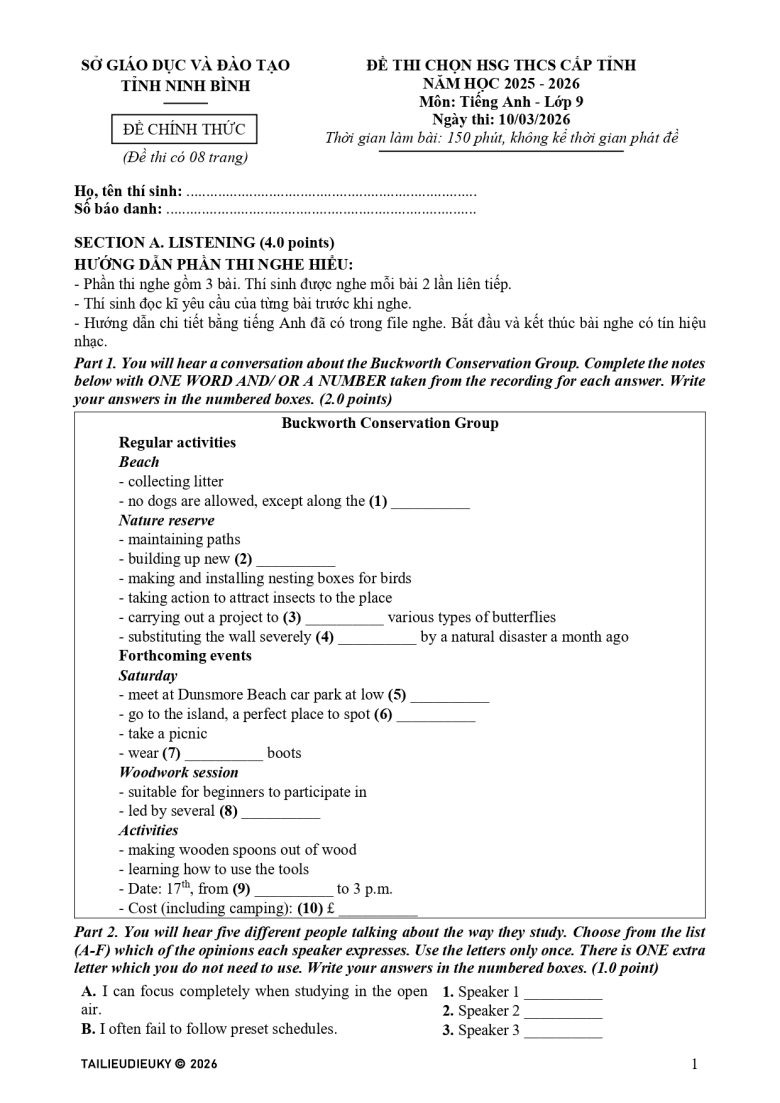
SỞ GIÁO DỤC VÀ ĐÀO TẠO
TỈNH NINH BÌNH
(Đề thi có 08 trang) ĐỀ THI CHỌN HSG THCS CẤP TỈNH
NĂM HỌC 2025 - 2026
Môn: Tiếng Anh - Lớp 9
Ngày thi: 10/03/2026
Thời gian làm bài: 150 phút, không kể thời gian phát đề
Họ, tên thí sinh: ..........................................................................
Số báo danh: ...............................................................................
SECTION A. LISTENING (4.0 points)
HƯỚNG DẪN PHẦN THI NGHE HIỂU:
- Phần thi nghe gồm 3 bài. Thí sinh được nghe mỗi bài 2 lần liên tiếp.
- Thí sinh đọc kĩ yêu cầu của từng bài trước khi nghe.
- Hướng dẫn chi tiết bằng tiếng Anh đã có trong file nghe. Bắt đầu và kết thúc bài nghe có tín hiệu nhạc.
Part 1. You will hear a conversation about the Buckworth Conservation Group. Complete the notes below with ONE WORD AND/ OR A NUMBER taken from the recording for each answer. Write your answers in the numbered boxes. (2.0 points)
Buckworth Conservation Group
Regular activities
Beach
- collecting litter
- no dogs are allowed, except along the (1) __________
Nature reserve
- maintaining paths
- building up new (2) __________
- making and installing nesting boxes for birds
- taking action to attract insects to the place
- carrying out a project to (3) __________ various types of butterflies
- substituting the wall severely (4) __________ by a natural disaster a month ago
Forthcoming events
Saturday
- meet at Dunsmore Beach car park at low (5) __________
- go to the island, a perfect place to spot (6) __________
- take a picnic
- wear (7) __________ boots
Woodwork session
- suitable for beginners to participate in
- led by several (8) __________
Activities
- making wooden spoons out of wood
- learning how to use the tools
- Date: 17th, from (9) __________ to 3 p.m.
- Cost (including camping): (10) £ __________
Part 2. You will hear five different people talking about the way they study. Choose from the list
(A-F) which of the opinions each speaker expresses. Use the letters only once. There is ONE extra letter which you do not need to use. Write your answers in the numbered boxes. (1.0 point)
A. I can focus completely when studying in the open air.
B. I often fail to follow preset schedules.
C. I am not in the habit of studying with a classmate.
D. I love music so much that it distracts me from my tasks.
E. I can concentrate more in the privacy of my own room.
F. I need complete concentration to do science homework. 1. Speaker 1 __________
2. Speaker 2 __________
3. Speaker 3 __________
4. Speaker 4 __________
5. Speaker 5 __________
Part 3. You will hear a short talk about kite-making. Choose the correct answer A, B or C for each question. Write your answers in the numbered boxes. (1.0 point)
1. Which of the following is true about Maori kite-making traditions?
A. Food was prohibited during the preparation of kites of all sizes.
B. Villagers assisted priests in operating the biggest, most sacred kites.
C. Priests invented rules and procedures for making scared kites.
2. What was used to form the structure of Maori kites?
A. bark and roots B. long grasses C. feathers
3. What could have been the most common image on Maori kites?
A. a shell B. a creature C. a priest
4. The ‘birdman’ kite exhibited in the Auckland Museum __________.
A. is the first to have ever been made
B. has a wooden mask on it
C. is shaped like a human head
5. What was one message the Maori delivered when their kites rose into the air?
A. beginning of a war
B. hope for a good crop
C. prayer for a dead hunter
SECTION B. LANGUAGE IN USE (4.0 points)
Part 1. Read the text below and decide which answer A, B, C or D best fits each gap. Write your answers in the numbered boxes. (2.0 points)
Why Is History Education Important?
History is incredibly popular today. We all want to learn about the past, discover new evidence, and explain historical mysteries. For educators, teaching history is crucial for (1) __________ critical thinking and empathy in students. By studying history, they can learn to (2) __________ fact from opinion and develop a better understanding of their place in the world.
(3) __________ viewing history as a lifeless subject, it’s more apt to see it as a dynamic force shaping our present. History teachers are striving to make their lessons more inclusive, (4) __________ diverse perspectives and sources to create a well-rounded curriculum.
Renowned historians have (5) __________ a vital role in reshaping the way history is taught. Their work has (6) __________ light on contemporary issues such as racism and migration, making history more relevant to students’ lives.
(7) __________ like statue removals and social movements requires an awareness of their historical context. By learning about migration, colonization, and civil rights movements, students can better comprehend modern-day challenges like systemic racism. (8) __________ essence, history is not a thing of the past; it’s a vibrant and essential part of (9) __________ student’s education, offering valuable lessons about humanity and the world (10) __________ we live in.
1. A. preventing B. nurturing C. satisfying D. determining
2. A. differentiate B. discourage C. divide D. distract
3. A. In spite of B. On account of C. With a view to D. Rather than
4. A. incorporating B. being incorporated C. have incorporated D. to incorporate
5. A. produced B. planted C. played D. provided
6. A. put B. shed C. burned D. fired
7. A. Understanding historical events
C. Students understand historical events B. Understood historical events
D. Historical events are understood by students
8. A. Under B. On C. In D. With
9. A. every B. most C. all D. almost
10. A. where B. which C. when D. what
Part 2. Give the correct form of the bold words in capital to complete the following passage. Write your answers in the numbered boxes. (1.0 point)
Youth Activism In The Digital Age
In recent years, youth activism has gained (1. REMARK) __________ momentum, largely due to the influence of social media platforms. What once required months of organizing can now be achieved within hours, as campaigns quickly spread across continents. Not only are young people raising awareness about environmental issues, but they are also demanding concrete policy changes. Many activists argue that, had governments acted decisively a decade ago, the climate crisis would be far less severe today.
Social media, however, is a(n) (2. EDGE) __________ sword. While it enables rapid communication, it also exposes users to misinformation, which may undermine public trust in scientific research. To address this issue, experts recommend that digital (3. LITERATE) __________ be included in school curricula worldwide.
Rarely has such a large-scale global movement been coordinated primarily by teenagers. Their determination has become a catalyst for broader societal change, inspiring adults to (4. CONSIDER) __________ long-standing habits. Despite the criticism they face, these young activists remain resilient. Were their efforts to be dismissed entirely, the opportunity for meaningful reform would be
(5. RETRIEVE) __________ lost.
Part 3. There are 5 mistakes in the following passage. Underline the mistakes and write the correct answers in the numbered spaces given below. One example (0) has been done for you. (1.0 point)
Too Much On Our Plates
An increasing number of people are overweight, probably due of growing prosperity, cheaper food and changing dietary habits. One noticeable example of this is that portion size increases dramatically over the last thirty years. What’s more, we are losing the ability to judge how large an “appropriate portion” should be. There is now so much food on our plates that if we eat up everything that is put in front of us, as our parents teach us to do, the chances are we will put up weight. Researchers at Pennsylvania State University investigating the factors that lead to obesity looked at the role portion size plays in determining how much people eat. With a view to test this, the researchers set the lunch table for four days for two groups of men and women. One group was given a plate that contained a pre-measured portion. The other was handed an empty plate and allowed to serve themselves from the same-sized portions presented in a dish. Whether the participants put the food on their own plates or not, the largest portion in front of them, the more they ate. Even if we think we are in control of what we eat, we all have the same innate reaction to portion size. No matter how hungry we are, we eat more if we give more.
Number Line Mistake Correction
0 1 of to
1
2
3
4
5
SECTION C. READING (5.0 points)
Part 1. Fill in each gap with ONE suitable word to complete the following passage. Write your answers in the numbered boxes. (1.0 point)
Language Changes
While linguistic change can occasionally bring about problems, the parts undergoing change are tiny compared to the vast unchanging areas. Some caution is desirable, (1) __________ there are no grounds for the extreme pessimism so often encountered.
For the most part, language changes because society changes. To hold back the one requires controlling the (2) __________ - a task with very limited success. Language change is inevitable. We need to develop greater awareness and put up with change. Schools should teach a common standard while recognizing linguistic diversity.
Some view language changes as progressions, but no evidence backs this (3) __________. Languages don’t progress or decay toward any endpoint. They simply change, (4) __________ does society. Languages die out because their status alters, not because they’ve grown too old. If metaphors (5) __________ called for, the tide works best - always changing, ebbing and flowing, but never progressing.
Part 2. Read the following passage and choose the best answer A, B, C or D for each of the questions. Write your answers in the numbered boxes. (2.0 points)
The phenomenon by which an organism produces one or more chemicals that influence the growth, survival and reproduction of other organisms is called allelopathy. [I] The term was first used by the Austrian scientist Hans Molisch in 1937, but people have been noting the negative effects that one plant can have on another for a long time. [II]
Allelopathy can be observed in many aspects of plant ecology. [III] It can affect where certain species of plants grow, the fertility of competitor plants, the natural change of plant communities over time, which plant species are able to dominate a particular area, and the diversity of plants in an area. Plants can release allelopathic chemicals in several ways: their roots can release chemicals directly into the soil, and their bark and leaves can release chemicals into the soil as they rot. [IV]
There may be at least three applications of allelopathy to agriculture. Firstly, the allelopathic properties of wild or cultivated plants may be bred into crop plants through genetic modification or traditional breeding methods to improve the release of desired allelochemicals and thus improve crop yield. Secondly, a plant with strong allelopathic properties could be used to control weeds by planting it in rotation with an agricultural crop and then leaving it to rot and become part of the soil in order to inhibit the growth of weeds. Finally, naturally occurring allelopathic chemicals could be used in combination with man-made chemicals. Boosting the efficiency of man-made herbicides could lead to a reduction in the amount of herbicides used in agriculture, which is better for the environment.
Despite the promising uses of allelopathic chemicals, agricultural scientists are still cautious. Firstly, allelopathic chemicals may break down and disappear in the soil more easily than artificial chemicals. Secondly, allelopathic chemicals may be deleterious to plants other than weeds. Thirdly, allelopathic chemicals could persist in the soil for a long time and may affect crops grown in the same field as the allelopathic plants at a later date. Because the effects of allelopathic chemicals are not yet fully known, agricultural scientists will need to continue to study the biological war between plants.
1. According to paragraph 1, Hans Molisch __________.
A. spent decades looking into harmful plants
B. was the first to detect mutual harm between plants
C. was not in favor of using allelopathy in agriculture
D. coined the term ‘allelopathy’
2. The word they in paragraph 2 refers to __________.
A. chemicals B. ways C. plants D. communities
3. According to paragraph 2, which of the following is NOT mentioned as something affected by allelopathy?
A. the reproduction of rival plants B. dominant plant species in a location
C. the diversity of local vegetations D. the sizes of roots, barks and leaves
4. The word inhibit in paragraph 3 is OPPOSITE in meaning to __________.
A. discourage B. stimulate C. imitate D. manage
5. The word deleterious in paragraph 4 is CLOSEST in meaning to __________.
A. harmful B. beneficial C. widespread D. significant
6. Which of the following best paraphrases the information in the underlined sentence in paragraph 4?
A. Agricultural specialists are applying allelopathic chemicals on a wide scale on account of their astonishing effectiveness.
B. Allelopathy is being adopted widely in agriculture in the face of various warnings from agriculturalists regarding its dangers.
C. Scientists’ confidence in promising agricultural applications of allelopathy has promoted the use of allelopathic chemicals by farmers.
D. Promising as applications of allelopathic chemicals are, experts in agriculture are not yet completely confident in the adoption of these.
7. Where in the passage does the following sentence best fit?
The term ‘allelopathy’ comes from the Greek: allelo and pathy meaning ‘mutual harm’.
A. [I] B. [II] C. [III] D. [IV]
8. Which of the following could be inferred from the passage?
A. Plants with allelopathic properties could exert influence on other species even after they have died.
B. Leafy plants with allelopathic properties are the most potential candidates for agricultural application.
C. Herbicides in agriculture will be prohibited and replaced by natural chemicals in the near future.
D. Famers have been using allelopathic plants to boost plants’ productivity since ancient time.
9. Which of the following is defined in the passage?
A. weeds B. agriculture C. allelopathy D. biological war
10. Which paragraph mentions the adoption of natural chemicals in conjunction with artificial ones?
A. Paragraph 1 B. Paragraph 2 C. Paragraph 3 D. Paragraph 4
Part 3. Read the following passage and do the tasks that follow. Write your answers in the corresponding numbered boxes. (2.0 points)
The Rise Of The Remote Professional
A. In recent years, a significant shift in the global labor market has emerged in the form of the ‘digital nomad’. This term refers to individuals who use telecommunications technologies to earn a living and, more generally, conduct their life in a nomadic manner. Unlike the traditional office worker, these professionals are often found in coffee shops, public libraries, or co-working spaces in foreign countries. Recent data from a major global freelance platform suggests that the number of people identifying as digital nomads has grown by nearly 500% since 2015, with the market for specialized travel insurance and long-stay visas for this group now valued at billions of dollars annually.
B. To cater to this burgeoning lifestyle, a diverse ecosystem of services has been established. This includes everything from ‘coliving’ spaces - residential communities that combine housing with office facilities - to digital platforms that help nomads navigate local tax laws and internet reliability. Marcus Thorne, CEO of a prominent global co-working network, suggests that his company’s success is rooted in ‘location independence’ branding. They offer a membership that allows access to hubs in over 50 countries, specifically targeting the need for a stable professional environment away from home. Conversely, economist Dr. Elena Rossi argues that the next phase of growth will come from ‘hybrid’ models, where traditional corporations allow employees to work remotely for several months a year rather than permanently.
C. Skeptics such as historian Arthur Miller argue that this lifestyle is a fleeting trend, inconsistent with the human need for rootedness and community stability. He believes the move away from the local office would have been unthinkable twenty years ago. However, cultural anthropologist Sarah Jenkins views the digital nomad as a modern-day version of the ‘itinerant scholar’ of the Renaissance. Just as those scholars traveled between European universities to share knowledge, today’s nomads move between global tech hubs, fostering a cross-pollination of ideas. In some regions, she notes, this movement is even linked to ‘economic activism’, where nomads choose to spend their high-currency salaries in developing economies to support local growth.
D. According to urban sociologist Leo Grant, the boundaries between work and personal life have become increasingly blurred. In previous generations, the office was a physical manifestation of professional identity, and ‘leaving work at the door’ was a social standard. Grant defines this traditional structure - fixed-location employment - as providing a sense of security and clear social hierarchy. He argues that the loss of this structure has placed immense psychological pressure on workers. Without a physical office, many nomads feel they must be ‘always on’, leading to burnout and a sense of isolation despite being in a crowded tourist destination.
E. Arthur Miller suggests that the way we perceive professional success is deeply ingrained during childhood through the observation of parents’ work habits. A child who grows up seeing work as a remote, screen-based activity may develop a very different understanding of social responsibility compared to one who sees work as a community-based physical task. Dr. Elena Rossi adds that media portrayals of digital nomads often glamorize the lifestyle, showing people working on beaches, while ignoring the realities of precarious internet connections and the lack of long-term social safety nets.
F. While the desire for travel varies, Professor Jenkins points out a universal trait among digital nomads: a high tolerance for ambiguity and risk. She attributes this to a psychological ‘openness to experience’ rather than just a desire to see new places. Research shows that nomads are significantly more likely to start their own businesses or invest in volatile markets than their office-bound counterparts. Leo Grant also observes that a ‘freedom-seeking’ mindset is dominant in this group, which often results in a rejection of traditional long-term commitments like home ownership or pension schemes.
G. Marcus Thorne remains confident that remote culture will endure. He views the movement as a revolt against the ‘cubicle culture’ of the 20th century. He believes that as technology continues to improve, the face of the global workforce will continue to decentralize, eventually leading to a world where a person’s geographic location has no bearing on their professional potential.
Match the names A-E with the corresponding expressions 1-5. Use each name ONCE only.
A. Elena Rossi B. Arthur Miller C. Leo Grant D. Marcus Thorne E. Sarah Jenkins
Which person …
1. implies that it is becoming increasingly difficult to distinguish workplace from private home.
2. associates people’s perception of professional triumph with their experience in formative years.
3. criticizes media for presenting one-sided images of digital nomads.
4. believes that where a worker lives will not necessarily affect their career prospects.
5. compares modern digital nomads with some people from the past.
Do the following statements agree with the information given in the Reading Passage? Write
TRUE if the statement agrees with the information.
FALSE if the statement contradicts the information.
NOT GIVEN if there is no information on this.
6. The number of digital nomads has exhibited a slight increase over the last decade.
7. A variety of services have emerged in response to the rise of the digital nomad.
8. Marcus Thorne attributes his company’s success to workers’ permanent settlement in their hometown.
9. Arthur Miller does not believe in the persistence of the digital nomad.
10. Digital nomads invariably work more productively than their traditional counterparts.
SECTION D. WRITING (5.0 points)
Part 1. Email writing (2.0 points)
Your school is going to organize an English festival next month. As the leader of the English club, write an email (about 120-150 words) to Mr. John Hughes, the principal of your school to propose some useful and exciting activities for the festival.
In the email, you should:
- introduce something about you (Tom - the leader of the English club).
- suggest activities during the festival.
- explain the skills and knowledge students can gain from the festival.
Begin and end your email as follows:
Dear Mr. John Hughes,
Yours sincerely, Tom
Part 2. Essay writing (3.0 points)
Teenagers today are suffering from more stress than previous generations. Why is this happening? How can teenagers cope with this stress?
Write an essay of about 200-250 words on this topic. Use specific reasons and examples to support your answer.
---------- THE END ----------