
Vừa qua 22/1, Sở GD&ĐT tỉnh Quảng Ninh đã tổ chức thành công kỳ thi chọn học sinh giỏi cấp tỉnh THCS năm 2026, thu hút 6.518 thí sinh đến từ 430 trường tham gia. Tại bài viết bạn có thể tải về miễn phí đầy đủ Đề thi + Đáp án chính thức môn Tiếng Anh 9 Quảng Ninh năm học 2025-2026.
Tóm tắt tài liệu
Đề HSG Tiếng Anh 9 Quảng Ninh 2026 – 150 phút – 08 trang – 4 phần – 100 câu
A. Listening (5.0 điểm)
• Form completion (Note filling): 10 câu – 2.0 điểm
• Multiple choice (A–D): 5 câu – 1.0 điểm
• Matching speakers – feelings: 5 câu – 1.0 điểm
• True/False statements: 5 câu – 1.0 điểm
B. Language (4.0 điểm)
• Multiple choice (Grammar & Vocabulary): 20 câu – 2.0 điểm
• Error identification: 10 câu – 1.0 điểm
• Word formation: 10 câu – 1.0 điểm
C. Reading (6.0 điểm)
• Cloze test (MCQ): 10 câu – 2.0 điểm
• Gap filling (1 word): 7 câu – 1.4 điểm
• Reading comprehension (MCQ): 8 câu – 1.6 điểm
• Matching headings: 5 câu – 1.0 điểm
D. Writing (5.0 điểm)
• Sentence transformation (rewrite): 8 câu – 1.6 điểm
• Sentence transformation (word form): 7 câu – 1.4 điểm
• Paragraph writing (150–180 words): 1 bài – 2.0 điểm
Link tải file Word đề thi + đáp án + transcript
Trên đây là đáp án và hướng dẫn chấm chi tiết, hy vọng sẽ là tài liệu hữu ích giúp các em tự đánh giá năng lực và chuẩn bị tốt hơn cho những kỳ thi quan trọng phía trước. Chúc các em ôn tập hiệu quả! ✨
Đáp án chính thức
🔹 HƯỚNG DẪN CHẤM HSG TIẾNG ANH 9 QUẢNG NINH 2026
SECTION A. LISTENING (5.0 points)
Part 1 (2.0 điểm) – 0.2/câu
1. 2.45
2. band
3. play
4. scientist
5. river
6. relationships
7. Handsworth
8. traditional dances
9. outdoor market
10. logo
Part 2 (1.0 điểm) – 0.2/câu
1. D
2. B
3. B
4. A
5. C
Part 3 (1.0 điểm) – 0.2/câu
1. E
2. F
3. H
4. A
5. C
Part 4 (1.0 điểm) – 0.2/câu
1. F
2. T
3. T
4. F
5. T
🔹 SECTION B. GRAMMAR & LEXICO (4.0 points)
Part 1 (2.0 điểm) – 0.1/câu
1. C 2. B 3. A 4. C 5. D
2. D 7. C 8. A 9. D 10. C
3. D 12. B 13. D 14. B 15. A
4. D 17. C 18. A 19. B 20. C
Part 2 (1.0 điểm) – 0.1/câu
1. D 2. A 3. D 4. D 5. D
2. B 7. B 8. D 9. A 10. B
Part 3 (1.0 điểm) – 0.1/câu
1. athletics
2. twice
3. sweeteners
4. unknown
5. indecisive
6. extracurricular
7. graphically
8. proofreading
9. hardships
10. uplifting
🔹 SECTION C. READING (6.0 points)
Part 1 (2.0 điểm) – 0.2/câu
1. B 2. C 3. D 4. A 5. D
2. B 7. A 8. B 9. A 10. B
Part 2 (1.4 điểm) – 0.2/câu
1. from
2. leads
3. moon
4. home
5. last
6. However / Nevertheless / Nonetheless
7. their
Part 3 (1.6 điểm) – 0.2/câu
1. D 2. B 3. D 4. B
2. B 6. B 7. B 8. B
Part 4 (1.0 điểm) – 0.2/câu
1. vi
2. v
3. iii
4. iv
5. ii
🔹 SECTION D. WRITING (5.0 points)
Part 1 (1.6 điểm) – 0.2/câu
1. Until last Friday, my car had never broken down.
2. None of the dishes on the menu is cheaper than / as cheap as the eel soup.
3. However experienced a driver you are, driving fast is dangerous.
4. Had I not had such a good English teacher at school, I wouldn’t have become a teacher.
5. The very thought of his face at the moment makes me laugh.
6. It came as no surprise to us that she won the first prize in our school’s speaking contest.
7. It’s your father rather than me who minds you staying out late.
8. Mass tourism is partly responsible for / to blame for the environmental problems.
Part 2 (1.4 điểm) – 0.2/câu
1. The landslides are believed to have resulted from recent floods.
2. There are hardly any tickets left / remaining / (still) available for next Saturday’s concert.
3. I want you to make a real effort to pass the exam.
4. There are some candles in the hall cupboard in the event of a power failure.
5. When he won the scholarship, it began to dawn on Alan just how lucky he was.
6. You shouldn’t have made him leave at short notice.
7. Kelvin has given his word that he will be of service to Lisa next Wednesday.
Part 3 (2.0 điểm) – Writing Criteria
1. Bố cục (0.25 điểm)
• Topic sentence rõ ràng
• Supporting ideas
• Concluding sentence
2. Nội dung (1.0 điểm)
• Ít nhất 2 ý phát triển + giải thích
• Logic, thuyết phục
3. Độ dài (0.25 điểm)
• Sai lệch không quá ±5% số từ
4. Ngôn ngữ (0.75 điểm)
• Từ vựng phù hợp
• Ngữ pháp, dấu câu, chính tả chính xác
👉 Total: 20 points
Lưu ý: Học sinh làm cách khác đúng vẫn cho điểm tối đa theo biểu điểm.
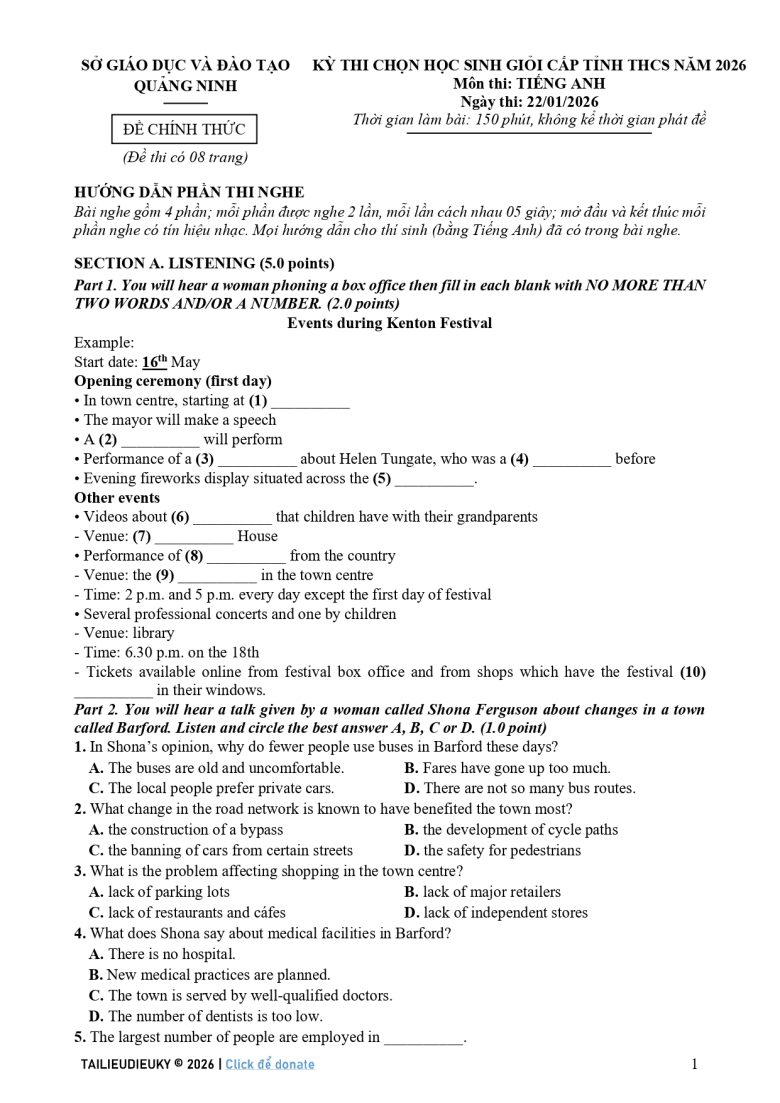
SỞ GIÁO DỤC VÀ ĐÀO TẠO
QUẢNG NINH
(Đề thi có 08 trang) KỲ THI CHỌN HỌC SINH GIỎI CẤP TỈNH THCS NĂM 2026
Môn thi: TIẾNG ANH
Ngày thi: 22/01/2026
Thời gian làm bài: 150 phút, không kể thời gian phát đề
HƯỚNG DẪN PHẦN THI NGHE
Bài nghe gồm 4 phần; mỗi phần được nghe 2 lần, mỗi lần cách nhau 05 giây; mở đầu và kết thúc mỗi phần nghe có tín hiệu nhạc. Mọi hướng dẫn cho thí sinh (bằng Tiếng Anh) đã có trong bài nghe.
SECTION A. LISTENING (5.0 points)
Part 1. You will hear a woman phoning a box office then fill in each blank with NO MORE THAN TWO WORDS AND/OR A NUMBER. (2.0 points)
Events during Kenton Festival
Example:
Start date: 16th May
Opening ceremony (first day)
• In town centre, starting at (1) __________
• The mayor will make a speech
• A (2) __________ will perform
• Performance of a (3) __________ about Helen Tungate, who was a (4) __________ before
• Evening fireworks display situated across the (5) __________.
Other events
• Videos about (6) __________ that children have with their grandparents
– Venue: (7) __________ House
• Performance of (8) __________ from the country
– Venue: the (9) __________ in the town centre
– Time: 2 p.m. and 5 p.m. every day except the first day of festival
• Several professional concerts and one by children
– Venue: library
– Time: 6.30 p.m. on the 18th
– Tickets available online from festival box office and from shops which have the festival (10) __________ in their windows.
Part 2. You will hear a talk given by a woman called Shona Ferguson about changes in a town called Barford. Listen and circle the best answer A, B, C or D. (1.0 point)
1. In Shona’s opinion, why do fewer people use buses in Barford these days?
A. The buses are old and uncomfortable. B. Fares have gone up too much.
C. The local people prefer private cars. D. There are not so many bus routes.
2. What change in the road network is known to have benefited the town most?
A. the construction of a bypass B. the development of cycle paths
C. the banning of cars from certain streets D. the safety for pedestrians
3. What is the problem affecting shopping in the town centre?
A. lack of parking lots B. lack of major retailers
C. lack of restaurants and cáfes D. lack of independent stores
4. What does Shona say about medical facilities in Barford?
A. There is no hospital.
B. New medical practices are planned.
C. The town is served by well-qualified doctors.
D. The number of dentists is too low.
5. The largest number of people are employed in __________.
A. manufacturing B. service C. education D. technology
Part 3: You will hear five short extracts in which teenagers are talking about doing an art project at school. Choose from the list (A-H) how each speaker felt about the art project. Use each letter only once and write it in the corresponding numbered space. There are three extra letters which you do NOT need to use. (1.0 point)
A. surprised by what they learned from the experience
B. unsure how useful it was
C. grateful for the support they received
D. critical of the resources available for it
E. satisfied that they achieved their aims
F. sorry that they weren’t more ambitious
G. amused by reactions to the art they produced
H. annoyed by the attitude of other students
1. Speaker 1: __________
2. Speaker 2: __________
3. Speaker 3: __________
4. Speaker 4: __________
5. Speaker 5: __________
Part 4. You will hear a conversation between a boy, Tom, and his sister, Clare about school. Listen and decide whether the following statements are true (T) or false (F) by putting a tick (√) in the correct column. (1.0 point)
1. Clare thinks their father will be delighted to hear Tom’s news.
2. Tom believes he can manage both swimming and school work.
3. Tom’s teacher thinks Tom is clever.
4. Clare thinks it is a good idea to take a friend’s advice.
5. Tom finally realises he will need his father’s agreement to his plans.
SECTION B. GRAMMAR AND LEXICO (4.0 points)
Part 1. Circle the letter A, B, C or D before the word or phrase that best completes each sentence or answers each question. (2.0 points)
1. The __________ in the stadium all cheered the athletes when they crossed the finish line.
A. sightseers B. witnesses C. spectators D. onlookers
2. When my grandfather came to visit me, he __________ always bring a little present.
A. was used to B. would C. might D. could
3. Once you get Tony __________ about his travels, he won’t stop.
A. talking B. talk C. to talk D. talked
4. Buying a cheaper car was a __________ decision considering you had a limited budget.
A. sensitive B. sensational C. sensible D. senseless
5. No other creatures spend so much time enjoying themselves as human beings do. Indeed, we __________ onto our sense of fun right into adulthood.
A. stay B. keep C. save D. hold
6. Our team has the __________ over the competition because of our new technology.
A. tip B. fringe C. rim D. edge
7. The sign says that all shoplifters will be __________.
A. persecuted B. disproved C. prosecuted D. prohibited
8. Minh’s compositions are full of mistakes but they are very __________.
A. imaginative B. imaginary C. imaginable D. imagining
9. __________ all other members of his family, I prefer him.
A. As from B. As to C. As for D. As against
10. He __________ the accident yesterday since he is a careful driver.
A. would have caused B. should have caused
C. can’t have caused D. mustn’t have caused
11. The team had been trying to win the competition for years. Last year, they finally __________.
A. carried it away B. carried it on C. brought it on D. brought it off
12. The boys looked as though they __________ bored playing soldiers, so I suggested them going for a cycle ride.
A. became B. had become C. were becoming D. had been becoming
13. The president is insistent that factories __________ out of the cities.
A. are moved B. will be moved C. move D. be moved
14. I know I want to have a __________ but I’m not sure in which field. I might study law.
A. work B. profession C. job D. occupation
15. If you think you are right, then __________. Don’t let him bully you into changing your mind.
A. stand your ground B. hit it off C. get a move on D. give the green light
16. It’s up to you what to do – the ball is __________ now.
A. on your side B. on your turf C. in your pitch D. in your court
17. I think you need to __________ your ideas more clearly so that the readers don’t get confused.
A. draw on B. keep up with C. set out D. give in
18. Do you think the wind has __________ enough for us to go sailing without any danger?
A. died down B. cleared up C. passed out D. gone off
19. – Lily: “The subject is so hard. There is a lot of information to remember.’’
– Joanna: “__________. The information is logically ordered and it is not that difficult to learn.”
A. I’m all ears B. I beg to differ
C. I’m with you D. You can say that again
20. – Anne: “What are you going to get me for my birthday?”
– Jim: “__________”
A. Oh, congratulations! B. There’s nothing to it!
C. Never you mind. D. In your dreams!
Part 2. Circle the letter A, B, C or D under the underlined word/ phrase in each sentence that needs correcting. (1.0 point)
1. He promised (A) to mend the (B) broken wheel (C) by the end of the week without (D) failure.
2. The two candidates, neither of (A) them had previous (B) experience in public office, (C) impressed the panel (D) with their confidence.
3. The (A) sudden appearance of the (B) northern lights in the sky (C) was a breathtaking natural (D) phenomena.
4. (A) Exhausted after (B) hours of hiking, they (C) rested under a tree, (D) admired the beautiful view of the valley.
5. They (A) carried out research (B) into (C) the role of electronic devices in (D) the society.
6. (A) Veterans were honoured at the A80 event (B) of their (C) bravery during the fierce battle (D) at Quảng Trị citadel in 1972.
7. He learned (A) to embrace every (B) perfection as (C) a part of his journey toward growth and self- improvement.
8. Jenny, (A) along with her colleagues, (B) has just registered (C) for a post-graduate course with a view to (D) enjoy more career prospects.
9. (A) Real thinking involves approaching challenges with a clear (B) understanding, considering (C) practical solutions, and making decisions (D) based on facts.
10. The (A) construction crew finished the building (B) ahead schedule, which impressed (C) the client with (D) their efficiency.
Part 3. Use the word in capitals at the end of each of the following sentences to form a word that fits suitably in the blank. (1.0 point)
1. My dad used to be really fit and was on his college __________ team. (ATHLETE)
2. The restaurant served diners a meal but charged some __________ as much as others. (TWO)
3. Artificial additives such as colourings, __________ and flavour enhancers aren’t permitted in baby foods. (SWEET)
4. My dad says he once met Robbie Williams when he was still __________. (KNOW)
5. I couldn’t decide which hat to get, but then again I’ve always been quite __________. (DECIDE)
6. She wanted to promote music and drama through __________ classes. (CURRICULUM)
7. The documentary __________ depicted the devastating effects of the natural disaster. (GRAPHICS)
8. She spent hours __________ her essay to ensure there were no grammatical errors before submitting it. (READ)
9. Despite many __________, she faced throughout her life, she remained resilient and determined to succeed. (HARD)
10. The speaker’s __________ words inspired the audience to pursue their dreams with renewed confidence and determination. (LIFT)
SECTION C. READING (6.0 points)
Part 1. Read the following passage and circle the letter A, B, C, or D to indicate the word or phrase that best fits each of the numbered blanks. (2.0 points)
SCAMS IN CAMBODIA’S SPECIAL ZONES
In recent years, many reports have revealed the rise of online and phone (1) __________ based in special economic zones in Cambodia. These scams often promise high-paying jobs to foreign workers, (2) __________ lure people from neighboring countries such as Vietnam, Thailand, and the Philippines. Once victims arrive, their passports are taken away, and they are forced to work for criminal organizations.
Most of these operations are located in remote or privately controlled areas, making them difficult for authorities to (3) __________. Criminal groups use advanced technology to create fake investment websites, romance scams, or online gambling platforms. (4) __________ these illegal activities, thousands of victims have lost large amounts of money or been trapped in harsh working conditions.
The Cambodian government has recently increased cooperation with other Southeast Asian countries to (5) __________ human from trafficking and online fraud. So far, rescue teams have helped hundreds of victims return home safely. (6) __________, experts say that the problem is far from over, as many scam networks continue to operate under new names (7) __________ companies.
(8) __________ the main causes are unemployment, lack of digital awareness, and the promise of quick income. Therefore, young people are advised to be cautious when accepting overseas job offers and to (9) __________ information carefully before traveling. Raising awareness and improving law enforcement are considered the most effective (10) __________ to prevent such crimes in the future.
1. A. systems B. scams C. workers D. groups
2. A. who B. where C. which D. that
3. A. control B. understand C. discover D. investigate
4. A. Due to B. Despite C. Although D. Since
5. A. reduce B. discuss C. protect D. prevent
6. A. Moreover B. However C. Therefore D. Meanwhile
7. A. and B. but C. yet D. with
8. A. Between B. Among C. Over D. From
9. A. check B. share C. ignore D. describe
10. A. reasons B. methods C. results D. effects
Part 2: Fill the gap with ONE suitable word. Write your answers in the numbered spaces provided. (1.4 points)
The transition (1) __________ childhood to adulthood can be a very painful one. The physical and emotional changes young people experience during puberty are confusing, and this confusion often (2) __________ to unpredictable behavior and mood swings – one minute they are over the (3) __________, and the next they are down in the dumps. Constant parental nagging and pressure to do well at school simply compound the problem and can result in rebellious behavior and create tension at (4) __________.
Parents should not be surprised when their advice falls on deaf ears. This is often due to the teen’s perception that adults play the role of ‘oppressor’ and deny them the liberty they crave while constantly finding fault with what they do. Therefore, parents are the (5) __________ people adolescents will want to talk to about sensitive issues. This friction also means that even if parental advice is sound, it is likely to go in one ear and out the other. (6) __________, such a situation is not unusual, and parents should not be too hard on their children. They must learn to accept them as individuals who are capable of making (7) __________ own decisions, and that their patience and understanding will likely be rewarded by their children becoming healthy and responsible adults.
Part 3. Read the following passage and circle the letter A, B, C or D to indicate the correct answer to each of the questions. (1.6 points)
Among all weather phenomena occurring on Earth, lightning ranks is one of the most potent and most frequent. Observations indicate that lightning flashes repeatedly in many regions around the globe; a single strike releases immense energy, enough in principle to power a small town for a brief interval. In under a second, a lightning discharge can heat nearby air to temperatures several times higher than the surface of the sun. Such extreme intensity underscores why lightning has long fascinated scientists, yet the physical mechanism that produces it is surprisingly intricate.
A lightning stroke is the culmination of a complex sequence of processes unfolding within a cloud. The sequence begins with the vertical movement of air masses: warmer air ascends while colder air descends. At the interface, these moving air currents carry countless microscopic water droplets and ice particles. Collisions among those moving drops and crystals generate separation of electrical charge. In somewhat analogous fashion to how a conventional battery has two poles, the colliding particles in the cloud develop distinct positive and negative charges. Within the cloud, the negatively charged region tends to settle toward the bottom, whereas the positively charged region concentrates toward the top. This separation creates an electrical imbalance in the cloud.
When the imbalance becomes sufficiently great, nature seeks to restore equilibrium. A visible, luminous channel forms – a streak of lightning – that reconnects the separated positive and negative regions. The whole event, from the initial buildup to the actual discharge, may transpire in a fraction of a second, yet involves a remarkable interplay among thermodynamics, fluid dynamics, and electrostatics. The luminous channel itself is an extremely hot, ionised path through the air, allowing rapid flow of electrical current between the regions that were once separated.
Lightning manifests in two principal forms. The first, cloud to cloud lightning, occurs entirely within the cloud and never contacts the ground. Also sometimes referred to colloquially as heat lightning, this form is particularly common in late afternoons and evenings, precisely when temperatures begin to fall and turbulence within the cloud increases, prompting more vigorous mixing of hot and cold air. Because no ground contact occurs, cloud to cloud strokes generally pose less direct hazard to people on the surface, though they remain visually dramatic.
The second primary form, cloud to ground lightning, carries far greater danger. It typically arises during a thunderstorm when the electrical imbalance is large enough to bridge the distance between the cloud and the Earth’s surface. Popular myth suggests that lightning will always strike the tallest or most recent object present, but in reality cloud to ground lightning is highly unpredictable. It can strike objects very close to the ground, not solely the tallest structures, and may even appear to target seemingly low or isolated objects. The unpredictability underscores significant safety concerns for individuals caught outdoors during storms.
Understanding lightning is not merely of academic interest. Regions with frequent lightning activity face practical implications for infrastructure, aviation, and public safety. Research into distribution patterns of strikes, as well as into the physics of charge separation and discharge, continues to evolve. Such studies help improve warning systems and protective measures, especially in places where lightning is both powerful and common.
1. According to the passage, all of the following are true of lightning EXCEPT __________.
A. lightning is the most frequent weather event
B. a lightning strike lasts less than a second
C. lightning creates extremely high temperatures
D. lightning is often used to power small towns
2. The word strikes in the passage is closest in meaning to __________.
A. occurs B. hits C. begins D. flashes
3. According to paragraph 2, the electrical charge in a cloud is created by __________.
A. electrical imbalances in the cloud B. lightning strikes
C. warm and cold air D. the collision of rising and falling water droplets
4. The author mentions the similarity to a battery in order to __________.
A. suggest that the energy in clouds our electronics could one day be used to power
B. better explain the concept of a positive and negative charge
C. suggest that lightning is far more powerful than batteries
D. suggest that MP3 players will not work well in a storm
5. According to the passage, what is the last event that occurs before a lightning strike?
A. The temperature begins to fall B. The cloud becomes electrically unbalanced
C. A thunderstorm forms D. Water droplets collide inside the cloud
6. The word culmination in paragraph 2 mostly means __________.
A. the beginning B. the highest point or final stage
C. a sudden explosion D. the typical example
7. Which statement best follows from the passage’s explanations?
A. Cloud to cloud lightning is always harmless.
B. The formation of lightning depends on charge separation within clouds.
C. Lightning always strikes the tallest object first.
D. Thunderstorms are unnecessary for any form of lightning.
8. Which of the following could best serve as the title of the passage?
A. Thunderstorm Safety B. Lightning and its causes
C. Atmospheric Temperature Changes D. Heat lightning only
Part 4: The following reading passage has five paragraphs, A-E. Read the paragraphs and choose the correct heading for each paragraph from the list below. There are more headings than paragraphs, so you will NOT use them all. Write the number of the heading in the corresponding provided space. (1.0 point)
List of headings
i. The expressive communicator described
ii. Flexibility in communication development
iii. Four distinct communication types
iv. Balanced styles ensure team success
v. Functions of recognizing communication styles
vi. Historical explanation of understanding personality
vii. The challenge of change and adaptability
1. Paragraph A: __________
2. Paragraph B: __________
3. Paragraph C: __________
4. Paragraph D: __________
5. Paragraph E: __________
COMMUNICATING CONFLICT!
A. From ancient times, humans have attempted to explain why individuals behave differently in similar situations. One of the earliest systematic explanations came from the Greek physician Hippocrates, who proposed that human behaviour was governed by four bodily fluids, or “humours.” These included blood, yellow bile, black bile, and phlegm, each believed to influence personality traits. Several centuries later, the Roman physician Galen expanded this framework by linking the humours to four temperaments: sanguine, choleric, melancholic, and phlegmatic. Although modern psychology has rejected the biological basis of this theory, the underlying assumption-that people display relatively stable patterns of behaviour-remains highly influential. Contemporary models of personality, learning preferences, and communication styles still reflect this early attempt to categorize human differences.
B. Today, many modern self-assessment tools draw inspiration from these classical theories to help individuals better understand how they communicate and respond to conflict. By identifying preferred communication styles, people can learn to separate reminders that disagreements are often not personal attacks. Conflicts frequently arise because individuals prioritize information differently or focus on contrasting goals, such as tasks, relationships, or details. When team members recognize these differences, they become more capable of adjusting their communication strategies. As a result, misunderstandings are reduced, collaboration improves, and workplace conflicts are less likely to escalate into emotional or personal disputes.
C. The four classical temperaments can still be clearly observed in modern professional environments. The expressive communicator, closely related to the sanguine type, is energetic, talkative, and highly enthusiastic. Such individuals often inspire others through stories and gestures but may overlook practical details. The technical communicator, resembling the phlegmatic type, prefers logic, structure, and factual accuracy. They are reliable and methodical but may resist rapid change. The considerate communicator, similar to the melancholic type, values harmony and emotional awareness, often acting as a mediator, though they may avoid confrontation. Finally, the direct communicator, reflecting the choleric temperament, is decisive and goal-focused but can appear impatient or overly forceful.
D. Because each communication style highlights different strengths, effective teams depend on balance rather than uniformity. Enthusiasm fuels motivation, structure ensures efficiency, empathy maintains trust, and decisiveness drives results. When teams recognize the value of all styles, tasks can be assigned more appropriately, and potential conflicts can be anticipated and managed. Instead of favoring a single dominant approach, successful organizations encourage diversity in communication, allowing teams to benefit from multiple perspectives and working styles.
E. Importantly, communication styles should not be viewed as fixed or unchangeable traits. Individuals are capable of developing flexibility and adjusting their behaviour according to context and audience. Workplace culture, social expectations, and experience all shape how people communicate over time. Those who can shift between empathy and efficiency, or between listening and directing, tend to manage conflict more effectively. As industrialist Henry Ford famously observed, “Whether you think you can or you can’t, you’re right.” This highlights that the willingness to adapt one’s communication habits is essential for long-term cooperation and success.
SECTION D. WRITING (5.0 points)
Part 1. Finish each of the following sentences in such a way that it means exactly the same as the sentence printed before it. (1.6 points)
1. Last Friday was the first time my car ever broke down.
Until last Friday, ________________________________________________________________
2. The eel soup is the cheapest dish on the menu.
None _________________________________________________________________________
3. Driving fast is dangerous although you are an experienced driver or not.
However ______________________________________________________________________
4. I wouldn’t have become a teacher if I hadn’t had such a good English teacher at school.
Had __________________________________________________________________________
5. Just thinking about his face at the moment makes me laugh.
The very ______________________________________________________________________
6. We were not surprised to hear that she won the first prize in our school’s speaking contest.
It came _______________________________________________________________________
7. I don’t mind you staying out late, but your father does.
It’s your father rather ____________________________________________________________
8. Mass tourism has been one of the causes of the environmental problems.
Mass tourism is _________________________________________________________________
Part 2. Complete the second sentence so that it has a similar meaning to the first one, using the word given. Do not change the word given. (1.4 points)
1. Experts believe that the landslides were caused by recent floods. (RESULTED)
The landslides are _______________________________________________________________
2. Almost all the tickets for next Saturday’s concert have been sold. (HARDLY)
There ________________________________________________________________________
3. I want you to try really hard to pass this exam. (EFFORT)
I want you to ___________________________________________________________________
4. If the power fails, there are some candles in the hall cupboard. (EVENT)
There are some candles in the hall cupboard _______________________________ power failure.
5. When he won the scholarship, Alan began to realize just how lucky he was. (DAWN)
When he won the scholarship, it began ____________________________ just how lucky he was.
6. It was wrong of you to ask him to leave so suddenly. (MADE)
You shouldn’t ____________________________________________________________ notice.
7. Kelvin has promised to help Lisa next Wednesday. (SERVICE)
Kelvin has given __________________________________________________ next Wednesday.
Part 3. Write a paragraph of about 150-180 words to express your idea about the role of friendship in teenagers’ lives. (2.0 points)
———- THE END ———-