
Sáng 22/1, Sở Giáo dục và Đào tạo tỉnh Đồng Nai tổ chức kỳ thi chọn học sinh giỏi lớp 12 cấp tỉnh năm học 2025–2026. Kỳ thi diễn ra trong một buổi, dành cho học sinh khối THPT và các cơ sở giáo dục tương đương trên toàn tỉnh. Đây là kỳ thi học sinh giỏi lớp 12 cấp tỉnh đầu tiên sau khi sáp nhập 2 tỉnh Đồng Nai và Bình Phước. Tại bài viết, Tài liệu diệu kỳ cập nhật file Đề thi HSG Tiếng Anh 12 tỉnh Đồng Nai 2025-2025 & đáp án kèm theo đầy đủ audio và transcripts phần Listening cho 2 bảng A, B (hệ chuyên và không chuyên)
Tóm tắt đề thi
A. Listening (5.0 điểm): Part 1: T/F/NG – 5 câu – 1.0 điểm – Part 2: Multiple choice – 6 câu – 1.5 điểm – Part 2: Matching features – 4 câu – 1.0 điểm – Part 3: Summary completion – 10 câu – 1.5 điểm
B. Lexico-Grammar (4.5 điểm): Part 1: Multiple choice – 15 câu – 1.5 điểm – Part 2: Word formation – 10 câu – 1.0 điểm – Part 3: Error correction – 10 câu – 1.0 điểm – Part 4: Prepositions/particles – 10 câu – 1.0 điểm
C. Communication (0.5 điểm): Multiple choice dialogues – 5 câu – 0.5 điểm
D. Reading Comprehension (5.0 điểm): Part 1: Multiple choice cloze – 8 câu – 1.0 điểm – Part 2: Multiple choice cloze – 7 câu – 1.0 điểm – Part 3: Gap-fill – 10 câu – 1.0 điểm – Part 4: Paragraph matching – 7 câu – 1.0 điểm – Part 5: Multiple choice – 8 câu – 1.0 điểm
E. Writing (5.0 điểm): Part 1: Essay – 1 bài – 3.0 điểm – Part 2: Letter/Email – 1 bài – 2.0 điểm
Tải Về Trọn Bộ Đề Thi, Đáp Án & File Nghe
Để xem chi tiết đề thi và đối chiếu kết quả, các bạn vui lòng nhấn vào các liên kết bên dưới để tải tài liệu về máy (Hoàn toàn miễn phí):
📥 Đề thi bảng A + đáp án + file nghe (word)
📥 Đề thi bảng B + đáp án + file nghe (word)
Đừng quên theo dõi trang web Tài liệu diệu kỳ để cập nhật thêm nhiều bộ đề thi HSG Tiếng Anh cấp tỉnh, cấp Quốc gia các năm học mới nhất nhé. Chúc các em học sinh có một quá trình ôn luyện hiệu quả và đạt kết quả cao!
Đáp án
1. T
2. F
3. F
4. T
5. NG
6. A
7. A
8. C
9. B
10. C
11. B
12. A
13. B
14. F
15. E
16. commercial use
17. a quarter
18. medical compounds
19. herbal remedies
20. carbon sinks
21. rising sea levels
22. war
23. exploitation
24. reducing poverty
25. vegetable oils
26. D
27. A
28. C
29. B
30. B
31. A
32. C
33. D
34. C
35. D
36. D
37. A
38. B
39. D
40. D
41. scientifically
42. enlightening
43. desirous
44. absentees
45. antidepressants
46. gatecrashed
47. disinfectants
48. objectionable
49. overcharged
50. upkeep
51. incredible → incredibly
52. which → where
53. name → named
54. with → without
55. lead → leading
56. initial → initially
57. it → them
58. in → at
59. who → whom
60. from → in
61. in
62. against
63. in
64. over
65. on
66. off
67. at
68. up
69. on
70. for
71. C
72. C
73. A
74. B
75. C
76. A
77. C
78. A
79. D
80. D
81. B
82. A
83. C
84. C
85. B
86. D
87. D
88. C
89. C
90. A
91. put
92. as
93. make
94. although / though / while
95. up
96. those
97. on
98. view
99. Regardless / Irrespective
100. a
101. C
102. H
103. F
104. E
105. A
106. D
107. B
108. B
109. D
110. C
111. A
112. B
113. C
114. A
115. C
116. ancestors
117. far-fetched
118. climate-warming
119. recorded history
120. ice age
121. F
122. T
123. F
124. NG
125. T
126. Barely had Ms. Green finished her presentation when her colleagues left the room.
127. The inhabitants in this village are nowhere near as badly off as they were ten years ago.
128. Bill was green with envy when he caught sight of his brother’s new villa.
129. Had it not been for the efforts of the Vietnamese medical staff, the English pilot Stephen Cameron would not have made a miraculous recovery.
130. My younger sister is a dab hand at cooking spaghetti.
131. You cannot get access to the village in winter because of the snow.
132. It was Natalie’s friends who dissuaded her from giving up her job.
133. Werner found it hard to come to terms with the fact that he’d lost his passport.
134. Paul wasn’t given any credit for working hard in the garden.
135. We should save our breath by not talking to that stubborn man.
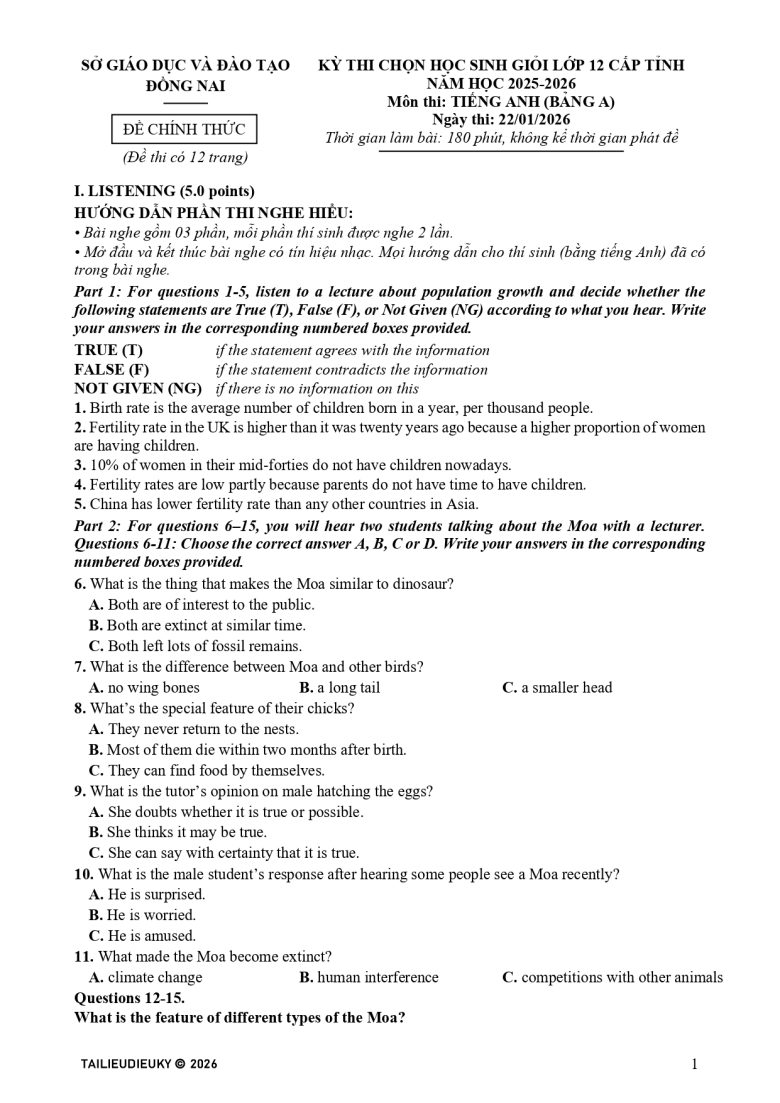
SỞ GIÁO DỤC VÀ ĐÀO TẠO
ĐỒNG NAI
(Đề thi có 12 trang) KỲ THI CHỌN HỌC SINH GIỎI LỚP 12 CẤP TỈNH
NĂM HỌC 2025-2026
Môn thi: TIẾNG ANH (BẢNG A)
Ngày thi: 22/01/2026
Thời gian làm bài: 180 phút, không kể thời gian phát đề
I. LISTENING (5.0 points)
HƯỚNG DẪN PHẦN THI NGHE HIỂU:
• Bài nghe gồm 03 phần, mỗi phần thí sinh được nghe 2 lần.
• Mở đầu và kết thúc bài nghe có tín hiệu nhạc. Mọi hướng dẫn cho thí sinh (bằng tiếng Anh) đã có trong bài nghe.
Part 1: For questions 1-5, listen to a lecture about population growth and decide whether the following statements are True (T), False (F), or Not Given (NG) according to what you hear. Write your answers in the corresponding numbered boxes provided.
TRUE (T) if the statement agrees with the information
FALSE (F) if the statement contradicts the information
NOT GIVEN (NG) if there is no information on this
1. Birth rate is the average number of children born in a year, per thousand people.
2. Fertility rate in the UK is higher than it was twenty years ago because a higher proportion of women are having children.
3. 10% of women in their mid-forties do not have children nowadays.
4. Fertility rates are low partly because parents do not have time to have children.
5. China has lower fertility rate than any other countries in Asia.
Part 2: For questions 6–15, you will hear two students talking about the Moa with a lecturer. Questions 6-11: Choose the correct answer A, B, C or D. Write your answers in the corresponding numbered boxes provided.
6. What is the thing that makes the Moa similar to dinosaur?
A. Both are of interest to the public.
B. Both are extinct at similar time.
C. Both left lots of fossil remains.
7. What is the difference between Moa and other birds?
A. no wing bones B. a long tail C. a smaller head
8. What’s the special feature of their chicks?
A. They never return to the nests.
B. Most of them die within two months after birth.
C. They can find food by themselves.
9. What is the tutor’s opinion on male hatching the eggs?
A. She doubts whether it is true or possible.
B. She thinks it may be true.
C. She can say with certainty that it is true.
10. What is the male student’s response after hearing some people see a Moa recently?
A. He is surprised.
B. He is worried.
C. He is amused.
11. What made the Moa become extinct?
A. climate change B. human interference C. competitions with other animals
Questions 12-15.
What is the feature of different types of the Moa?
Choose FOUR answers from the box and write the correct letter, A-F in the corresponding numbered boxes provided.
Features
A. the much taller female
B. less fossils left
C. the biggest eggs
D. feeding at night
E. better vocal sound
F. poor eyesight
12. the North Island Giant Moa __________
13. the Crested Moa __________
14. the Stout-legged Moa __________
15. the Eastern Moa __________
Part 3: For questions 16–25, you will listen to a piece of news about the loss of rainforests. Complete the summary with NO MORE THAN THREE WORDS AND/OR A NUMBER for each gap. Write your answers in the corresponding numbered boxes provided.
Since the beginning of the 20th century, rainforests have been under threat of extinction. One major cause of deforestation is repurposing the land for (16) __________ such as growing rubber or palm oil on its property.
The loss of this dense biodiversity can pose several threats to our modern society. It is estimated that
(17) __________ modern medicines would be lost along with thousands of (18) __________ derived from plants while underprivileged groups are relying on rainforest plants for medicines. According to World Health Organization, (19) __________ take up to 50% of all medicines in China. Another major problem is climate change. Known as (20) __________, rainforests absorb CO2, clearing it from the atmosphere. A rise in CO2 levels and a fall in rainforest acreage would contribute to (21) __________ and severe droughts. More seriously, (22) __________ over resources such as farming land has led to farmers’ deaths globally.
It is not easy to find a feasible approach to stop deforestation as many people on Earth survive by means of natural resource (23) __________. A typical example is palm oil industry which plays an important role in (24) __________ by creating jobs for millions of farmers. Switching to another production of (25) __________ like sunflower or soybean would even cause more land destruction.
II. LEXICO-GRAMMAR (4.5 points)
Part 1: For questions 26-40, write the letter A, B, C or D in the corresponding numbered boxes provided to indicate the best answer to each of the following questions.
26. It is mandatory that smoking in public __________.
A. is prohibited B. must be prohibited C. prohibiting D. be prohibited
27. __________, the balcony chairs will be ruined in this weather.
A. Left uncovered B. Leaving uncovered
C. Having left uncovered D. Been left uncovered
28. A: “It was such a bargain; I wish it hadn’t fallen to bits.” – B: “It was a waste of money, __________ cheap it was!”
A. yet B. still C. however D. but
29. I’d sooner the children __________ noise last night; I couldn’t get to sleep.
A. wouldn’t make B. hadn’t made C. didn’t make D. wouldn’t have made
30. The __________ serial killer was finally captured after a long investigation.
A. famous B. notorious C. reputable D. conspicuous
31. My neighbor seems to be proud of her __________ new Rolls-Royce.
A. spanking B. roaring C. whacking D. thumping
32. To apply for this position, each candidate has to submit a __________ photo besides other required documents.
A. full-bodied B. full-fledged C. full-length D. full-scale
33. When the state healthcare system was __________, many large hospitals closed down.
A. outlawed B. uprooted C. denounced D. abolished
34. The teacher __________ the girl’s mobile phone until after school, as she was using it during lessons.
A. commissioned B. collected C. confiscated D. conceded
35. Having been exposed to the sun, his already dark complexion became __________.
A. tarnished B. sweltering C. sullen D. swarthy
36. Mrs. Kelly was on the point of going out of her apartment when she was __________ short by a phone call from her husband.
A. caught B. halted C. brought D. stopped
37. I know you are angry, but you should try to keep your __________.
A. temper B. conduct C. mood D. temperament
38. The reporters’ questions about the budget put the government spokesperson __________.
A. to the grounds B. on the spot C. at hand D. in the know
39. Now that you have more money, you’ll be able to __________ a little; you have no excuse any more.
A. fly off the handle B. make a break C. cut and run D. live it up
40. It will be overstepping the __________ if you address the managing director by his first name.
A. frame B. limit C. grade D. mark
Part 2: For questions 41-50, write the correct form of each bracketed word in the corresponding numbered boxes provided.
41. The benefits of music for the embryo have been documented __________ over the last twenty years. (SCIENCE)
42. The instruction manual that came with my new computer wasn’t very __________ about how to operate it. (LIGHT)
43. Hardly a day passes by without Sarah being __________ of eating a bar of chocolate. (DESIRE)
44. There are several __________ in the school this week, because a lot of people have got flu. (ABSENCE)
45. The old lady’s been on __________ ever since the sudden death of her little daughter. (DEPRESS)
46. The Smiths had a guard at the door to ensure that nobody __________ their son’s birthday party. (GATE)
47. Antiseptics and __________ are widely used in hospitals to kill bacteria. (INFECT)
48. I wouldn’t go so far as to punish them. By and large, their behavior wasn’t that __________. (OBJECT)
49. We were __________ £40 for travelling on a Friday because of a rise in airline tickets. (CHARGE)
50. Money from visitors goes towards the __________ of the palace and grounds. (KEEP)
Part 3: The passage below contains 10 mistakes. For questions 51-60, find the mistakes and write the corrections in the numbered space provided. (0) has been done as an example.
Example: was were
In 1912, the world’s top mathematicians began to receive letters which was full of incredible complex formulae. They came from Madras, in India, which a 23-year-old clerk name Srinivasa Ramanujan had seemingly come up with hundreds of new solutions to known mathematical problems with any form of assistance or training.
For the most part, the professional mathematicians’ response was the usual one if faced with eccentric letters: they consigned them straight to the bin. But in 1913, some reached G.H. Hardy, a lead authority in number theory at Cambridge University. He, too, initial dismissed the letters as the work of an eccentric, but unable to get it out of his head, he eventually subjected them to closer scrutiny. After a few hours, Hardy arrived in the conclusion that what he had before him was the work of a mathematical genius, a view confirmed by colleagues with who he shared his discovery.
Before very long, Ramanujan had received an invitation to Cambridge and, once there, he soon proved his worth. A fruitful collaboration with Hardy resulted from the opening up of vast areas of mathematical research, still being worked on to this day.
Part 4: For questions 61-70, fill in each blank with ONLY ONE PREPOSITION or PARTICLE. Write your answers in the corresponding numbered boxes provided.
61. By noon, the art workshop was __________ full swing, with everyone deeply engrossed in their projects.
62. Although it went __________ the grains, Rose tried hard not to get involved in an argument with the overtly racist politician.
63. Our little cottage has been hemmed __________ by all the big housing developments going up in our neighborhood.
64. After making several bad business deals, the company was losing money hand __________ fist.
65. Although Brian was collecting unemployment benefit, __________ the quiet, he was also working as a hospital porter.
66. That naughty boy was let __________ with a warning instead of being given a fine.
67. I wish my mother wouldn’t fly __________ me like that every time I make a mistake.
68. The painter touched __________ on the mural to fix the fading colours caused by weather exposure.
69. Mike is so quick __________ the uptake that you never have to repeat instructions twice.
70. I’m done __________! Here comes my teacher and she’ll see I should see in my Maths lessson.
III. COMMUNICATION (0.5 points)
Choose the best answer (A, B, C, or D) to indicate the sentence that best completes each of the following exchanges. Write your answers in the corresponding numbered boxes provided.
71. Mike and Laura are talking about their plan for the weekend.
– Mike: “I promise to go shopping with you if you help me with the housework.”
– Laura: “__________. You are the last person to keep a promise.”
A. That’s great! B. How come? C. Come off it! D. I hate to differ.
72. Two friends are discussing the major they are going to choose at university.
– Peter: “My parents gave me no choice but to study Arts.”
– Danny: “__________”
A. Of course, not. B. No, I can’t get it. C. Well, so be it. D. Oh, by all means.
73. Alice and Jenny are talking about Jenny’s new house.
– Alice: “What a spacious house you have got, Jenny!”
– Jenny: “__________”
A. It’s so kind of you to say so. B. Thank you. I am afraid.
C. No, this is on me. D. At all costs.
74. Two friends, Carter and Suzy, are talking about pets.
– Carter: “Well, as I know, dogs are the most faithful animals.”
– Suzy: “__________”
A. Nothing more to say. B. You can say that again.
C. Yes. I hope so. D. No. What nonsense!
75. John was late for a meeting with Jane. He’s now apologizing to Jane for the incident.
– John: “Sorry I’m late. I was held up in the traffic.”
– Jane: “__________”
A. Little wonder you do! B. Forget about it!
C. Don’t sweat over it! D. No offense intended!
IV. READING COMPREHENSION (5.0 points)
Part 1: For questions 76-83, read the passage and write the letter A, B, C or D in the corresponding numbered boxes provided to indicate the option that best fits each of the following numbered blanks.
Effective team management
Leading a team effectively is a skill that, admittedly, requires both patience and strategic thinking. While goals should be ambitious, leaders must remain (76) __________ aware of obstacles that may arise. Creating a supportive (77) __________ is crucial, as it allows team members to collaborate seamlessly.
It is also essential not to (78) __________ behind when making decisions. Reacting promptly can prevent minor issues from becoming major problems. Every member is a vital (79) __________ of the team, contributing their unique strengths.
Sometimes, unexpected challenges can throw a project (80) __________, leading to setbacks. In such cases, leaders must (81) __________ their composure and encourage resilience. Imagine a project where equipment has to be (82) __________ across difficult terrain; without a motivated team, progress would be slow. Therefore, always look for ways to (83) __________ innovation and efficiency.
(Adapted from 10 Use of English Tests for C2 Proficiency CPE)
76. A. potentially B. plausibly C. predictably D. prospectively
77. A. set B. scenery C. setting D. scenario
78. A. lag B. stray C. delay D. linger
79. A. constituent B. compartment C. complement D. component
80. A. away B. overboard C. overhead D. off
81. A. have B. keep C. hold D. store
82. A. lugged B. clambered C. grabbed D. lumbered
83. A. provoke B. incite C. further D. elicit
Part 2: For questions 84-90, read the passage and write the letter A, B, C or D in the corresponding numbered boxes provided to indicate the option that best fits each of the following numbered blanks.
Ever had a song stuck in your head, playing on an endless loop? Scientists call them “involuntary musical images”, or “earworms”, and a wave of new research (84) __________ and what can be learned from them. Some neuroscientists and cognitive psychologists are studying earworms to explore the mysteries of memory and the part of the brain that is beyond our conscious control. “The idea (85) __________ is an illusion,” says psychologist Lauren Stewart, who founded the master’s program in music, mind and brain at Goldsmiths, University of London, UK, where recent research has taken place. (86) __________, researchers haven’t been able to watch what happens in the brain when they occur. (87) __________ comes from surveys, questionnaires, diaries and lab experiments.
A Goldsmiths study published in the journal Memory and Cognition this year showed that the singing we hear in our heads (88) __________. Researchers had 17 volunteers tap to the beat of any earworm they heard during a four-day period (89) __________ recorded their movements. The tapping tempos were within 10% of the tempos of the original recordings. Another Goldsmiths study, published this year in Consciousness and Cognition, found that people who report hearing earworms often, and find them most intrusive, have slightly different brain structures, (90) __________.
(Adapted from IELTS Reading Practice Tests)
84.
A. of which their occurrences are clarified B. that is casting light on their occurrences
C. is shedding light on why they occur D. giving clarifications on how they occur
85.
A. of thought procedures gets out of human’s control
B. that we have full control over our thinking processes
C. to take absolute power over our act of thinking
D. entirely dominates the way our minds work
86.
A. Coming about despite earlier predictions B. Having appeared against all expectations
C. Although earworms occur unexpectedly D. Because earworms happen unpredictably
87.
A. Most of which we know about them B. Our primarily knowledge about them
C. That we know much about them D. Much of what is known about them
88.
A. tends to be contrasting to authentic recordings
B. is bound to bear no resemblance to recordings
C. has a tendency to be true to actual recordings
D. is likely to be inexact in terms of recordings
89.
A. once their wrist on attachment to a device
B. when a device fastens to their wrist
C. while a device attached to their wrist
D. as their wrist in connection with a device
90.
A. with more gray matter in areas associated with processing emotions
B. in which emotional processes conjoining with areas of gray matter
C. showing more problems in gray areas where emotions process
D. have close connection with the expression of feelings in grey areas
Part 3: For questions 91-100, read the passage and fill in each of the following numbered blanks with ONE suitable word. Write your answers in the corresponding numbered boxes provided.
Food for a Future
Jon Wynne-Tyson was an original thinker (0) WHOSE best-known book “Food for a Future” was published in 1975. In this classic work, a case was (91) __________ forward for what can only be described (92) __________ a more responsible and humane attitude towards the world’s food resources. It had gradually become clear to Wynne-Tyson that the economics and ecology of meat production did not (93) __________ sense. What justification was there, he argued, for using seven tonnes of cereal to produce one tonne for meat?
Even today, the book’s succinct style makes it compulsively readable. (94) __________ his approach is basically an emotional one, Wynne-Tyson goes to great lengths to back (95) __________ every statement with considerable supporting evidence and statistical data. Thus, even (96) __________ of us who are widely read (97) __________ the subject of vegetarianism will gain fresh insights from this book. It is generally agreed that his most skillful achievement is the slow revelation of his main thesis as the arguments unfold. The book concludes that a move away from an animal-based diet to one which is based on plant sources is inevitable in the long term, in (98) __________ of the fact that there is no sound nutritional, medical or social justification for meat-eating. (99) __________ of whether you agree with such a conclusion or not, the book certainly makes (100) __________ fascinating read.
(Adapted from Cambridge Certificate of Proficiency in English)
Part 4: For questions 101-107, read a passage about investigations into the origins of the universe. Seven paragraphs have been removed from the extract. Choose from the paragraphs A-H the one which fits each gap. There is ONE extra paragraph which you do not need to use. Write your answers in the corresponding numbered boxes provided.
THE ORIGINS OF THE UNIVERSE
A powerful conviction for me is the idea that as we converge on the moment of creation, the constituents and laws of the universe become ever simpler. A useful analogy here is life itself, or, more simply, a single human being. Each of us is a vastly complex entity, assembled from many different tissues and capable of countless behaviours and thoughts.
101. __________
Cosmology is showing us that this complexity flowed from a deep simplicity as matter metamorphosed through a series of phase transitions. Travel back in time through those phase transitions, and we see an ever- greater simplicity and symmetry, with the fusion of the fundamental forces of nature and the transformation of particles to ever-more fundamental components.
102. __________
Go back further still. What was there before the big bang? What was there before time began? Facing this question challenges our faith in the power of science to find explanations of nature. The existence of a singularity – in this case the given, unique state from which the universe emerged — is anathema to science, because it is beyond explanation.
103. __________
Cosmologists have long struggled to avoid this bad dream by seeking explanations of the universe that avoid the necessity of a beginning. Einstein, remember, refused to believe the implication of his own equations – that the universe is expanding and therefore must have had a beginning – and invented the cosmological constant to avoid it. Only when Einstein saw Hubble’s observations of an expanding universe could he bring himself to believe his equations.
104. __________
Stephen Hawking and J B Hartle tried to resolve the challenge differently, by arguing the singularity out of existence. Flowing from an attempt at a theory of quantum gravity, they agreed that time is finite, but without a beginning. Think of the surface of a sphere. The surface is finite, but it has no beginning or end – you can trace your finger over it continuously, perhaps finishing up where you began. Suppose the universe is a sphere of space time. Travel around the surface, and again you may finish up where you started both in space and time.
105. __________
We simply do not know yet whether there was a beginning of the universe, and so the origin of space-time remains in terra incognita. No question is more fundamental, whether cast in scientific or theological terms. My conviction is that science will continue to move ever closer to the moment of creation, facilitated by the ever-greater simplicity we find there. Some physicists argue that matter is ultimately reducible to pointlike objects with certain intrinsic properties.
106. __________
To an engineer, the difference between nothing and practically nothing might be close enough. To a scientist, such a difference, however miniscule, would be everything. We might find ourselves experiencing Jarrow’s bad dream, facing a final question: Why? “Why” questions are not amenable to scientific inquiry and will always reside within philosophy and theology, which may provide solace if not material explication.
107. __________
The list of cosmic coincidences required for our existence in the universe is long, moving Stephen Hawking to remark that, “the odds against a universe like ours emerging out of something like the big bang are enormous.” Princeton physicist Freeman Dyson went further, and said: “The more I examine the universe and the details of its architecture, the more evidence I find that the universe in some sense must have known we were coming”. This concatenation of coincidences required for our presence in this universe has been termed the anthropic principle. In fact, it is merely a statement of the obvious: Had things been different, we would not exist.
(Adapted from The BALANCE series FOR THE REVISED CPE)
Missing paragraphs:
A. This, of course, requires time travel, in violation of Mach’s principle. But the world of quantum mechanics, with its uncertainty principle, is an alien place in which otherworldly things can happen. It is so foreign a place that it may even be beyond human understanding.
B. But what if the universe we see were the only one possible, the product of a singular initial state shaped by singular laws of nature? It is clear that the minutest variation in the value of a series of fundamental properties of the universe would have resulted in no universe at all, or at least a very alien universe. For instance, if the strong nuclear force had been slightly weaker, the universe would have been composed of hydrogen only. An expansion more rapid by one part in a million would have excluded the formation of stars and planets.
C. Trace that person back through his or her life, back beyond birth to the moment of fertilisation of a single ovum by a single sperm. The individual becomes ever simpler, ultimately encapsulated as information encoded in DNA. The development that gradually transforms a DNA code into a mature individual is an unfolding, a complexification, as the information in the DNA is translated and manifested through many stages of life. So, I believe, it is with the universe. We can see how very complex the universe is now, and we are part of that complexity.
D. Others argue that fundamental particles are extraordinarily tiny strings that vibrate to produce their properties. Either way, it is possible to envisage creation of the universe from almost nothing – not nothing, but practically nothing. Almost creation ex nihilo, but not quite. That would be a great intellectual achievement, but it may still leave us with a limit to how far scientific inquiry can go, finishing with a description of the singularity, but not an explanation of it.
E. For many proponents of the steady state theory, one of its attractions was its provision that the universe had no beginning and no end, and therefore required no explanation of what existed before time = 0. It was known as the perfect cosmological principle.
F. There can be no answer to why such a state existed. Is this, then, where scientific explanation breaks down and God takes over, the artificer of that singularity, that initial simplicity? The astrophysicist Robert Jastrow described such a prospect as the scientist’s nightmare: “He has scaled the mountains of ignorance; he is about to conquer the highest peak; as he pulls himself over the final rock, he is greeted by a band of theologians who have been sitting there for centuries.”
G. Various COBE team members and other cosmologists were on TV, radio talk shows, and in newspapers for several days. The publicity and tremendous public interest provided a unique opportunity to discuss science with a very large audience and to promote the power of human endeavour in pursuing the mysteries of nature.
H. Go back further and we reach a point when the universe was nearly an infinitely tiny, infinitely dense concentration of energy. This increasing simplicity and symmetry of the universe as we near the point of creation gives me hope that we can understand the universe using the powers of reason and philosophy. The universe would then be comprehensible, as Einstein had yearned.
Part 5: For questions 108-115, read the passage and choose the best option A, B, C, or D to answer the questions. Write your answers in the corresponding numbered boxes provided.
WATER IN THE DESERT
Rainfall is not completely absent in desert areas, but it is highly variable. An annual rainfall of four inches is often used to define the limits of a desert. The impact of rainfall upon the surface water and groundwater resources of the desert is greatly influenced by landforms. Flats and depressions where water can collect are common features, but they make up only a small part of the landscape.
Arid lands, surprisingly, contain some of the world’s largest river systems, such as the Murray-Darling in Australia, the Rio Grande in North America, the Indus in Asia, and the Nile in Africa. These rivers and river systems are known as “exogenous” because their sources lie outside the arid zone. They are vital for sustaining life in some of the driest parts of the world. For centuries, the annual floods of the Nile, Tigris, and Euphrates, for example, have brought fertile silts and water to the inhabitants of their lower valleys. Today, river discharges are increasingly controlled by human intervention, creating a need for international river-basin agreements. The filling of the Ataturk and other dams in Turkey has drastically reduced flows in the Euphrates, with potentially serious consequences for Syria and Iraq.
The flow of exogenous rivers varies with the season. The desert sections of long rivers respond several months after rain has fallen outside the desert, so that peak flows may be in the dry season. This is useful for irrigation, but the high temperatures, low humidity, and different day lengths of the dry season, compared to the normal growing season, can present difficulties with some crops.
Regularly flowing rivers and streams that originate within arid lands are known as “endogenous”. These are generally fed by groundwater springs, and many issues from limestone massifs, such as the Atlas Mountains in Morocco. Basaltic rocks also support springs, notably at the Jabal Al-Arab on the Jordan-Syria border. (I) Endogenous rivers often do not reach the sea but drain into inland basins, where the water evaporates or is lost in the ground. (II) Most desert streambeds are normally dry, but they occasionally receive large flows of water and sediment. (III)
Deserts contain large amounts of groundwater when compared to the amounts they hold in surface stores such as lakes and rivers. (IV) But only a small fraction of groundwater enters the hydrological cycle – feeding the flows of streams, maintaining lake levels, and being recharged (or refilled) through surface flows and rainwater. In recent years, groundwater has become an increasingly important source of freshwater for desert dwellers. The United Nations Environment Programme and the World Bank have funded attempts to survey the groundwater resources of arid lands and to develop appropriate extraction techniques. Such programs are much needed because in many arid lands there is only a vague idea of the extent of groundwater resources. It is known, however, that the distribution of groundwater is uneven, and that much of it lies at great depths.
Groundwater is stored in the pore spaces and joints of rocks and unconsolidated (unsolidified) sediments or in the openings widened through fractures and weathering. The water-saturated rock or sediment is known as an “aquifer”. Because they are porous, sedimentary rocks, such as sandstones and conglomerates, are important potential sources of groundwater. Large quantities of water may also be stored in limestones when joints and cracks have been enlarged to form cavities. Most limestone and sandstone aquifers are deep and extensive but may contain groundwaters that are not being recharged. Most shallow aquifers in sand and gravel deposits produce lower yields, but they can be rapidly recharged. Some deep aquifers are known as “fossil” waters. The term “fossil” describes water that has been present for several thousand years. These aquifers became saturated more than 10,000 years ago and are no longer being recharged.
Water does not remain immobile in an aquifer but can seep out at springs or leak into other aquifers. The rate of movement may be very slow: in the Indus plain, the movement of saline (salty) groundwaters has still not reached equilibrium after 70 years of being tapped. The mineral content of groundwater normally increases with the depth, but even quite shallow aquifers can be highly saline.
(Adapted from Official TOEFL iBT® Tests)
108. Which of the following statements about annual rainfall can be inferred from paragraph 1?
A. Flat desert areas receive more annual rainfall than desert areas with mountains.
B. Areas that receive more than four inches of rain per year are not considered deserts.
C. Many areas receive less than four inches of annual rainfall, but only a few are deserts.
D. Annual rainfall has no impact on the groundwater resources of desert areas.
109. In paragraph 2, why does the author mention the Ataturk and other dams in Turkey?
A. To contrast the Euphrates River with other exogenous rivers
B. To illustrate the technological advances in dam building
C. To argue that dams should not be built on the Euphrates River
D. To support the idea that international river-basin agreements are needed
110. According to paragraph 2, which of the following is TRUE of the Nile River?
A. The Nile’s flow in its desert sections is at its lowest during the dry season.
B. The Nile’s sources are located in one of the most arid zones of the world.
C. The Nile’s annual floods bring fertile silts and water to its lower valley.
D. The Nile’s periodic flooding hinders the growth of some crops.
111. Paragraph 5 supports all of the following statements about the groundwater in deserts EXCEPT __________.
A. The groundwater is consistently found just below the surface.
B. A small part of the groundwater helps maintain lake levels.
C. Most of the groundwater is not recharged through surface water.
D. The groundwater is increasingly used as a source of freshwater.
112. According to paragraph 6, which of the following statements about aquifers in deserts is TRUE?
A. Water from limestone and sandstone aquifers is generally better to drink than water from sand and gravel aquifers.
B. Sand and gravel aquifers tend to contain less groundwater than limestone or sandstone aquifers.
C. Groundwater in deep aquifers is more likely to be recharged than groundwater in shallow aquifers.
D. Sedimentary rocks, because they are porous, are not capable of storing large amounts of groundwater.
113. The word immobile in the passage is CLOSEST in meaning to __________.
A. enclosed B. permanent C. motionless D. intact
114. The passage supports which of the following statements about water in the desert?
A. The most visible forms of water are not the most widespread forms of water in the desert.
B. Groundwater in the desert cannot become a source of drinking water but can be used for irrigation.
C. Most of the water in the desert is contained in shallow aquifers that are being rapidly recharged.
D. Desert areas that lack endogenous or exogenous rivers and streams cannot support life.
115. Where would the following sentence best fit?
These sudden floods provide important water supplies but can also be highly destructive.
A. (I) B. (II) C. (III) D. (IV)
Part 6: For questions 116-125, read the passage and do the tasks that follow.
The Climate Changers
A. The romantic notion that early humans lived in harmony with their environment has taken quite a battering lately. Modern humans may have started eliminating other species right from the start; our ancestors stand accused of wiping out megafauna – from giant flightless birds in Australia to mammoths in Asia and the ground sloth of North America – as they spread across the planet. Even so, by around 6,000 years ago there were only about 12 million people on earth – less than a quarter of the current population of Great Britain. That’s a far cry from today’s 6.6 billion, many of us guzzling fossil fuels, churning out greenhouse gases, and messing with our planet’s climate like there’s no tomorrow. So it may seem far-fetched to suggest that humans have been causing global warming ever since our ancestors started burning and cutting forests to make way for fields at least 7,000 years ago.
B. Yet that’s the view of retired climate scientist William Ruddiman, formerly of the University of Virginia, Charlottesville. Ancient farmers were pumping climate-warming carbon dioxide and methane into the atmosphere long before recorded history began, he says. Far from causing a catastrophe, however, early farmers halted the planet’s descent into another ice age and kept Earth warm and stable for thousands of years. Could a few primitive farmers really have changed the climate of the entire globe? If you find this hard to believe, you’re not the only one. Ruddiman’s idea has been hugely controversial ever since he proposed it in 2003. “Most new ideas, especially controversial ones, die out pretty fast. It doesn’t take science long to weed them out,” he says. Yet five years on, his idea is still not dead. On the contrary, he says the latest evidence strengthens his case. “It has become clear that natural explanations for the rise in greenhouse gases over the past few thousand years are the ones that are not measuring up, and we can reject them,” he claims.
C. There is no doubt that the soaring levels of carbon dioxide and other greenhouse gases that we see in the atmosphere today – causing a 0.70C rise in average global temperature during the 20th century – are the result of human activities. In the late 1990s, however, Ruddiman started to suspect that our contribution to the global greenhouse began to become significant long before the Industrial Age began. This was when an ice core drilled at the Vostok station in Antarctica revealed how atmospheric CO2 and methane levels have changed over the past 400,000 years. Bubbles trapped in the ice provide a record of the ancient atmosphere during the past three interglacials.
D. What we see is a regular pattern of rises and falls with a period of about 100,000 years, coinciding with the coming and going of ice ages. There are good explanations for these cycles: periodic changes in the planet’s orbit and the axis of rotation alter the amount of sunlight reaching the Earth. We are now in one of the relatively brief, warm interglacial periods that follow an ice age. Within this larger pattern, there are regular peaks in methane every 22,000 years that coincide with the times when the Earth’s orbit makes summers in the northern hemisphere warmest. This makes sense because warm northern summers drive strong tropical monsoons in southern Asia that both encourage the growth of vegetation and cause flooding, during which vegetation rotting in oxygen-poor water will emit methane. Around the Arctic, hot summers thaw wetlands for longer, again promoting both vegetation growth and methane emission.
E. In recent times, however, this regular pattern has changed. The last methane peak occurred around 11,000 years ago, at about 700 parts per billion (ppb), after which levels began to fall. But instead of continuing to fall to what Ruddiman says should have been a minimum of about 450 ppb today, the atmospheric methane began to climb again 5,000 years ago. Working with climate modellers Stephen Serves and John Kutzbach, Ruddiman has shown that if the levels of these gases had continued to fall rather than rising when they did, ice sheets would now cover swathes of northern Canada and Siberia. The world would be heading into another ice age. So why did both methane and CO2 rise over the past few thousand years? In other words, why has this interglacial period been different from previous ones? Could humans be to blame?
F. Agriculture emerged around the eastern Mediterranean some 11,000 years ago, then shortly afterwards in China and several thousand years later in the Americas. Farming can release greenhouse gases in various ways: clearing forests liberates lots of stored carbon as the wood rots or is burned, for instance, while flooded rice paddies release methane just as wetlands do. To find out more about early farming, Ruddiman began to dig around in studies of agricultural history. These revealed that there was a sharp rise in rice cultivation in Asia around 5,000 years ago, with the practice spreading across China and south-east Asia. Here at least was a possible source for the unexpected methane rise.
(Adapted from IELTS Reading Academic Actual Tests)
Questions 116-120:
Complete the summary. Choose NO MORE THAN TWO WORDS from the passage for each answer. Write your answers in the corresponding numbered boxes provided.
To many people the controversial idea that our (116) __________ were responsible for global warming appears (117) __________, yet Ruddiman believes that high levels of carbon dioxide and methane – both (118) __________, or greenhouse gases – were being released into the Earth’s atmosphere in times prior to (119) __________. However, Ruddiman claims that this had a positive effect, as it may well have saved us from another (120) __________.
Questions 121-125:
Do the following statements agree with the information given in the text? Write your answers in the corresponding numbered boxes provided.
TRUE (T) if the statement agrees with the information
FALSE (F) if the statement contradicts the information
NOT GIVEN (NG) if there is no information on this
121. Some megafauna has been eliminated by humans in the past 100 years.
122. Ruddiman’s idea caused a great deal of argument among scientists.
123. New scientific evidence proves for certain that Ruddiman’s theory is correct.
124. The 20th century has seen the greatest ever increase in global temperatures.
125. Changes in the Earth’s orbit can affect global temperatures.
V. WRITING (5.0 points)
Part 1: SENTENCE TRANSFORMATION (2.0 points)
A. For questions 126-130, rewrite the second sentence so that it has the same meaning as the first one. You MUST write the complete sentences in the corresponding numbered boxes provided.
126. The moment Ms. Green finished her presentation, her colleagues left the room.
Barely had _____________________________________________________________________
127. The inhabitants in this village were far worse-off ten years ago than they are now.
The inhabitants in this village are nowhere ____________________________________________
128. Bill was really jealous when he caught sight of his brother’s new villa.
Bill was green __________________________________________________________________
129. The English pilot Stephen Cameron made a miraculous recovery thanks to the efforts of the Vietnamese medical staff.
Had it ________________________________________________________________________
130. My younger sister is very good at cooking spaghetti.
My younger sister is a dab ________________________________________________________
B. For questions 131-135, complete the second sentence so that it has the same meaning as the first sentence. DO NOT change the word given. You must use between THREE and SIX words, including the word given. Write your answers in the corresponding numbered boxes provided.
131. You cannot get to the village in winter because of the snow. (ACCESS)
You _________________________________________ the village in winter because of the snow.
132. Natalie’s friends talked her out of giving up her job. (DISSUADED)
It was Natalie’s friends _____________________________________________________ her job.
133. Werner found it hard to get used to the fact that he’d lost his passport. (TERMS)
Werner found it hard to ________________________________ the fact that he’d lost his passport.
134. Paul worked hard in the garden, but no one acknowledged his work. (CREDIT)
Paul wasn’t ____________________________________________________ hard in the garden.
135. It’s a waste of time talking to that stubborn man. (BREATH)
We should ____________________________________________________ to that stubborn man.
PART 2: (3.0 points)
Write an essay of at least 250 words on the following topic.
Many people think that creative artists should be given freedom to express their ideas through words, pictures, music or films while others argue that the government should restrict artists’ freedom of expression.
Discuss both views and give your own opinion. Provide specific reasons and examples to support your answer.
———- THE END ———-