

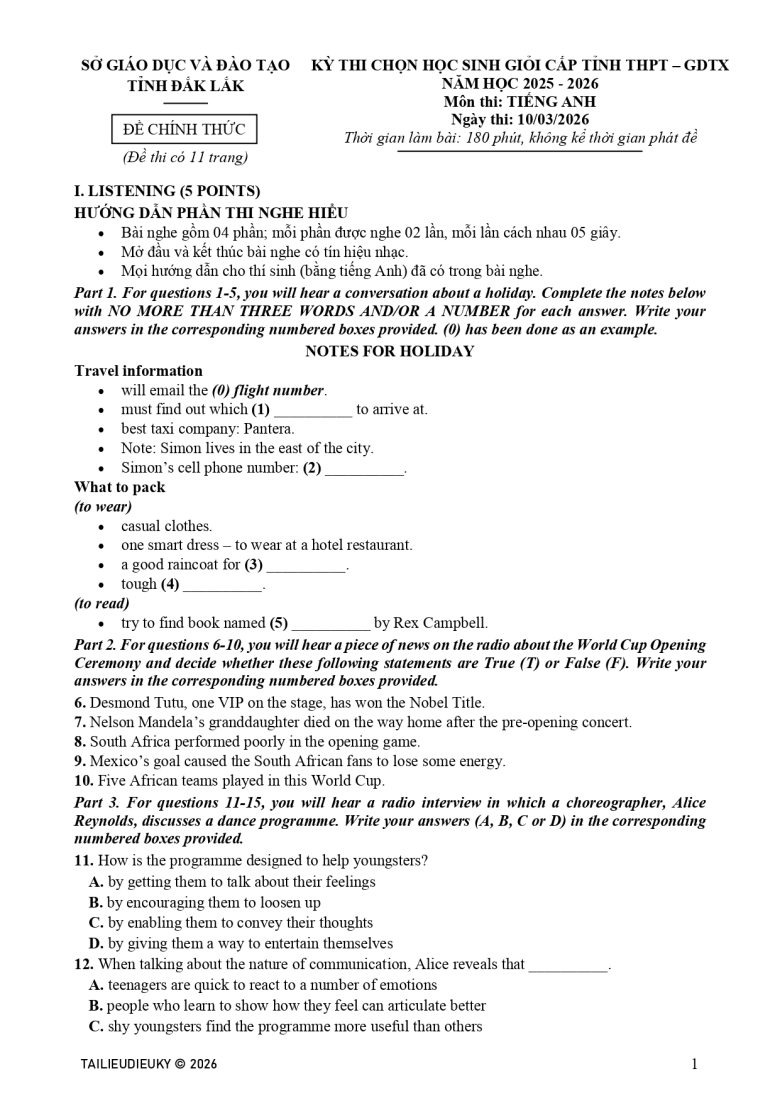
Sáng ngày 10/3, Sở Giáo dục và Đào tạo tỉnh Đắk Lắk đã chính thức tổ chức Kỳ thi chọn học sinh giỏi cấp tỉnh THPT và GDTX năm học 2025–2026. Kỳ thi năm nay ghi nhận con số ấn tượng với 2.779 thí sinh tham gia.
Để hỗ trợ các bạn học sinh và quý thầy cô có thêm nguồn tư liệu ôn tập chất lượng, bám sát cấu trúc đề thi thực tế, tailieudieuky.com xin chia sẻ trọn bộ Đề thi HSG Tiếng Anh 12 tỉnh Đắk Lắk 2025–2026. Tài liệu đi kèm đầy đủ đáp án chi tiết, file nghe (audio) và bản chép lời (transcript).
Tóm tắt cấu trúc đề thi
Đề HSG Tiếng Anh Tỉnh Đắk Lắk 2025–2026 – 180 phút – 11 trang – 4 phần – 100 câu
A. Listening (5.0 điểm)
• Note Completion: 5 câu – 1.0 điểm
• True/False: 5 câu – 1.0 điểm
• Multiple Choice (MCQ): 5 câu – 1.0 điểm
• Gap-filling (1 word): 10 câu – 2.0 điểm
B. Lexico-Grammar (3.0 điểm)
• Multiple Choice (MCQ): 15 câu – 1.5 điểm
• Word Formation: 10 câu – 1.0 điểm
• Error Correction: 5 câu – 0.5 điểm
C. Reading (6.0 điểm)
• Cloze Test (1 word): 10 câu – 1.0 điểm
• Reading Passage 1 (Headings + MCQ + Short Answer): 13 câu – 2.0 điểm
• Reading Passage 2 (Paragraph Matching): 7 câu – 1.5 điểm
• Reading Passage 3 (Matching information): 10 câu – 1.5 điểm
D. Writing (6.0 điểm)
• Sentence Transformation: 5 câu – 1.0 điểm
• Summary Writing (100–120 words): 1 bài – 2.0 điểm
• Essay Writing (~250 words): 1 bài – 3.0 điểm
Link tải file Word đề thi + đáp án + transcript
Hy vọng tài liệu này sẽ là người bạn đồng hành hữu ích giúp các sĩ tử Đắk Lắk nói riêng và cả nước nói chung tự tin chinh phục giải cao trong kỳ thi HSG!
Đáp án
SỞ GIÁO DỤC VÀ ĐÀO TẠO
TỈNH ĐẮK LẮK
(Đề thi có 11 trang) KỲ THI CHỌN HỌC SINH GIỎI CẤP TỈNH THPT – GDTX
NĂM HỌC 2025 – 2026
Môn thi: TIẾNG ANH
Ngày thi: 10/03/2026
Thời gian làm bài: 180 phút, không kể thời gian phát đề
I. LISTENING
1. terminal
2. 07765328411
3. (plenty of) hikes
4. walking shoes
5. Mountain Lives
6. T
7. F
8. F
9. T
10. F
11. C
12. B
13. D
14. A
15. C
16. insects
17. biology
18. pandas
19. rain
20. food
21. talks
22. finger
23. radio
24. teachers
25. China
II. LEXICO-GRAMMAR
Part 1
26. B
27. B
28. A
29. B
30. B
31. A
32. B
33. D
34. A
35. B
36. A
37. B
38. C
39. A
40. B
Part 2
41. gratitude
42. grievances
43. resurfaced
44. confrontational
45. demystify
46. ill-advised
47. profundity / profoundness
48. afterglow
49. imperceptibly
50. shipwrecked
Part 3
51. well good
52. have be
53. may may not
54. other rather
55. jewel jewellery / jewelry
III. READING
Part 1
56. consider / find
57. helping
58. without
59. figured / mapped / planned / laid / worked
60. same
61. domestic
62. Adaptivity
63. equip / program / supply
64. recognize / identify / distinguish
65. ahead
Part 2
66. v
67. ix
68. i
69. vi
70. x
71. A
72. C
73. A
74. C
75. B
76. Horace Walpole
77. fairy tale
78. Sri Lanka
Part 3
79. C
80. E
81. B
82. H
83. F
84. A
85. G
Part 4
86. C
87. A
88. E
89. B
90. E
91. D
92. B
93. A
94. C
95. A
IV. WRITING (6 POINTS)
Part 1. Sentence Transformation
96. It’s common knowledge that Britain’s economy is heavily dependent on North Sea oil.
97. We don’t hold out much hope for the missing climbers.
98. This medicine will not work miracles but it will bring some pain relief.
99. The trouble with Thomas is that he always looks on the dark side of everything.
100. You really put your foot in it when you asked him where his wife was. Didn’t you realize she was dead?
TRANSCRIPTS
Part 1.
Tanya: Hello.
Simon: Hi, is that Tanya?
Tanya: Yes … Simon … lovely to hear you! How are you?
Simon: Very well … and we’re so looking forward to seeing you.
Tanya: So am I.
Simon: Now I don’t have a lot of time, I’m afraid, so I wanted to make sure we’ve got all your details. Have you confirmed your flights?
Tanya: Yes, I’m definitely coming on the twenty-second of June.
Simon: Excellent. Have you got your flight number?
Tanya: Not with me, I’m afraid, but I promise I’ll email it … let me make a note of all this.
Simon: Yes, do, because one of us will try to come and collect you from the airport, if we can. I presume you’ll be coming into Terminal One?
Tanya: Aggh … I don’t know … I’ll have to find out which one it is …
Simon: Yes, you must. We don’t want to wait for the wrong one!
Tanya: But hang on … I’ll be arriving at about lunch time … and that’ll mean you have to take time off work to pick me up. You really mustn’t do that.
Simon: Look … we’re not all that busy at work and if there’s a problem I can text you when you arrive and you can take a taxi.
Tanya: OK.
Simon: There’s a really good company called Pantera.
Tanya: Can you spell that?
Simon: It’s P-A-N-T-E-R-A. They have a stand at the airport … you can’t miss it … and they’re really reliable.
Tanya: Great, thanks … how far are you from the airport?
Simon: About forty minutes.
Tanya: And you’re near the city centre, aren’t you?
Simon: We’re East of it actually … don’t tell the driver city centre because you’ll really get caught up in traffic!
Tanya: OK! And I’ll make sure I carry your address with me. Now have you got my mobile … um … cell phone number?
Simon: Yes, you sent it last month.
Tanya: But I’ll tell you what. I don’t think I’ve got yours. I’d better have it now, just in case.
Simon: OK … and I changed it recently anyway. Ready? It’s zero seven seven six five, three two eight, four double one.
Tanya: Thanks. Now, what should I pack …?
Simon: Well, all the usual … casual clothes mainly. Though you’d better bring an evening dress. We’ll be having at least one fancy dinner at a hotel restaurant. Now, when you’re coming, unfortunately the weather’s not going to be brilliant.
Tanya: I know, it’s the rainy season … I’m bringing an umbrella.
Simon: We have tons of those … so don’t pack one, but pack a raincoat. a good one ‘cause we’ll try and get out for plenty of hikes.
Tanya: OK, sure. Sounds super … just what I love. And I’d better remember to pack my sturdy
walking shoes.
Simon: Excellent idea … it’s pretty rugged round here … so they have to be tough!
Tanya: I can imagine. I’m so looking forward to getting out. Oh Simon, before I forget, you recommended I read a book about your area.
Simon: Yeah.
Tanya: What was the name again? I’d like to read it … to get an idea of the history, etc.
Simon: It’s called ‘Mountain Lives’ and it’s …
Tanya: Hang on … I’m just writing it down … OK.
Simon: … and it’s by Rex Campbell.
Tanya: Great, I’ll try and get hold of that.
Simon: Well worth it.
Tanya: Now the really important things are gifts.
Simon: Oh don’t worry about that. just bring yourself.
Tanya: I know, but I’d like to get something for your parents. What about Janice … I know she loves English tea.
Simon: That’s very kind … but she’s not drinking so much of that these days. But she’d love some chocolate … you know her favourite.
Tanya: Oh yes … that’d be nice … I’ll do that. And Alec? Is he still into racing?
Simon: Very much so.
Tanya: I was thinking of bringing a calendar … you know, with horse-racing pictures.
Simon: What a good idea … he’d love that …
Tanya: Great. So that’s about it, I think.
Simon: Yes, I think so you’ll send me your number.
Part 2.
World Cup Begins. The World Cup began today, the first ever held in Africa. 90,000 fans dressed mostly in the yellow of the South African team packed into the refurbished soccer city in Johannesburg Friday. South Africa played Mexico in the opening game, the first of the 32-nation month-long tournament.
The opening ceremony preceding the game featured celebrated artists such as R. Kelly and South African Trumpeter Hugh Mescala. South African singers and dancers in colorful costumes and body paint also entertained the crowd, and Noble Laureate Desmond Tutu was seen wearing the home team’s colors, dancing in the stands.
Jacob Zuma and Mexican President Felipe Calderon set side by side, each wearing his national team’s scarf.
U.S. Vice President Joe Biden was also among the VIPs in attendance.
Nelson Mandela made a last-minute cancellation to grieve the death of his 13-year-old great-granddaughter,
who was killed in a traffic accident the previous night on her way home from the pre-opening concert. In opening remarks, Jacob Zuma told the crowd the 92-year-old Mandela said he was sad not to be there, but had urged everyone to enjoy Africa’s World Cup.
The South Africa game ended in a 1-1 draw, a respectable showing from the home team, which is not expected to get beyond group play. Sifé Shafbala made the first goal of the game for the home team in the 55th minute, sending the crowd to new heights.
The buzz of the favored vuvuzellas, plastic horns that are South African fans’ favored noise makers, made the stadium sound like the interior of a beehive. Mexico countered with a 77th-minute goal that momentarily subdued the crowd. The South Africa nearly gained control again but posted the shot and had to settle for the draw.
The World Cup is being played in 10 stadiums across South Africa, including Soccer City and Ellis Park in Johannesburg. Five other African teams will join the host country, which automatically qualified, including Ivory Coast, Ghana, Cameroon, Nigeria and Algeria. Italy is the reigning World Cup champion, but Spain is the current European champion, and five-time World Cup winner Brazil is always in contention for the crowd.
Part 3.
Host: Good morning listeners and welcome to “Window on the World.” Today we’re continuing our segment on communication. Yesterday we took a look at music and the way in which we express ourselves through song. Now we’re going to delve into something that’s very closely related and that is the medium of dance.
With us in the studio is Alice Reynolds, a choreographer who has worked with the London Ballet and the Royal Ballet School and is running a project with the local youth center to encourage teenagers to express themselves through dance. Welcome to the show.
Alice: It’s a pleasure to be here.
Host: Why don’t you tell our listeners something about what it is you do?
Alice: Well, as you said, I’m a choreographer. I’ve worked with some amazing dancers through the years and it’s always struck me how well emotions can be portrayed through movement. Even when simply loosening up at a rehearsal, the dancers showed how they were feeling.
Dance has been around centuries. Human cultures have used it throughout that time as a means of communication in ceremonial rites and celebrations as well as entertainment. So we decided to put this unique ability to communicate to good use in helping young people express themselves.
Host: In what way?
Alice: It can be difficult for people, especially young people and teenagers, to talk about how they feel. There can be a number of reasons for that. They may be shy or just simply not be able to find the appropriate words. But for those that can’t find their voice, dance offers a way of getting those feelings out. Whether they are feelings of anger, love, remorse, it doesn’t matter. Dance allows you to express these emotions in a positive way instead of keeping them locked away. And we found that once you can express yourself through movement, it’s easier to open up verbally.
Host: Teenagers are not exactly known for their communication skills.
Alice: No, they can be quite socially awkward. But that’s another side to the dance program we run. It forces them to interact, and by the end of it, they usually come out of their shells. Also, because we don’t suppress emotions—we let them loose—they’re forced to deal with whatever is ailing them, any anxieties they may have. It can be quite cathartic. It’s almost a form of therapy, but without the therapist. It offers a level of freedom unlike anything else. Afterwards, the children seem to be more emotionally well-balanced.
Host: So do you think it would work for anyone?
Alice: Of course. When I worked with professionals, I noted that through their training, no matter what type, they had learned to express their emotions but not betray their personalities. With the teenagers, it was the opposite. We can already see their personalities, but their emotions are suppressed. It was this insight that showed me how effective this venture could be.
Our work with them is designed to bring those emotions out for all to see, and they are recognizable emotions. Dancing conveys subtle messages about what people are thinking and feeling that other people can read. After all, communication is a two-way street. This ability to read these messages is an inherent human trait that has its roots in our evolutionary history. The power of movement to tell a story is quite exceptional.
Host: I suppose there are certain types of people, personalities, that take to dance, find it easy to get up and let loose?
Alice: Actually, it’s not whether someone will dance or how well they dance that’s determined by their personality, but rather how they dance. There was a study conducted to see if you could tell a person’s personality from the way they moved, and the findings were emphatically yes. It seems we can’t hide who we are when we dance. Be we an extrovert, neurotic, conscientious, open-minded or agreeable—it all comes out on the dance floor. Having said that, certain personalities are better able to convey emotion without assistance.
Host: I wonder what my dancing would show. Probably just that I should really have some classes. Well, thank you for taking the time to come in and talk to us.
Alice: Thank you for asking me.
Host: If that has got any of you wanting to put on your dance shoes…
Part 4.
Hello. Thank you for inviting me here to talk to you today.
I’ve wanted to work with animals ever since I was 4 or 5 years old. What really interested me was not looking after cats or dogs like other children, but lying in the long grass watching insects. That interest in nature stayed with me throughout my childhood, and when fairly young, I decided to become a zookeeper.
In order to achieve my aim, I had to work hard to get into university. I did biology, though for my job you can do a variety of different degrees as long as they have some connection with animals. Things like zoology, obviously, and psychology and animal science are fine too.
When you’re appointed as a zookeeper, you generally work with just one species of animal. I worked with the sea lions for a couple of years, but for the last few months I’ve been in charge of the pandas, which is particularly exciting as they’re an endangered species and we have a special breeding program in place.
There are some downsides to being a zookeeper. We sometimes have to work quite long hours, sometimes all night, especially in the hospital when an animal’s sick, but I don’t really mind that as it’s part of the job.
What does get me, however, is the rain. It’s quite hard to make yourself go outside when it’s wet. Even the animals don’t like it.
My typical day usually starts around seven o’clock. I guess the main task I have in the morning is getting the food ready. I don’t clean out the enclosures. Someone else is responsible for that. Then in the afternoon, I write up health reports or assist with any medical procedures.
On Saturdays and Wednesdays, I also do talks, but that’s only in the summer when we have a lot of visitors.
In the winter, it’s obviously much quieter, and I can get more involved in research projects. The animals I look after can be dangerous, so you need to take care when you’re around them.
Early on in my career, a monkey bit my finger, but I only needed a few stitches. Someone else I worked with had his arm bitten by a tiger, so I’ve been lucky. That sort of thing doesn’t happen very often, though.
I’m pleased to say.
I don’t have to carry a stick or anything to protect myself, but what you do have to have with you is a radio,
and if we get on that, someone will come running immediately. It’s always good to know that there are other people around to give you a hand if things get difficult with an animal.
The visitors are usually great, especially the children. The people who do irritate me, though, are sometimes the teachers who bring their class to the zoo. They often don’t spend enough time talking to their pupils,
explaining about each animal. I think they see it as a day out, really. It’s as pity as it’s a missed opportunity, I always think.
As to the future, you do get attached to the animals you’re looking after. So it will be hard for me to leave them at the moment. However, there are a couple of things I might do in the future. I’ve been offered the chance to go to China next spring to see how my animals behave in the wild. There’s also a possibility of going to the USA to work on a breeding project, but that’s not going to happen for a few years yet. I do hope what I’ve told you has given you some insight into what I do. I can definitely recommend being a zookeeper.