
Kỳ thi tuyển sinh vào lớp 10 THPT Chuyên Lê Quý Đôn, tỉnh Lai Châu năm học 2026–2027 được tổ chức nhằm tuyển chọn học sinh có năng lực nổi bật vào các lớp chuyên của nhà trường. Năm nay, Trường THPT Chuyên Lê Quý Đôn được giao 315 chỉ tiêu, tương ứng với 9 lớp chuyên gồm Toán, Vật lí, Hóa học, Sinh học, Ngữ văn, Lịch sử, Tin học và 2 lớp chuyên Tiếng Anh. Đây cũng là môn chuyên có số lớp tuyển sinh nhiều nhất trong kỳ thi năm nay. Nếu đang tìm kiếm Đề Chuyên Anh Lê Quý Đôn, Lai Châu 2026-2027 kèm đáp án chính thức, bạn có thể tham khảo đầy đủ đề thi, cấu trúc và hướng dẫn giải dưới đây.
Đề Chuyên Tiếng Anh tuyển sinh vào lớp 10 tỉnh Lai Châu 2026–2027 – 150 phút – 07 trang – 04 phần – 80 câu
A. Language (4.2 điểm)
+ Phonetics (Phát âm): 5 câu – 0.5 điểm
+ Word Stress (Trọng âm): 5 câu – 0.5 điểm
+ Vocabulary & Grammar (Chọn đáp án): 18 câu – 1.8 điểm
+ Word Formation: 10 câu – 1.0 điểm
+ Error Identification (Tìm lỗi sai): 4 câu – 0.4 điểm
B. Reading (3.0 điểm)
+ Cloze Test 1: 10 câu – 1.0 điểm
+ Cloze Test 2: 10 câu – 1.0 điểm
+ Reading Comprehension: 10 câu – 1.0 điểm
C. Writing (2.8 điểm)
+ Sentence Transformation (Viết lại câu): 8 câu – 0.8 điểm
+ Opinion Paragraph (~200 từ): 1 bài – 2.0 điểm
Theo kế hoạch tuyển sinh của UBND tỉnh Lai Châu, kết quả tuyển sinh và danh sách trúng tuyển sẽ được các đơn vị hoàn thành, phê duyệt trước 15/7/2026. Hy vọng đề thi và đáp án sẽ giúp các em đánh giá chính xác năng lực của mình. Chúc tất cả thí sinh đạt kết quả xuất sắc và sớm trở thành tân học sinh Trường THPT Chuyên Lê Quý Đôn.
Đáp án
UBND TỈNH LAI CHÂU
SỞ GIÁO DỤC VÀ ĐÀO TẠO
(Đề thi có 07 trang) KỲ THI TUYỂN SINH VÀO LỚP 10
NĂM HỌC 2026 – 2027
Môn thi: Tiếng Anh (môn chuyên)
Ngày thi: 26/5/2026
Thời gian làm bài: 150 phút, không kể thời gian phát đề
PART I: PHONETICS
1. A
2. A
3. B
4. B
5. A
6. D
7. A
8. A
9. D
10. C
PART II: VOCABULARY & GRAMMAR
11. A
12. C
13. D
14. A
15. C
16. B
17. A
18. B
19. C
20. C
21. C
22. B
23. A
24. C
25. C
26. C
27. C
28. A
29. unemployment
30. tirelessly
31. effectiveness
32. modernized
33. misbehaved
34. comparatively
35. expressionless
36. mismanagement
37. overworked
38. unreasonable
39. A (are is)
40. A (with for)
41. C (their his/her)
42. A (companion company)
PART III: READING
43. A
44. A
45. C
46. D
47. D
48. B
49. C
50. A
51. D
52. C
53. A
54. D
55. A
56. C
57. A
58. C
59. D
60. C
61. B
62. B
63. B
64. D
65. A
66. B
67. D
68. D
69. A
70. C
71. A
72. A
PART IV: WRITING
73. Such difficult words did the teacher use that no one could understand him.
74. But for his father’s early retirement, Richard wouldn’t have taken over the family business.
75. No sooner had the announcement been made than everyone started complaining.
76. Though he had been extremely tired after the journey, he continued working until midnight.
77. The manager asked her why she had left the office before finishing the report.
78. Colourful T-shirts are known to have been popular during the 1960s.
79. They had the damaged bridge repaired by a professional company last month.
80. That commentator, whose name I’ve forgotten, is very well-known.
UBND TỈNH LAI CHÂU
SỞ GIÁO DỤC VÀ ĐÀO TẠO
(Đề thi có 07 trang) KỲ THI TUYỂN SINH VÀO LỚP 10
NĂM HỌC 2026 – 2027
Môn thi: Tiếng Anh (môn chuyên)
Ngày thi: 26/5/2026
Thời gian làm bài: 150 phút, không kể thời gian phát đề
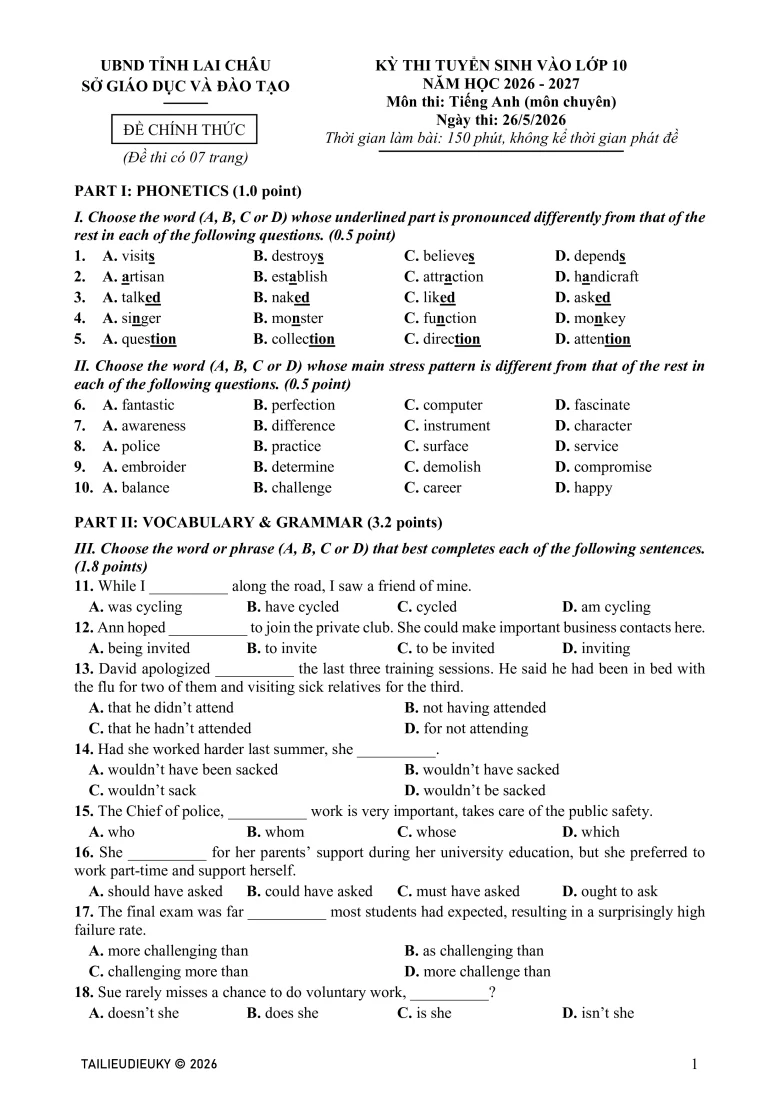
PART I: PHONETICS (1.0 point)
I. Choose the word (A, B, C or D) whose underlined part is pronounced differently from that of the rest in each of the following questions. (0.5 point)
1. A. visits B. destroys C. believes D. depends
2. A. artisan B. establish C. attraction D. handicraft
3. A. talked B. naked C. liked D. asked
4. A. singer B. monster C. function D. monkey
5. A. question B. collection C. direction D. attention
II. Choose the word (A, B, C or D) whose main stress pattern is different from that of the rest in each of the following questions. (0.5 point)
6. A. fantastic B. perfection C. computer D. fascinate
7. A. awareness B. difference C. instrument D. character
8. A. police B. practice C. surface D. service
9. A. embroider B. determine C. demolish D. compromise
10. A. balance B. challenge C. career D. happy
PART II: VOCABULARY & GRAMMAR (3.2 points)
III. Choose the word or phrase (A, B, C or D) that best completes each of the following sentences. (1.8 points)
11. While I __________ along the road, I saw a friend of mine.
A. was cycling B. have cycled C. cycled D. am cycling
12. Ann hoped __________ to join the private club. She could make important business contacts here.
A. being invited B. to invite C. to be invited D. inviting
13. David apologized __________ the last three training sessions. He said he had been in bed with the flu for two of them and visiting sick relatives for the third.
A. that he didn’t attend B. not having attended
C. that he hadn’t attended D. for not attending
14. Had she worked harder last summer, she __________.
A. wouldn’t have been sacked B. wouldn’t have sacked
C. wouldn’t sack D. wouldn’t be sacked
15. The Chief of police, __________ work is very important, takes care of the public safety.
A. who B. whom C. whose D. which
16. She __________ for her parents’ support during her university education, but she preferred to work part-time and support herself.
A. should have asked B. could have asked C. must have asked D. ought to ask
17. The final exam was far __________ most students had expected, resulting in a surprisingly high failure rate.
A. more challenging than B. as challenging than
C. challenging more than D. more challenge than
18. Sue rarely misses a chance to do voluntary work, __________?
A. doesn’t she B. does she C. is she D. isn’t she
19. Park Hang-seo, who is the head coach of __________ Vietnam national football team, is a new idol of many people.
A. ∅ B. a C. the D. an
20. Although he is my friend, I find it hard to __________ his selfishness.
A. keep up with B. come down with C. put up with D. catch up with
21. Older people rarely approve __________ habits of the younger generation.
A. for B. to C. of D. with
22. __________ the TRUMPET is the smallest brass instrument, it can play the highest notes of all the brass instruments and often plays in marches or fanfares.
A. Because B. Although C. However D. Since
23. __________ one cigarette when he reached for the packet and took another.
A. Hardly had he finished B. Only he had finished
C. Not only he had finished D. He had finished hardly
24. We regret __________ passengers that all flights have been cancelled due to bad weather.
A. informing B. having informed C. to inform D. to informing
25. I’m sorry I haven’t got any money on me. I wish __________.
A. I have got no money on me B. I have some money on me
C. I had some money on me D. I had got no money on me
26. The day their first child was born, the new parents were __________ with joy.
A. overpowered B. overtaken C. overcome D. overthrow
27. Students were like __________ with two tails after hearing their demanding final examinations had been unexpectedly postponed.
A. horses B. ducks C. dogs D. cats
28. If you go on __________ me like this, I will never be able to finish writing my report.
A. disturbing B. afflicting C. concerning D. affecting
IV. Give the correct form of the word in brackets to complete each of the following sentences. (1.0 point)
29. The government is going to introduce measures aimed at reducing the level of __________ in the country. (EMPLOY)
30. Yvonne has been working __________ to get the presentation ready for tomorrow. (TIRE)
31. I don’t doubt the __________ of this new gadget, but we simply don’t have the money to buy it. (EFFECT)
32. Some designers have __________ the ao dai by printing lines of poetry. (MODERN)
33. The teacher warned the children that if they __________ again, they’d be punished. (BEHAVE)
34. Things in this shop are __________ cheaper than those in other shops. (COMPARE)
35. She stood there completely __________, so I had no idea at all what she was thinking. (EXPRESSION)
36. The company is being investigated for __________ of funds that appear to have been used inappropriately. (MANAGE)
37. Unfortunately, a lot of nurses are __________ because the hospitals are short-staffed. (WORK)
38. I think it is very __________ of him to expect us to work overtime every night this week. (REASON)
V. Mark the letter A, B, C or D on your answer sheet to indicate the underlined part that needs correction in each of the following questions. (0.4 point)
39. Protecting Earth’s rainforests are important because they are unique habitats for millions of plant and animal species.
A. are B. for C. and D. species
40. You’ll have to make allowances with him because he is new at the job, and everyone needs time to adjust.
A. with B. because C. at the job D. to adjust
41. All the judges paid the dancer compliments on their excellent performance in the competition.
A. All B. paid C. their D. in
42. Germany, in companion with France, has now lifted the ban on the export of live animals to Europe.
A. companion B. has C. lifted D. export
PART III: READING (3.0 points)
VI. Read the following passage and mark the letter A, B, C or D on your answer sheet to indicate the correct option that best fits each of the numbered blanks from 43 to 52. (1.0 point)
Social media is often described as a harmful influence on individuals and society. This perception is reinforced by frequent warnings (43) __________. While these dangers are real, (44) __________ of social media and the role of user behavior. Social media platforms themselves are not inherently harmful; rather, (45) __________.
In a world with billions of people and limited opportunities for direct interaction, social media has become a primary (46) __________ beyond one’s immediate environment. Similar to how children’s books convey lessons through stories, digital content shapes attitudes and beliefs through repeated exposure. (47) __________. Feeds filled with conflict, comparison, or negativity may contribute to negative perceptions, while content focused on learning, creativity, or personal development can (48) __________.
(49) __________. Algorithms prioritize content based on previous interactions, meaning that engagement with certain topics increases their visibility. By intentionally following positive social connections, goal-oriented individuals, inspirational figures, and constructive entertainment sources, (50) __________. When used deliberately, social media can provide access to information, motivation, and opportunities aligned with personal and professional goals. (51) __________, but the way it is consumed and curated. Responsible and mindful use allows social media to function as a (52) __________ rather than a negative influence.
(Adapted from Pathways)
43.
A. that emphasize risks such as misinformation, online harassment, or exploitation
B. about some issues that are misinformed and exploited the online harassment
C. that online harassment and exploitation should be emphasized to reduce the risks
D. the possibility of being misinformed, facing online harassment, or being exploited
44.
A. focusing solely on negative outcomes overlooks the broader function
B. focusing solely on negative outcomes overlook the broader function
C. focused solely on negative outcomes overlooks the broader function
D. focusing solely at negative outcomes overlooks the broader function
45.
A. the type of content depends on how the users choose to engage with the impact of social media
B. the users choose to engage with the type of content which depends on the impact of social media
C. their impact depends on how they are used and the type of content users choose to engage with
D. the social media engages with the type of content which users depend on and choose to use
46.
A. paths of learning about perspectives B. ways of learning about perspectives
C. tracks of learning about perspectives D. means of learning about perspectives
47.
A. Therefore, how they perceive the world influences on the content that dominates an individual’s online feed.
B. However, the influence of the fact that how they perceive the world dominates an individual’s online feed.
C. Additionally, an individual’s online feed dominates the content that influences how they perceive the world.
D. As a result, the content that dominates an individual’s online feed can influence how they perceive the world.
48.
A. encouraging more destructive thinking B. encourage more constructive thinking
C. encourages more critical thinking D. encourage more pessimistic thinking
49.
A. The design of social media and the user choice are quite important to highlight the platform.
B. The social media platforms highlight the further choice of users, which is quite important.
C. The design of social media platforms further highlights the importance of user choice.
D. The important choice of users further highlights the design of social media platforms.
50.
A. users can shape a more beneficial online experience
B. benefits of online experience can shape users’ behavior
C. shaping users’ online experience can be beneficial
D. the online experience shapes the benefits users receive
51.
A. Additionally, the issue is not social media itself
B. Moreover, the issue is not social media itself
C. Consequently, the issue is not social itself media
D. Therefore, the issue is not social media itself
52.
A. a productively and supportively tool B. a production and support tool
C. a productive and supportive tool D. a productive and supportively tool
VII. Read the following passage and mark the letter A, B, C or D on your answer sheet to indicate the correct option that best fits each of the numbered blanks from 53 to 62. (1.0 point)
A POWERFUL INFLUENCE
There is no doubt at all that the Internet has made a huge difference to our lives. (53) __________, most parents worry that their children spend too much time browsing the Internet or playing computer games, hardly (54) __________ doing anything else in their spare time. Naturally, parents are curious to find out why the Internet is so attractive, and they want to know if it can be harmful for their children. Should parents worry if their children are spending that much time (55) __________ their computers.
Obviously, if children are bent over their computers for hours, absorbed (56) __________ some game, instead of doing their homework, then something is wrong. Parents and children could decide how much use the child should make of the Internet, and the child should give his or her (57) __________ that it won’t interfere with homework. If the child is not holding to this arrangement, parents can (58) __________ more drastic steps. Dealing with a child’s use of the Internet is not much different from negotiating any other sort of bargain about behaviour.
Any parents (59) __________ is seriously alarmed about a child’s behaviour should make an appointment to discuss the matter with a teacher. Spending time in front of a computer screen does not necessarily affect a child’s (60) __________ at school. Even if a child is (61) __________ crazy about using the Internet, he or she is probably just going through a phase, and in (62) __________ months there will be something else to worry about!
(Adapted from CAE Practice Tests by Mark Harrison & Rosalie Kerr © Oxford, Paper 3 – Part 1)
53. A. However B. Therefore C. Consequently D. Moreover
54. A. always B. rarely C. never D. ever
55. A. staring at B. glancing at C. looking D. watching
56. A. with B. for C. in D. about
57. A. word B. promise C. vow D. claim
58. A. get B. keep C. take D. use
59. A. whom B. which C. whose D. who
60. A. perform B. performer C. performance D. performing
61. A. more B. absolutely C. quite D. a lot
62. A. few B. a few C. little D. a little
VIII. Read the following passage and mark the letter A, B, C or D on your answer sheet to indicate the correct answer to each of the questions from 63 to 72. (1.0 point)
Early peoples had no need of engineering works to supply their water. Hunters and nomads camped near natural sources of fresh water, and populations were so sparse that pollution of the water supply was not a serious problem. After community life developed and agricultural villages became urban centers, the problem of supplying water became important for inhabitants of a city, as well as for irrigation of the farms surrounding the city. Irrigation works were known in prehistoric times, and before 2000 BC the rulers of Babylonia and Egypt constructed systems of dams and canals to impound the flood waters of the Euphrates and Nile rivers, controlling floods and providing irrigation water throughout the dry season. Such irrigation canals also supplied water for domestic purposes. The first people to consider the sanitation of their water supply were the ancient Romans, who constructed a vast system of aqueducts to bring the clean waters of the Apennine Mountains into the city and built basins and filters along these mains to ensure the clarity of the water. The construction of such extensive water-supply systems declined when the Roman Empire disintegrated, and for several centuries local springs and wells formed the main source of domestic and industrial water.
The invention of the force pump in England in the middle of the 16th century greatly extended the possibilities of development of water-supply systems. In London, the first pumping waterworks was completed in 1562; it pumped river water to a reservoir about 37 m above the level of the River Thames and from the reservoir the water was distributed by gravity, through lead pipes, to buildings in the vicinity. Increased per-capita demand has coincided with water shortages in many countries. Southeast England, for example, receives only 14 per cent of Britain’s rainfall, has 30 per cent of its population, and has experienced declining winter rainfall since the 1980s.
In recent years a great deal of interest has been shown in the conversion of seawater to fresh water to provide drinking water for very dry areas, such as the Middle East. Several different processes, including distillation, electrodialysis, reverse osmosis, and direct-freeze evaporation, have been developed for this purpose. Some of these processes have been used in large facilities in the United States. Although these processes are successful, the cost of treating seawater is much higher than that for treating fresh water.
(From A. Briggs’ article on culture, Microsoft® Student 2008)
63. The word disintegrated in paragraph 1 is closest in meaning to __________.
A. emerged B. failed C. distorted D. thrived
64. What does the passage mainly discuss?
A. the water pumping system B. the fresh water shortage
C. the results of water shortages D. the development of water supply
65. According to the passage, which of the following can be inferred about London’s water supply in the middle of the 16th century?
A. It was facilitated since the advent of the force pump.
B. It contributed to the River Thames’ flow considerably.
C. It was conducted through canals.
D. It circulated throughout the buildings.
66. Which of the following is NOT mentioned as a process of conversing seawater to freshwater?
A. purification method B. dissolving chemicals
C. water evaporation D. streaming and cooling
67. The word impound in paragraph 1 is opposite in meaning to __________.
A. supply B. irrigate C. provide D. release
68. Early peoples didn’t need water supply engineering works because __________.
A. they had good ways to irrigate their farms
B. their community life had already developed
C. there was almost no dry season in prehistoric times
D. natural sources of fresh water nearby were always available
69. The word that in the last paragraph refers to __________.
A. the cost B. treating seawater C. the United States D. this purpose
70. Clean water supply was first taken into consideration by __________.
A. the US people B. the English people
C. the ancient Romans D. the Egyptians
71. For several centuries after the disintegration of the Roman Empire, the main source of water supply was from __________.
A. springs and wells B. water pipes
C. dams and canals D. systems of aqueducts
72. Which of the following is NOT true about London’s water supply in the middle of the 16th century?
A. Water was conducted through canals. B. Water ran from the reservoir to buildings.
C. Water was stored in a reservoir. D. Water was pumped from the River Thames.
PART IV: WRITING (2.8 points)
IX. Rewrite the sentences below in such a way that their meanings stay the same. You must use the words in capital without changing their forms. (0.8 point)
73. The teacher used such difficult words that no one could understand him. (DID)
Such ______________________________________________ that no one could understand him.
74. Richard only took over the family business because his father decided to retire early. (RETIREMENT)
But for _______________________________________________________ the family business.
75. Everyone started complaining the moment the announcement was made. (MADE)
No sooner _____________________________________________ everyone started complaining.
76. Despite being extremely tired after the journey, he continued working until midnight. (BEEN)
Though ___________________________________________________________ until midnight.
77. “Why did you leave the office before finishing the report?” the manager asked her. (LEFT)
The manager asked _____________________________________________________ the report.
78. It is known that colourful T-shirts were popular during the 1960s. (HAVE)
Colourful T-shirts _________________________________________________ during the 1960s.
79. They asked a professional company to repair the damaged bridge last month. (REPAIRED)
They ________________________________________________________________ last month.
80. I’ve forgotten that commentator’s name but he’s very well-known. (WHOSE)
That commentator, _____________________________________________, is very well-known.
X. Write a paragraph (about 200 words) on the following topic. (2.0 points)
Do you agree or disagree with the following statement?
“Fast food is becoming a part of our daily life. Some people argue that fast food has negative effects on our lifestyle and diet.”
Write about 200 words to support your opinion (and do not include your personal information).
———- THE END ———-