
Vừa qua, vào tháng 3/2026, Sở Giáo dục và Đào tạo Thái Nguyên đã tổ chức Kỳ thi chọn học sinh giỏi cấp tỉnh lớp 9 năm học 2025–2026. Đây là một trong những kỳ thi quan trọng nhằm đánh giá năng lực học sinh THCS trên toàn tỉnh, đặc biệt ở môn Tiếng Anh.
Dưới đây là Đề thi HSG Tiếng Anh 9 cấp tỉnh Thái Nguyên 2025–2026 kèm đáp án chính thức, được tổng hợp đầy đủ bởi Tài liệu Diệu Kỳ, bao gồm file Word, audio bài nghe và transcript chi tiết, hỗ trợ ôn luyện hiệu quả.
📚 Cấu trúc đề thi HSG Tiếng Anh 9 Thái Nguyên 2025–2026
Thời gian: 150 phút | Số trang: 10 | Gồm 5 phần | Tổng: 100 câu
A. Listening (4.0đ): Nghe hiểu 3 phần – MCQ hội thoại (5c) – MCQ bài giảng (5c) – điền thông tin/form (10c)
B. Phonetics (1.0đ): Chọn từ phát âm khác (5c)
C. Lexico–Grammar (5.0đ): MCQ ngữ pháp (10c) – Word form (5c) – Sửa lỗi (5c) – Giới từ/particle (5c)
D. Reading (4.8đ): Cloze test MCQ (7c) – Điền từ (7c) – T/F/NG (5c) – Đọc hiểu MCQ (6c)
E. Writing (3.2đ): Viết lại câu (13c) – Biến đổi từ gợi ý (12c) – Viết đoạn luận 180–200 từ (1 bài)
📥 Tải xuống đề thi + đáp án chính thức
📥 Đề HSG Anh 9 Thái Nguyên 2025
Hy vọng Đề thi HSG Tiếng Anh 9 cấp tỉnh Thái Nguyên 2025-2026 có đáp án sẽ là một “trợ thủ” đắc lực giúp các sĩ tử ôn luyện hiệu quả, tự tin bước vào các kỳ thi học sinh giỏi sắp tới cũng như kỳ thi vào lớp 10 Chuyên Anh.
Đáp án chính thức
📘 SECTION A. LISTENING (4 points)
1. B
2. B
3. A
4. D
5. B
6. C
7. D
8. A
9. B
10. D
11. 📌 passport photos
12. 🏦 bank statement
13. 125
14. 8
15. 1.50
16. 48
17. 📰 local papers
18. 💳 a card
19. Grantingham
20. Friday
________________________________________
🔤 SECTION B. PHONETICS (1 point)
21. C
22. B
23. D
24. D
25. B
________________________________________
📚 SECTION C. LEXICO AND GRAMMAR (5 points)
26. D
27. C
28. A
29. D
30. B
31. C
32. C
33. B
34. B
35. B
36. increasingly
37. organisations
38. discourage
39. disappearance
40. choice
41. to feel → feeling
42. but → and
43. doing → earning / making
44. materialistically → materialistic
45. that → what
46. over / about
47. against
48. out
49. under
50. into
________________________________________
📖 SECTION D. READING COMPREHENSION
51. B including
52. D rather
53. C grown
54. A often
55. C come
56. C While
57. B sets off
58. so
59. to
60. of
61. be
62. who
63. in
64. from
65. NOT GIVEN
66. TRUE
67. FALSE
68. FALSE
69. TRUE
70. A
71. A
72. B
73. D
74. D
75. A
________________________________________
✍️ SECTION E. WRITING
76. I prefer talking calmly to arguing.
77. Except for Jenny, Mark has no real friend.
78. Rather than take the things back to the shop, he decided to repair them himself.
79. But for his father’s retirement, John would not have taken over the family business.
80. Hard as his mother tried, she could not convince him.
81. Heart disease is thought to be caused by eating the wrong things.
82. It wasn’t as easy to find a place to park the car as I thought it would be.
83. Bob will go to any lengths to get an A in this class.
84. I now wish I had paid attention to the teacher during my English lessons.
85. I’d rather you had kept my news secret instead of telling everyone.
86. This project is by far the most interesting one that I’ve ever had.
87. Many companies fail to take full advantage of their marketing opportunities.
88. Frank had no choice but to move to the capital because of the lack of work in his home area.
________________________________________
📝 Paragraph Writing
The mark given to this part is based on the following criteria:
1. Task achievement
a. All requirements of the task are sufficiently addressed.
b. Ideas are adequately supported and elaborated with relevant and reliable explanations, examples, evidence, personal experience, etc.
2. Organization
a. Ideas are well/logically organized and presented with coherence, cohesion, and unity.
b. The paragraph is well-structured:
• The topic sentence is presented with a clear statement introducing the points to be developed.
• The supporting sentences, with explanations and examples when necessary, develop the points introduced with unity, coherence, and cohesion.
• The conclusion summarises the main points and offers personal opinions (prediction, recommendation, consideration, …) on the topic.
3. Language use
a. Demonstration of a variety of topic-related vocabulary, using vocabulary in correct context, meaning and form.
b. Excellent use and control of grammatical structures.
4. Punctuation, spelling, and handwriting
a. Correct punctuation and no spelling mistakes.
b. Legible handwriting.
________________________________________
📊 Total: 100 questions x 0.2 points = 20 points
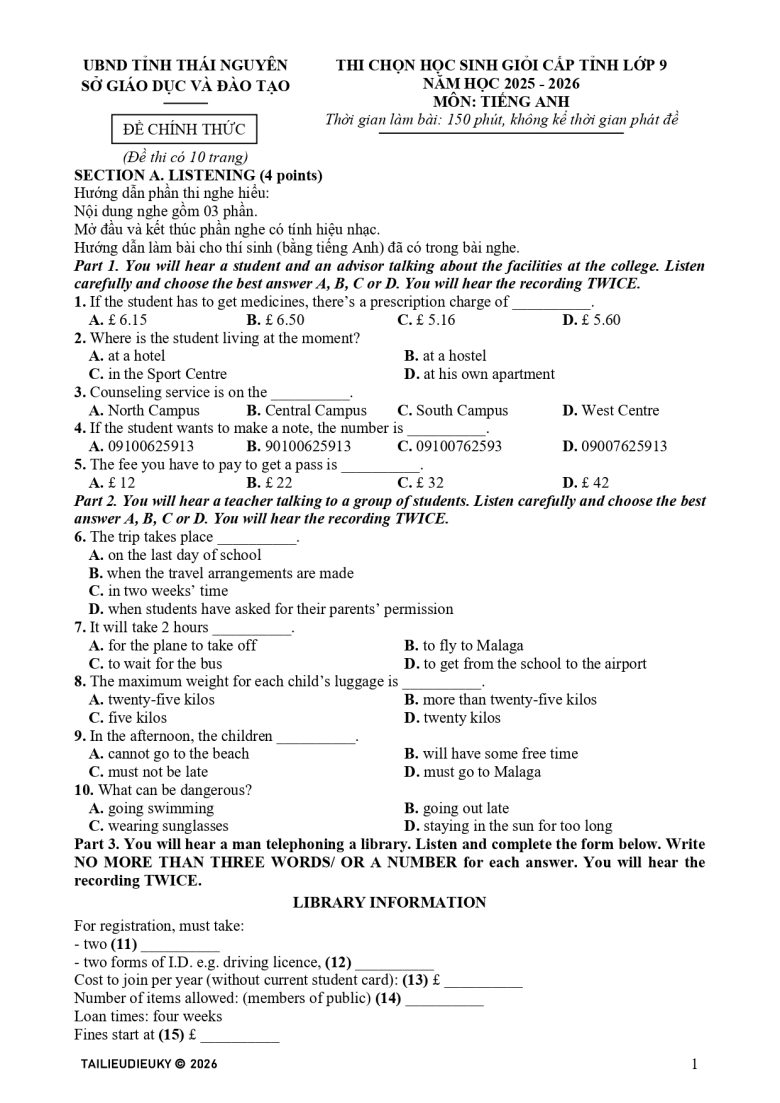
UBND TỈNH THÁI NGUYÊN
SỞ GIÁO DỤC VÀ ĐÀO TẠO
(Đề thi có 10 trang) THI CHỌN HỌC SINH GIỎI CẤP TỈNH LỚP 9
NĂM HỌC 2025 – 2026
MÔN: TIẾNG ANH
Thời gian làm bài: 150 phút, không kể thời gian phát đề
SECTION A. LISTENING (4 points)
Hướng dẫn phần thi nghe hiểu:
Nội dung nghe gồm 03 phần.
Mở đầu và kết thúc phần nghe có tính hiệu nhạc.
Hướng dẫn làm bài cho thí sinh (bằng tiếng Anh) đã có trong bài nghe.
Part 1. You will hear a student and an advisor talking about the facilities at the college. Listen carefully and choose the best answer A, B, C or D. You will hear the recording TWICE.
1. If the student has to get medicines, there’s a prescription charge of __________.
A. £ 6.15 B. £ 6.50 C. £ 5.16 D. £ 5.60
2. Where is the student living at the moment?
A. at a hotel B. at a hostel
C. in the Sport Centre D. at his own apartment
3. Counseling service is on the __________.
A. North Campus B. Central Campus C. South Campus D. West Centre
4. If the student wants to make a note, the number is __________.
A. 09100625913 B. 90100625913 C. 09100762593 D. 09007625913
5. The fee you have to pay to get a pass is __________.
A. £ 12 B. £ 22 C. £ 32 D. £ 42
Part 2. You will hear a teacher talking to a group of students. Listen carefully and choose the best answer A, B, C or D. You will hear the recording TWICE.
6. The trip takes place __________.
A. on the last day of school
B. when the travel arrangements are made
C. in two weeks’ time
D. when students have asked for their parents’ permission
7. It will take 2 hours __________.
A. for the plane to take off B. to fly to Malaga
C. to wait for the bus D. to get from the school to the airport
8. The maximum weight for each child’s luggage is __________.
A. twenty-five kilos B. more than twenty-five kilos
C. five kilos D. twenty kilos
9. In the afternoon, the children __________.
A. cannot go to the beach B. will have some free time
C. must not be late D. must go to Malaga
10. What can be dangerous?
A. going swimming B. going out late
C. wearing sunglasses D. staying in the sun for too long
Part 3. You will hear a man telephoning a library. Listen and complete the form below. Write NO MORE THAN THREE WORDS/ OR A NUMBER for each answer. You will hear the recording TWICE.
LIBRARY INFORMATION
For registration, must take:
– two (11) __________
– two forms of I.D. e.g. driving licence, (12) __________
Cost to join per year (without current student card): (13) £ __________
Number of items allowed: (members of public) (14) __________
Loan times: four weeks
Fines start at (15) £ __________
Computers can be booked up to (16) __________ hours in advance
Library holds most national papers, all (17) __________, and magazines
Need (18) __________ to use photocopier
Creative Writing Class
• Tutor: John (19) __________
• Held on (20) __________ evenings
SECTION B. PHONETICS (1 point)
Choose the word whose underlined part is pronounced differently from that of the rest.
21. A. walked B. finished C. played D. washed
22. A. stomach B. church C. toothache D. chemistry
23. A. coordinate B. subordinate C. exorbitant D. elaborate
24. A. chimpanzee B. interviewee C. refugee D. committee
25. A. kite B. Christian C. bite D. Christ
SECTION C. LEXICO AND GRAMMAR (5 points)
Part 1. Choose the word, phrase or expression A, B, C, or D which best completes each sentence.
26. Bill’s mother won’t let him go out with his friends __________.
A. when he finished his homework B. after he had finished his homework
C. once he finished his homework D. until he has finished his homework
27. I remember __________ of his problem when it happened.
A. to be informed B. to inform C. being informed D. having informed
28. By the time you finish cooking, they __________ their homework.
A. will have finished B. will finish C. had finished D. have finished
29. Three-fifths of the police __________ in the school near the town.
A. has trained B. have trained C. has been trained D. have been trained
30. __________ any employee be ill, they must call the office to inform their head of departure.
A. Were B. Should C. Had D. If
31. These two boys look identical. They __________ twins.
A. must have been B. should be C. must be D. should have been
32. It is necessary that children __________ of their old parents in their culture.
A. takes care B. to take care C. take care D. took care
33. I would like to have __________ sports shoes to run in the park.
A. a grey medium leather comfortable B. comfortable medium grey leather
C. comfortable leather grey medium D. medium leather comfortable grey
34. We’re over the __________! Who wouldn’t be? We’ve just won the scholarship to study abroad!
A. planet B. moon C. stars D. clouds
35. Six novels a year, you say? He’s certainly a __________ writer.
A. fruitful B. prolific C. virile D. fertile
Part 2. Use the correct form of the words in brackets to complete the passage.
Even in fairly traditional communities, dietary habits are evolving. In the past, people often prepared good filling meals using fresh ingredients and whatever was easily found at local markets. Nowadays, however, convenience food is becoming (36. INCREASE) __________ popular.
Studies indicate that consuming certain kinds of food too frequently can lead to health issues. As a result, governments and other (37. ORGANISE) __________ now provide guidance on healthy eating and nutrition in the hope that it will (38. COURAGE) __________ people from consuming too much of the same food and encourage them to maintain a more balanced diet.
On the other hand, some people claim that despite the (39. APPEAR) __________ of many traditional dishes from modern menus, overall, our diets are less monotonous than they were in the past. There is now a much greater (40. CHOOSE) __________ of goods available in supermarkets and grocery stores than there was two decades ago.
Part 3. There are FIVE mistakes in the passage. Find and correct them. The first one has been done as an example.
For example: much many
Everyday life today is much more complicated than it was in the past. Even in our leisure time we have to make so much choices about what to do or even what to watch on TV. We are often spoilt for choice and this can leave us to feel confused and dissatisfied. We all know that it is important to achieve a balance between work but play, yet many of us do not succeed. We put extra pressure on ourselves trying to be as successful in our work life as in our personal life.
Life in the past was much simpler as many people worked to meet their basic needs. Today, our job is not just a way of doing a living. Work plays an important role in our everyday life and gives us a strong sense of personal fulfillment. What’s more, we have become much more materialistically. We always want to buy new houses and cars, and we usually measure our success by the material things we own. Desiring these luxuries is that motivates us to work much harder than in the past, so in many ways we choose this way of life.
Part 4. Fill in each of the following blanks with a correct preposition or particle.
46. We quarreled __________ the choice of a house.
47. Using your cell phone while driving is __________ the law.
48. I’m afraid we have run __________ of apple juice. Will orange juice do?
49. The camera is __________ guarantee, so Mr. Brown will bring it back to the shop.
50. I got __________ the habit of doing exercise in the morning.
SECTION D. READING COMPREHENSION (4.8 points)
Part 1. Read the following passage and decide which answer, A, B, C or D, best fits each gap. Write your answers in the numbered boxes.
A rising number of school students are turning to the Internet to increase their pocket money by selling clothes and fashion accessories online. One shopping platform now has over seven million users across the globe, (51) __________ many ambitious under-18s who have decided they would (52) __________ work for themselves than take a part-time position in a shop or café.
Sixteen-year-old Eva Laidlaw, who has (53) __________ up in a family of successful entrepreneurs, purchases second-hand clothing and then resells it through the app, more (54) __________ than not, at a reasonable profit. “I usually get my stock from charity shops and car boot sales,” she explains. “You can (55) __________ across high-quality pieces if you’re prepared to spend time searching.”
Katie Simmons is another teenage business owner. (56) __________ on vacation in Tuscany three years ago, she realised that clothes sold at the local markets were incredibly inexpensive. As a result, every two months, Katie, who is now eighteen, (57) __________ for Italy to look for items she believes will sell well back home. “I had planned to go to university,” Katie says, “but now I have a company to manage.”
51. A. containing B. including C. consisting D. involving
52. A. better B. prefer C. like D. rather
53. A. turned B. brought C. grown D. lived
54. A. often B. frequently C. regularly D. ever
55. A. get B. discover C. come D. locate
56. A. Whereas B. Whenever C. While D. Whether
57. A. goes away B. sets off C. carries on D. catches up
Part 2. Fill in the gap with ONE suitable word. Write the answers in the corresponding numbered boxes.
Nowadays, many people are questioning whether they need quite (58) __________ much stuff in their homes, from old jackets long forgotten at the back of wardrobes (59) __________ bulky gadgets filling up kitchen cupboards. They believe that by disposing (60) __________ unnecessary items and reducing general clutter, their general state of mind will improve.
If the thought of starting the “decluttering” process seems overwhelming, the advice offered online may (61) __________ helpful. Minimalist bloggers suggest, for example, that people start with one area that particularly bothers them, and visualise what they want it to look like. Alternatively, for those (62) __________ can afford it, there is the option of hiring a professional declutterer.
Because it is easy to give (63) __________ to temptation when out shopping, some bloggers suggest setting a weekly budget, so no new items are bought on impulse. Some approach can certainly deter people (64) __________ living beyond their means. And since it is often compulsive spending which leads to debt, cutting up the credit card is also recommended.
Part 3. Read the text and answer questions 65-69.
The amount of time people spend watching television is astonishing. On average, individuals in the industrialized world devote three hours a day to the pursuit – fully half of their leisure time, and more than on any single activity save work and sleep. At this rate, someone who lives to 75 would spend nine years in front of the tube. To some commentators, this devotion means simply that people enjoy TV and make a conscious decision to watch it. But if that is the whole story, why do so many people experience misgivings about how much they view? In Gallup polls in 1992 and 1999, two out of five adult respondents and seven out of 10 teenagers said they spent too much time watching TV. Other surveys have consistently shown that roughly 10 percent of adults call themselves TV addicts.
To study people’s reactions to TV, researchers have undertaken laboratory experiments in which they have monitored the brain waves (using an electroencephalograph, or EEG) to track behavior and emotion in the normal course of life, as opposed to the artificial conditions of the lab. Participants carried a beeper, and we signaled them six to eight times a day, at random, over the period of a week; whenever they heard the beep, they wrote down what they were doing and how they were feeling using a standardized scorecard.
As one might expect, people who were watching TV when we beeped them reported feeling relaxed and passive. The EEG studies similarly show less mental stimulation, as measured by alpha brain-wave production, during viewing than during reading. What is more surprising is that the sense of relaxation ends when the set is turned off, but the feelings of passivity and lowered alertness continue. Survey participants say they have more difficulties concentrating after viewing than before. In contrast, they rarely indicate such difficulties after reading. After playing sports or engaging in hobbies, people report improvements in mood. After watching TV, people’s moods are about the same or worse than before. That may be because of viewers’ vague learned sense that they will feel less relaxed if they stop viewing. So they tend not to turn the set off. Viewing begets more viewing which is the same as the experience of habit-forming drugs. Thus, the irony of TV: people watch a great deal longer than they plan to, even though prolonged viewing is less rewarding. In our ESM studies the longer people sat in front of the set, the less satisfaction they said they derived from it. For some, a twinge of unease or guilt that they aren’t doing something more productive may also accompany and depreciate the enjoyment of prolonged viewing. Researchers in Japan, the U.K. and the U.S. have found that this guilt occurs much more among middle-class viewers than among less affluent ones.
Questions 65-69.
Do the following statements agree with the information given in the text?
In boxes 65-69, write
TRUE if the statement is true
FALSE if the statement is false
NOT GIVEN if the information is not given in the passage
65. Study shows that males are more likely to be addicted to TV than females.
66. TV addiction works in similar ways as drugs.
67. Greater improvements in mood are experienced after watching TV than playing sports.
68. It is reported that people’s satisfaction is in proportion to the time they spend watching TV.
69. Middle-class viewers are more likely to feel guilty about watching TV than the poor.
Part 4. Read the following passage and choose the letter A, B, C or D to indicate the correct answer to each of the questions.
The Native Americans of northern California were highly skilled at basketry, using the reeds, grasses, barks, and roots they found around them to fashion articles of all sorts and sizes – not only trays, containers, and cooking pots, but hats, boats, fish traps, baby carriers, and ceremonial objects.
Of all these experts, none excelled the Pomo – a group who lived on or near the coast during the 1800’s, and whose descendants continue to live in parts of the same region to this day. They made baskets three feet in diameter and others no bigger than a thimble. The Pomo people were masters of decoration. Some of their baskets were completely covered with shell pendants; others with feathers that made the baskets’ surfaces as soft as the breasts of birds. Moreover, the Pomo people made use of more weaving techniques than did their neighbors. Most groups made all their basketwork by twining – the twisting of a flexible horizontal material, called a weft, around stiffer vertical strands of material, the warp. Others depended primarily on coiling – a process in which a continuous coil of stiff material is held in the desired shape with tight wrapping of flexible strands. Only the Pomo people used both processes with equal ease and frequency. In addition, they made use of four distinct variations on the basic twining process, often employing more than one of them in a single article.
Although a wide variety of materials was available, the Pomo people used only a few. The warp was always made of willow, and the most commonly used weft was sedge root, a woody fiber that could easily be separated into strands no thicker than a thread. For color, the Pomo people used the bark of redbud for their twined work and dyed bullrush root for black in coiled work. Though other materials were sometimes used, these four were the staples in their finest basketry.
If the basketry materials used by the Pomo people were limited, the designs were amazingly varied. Every Pomo basketmaker knew how to produce from fifteen to twenty distinct patterns that could be combined in a number of different ways.
70. The Pomo people used each of the following materials to decorate baskets EXCEPT __________.
A. leaves B. shells C. feathers D. bark
71. In paragraph 2, the discussion of twining and coiling primarily serves to __________.
A. contrast Pomo practices with those of neighboring groups
B. define technical terminology for specialists
C. illustrate the historical development of weaving
D. question the superiority of Pomo craftsmanship
72. The word others in paragraph 2 refers to __________.
A. masters B. baskets C. pendants D. surfaces
73. According to the passage, the relationship between redbud and twining is most similar to the relationship between __________.
A. weft and warp B. willow and feathers
C. sedge and weaving D. bullrush and coiling
74. The word staples in paragraph 3 is closest in meaning to __________.
A. combinations B. limitations C. accessories D. basic elements
75. Which of the following statements about Pomo baskets can be best inferred from the passage?
A. Baskets produced by other Native Americans were less varied in design than those of the Pomo people.
B. Baskets produced by Pomo weavers were primarily for ceremonial purposes.
C. There were a very limited number of basketmaking materials available to the Pomo people.
D. The basketmaking production of the Pomo people has increased over the years.
SECTION E. WRITING (3.2 points)
Part 1. Finish each of the following sentences in such a way that it means the same as the sentence printed before it.
Example: He started to play the guitar five years ago.
He has been playing the guitar for five years.
76. In my opinion, it’s better to talk calmly than to argue.
I prefer _______________________________________________________________________
77. Jenny is the only real friend that Mark has.
Except ________________________________________________________________________
78. He decided to repair the things himself and not to take them back to the shop.
Rather than ____________________________________________________________________
79. John only took over the family business because his father decided to retire.
But for ________________________________________________________________________
80. His mother tried extremely hard to convince him, but it was no use.
Hard as _______________________________________________________________________
81. People think that heart disease is caused by eating the wrong things.
Heart disease ___________________________________________________________________
Part 2. Finish each of the following sentences so that it has a similar meaning to the sentences printed before it, using the word given. DON’T CHANGE THE WORD GIVEN.
82. Finding a place to park the car was harder than I thought it would be. (AS)
It wasn’t _________________________________ a place to park the car as I thought it would be.
83. Bob will do anything to get an A in this class. (LENGTHS)
Bob will go __________________________________________________________ in this class.
84. I regret not concentrating more on what the teacher said during my English lessons. (ATTENTION)
I now wish ______________________________________ the teacher during my English lessons.
85. You were not supposed to tell anyone about my news. (SECRET)
I’d rather you had _________________________________________ instead of telling everyone.
86. I’ve never had another project that has interested me as much as this one. (MOST)
This project is by ______________________________________________ one that I’ve ever had.
87. Many companies don’t make the most of their marketing opportunities. (ADVANTAGE)
Many companies fail to ___________________________________ their marketing opportunities.
88. A lack of work in his home area forced Frank to move to the capital. (CHOICE)
Frank ___________________ to move to the capital because of the lack of work in his home area.
Part 3. Questions 89-100.
In our modern world, soft skills are believed to be one of the keys to success. Write a paragraph of about 180-200 words about the most important soft skills that you think school students need in the modern world.
———- THE END ———-