
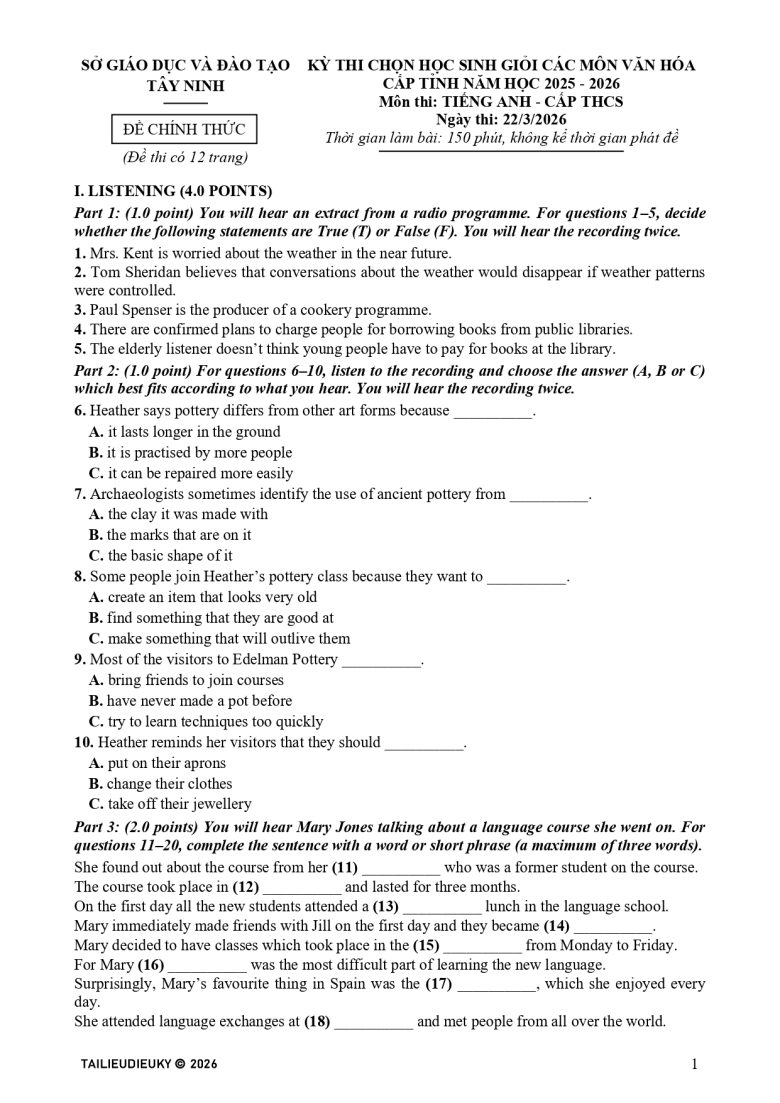
Bạn đang tìm kiếm tài liệu ôn thi HSG Tiếng Anh cấp THCS mới nhất? Tài liệu diệu kỳ xin giới thiệu đến các bạn Đề thi chọn học sinh giỏi các môn văn hóa cấp tỉnh năm học 2025-2026 môn Tiếng Anh của Sở GD&ĐT Tây Ninh, vừa diễn ra ngày 22/03/2026.
Đây là bộ đề thi có cấu trúc quen thuộc, phân hóa cao, bao gồm đầy đủ các kỹ năng: Listening, Use of English, Reading và Writing. Đặc biệt, các chủ đề trong bài đọc và bài viết luận (Essay) rất thời sự, xoay quanh các vấn đề như: Zero-waste lifestyle, Caffeine culture in Vietnam, và sự ảnh hưởng của AI trong giáo dục.
⚡ Tóm tắt nhanh đề HSG Anh 9 Tây Ninh 2025–2026
12 trang – 150 phút
4 kỹ năng, tổng ~80–90 câu + 1 bài luận
🎧 Listening: nghe hiểu (radio, pottery, khóa học)
📚 Use of English: grammar + vocab + sửa lỗi + word form
📖 Reading: 3 bài (cà phê VN, lightning, điền từ)
✍️ Writing: biến đổi câu + essay (AI & giáo viên)
Tải xuống Đề thi HSG Tiếng Anh THCS Tây Ninh 2025
Tải: Đề thi + Đáp án + File nghe + Audioscripts
Tài liệu diệu kỳ luôn cập nhật nhanh nhất các bộ đề thi học sinh giỏi, thi vào lớp 10 chuyên Anh và thi tốt nghiệp THPT trên cả nước. Hãy thường xuyên ghé thăm website để không bỏ lỡ những tài liệu quý giá nhé!
Đáp án
1. T
2. T
3. T
4. F
5. F
6. A
7. B
8. C
9. B
10. C
11. cousin
12. Barcelona
13. welcome
14. flatmates
15. mornings
16. grammar
17. lunch / long lunch(es)
18. weekends
19. Economics
20. write a letter
21. B
22. C
23. A
24. D
25. A
26. D
27. B
28. B
29. A
30. C
31. makes takes
32. few little
33. despite instead of / rather than
34. if unless
35.affect effect
36. relative
37. tirelessly
38. ecological
39. likelihood
40. proudly
41. heightened
42. foundations
43. disagreeable
44. injustice
45. overcome
46. includes
47. lane
48. which
49. extremely
50. against
51. filled
52. their
53. by
54. Although
55. involved
56. D
57. C
58. B
59. A
60. B
61. C
62. E
63. A
64. B
65. D
66. C
67. F
68. A
69. D
70. B
71. C
72. B
73. D
74. A
75. A
76. B
77. C
78. B
79. C
80. D
81. on paying for my / our tickets.
82. the last person to leave the office.
83. have understood the instructions.
84. it was too late did I realise how dangerous the situation was.
85. no difficulty (in) passing the exam.
86. making no effort
87. cost an arm and a leg
88. wears glasses apart from
89. be working late tonight unless
90. spilled the beans
TRANSCRIPTS
Part 1.
JIM ADAMS: Hi, this is “Say it like it is”, the programme in which your comments about what’s been on Radio One for the last week are read. And for today … Well, we had many listeners writing in about last Tuesday’s science programme which is based on weather this time. John Holmes from Oxford says:
READER: Your “Climate changes” turned out to be quite an interesting programme. Professor Jones’ theory that we’re slowly going towards another Ice Age was quite astounding. I was taught that the earth was moving nearer the sun!
JIM ADAMS: You could be right. But I don’t think that it will happen in our lifetime. Mrs Kent from Brighton talks about weather problems which could affect us in the near future.
READER: Some experts may tell us what the weather may be like in the next century but I’m more concerned about the present day situation. I think that tax money and scientific studies should try to focus on short-term weather forecasts and try to make them more precise and accurate.
JIM ADAMS: Many listeners have the same point of view. On the other hand, Tom Sheridan from Manchester has a different opinion.
READER: I hear that experiments are being made to change the weather in Britain. But, who wants it? Nobody would like a set weather pattern. All those conversations about the weather would disappear.
JIM ADAMS: We’d find something else to talk about. I’m sure. Food, for example. It seems to be a favourite of our readers judging from the letters we receive …
READER: Dear Jim, I’m writing in objection to the Cookery Series on Wednes days.
JIM ADAMS: Tim Saunders, from Coventry writes;
READER: Most men already know how to do things like making toast so our time shouldn’t be wasted by such programmes.
JIM ADAMS: Tim would like more challenging cooking tips. We’ve got the producer of our cookery show here today, Mr. Paul Spenser. What about more difficult cookery on your show?
PAUL SPENSER: I can relate to what Mr. Saunders is saying. Up to now we’ve been doing basic things to help beginners but we’ll be moving on to more difficult recipes in the next few weeks. I hope that the programme will be more interesting for Mr. Saunders in the future.
JIM ADAMS: I hope so! To finish off we have a few letters referring to the rumours that lending libraries won’t be free to the public anymore. Jane from Bournemouth has a few things to say about this.
READER: For students like me, books are too expensive to buy and we depend on libraries for our books! 20p is too much to pay for every book we take out.
JIM ADAMS: Don’t worry Jane. It’s only a rumour so far. And our last letter comes from one of the elderly in our community.
READER: The elderly have to pay for their needs so why shouldn’t others pay for theirs? They pay in pubs and discos, why not at libraries.
JIM ADAMS: Well, that’s all for today. More for you to think about. If there’s something you’d like to comment on write to Jim Adams, “Say It Like It Is” Radio One.
Part 2.
Hello and welcome. My name’s Heather McCallum and I’m one of the potters who work here at Edelman Pottery. Before we go into the workshop, I just want to say a bit about the craft of pottery. Then we’ll have a look at the equipment and you can try making a pot of your own.
Like many people, I’m sure you know that pottery as an art form is tens of thousands of years old. And we know this because it stands the test of time. Things like baskets and pictures don’t survive in the earth in the same way that pots do and even if ancient pots are found in small pieces they still provide a lot of information about the past. There no doubt that pottery has given archaeologists a fascinating insight into how ancient hls lived The shape of an artefact may have been lost but archaeologists can tell whether the pots were for, say, storage or cooking by examining the impressions on the clay, the scratches from
tools, and the clay itself can reveal where the pots came from.
When I ask people why they want to take a pottery class with me, they sometimes talk about these things. Like our ancestors, they hope that something they create will also last longer than they do, that their work, whether it is good or not, might say something about humanity many years after their death. Of course, you will all have your own reasons for coming here. As far as I’m concerned, what I love most is the concentration you need to make a good pot. That focus takes you away from the stresses of everyday life. If you’re elderly, it’s also good exercise for hands and wrists and helps with arthritis. And of course, it’s a fun activity for children because it’s so messy.
Here at Edelman Pottery, we show you some of the basic pottery techniques so that you can use these to create whatever you wish. A gift for a friend, perhaps. Like nearly everyone who comes here, I’m sure this is the first time you will have tried the art. So we’ll keep things simple today. Now, before we move on, can I just say a word about what you’re wearing? As we said in our email please remove any watches necklaces etc and put them somewhere safe. If you have long hair do tie it back now. We provide aprons later but I trust your clothes are old but comfortable not your favourite T-shirt or jeans.
Part 3.
I had wanted to study Spanish for as long as I can remember. At school we did French and German and I hated both. So when I was finally old enough and I had saved up enough money, I decided to go to Spain and do an intensive Spanish course. I looked on the internet for details of courses but as commonly happens it was someone in my circle of friends, my cousin in fact, who was actually able to give me the best information. She had previously done the same as I wanted to do and she told me all about her wonderful experience.
She had been to Madrid, the Spanish capital. She said it was wonderful but a bit hot in the summer. I had visited Spain before but only the coast which was much more touristy. I still wanted to have a beach which Madrid doesn’t so finally I chose Barcelona, the capital of Catalonia in the north east of Spain. The language academy my cousin attended had a school in Barcelona. She said she’d had a great experience there so I called them up and booked on to a three month course.
I arrived the day the course started very early in the morning and went straight to the academy. There was a welcome lunch and everyone on the course and all the teachers turned up and there was a buffet and soft drinks. I suppose it was intended as a way to get to know people and that’s exactly what I did. There was one girl called Jill who I hit it off with straight away. Turns out she was looking for someone to share her newly rented flat with. After the lunch she invited me round to see the place and just like that we became flatmates.
It was really fortunate for both of us actually and the very next day we got down to studying. We opted for the early morning classes from ten till two so as to have our afternoons free. The classes were great and we helped each other a lot. Jill could never remember the new vocabulary but for me that was easy. It was grammar I really struggled with. We made a promise to only speak to each other in Spanish despite the fact that she is from the US and her first language is English just like me.
What I loved more than anything and it had never even crossed my mind before I came to Spain was the wonderful long lunches. I made sure I went for one every single day after studying. We really enjoyed the social life in Spain too. We wanted to keep studying at the weekends also and so we went to Inter-Cambios culture and language exchanges. I was really surprised by the diversity of people I met there from all over the world. It was incredible. I had a wonderful time and the three months just flew by.
I’m back in the UK now. I did consider studying Spanish at university but since I didn’t study at school I didn’t have the qualifications to get onto a unicourse so I’m doing economics instead. I am however studying Spanish at night school so who knows what will happen in the future. Jill and I made a promise to stay in contact. On Facebook as everyone does but we also write a letter to each other once a month. Spanish of course.
SỞ GIÁO DỤC VÀ ĐÀO TẠO
TÂY NINH
(Đề thi có 12 trang) KỲ THI CHỌN HỌC SINH GIỎI CÁC MÔN VĂN HÓA CẤP TỈNH NĂM HỌC 2025 – 2026
Môn thi: TIẾNG ANH – CẤP THCS
Ngày thi: 22/3/2026
Thời gian làm bài: 150 phút, không kể thời gian phát đề
I. LISTENING (4.0 POINTS)
Part 1: (1.0 point) You will hear an extract from a radio programme. For questions 1–5, decide whether the following statements are True (T) or False (F). You will hear the recording twice.
1. Mrs. Kent is worried about the weather in the near future.
2. Tom Sheridan believes that conversations about the weather would disappear if weather patterns were controlled.
3. Paul Spenser is the producer of a cookery programme.
4. There are confirmed plans to charge people for borrowing books from public libraries.
5. The elderly listener doesn’t think young people have to pay for books at the library.
Part 2: (1.0 point) For questions 6–10, listen to the recording and choose the answer (A, B or C) which best fits according to what you hear. You will hear the recording twice.
6. Heather says pottery differs from other art forms because __________.
A. it lasts longer in the ground
B. it is practised by more people
C. it can be repaired more easily
7. Archaeologists sometimes identify the use of ancient pottery from __________.
A. the clay it was made with
B. the marks that are on it
C. the basic shape of it
8. Some people join Heather’s pottery class because they want to __________.
A. create an item that looks very old
B. find something that they are good at
C. make something that will outlive them
9. Most of the visitors to Edelman Pottery __________.
A. bring friends to join courses
B. have never made a pot before
C. try to learn techniques too quickly
10. Heather reminds her visitors that they should __________.
A. put on their aprons
B. change their clothes
C. take off their jewellery
Part 3: (2.0 points) You will hear Mary Jones talking about a language course she went on. For questions 11–20, complete the sentence with a word or short phrase (a maximum of three words).
She found out about the course from her (11) __________ who was a former student on the course.
The course took place in (12) __________ and lasted for three months.
On the first day all the new students attended a (13) __________ lunch in the language school.
Mary immediately made friends with Jill on the first day and they became (14) __________.
Mary decided to have classes which took place in the (15) __________ from Monday to Friday.
For Mary (16) __________ was the most difficult part of learning the new language.
Surprisingly, Mary’s favourite thing in Spain was the (17) __________, which she enjoyed every day.
She attended language exchanges at (18) __________ and met people from all over the world.
Mary has now returned to the UK and has decided to study (19) __________ at college.
Mary and Jill will keep in touch through Facebook and have promised to (20) __________ every month.
II. USE OF ENGLISH (6.0 POINTS)
Part 1: (1.0 point) For questions 21–30, choose the correct answer (A, B, C or D) which best fits each gap.
21. He is a __________.
A. capable of making difficult decisions manager
B. manager capable of making difficult decisions
C. capable manager of making difficult decisions
D. manager capable to make difficult decisions
22. Some consumers remain fiercely __________ a particular brand despite cheaper alternatives.
A. committed for B. faithful with C. loyal to D. attached with
23. The international study on digital education was conducted __________ collaboration with several leading universities.
A. in B. through C. under D. with
24. If you agreed to work for our company, your income would be __________ your present one.
A. twice as much as B. twice as much as that of
C. twice as high as D. twice as high as that of
25. The rapid expansion of artificial intelligence has __________ fresh concerns about data privacy among experts.
A. raised B. lifted C. stirred D. elevated
26. While I was tidying up my house, I __________ an old album containing some photographs of my parents’ wedding.
A. took after B. made up C. turned down D. came across
27. Of the eight social media platforms surveyed in the study, __________ was considered completely safe for teenagers.
A. none of which B. not one of them
C. which none D. and none of them
28. For the first few months, the babies looked so alike I couldn’t tell __________.
A. who is whom B. which is which
C. which from which D. whom with whom
29. __________ to improve online learning, many schools have invested heavily in digital platforms.
A. Attempting B. Attempted C. Having attempted D. Attempt
30. It seems that you are right, __________?
A. doesn’t it B. does it C. aren’t you D. are you
Part 2: (1.0 point) For questions 31 -35, identify 5 mistakes in the following passage and correct them. There is onc example.
Example: concern concerned
A zero-waste lifestyle
I am extremely concern about the amount of waste we produce. There is too much of it. It uses up natural resources, makes up landfill space and in the case of plastic, makes its way into our oceans. So, I follow the three Rs – reduce, reuse, recycle. I’m trying initially to generate as few rubbish as possible, but my ultimate aim is to lead a zero-waste lifestyle.
Recycling is important, but I do my best to avoid disposable items in favour of reusable ones. So, for example, despite paper towels, serviettes and tissues, I only ever use cloth ones. I always take several bags with me when I go shopping, and won’t buy anything that’s wrapped or comes in a container if the wrapping or container can be reused. Although I realise what I do won’t make a huge difference on its own, it might at least help to influence others. And if we all played our part, it would undoubtedly have a positive affect on the environment.
Part 3: (2.0 points) For questions 36–45, read the text below. Use the word given in capitals at the end of some of the lines to form a word that fits in the gap in the same line.
What drives an eco-warrior?
The term ‘eco-warrior’ is a (36. RELATE) __________ newcomer to the English language. It describes someone who campaigns (37. TIRE) __________ for environmental causes, highlighting instances of (38. ECOLOGY) __________ damage and confronting those responsible for it. This might entail using court action, even when the (39. LIKELY) __________ of success in the face of huge corporate wealth is low. Some eco-warriors (40. PRIDE) __________ turn their backs on their ‘normal’ lives and commit wholeheartedly to their cause as if it were a full-time job.
Whichever route a person takes into this type of activism, a (41. HEIGHT) __________ awareness of environmental issues is what lays the (42. FOUND) __________ of their cause. Some are inspired to become eco-warriors after seeing something deeply (43. AGREE) __________ to them on the news: a forest fire, perhaps, or a sea bird covered in thick, black oil after a devastating spillage. Many are driven by feelings of anger about what they see as the (44. JUST) __________ of our world, and see direct action as the only possible way to (45. COME) __________ the imbalance between humans and nature.
Part 4: (2.0 points) For questions 46–55, read the text below and think of the word which best fits each gap. Use only ONE word in each gap.
The secrets of a shark’s slow life
Sleeper sharks, a group that (46) __________ the iconic Greenland shark are big-bodied, slow-moving sharks found in cold deep waters, especially in the Arctic and North Pacific. Rarely seen, these sharks have a super-sluggish metabolism that forces them to live life in the slow (47) ____________. Greenland sharks, for example, have a top speed of less than two miles per hour and grow less than one centimeter per year. This leisurely lifestyle allows sleeper sharks to conserve energy, (48) __________ is needed to stay warm in cold water. It also allows them to live (49) __________ long lives, with some estimates suggesting they can endure for over 400 years. (A recent study of their genome found duplicates of genes related to DNA repair, immune function, and protection (50) __________ oxidative stress, all of which reduce the physical toll of time.)
Another cold-water survival trick of sleeper sharks: their tissues are (51) __________ with urea and trimethylamine N-oxide (TMAO). Urea, a common compound also found in our urine, helps sharks maintain osmotic balance with the surrounding seawater, but it also destabilizes (52) __________ proteins. TMAO solves this problem (53) __________ reinforcing the shark’s proteins, so much so that they can function at near-freezing temperatures. (54) __________ all sharks have TMAO in their bodies, sleeper sharks have far more than most.
“These are true polar sharks,” says Dave Ebert, a shark scientist at San Jose State University. Ebert, who was not (55) __________ with the discovery, says it was exciting but not unexpected to see a sleeper shark in Antarctica.
III. READING (5.0 POINTS)
Part 1: (1.0 point) You are going to read an article. For questions 56 – 60, choose the best answer (A, B, C or D) for the following questions.
A caffeine-fueled journey through Vietnam’s rich coffee culture
By Kristin Braswell
Coffee is an essential beverage around the world, enjoyed as both a ritual, a social centerpiece, and a stimulant to face the day. In Italy, people enjoy un caffè standing at a bar, and in Senegal, vendors sell spicy café touba at street-side shops called tanganas. In Mexico City, café de olla contains notes of cinnamon and cloves, and in Indonesia, brewers make kopi joss by plunging a piece of burning charcoal into iced coffee.
The history of coffee in Vietnam
Behind each distinctive cup is its history. Vietnam, in particular, has a storied past tied to the beverage that points to its resilience and ingenuity. First introduced by French missionaries in 1857, coffee’s success was due to Vietnamese laborers who cultivated Arabica. The bean didn’t fare well in the country’s climate, and the more flexible Robusta soon replaced it, flourishing in the Central Highlands and the south. After the Vietnam War, coffee became one of the main exports that helped rebuild the country, buoyed primarily through government investment in coffee crops in the 1980s. Today, Vietnam is the second-largest coffee exporter in the world, after Brazil.
With the post war boom of coffee production, Vietnamese people found distinct ways to make it their own, including the creation of the Phin filter, a portable metal brewing tool that produces an unapologetically bold, thick, and slightly smoky coffee from the robusta bean, and turning necessity into invention with the use of condensed milk – which was more readily available after the war. When milk was scarce in the 1940s, people whipped egg yolk with sugar to create the country’s iconic egg coffee, while the country’s abundance of tropical palm trees gave rise to the popular coconut coffee. “We’ve always taken what’s limited or what’s plentiful and turned it into something memorable,” says Helen Le, Vietnamese food influencer and founder of Helen’s Recipes.
The rise of Vietnam’s caffeine-infused social culture
Whether you’re in the Central Highlands, where high-altitude farms grow robusta bean, or Ho Chi Minh, where hip alleyway cafes and corner stands serve the famous iced coffee called cà phê sữa đá, coffee drinking clearly emerges as a communal ritual that people savor slowly. “In Vietnam, coffee isn’t just a drink – it’s a lifestyle and a social rhythm. Coffee is everywhere, in every form, and everyone can afford it. People don’t always drink it to stay awake; they drink it to sit, to chat, to hang out, to catch up, to watch life go by,” says Le.
The caffeine-fueled social fixture has quickly attracted tourists, who have no shortage of options while visiting. “Younger generations and local entrepreneurs have reimagined coffee culture from a place of pride, working to elevate coffee production, roasting, and cafe experiences to earn their spot on the global coffee stage,” says Sasha Nguyen, CEO and founder of Nguyen Coffee Supply. “There is an increasing commitment to craftsmanship and care in Vietnamese coffee – it’s just been overlooked due to historical stigma. That’s a big part of what drives me – changing how people see Vietnamese coffee,” explains Nguyen, the first Vietnamese-American and woman-owned importer of Vietnamese beans to the U.S.
Best places to try coffee and coffee-infused cocktails
Passionate tour guides, coffee makers, and mixologists throughout Vietnam – including Tran Duc Thang, the head barista at Capella Hanoi – lead the commitment Nguyen describes. Cafés line nearly every corner of the city’s bustling backdrop in Ha Noi. Duc Thang recommends the traditional local café Cà phê Nhân – known for its strong Robusta coffee. Gọi Tân Coffee, which makes a popular salted caramel variation, and XLIII Coffee, a speciality cafe that focuses on pouring hot water over premium light-roasted coffee grounds in a filter or single-origin pour-overs.
For a more intimate experience, Tran welcomes guests at the storied Capella Hanoi for a Coffee Trail & Cupping Experience, where he teaches the history and terroir of the country’s coffee landscape, from the brightness of Son La Arabica grown in the dewy northern mountains, to the rare typica beans from Da Lat, one of the oldest and most prized Arabica varieties in Vietnam. “Cupping is a way to experience the soul of coffee – its aromas, textures, acidity, and stories. When guests begin to ask questions – Where is this from? Why does it taste like fruit? – that’s the moment we’ve achieved our purpose: we’ve sparked curiosity,” he says.
Upstairs at Capella’s Hudson Rooms, Head Bartender Nguyen Ngoc Khuu manages these same beans in inventive cocktails. The rooftop bar is at the forefront of the city’s mixology scene. To make its coffee cocktails, the bar employs innovative Hanoi-based distilleries like Ve De Di, which created a bold coffee liqueur from Dak Lak beans. “We saw a chance to become a true destination for this, to dive deeper than just one drink on a menu and build an entire ritual around it,” Nguyen says.
He employs Robusta from Dak Lak to add depth, saying it doesn’t just add a coffee flavor but also a strong foundation for other drinks to build upon. One of his favorite cocktails blends Vietnamese espresso with a cold-brew amaro, enhanced by a nitrous-shake technique for a smooth, velvety texture. Each pour is just one more example of Vietnam’s evolving creativity, merging traditional craftsmanship with modern innovation.
56. What is the main theme of the article?
A. To compare the agricultural success of Vietnam’s coffee production with that of Brazil.
B. To promote specific luxury hotels and rooftop bars in the city of Hanoi.
C. To explain the step-by-step process of growing Robusta beans in the Central Highlands.
D. To explore how historical circumstances and modern creativity have shaped Vietnam’s coffee culture.
57. According to the passage, why did Vietnamese people originally invent egg coffee?
A. Because Arabica beans could not survive in the Vietnamese climate.
B. Because condensed milk was considered too sweet for the traditional Phin filter.
C. Because there was a severe scarcity of milk during the 1940s.
D. Because the government heavily invested in egg production in the 1980s.
58. The word stigma in the fifth paragraph probably means __________.
A. a strong feeling of national pride and identity
B. a set of negative beliefs or unfair judgments
C. a sudden decline in agricultural exports
D. a lack of modern brewing equipment
59. What can be inferred about the traditional Vietnamese coffee-drinking habit from Helen Le’s statement?
A. It serves as a medium for social connection and relaxation rather than just a physical stimulant.
B. It is primarily consumed as a quick energy boost before a busy workday.
C. It is an exclusive activity that only wealthy individuals can afford.
D. It has completely lost its traditional appeal among the younger generations.
60. According to the text, what is the primary goal of the “Cupping Experience” led by Tran Duc Thang?
A. To teach international guests how to properly use a traditional Phin filter.
B. To help guests appreciate the diverse origins, aromas, and stories behind Vietnamese coffee beans.
C. To promote the sale of local coffee liqueurs to high-end tourists.
D. To train local baristas on how to create cocktails using a nitrous-shake technique.
Part 2: (2.0 points) You are going to read a passage. For questions 61 – 70, choose from (A-F). The sections may be chosen more than once.
Lightning strikes!
A. Three years ago a bolt of lightning all but destroyed Lyn Miller’s house in Aberdeen – with her two children inside. There was a huge rainstorm, she says, recalling the terrifying experience. ‘My brother and I were outside desperately working to stop floodwater from coming in the house. Suddenly, I was thrown to the ground by an enormous bang. When I picked myself up, the roof and the entire upper story of the house had been demolished. The door was blocked by rubble, but we forced our way in and found the children, thankfully unharmed. Later, I was told that being struck by lightning is a chance in a million! In fact, it’s calculated at one chance in 600,000. Even so, Dr Mark Keys of AER Technology, an organisation that monitors the effects of lightning, thinks you should be sensible. “I wouldn’t go out in a storm – but then I’m quite a careful person.” He advises anyone who is unlucky enough to be caught in a storm to get down on the ground and curl up into a ball, making yourself as small as possible.
B. Lightning is one of nature’s most awesome displays of sheer power. No wonder the ancient Greeks thought it was Zeus, father of the gods, throwing thunderbolts around in anger. 250 years ago, Benjamin Franklin, the American scientist and statesman, proved that lightning is a form of electricity, but scientists still lack a complete understanding of how it works.
C. Occasionally, there are indications that lightning may strike. Positive electrical charges streaming upwards from trees or church spires may glow and make a buzzing noise, and people’s hair can stand on end. And if you hear lightning, you’ll be glad to know that a company in the USA has manufactured a hand-held lightning detector which can detect it up to 70 km away, sound a warning tone, and monitor the storm’s approach.
D. Lizzie Anne Bright was on a camping trip when lightning struck a tree and then travelled to where she was sitting. The feeling I got is hard to explain. I felt as if I was rising above the ground. I couldn’t move, and my shoulder really hurt and had burns. I was in the hospital for five days. I still keep the clothes I was wearing that day. My jacket has a large black hole in it, and my trousers and socks just melted.
E. Harold Deal, a retired electricalian from South Carolina, USA, was struck by lightning 26 years ago. He was apparently unhurt, but it later emerged that the strike had damaged the part of the brain that controls the sensation of temperature. Since then, the freezing South Carolina winters haven’t bothered Harold, since he is completely unable to feel the cold.
F. Animals are victims of lightning, too. Hundreds of cows and sheep are killed every year, largely because they go under trees. In East Anglia in 1918, 504 sheep were killed instantaneously by the same bolt of lightning that hit the ground and travelled through the entire flock. Lightning is also responsible for starting more than 10,000 forest fires each year worldwide.
Which section
61. talks about a gadget?
62. mentions a person who only seemed unharmed on the outside?
63. mentions victims being in an enclosed space?
64. mentions a myth?
65. describes how someone felt when they were struck?
66. mentions possible warning signs of a lightning strike?
67. blames lightning for certain natural disasters?
68. recommends the best position to get into?
69. mentions keeping souvenirs of being hit?
70. mentions someone who made a discovery about lightning?
Part 3: (2.0 points) For questions 71–80, read the text below and decide which answer (A, B, C or D) best fits each gap.
Book sculptures appear in Edinburgh’s cultural centres
Over the course of a nine-month (71) __________, a total of ten sculptures, beautifully crafted from books, were left anonymously in (72) __________ cultural buildings in the city of Edinburgh. Each was accompanied by a note, which (73) __________ the words, ‘In (74) __________ of libraries, books, words, ideas and festivals’. Cutting up books may at first seem a rather (75) __________ way to show one’s support for the written word, but there was unanimous approval of the intricate sculptures from all those lucky enough to (76) __________ them when they were put on display.
Each sculpture was (77) __________ chosen: a dinosaur for the National Museum or a tiny cinema for the city’s Filmhouse. Despite a strong suggestion in one of the notes that the person leaving the sculptures was a woman, journalists at a (78) __________ newspaper said the donor was a man. They claimed they had (79) __________ his identity, but kept it quiet, given that the general view was that he, or she, should (80) __________ anonymous.
71. A. time B. term C. period D. season
72. A. plenty B. various C. lots D. much
73. A. consisted B. enclosed C. constituted D. included
74. A. support B. favour C. help D. benefit
75. A. strange B. unique C. rare D. unknown
76. A. look B. view C. notice D. watch
77. A. highly B. strongly C. carefully D. heavily
78. A. regional B. local C. native D. domestic
79. A. invented B. explored C. discovered D. created
80. A. maintain B. attain C. contain D. remain
IV. WRITING (5.0 POINTS)
Part 1: (2.0 points) For questions 81-85, complete the sentences so that the meaning remains the same.
81. “I really would like to pay for your tickets,” said James.
James insisted __________________________________________________________________
82. Nobody stayed in the office after the manager had gone home.
The manager was _______________________________________________________________
83. I’m certain that they didn’t understand the instructions.
They can’t _____________________________________________________________________
84. I only realised how dangerous the situation was after it was too late.
Not until ______________________________________________________________________
85. It was easy for us to pass the exam.
We had _______________________________________________________________________
For questions 86–90, complete the second sentence so that it has a similar meaning to the first sentence, using the word given. Do not change the word given. You must use between two and six words, including the word given.
86. Samuel is not trying to improve himself. (EFFORT)
Samuel is _______________________________________________________________ himself.
87. The price of the concert tickets was extremely high. (ARM)
The concert tickets ______________________________________________________________
88. My sister is the only person in my family who doesn’t wear glasses. (APART)
Everybody in my family __________________________________________________ my sister.
89. Martin is only working late tonight because he has to finish an urgent task. (UNLESS)
Martin would not _______________________________________ he had to finish an urgent task.
90. When the manager finally revealed the secret, everyone was shocked. (BEANS)
When the manager finally ______________________________________, everyone was shocked.
Part 2: Essay writing (3.0 points)
Some people believe that computers and artificial intelligence will eventually replace teachers in the future, while others think that teachers will always be necessary.
Discuss both views and give your own opinion.
Give reasons for your answer and include any relevant examples from your own knowledge or experience.
Write an essay of about 250 words.
———- THE END ———-