Vào chiều ngày 06/03/2026, Sở Giáo dục và Đào tạo tỉnh Đồng Tháp đã chính thức tổ chức Kỳ thi chọn học sinh giỏi THPT cấp tỉnh năm học 2025 – 2026. Đây là một trong những kỳ thi có quy mô lớn nhất tỉnh với sự tham gia của 4.258 thí sinh hệ giáo dục phổ thông và giáo dục thường xuyên.
Bài viết này cung cấp trọn bộ đề thi HSG Tiếng Anh 12 Đồng Tháp 2026 kèm đáp án chi tiết, giúp các em học sinh ôn tập và các thầy cô làm tài liệu giảng dạy.
 Cấu trúc đề HSG Tiếng Anh 12 Đồng Tháp
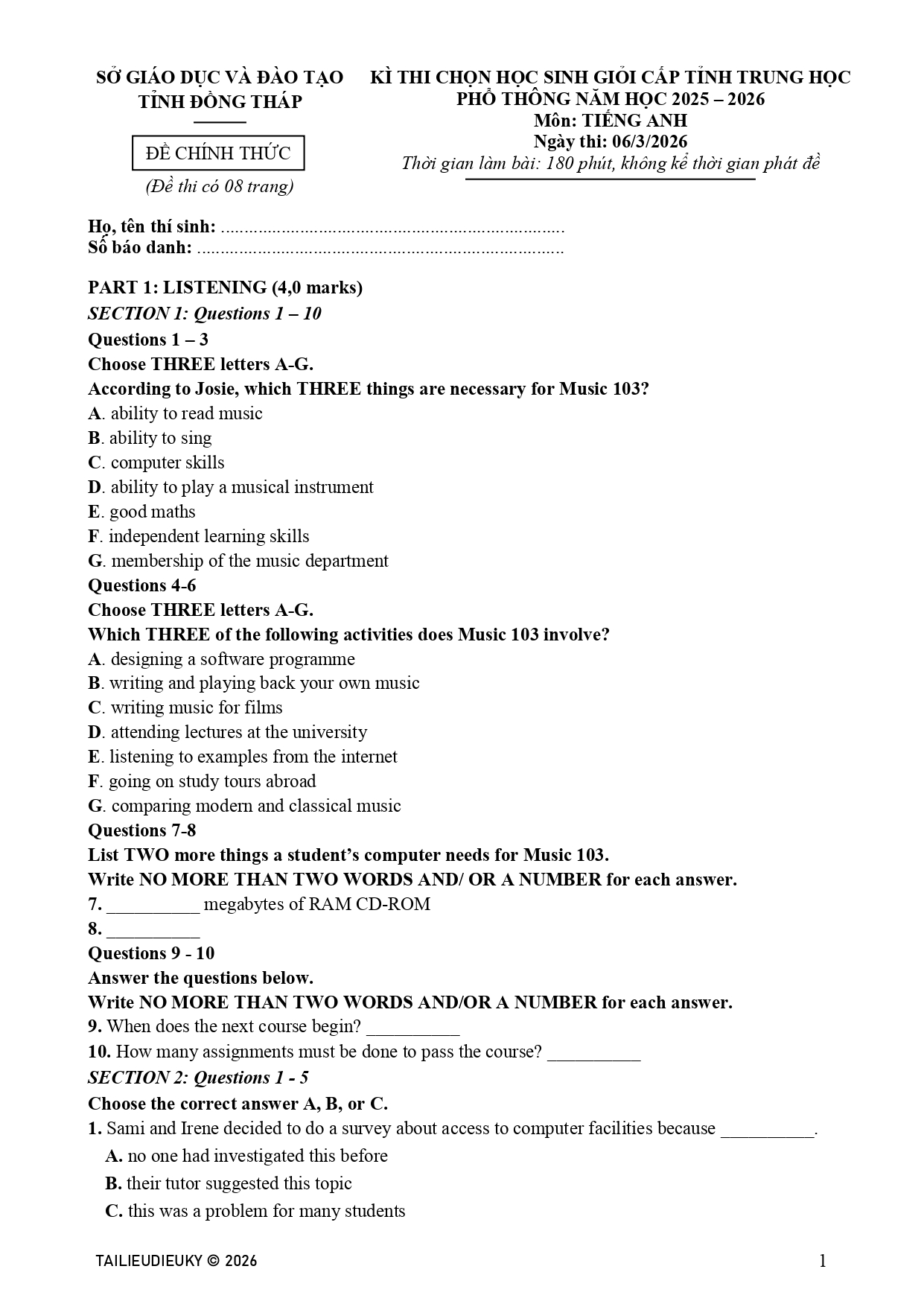
• Listening (4.0)
• MCQ + điền từ
• Chủ đề: khóa học, khảo sát sinh viên
• Lexico-Grammar (6.0)
• Trắc nghiệm từ vựng/ngữ pháp
• Word form, verb tense
• Giới từ, sửa lỗi
• Reading (5.5)
• Matching heading
• True/False/NG
• Summary + MCQ + điền từ
• Writing (4.5)
• Rewrite câu
• Essay: AI trong học tập (agree/disagree)
Link tải file Word đề thi + đáp án + transcript
Chúc bạn ôn tập hiệu quả và đạt kết quả cao trong kỳ thi HSG Tiếng Anh 12 sắp tới!
Từ khóa tìm kiếm: Đề thi học sinh giỏi Tiếng Anh 12 Đồng Tháp 2025 2026, Đáp án đề HSG Anh 12 Đồng Tháp, Tải đề thi HSG Tiếng Anh 12 file word, Tài liệu ôn thi HSG Tiếng Anh 12 mới nhất.
✅ Đáp án chuẩn
PART 1: LISTENING
SECTION 1
1-3. C, E, F (in any order)
4-6. B, E, G (in any order)
7. 64
8. Sound card
9. January
10. 6
SECTION 2
1. C
2. B
3. A
4. A
5. C
SECTION 3
6. B
7. D
8. F
9. E
10. G
PART 2: LEXICO - GRAMMAR
SECTION 1
1. B
2. A
3. B
4. D
5. D
6. C
7. B
8. B
SECTION 2
1. futuristic
2. irrationally
3. distinguish
4. allowance
SECTION 3
1. (should) be taken
2. Having bought
3. should/ought to have been given
4. will be playing
SECTION 4
1. of
2. off
3. through
4. at
SECTION 5
1. with
2. ✓
3. ✓
4. one
PART 3: READING
Reading Passage 1
1. v
2. i
3. vi
4. x
5. ix
6. iv
7. TRUE (or T)
8. NOT GIVEN (or NG)
9. TRUE (or T)
10. TRUE (or T)
11. FALSE (or F)
12. TRUE (or T)
Reading Passage 2
13. pioneers
14. underground vaults
15-16. B, A
Reading Passage 3
17. hooked
18. couch
19. droves
20. end
21. off
22. want
PART 4: WRITING
Section 1
1. She can’t have done it on purpose.
2. Hardly had they announced Vietnam’s victory when the streets turned into a sea of red flags.
3. No matter how badly I did, my teacher always gave me encouragement.
4. It’s about time you began thinking about your future.
5. The less time Carol has, the more effectively she works.
6. The documents were claimed to have been signed by the CEO.
Section 2
1. Reserved though he looks, he has a marked sense of humour.
2. We told John not to call off his trip because of us.
3. She came across the photographs when she was cleaning her room.
4. I left my last job because I didn’t see eye to eye with my manager’s approach.
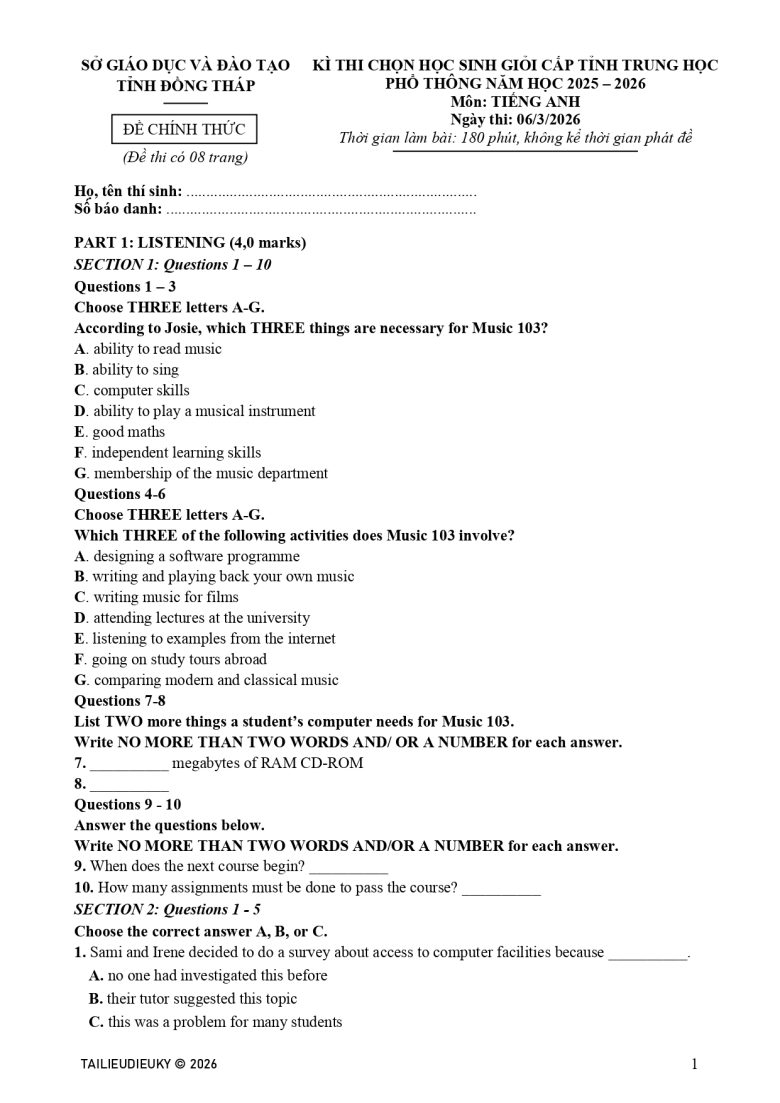
SỞ GIÁO DỤC VÀ ĐÀO TẠO
TỈNH ĐỒNG THÁP
(Đề thi có 08 trang) KÌ THI CHỌN HỌC SINH GIỎI CẤP TỈNH TRUNG HỌC
PHỔ THÔNG NĂM HỌC 2025 – 2026
Môn: TIẾNG ANH
Ngày thi: 06/3/2026
Thời gian làm bài: 180 phút, không kể thời gian phát đề
Họ, tên thí sinh: ..........................................................................
Số báo danh: ...............................................................................
PART 1: LISTENING (4,0 marks)
SECTION 1: Questions 1 – 10
Questions 1 – 3
Choose THREE letters A-G.
According to Josie, which THREE things are necessary for Music 103?
A. ability to read music
B. ability to sing
C. computer skills
D. ability to play a musical instrument
E. good maths
F. independent learning skills
G. membership of the music department
Questions 4-6
Choose THREE letters A-G.
Which THREE of the following activities does Music 103 involve?
A. designing a software programme
B. writing and playing back your own music
C. writing music for films
D. attending lectures at the university
E. listening to examples from the internet
F. going on study tours abroad
G. comparing modern and classical music
Questions 7-8
List TWO more things a student’s computer needs for Music 103.
Write NO MORE THAN TWO WORDS AND/ OR A NUMBER for each answer.
7. __________ megabytes of RAM CD-ROM
8. __________
Questions 9 - 10
Answer the questions below.
Write NO MORE THAN TWO WORDS AND/OR A NUMBER for each answer.
9. When does the next course begin? __________
10. How many assignments must be done to pass the course? __________
SECTION 2: Questions 1 - 5
Choose the correct answer A, B, or C.
1. Sami and Irene decided to do a survey about access to computer facilities because __________.
A. no one had investigated this before
B. their tutor suggested this topic
C. this was a problem for many students
2. Sami and Irene had problems with the reading for their project because __________.
A. the language was too technical
B. not much had been written about the topic
C. they could not locate the books in the library
3. How did Sami and Irene get the main data in their survey?
A. from face-to-face interviews
B. from observation of students
C. from online questionnaires
4. The tutor suggests that one problem with the survey was, limitations in __________.
A. the range of students questioned
B. the number of students involved
C. the places where the questions were asked
5. What proportion of students surveyed thought that a booking system would be the best solution?
A. 25% B. 65% C. 77%
SECTION 3: Questions 6 - 10
What disadvantage was mentioned in relation to each suggestion?
Choose your answers from the box and write the letters A - H next to Questions 6 - 10.
SUGGESTIONS DISADVANTAGES
6. different rooms for educational and recreational use
__________
7. restrictions on use by classes __________
8. new computers __________
9. 24-hour access to computers __________
10. booking system __________
A. against university regulations
B. inconvenient for users
C. involves long waits
D. lack of alternative resources
E. need for security arrangements
F. not a long-term solution
G. more work for staff at centres
H. too expensive
PART II: LEXICO - GRAMMAR (6,0 marks)
SECTION 1: Pick out ONE best option (A, B, C, or D) to complete each blank for Questions from 1 to 8. (2,0 marks)
1. She always __________ the smell of fresh bread with her mother, who loved baking.
A. remembered B. associated C. exemplified D. attributed
2. He thinks he should get his house __________.
A. redecorated B. to be redecorated C. to redecorate D. redecorate
3. They turned down the proposal __________ that it didn’t fulfill their requirement.
A. by reason B. on the grounds C. as a cause D. allowing
4. She believes that all countries should __________ the death penalty as it is inhumane.
A. catch up with B. put up with C. get up to D. do away with
5. When we were in Athens, I bought a __________ statue.
A. white beautiful marble little B. marble beautiful little white
C. beautiful marble little white D. beautiful little white marble
6. __________ as a masterpiece, a work of art must transcend the ideas of the period in which they were created.
A. To rank B. Having been ranked
C. To be ranked D. Having ranked
7. __________ the rising population of the industrial nations has not suffered from a major epidemic since the last century.
A. A miracle that B. It is a miracle that
C. That a miracle has been D. Because the miracle
8. Their father always says that they should never __________ to violence.
A. demand B. resort C. recall D. exert
SECTION 2: Complete these sentences, using the suitable form of the words in brackets for Questions from 1 to 4. (1,0 mark)
1. The building looks a bit __________ from the outside, but it’s quite traditional inside. (FUTURE)
2. You’re acting completely __________. Just calm down and pull yourself together. (RATIONAL)
3. Is it possible to __________ between a hobby or an interest? (DISTINCT)
4. When I was a child, I often got a weekly __________ of 15 dollars. (ALLOW)
SECTION 3: Complete the sentences with the correct tense or form of the verbs given in the brackets for Questions from 1 to 4. (1,0 mark)
1. It is important that two medicines (take) __________ every day.
2. (Buy) __________ a very nice bunch of flowers, he went straight to her house.
3. Look! The plant is dead. It (give) __________ more water.
4. Mary: I’ll phone you at 8 o’clock. - Tom: No, I (play) __________ football then.
SECTION 4: Complete these sentences with proper particles (ONE WORD) for Questions from 1 to 4. (1,0 mark)
1. Their counterparts were envious __________ their success.
2. My brother is so tired after work that he often drops __________ in front of the TV.
3. The company pulled __________ despite the economic crisis.
4. My cousin talked __________ length about his recent holiday, and we all felt bored.
SECTION 5: Read the text below and look carefully at each line. Some of the lines are correct, but some have a word which should not be there. If a line is correct, put a cross (✓) in the space provided on your answer sheet. If a line has a word which should not be there, write the word on your answer sheet. There are two examples at the beginning (0 and 00). (1,0 mark)
Sometimes I just want for to be left alone. Don’t get me wrong. I love all my fans and I love it that they say such nice things to me and send me such lovely letters. It’s just that when I’m enjoying with a meal in a restaurant, for example, I don’t always want to be bothered by people asking me for autographs. To be honest, I hate it when that happens. But I can’t be rude, can I? I mean, I’d hate to get a reputation for being the sort of person one who’s horrible to the public. And I really don’t like the way some other movie stars behave. So I sign the autograph even if I don’t like doing that. 0. for
…………....
…………....
…………....
…………....
…………....
…………....
PART III: READING (5,5 marks)
Reading Passage 1: Questions 1 - 6 (1,5 marks)
Read the passage and answer the questions below.
A. 16th and 17th centuries saw two great pioneers of modern science: Galileo and Gilbert. The impact of their findings is eminent. Gilbert was the first modern scientist, also the accredited father of the science of electricity and magnetism, an Englishman of learning and a physician at the court of Elizabeth. Prior to him, all that was known of electricity and magnetism was what the ancients knew, nothing more than that the lodestone possessed magnetic properties and that amber and jet, when rubbed, would attract bits of paper or other substances of small specific gravity. However, he is less well-known than he deserves.
B. Gilbert’s birth predated Galileo. Born in an eminent local family in Colchester county in the UK, on May 24, 1544, he went to grammar school, and then studied medicine at St. John’s College, Cambridge, graduating in 1573. Later he traveled in the continent and eventually settled down in London.
C. He was a very successful and eminent doctor. All this culminated in his election to the president of the Royal Science Society. He was also appointed the personal physician to the Queen (Elizabeth I), and later knighted by the Queen. He faithfully served her until her death. However, he didn’t outlive the Queen for long and died on December 10, 1603, only a few months after his appointment as personal physician to King James.
D. Gilbert was first interested in chemistry but later changed his focus due to the large portion of mysticism of alchemy involved (such as the transmutation of metal). He gradually developed his interest in physics after the great minds of the ancient, particularly about the knowledge the ancient Greeks had about lodestones, strange minerals with the power to attract iron. In the meantime, Britain became a major seafaring nation in 1588 when the Spanish Armada was defeated, opening the way to British settlement of America. British ships depended on the magnetic compass, yet no one understood why it worked. Did the pole star attract it, as Columbus once speculated; or was there a magnetic mountain at the pole, as described in Odyssey’s which ships would never approach because the sailors thought its pull would yank out all their iron nails and fittings? For nearly 20 years William Gilbert conducted ingenious experiments to understand magnetism. His works include On the Magnet and Magnetic Bodies, Great Magnet of the Earth.
E. Gilbert’s discovery was so important to modern physics. He investigated the nature of magnetism and electricity. He even coined the word “electric”. Though the early beliefs of magnetism were also largely entangled with superstitions such as that rubbing garlic on (lodestone can neutralize) its magnetism, one example being that sailors even believed the smell of garlic would even interfere with the action of compass, which is why helmsmen were forbidden to eat it near a ship’s compass. Gilbert also found that metals can be magnetized by rubbing materials such as fur, plastic or the like on them. He named the ends of a magnet “north pole” and “south pole”. The magnetic poles can attract or repel, depending on polarity. In addition, however, ordinary iron is always attracted to a magnet. Though he started to study the relationship between magnetism and electricity, sadly he didn’t complete it. His research of static electricity using amber and jet only demonstrated that objects with electrical charges can work like magnets attracting small pieces of paper and stuff. It is a French guy named du Fay that discovered that there are actually two electrical charges, positive and negative.
F. He also questioned the traditional astronomical beliefs. Though a Copernican, he didn’t express in his quintessential beliefs whether the earth is at the center of the universe or in orbit around the sun. However he believed that stars are not equidistant from the earth, but have their own earth-like planets orbiting around them. The earth is itself like a giant magnet, which is also why compasses always point north. They spin on an axis that is aligned with the earth’s polarity. He even likened the polarity of the magnet to the polarity of the earth and built an entire magnetic philosophy on this analogy. In his explanation, magnetism was the soul of the earth. Thus a perfectly spherical lodestone, when aligned with the earth’s poles, would wobble all by itself in 24 hours. Further, he also believed that suns and other stars wobble just like the earth does around a crystal core, and speculated that the moon might also be a magnet caused to orbit by its magnetic attraction to the earth. This was perhaps the first proposal that a force might cause a heavenly orbit.
Choose the correct heading for each paragraph from the list of headings below. Write the correct number i-x in sentences 1 - 6 on your answer sheet.
List of Headings
i. Early years of Gilbert
ii. What was new about his scientific research method
iii. The development of chemistry
iv. Questioning traditional astronomy
v. Pioneers of the early science
vi. Professional and social recognition
vii. Becoming the president of the Royal Science Society
viii. The great works of Gilbert
ix. His discovery about magnetism
x. His change of focus
1. Paragraph A __________
2. Paragraph B __________
3. Paragraph C __________
4. Paragraph D __________
5. Paragraph E __________
6. Paragraph F __________
Reading Passage 2: Questions 7 - 16 (2,5 marks)
Read the passage and answer the questions below.
SEED HUNTING
A. With quarter of the world’s plants set to vanish within the next 50 years, Dough Alexander reports on the scientists working against the clock the preserve the Earth’s botanical heritage. They travel the four comers of the globe, scouring jungles, forests and savannas. But they’re not looking for ancient artifacts, lost treasure or undiscovered tombs. Just pods. It may lack the romantic allure of archaeology, or the whiff of danger that accompanies going after big game, but seed hunting is an increasingly serious business. Some seek seeds for profit - hunters in the employ of biotechnology firms, pharmaceutical companies and private corporations on the lookout for species that will yield the drugs or crops of the future. Others collect to conserve, working to halt the sad slide into extinction facing so many plant species.
B. Among the pioneers of this botanical treasure hunt was John Tradescant, an English royal gardener who brought back plants and seeds from his journeys abroad in the early 1600s. Later, the English botanist Sir Joseph Banks, who was the first director of the Royal Botanic Gardens at Kew and travelled with Captain James Cook on his voyages near the end of the 18th century - was so driven to expand his collections that he sent botanists around the world at his own expense.
C. Those heady days of exploration and discovery may be over, but they have been replaced by a pressing need to preserve our natural history for the future. This modern mission drives hunters such as Dr Michiel van Slageren, a good-natured Dutchman who often sports a wide-brimmed hat in the field, could easily be mistaken for the cinematic hero Indiana Jones. He and three other seed hunters work at the Millennium Seed Bank, an 80 million [pounds sterling] international conservation project that aims to protect the world’s most endangered wild plant species.
D. The group’s headquarters are in a modern glass-and-concrete structure on a 200-hectare Estate at Wakehurst Place in the West Sussex countryside. Within its underground vaults are 260 million dried seeds from 122 countries, all stored at -20 Celsius to survive for centuries. Among the 5,100 species represented are virtually all of Britain’s 1,400 native seed-bearing plants, the most complete such collection of any country’s flora.
E. Overseen by the Royal botanic gardens, the Millennium Seed Bank is the world’s largest wild- plant depository. It aims to collect 24,000 species by 2010. The reason is simple: thanks to humanity’s efforts, an estimated 25 per cent of the world’s plants are on the verge of extinction and may vanish within 50 years. We’re currently responsible for habitat destruction on an unprecedented scale, and during the past 400 years, plant species extinction rates have been about 70 times greater than those indicated by the geological record as being ‘normal’. Experts predict that during the next 50 years a further one billion hectares of wilderness will be converted to farmland in developing countries alone.
F. The implications of this loss are enormous. Besides providing staple food crops, plants are a source of many machines and the principal supply of fuel and building materials in many parts of the world. They also protect soil and help regulate the climate. Yet, across the globe, plant species are being driven to extinction before their potential benefits are discovered.
G. The world Conservation Union has listed 5,714 threatened species which is sure to be much higher. In the UK alone, 300 wild plant species are classified as endangered. The Millennium Seed Bank aims to ensure that even if a plant becomes extinct in the wild, it won’t be lost forever. Stored seeds can be used to help restore damaged or destroyed environment or in scientific research to find new benefits for society that would otherwise be lost.
H. Seed banks are an insurance policy to protect the world’s plant heritage for the future, explains Dr Paul Smith, another Kew seed hunter. “Seed conservation techniques were originally developed by farmers” he says. “Storage is the basis what we do, conserving seeds until you can use them— just as in farming.” Smith says there’s no reason why any plant species should become extinct, given today’s technology. But he admits that the biggest challenge is finding, naming and categorizing all the world’s plants. And someone has to gather these seeds before it’s too late. “There aren’t a lot of people out there doing this,” he says. “The key is to know the flora from a particular area, and that knowledge takes years to acquire.”
I. There are about 1,470 seed banks scattered around the globe, with a combined total of 5.4 million samples, of which perhaps two million are distinct non-duplicates. Most preserve genetic material for agriculture use in order to ensure crop diversity; others aim to conserve wild species although only 15 per cent of all banked plants are wild.
J. Imperial College, London, examined crop collections from 151 countries and found that while the number of plant samples had increased in two thirds of the countries, budget had been cut in a quarter and remained static in another 35 per cent. The UN’s Food and Agriculture Organization and the Consultative Group on International Agricultural Research has since set up the Global Conservation Trust, which aims to raise US $260 million to protect seed banks in perpetuity.
Questions 7 - 12
Do the following statements agree with the information given in the Reading Passage? On your answer sheet, write
TRUE or T if the statement is true
FALSE or F if the statement is false
NOT GIVEN or NG if the information is not given in the passage
7. The purpose of collecting seeds now is different from the past.
8. The Millennium Seed Bank is the earliest seed bank.
9. One of the causes for plant species extinction is farmland expansion into wildness.
10. The approach that scientists apply to store seeds is similar to that used by farmers.
11. Technological development is the only hope to save plant species.
12. The work of seed conservation is often limited by financial problems.
Questions 13 - 14 Summary
Complete the following summary of the paragraphs of the Reading Passage, using NO MORE THAN THREE WORDS from the Reading Passage for each answer. Write your answers in sentences 13 - 14 on your answer sheet.
Some people collect seeds for the purpose of protecting certain species from extinction; others collect seeds for their ability to produce crop. They are called seed hunters. The (13) __________ of them included both gardeners and botanists, such as Sir Joseph Banks, who financially supported collectors out of his own pocket. The seeds collected are usually stored in seed banks, one of which is the famous millennium seed bank, where seeds are all stored in the (14) __________ at a low temperature.
Questions 15 - 16
Choose the correct letters, A - E.
Which TWO of the followings are provided by plants to the human?
A. food
B. fuels
C. clothes
D. traffic
E. trade
Reading Passage 3: Questions 17 - 22 (1,5 marks) Fill in each blank with ONE most suitable word.
Teenagers
Until very recently, teenagers have been (17) __________ on television. Parents have worried that their children are becoming fat, lazy (18) __________ potatoes, and teenagers seem to have preferred watching TV to almost any other activity in the home, except perhaps sleeping. But no more! According to the latest statistics, teenagers have gone off TV and are turning off in (19) __________. Given the choice between TV and the Internet, it’s clear what most teens prefer. The Internet meets an interactive, social need that TV doesn’t. Teenagers at a loose (20) __________ in their bedrooms can hang out with their mates in cyberspace. As websites such as MySpace have taken (21) __________, teenagers have been only too eager to join in and spend hours a day and night online. We are witnessing the birth of the generation of the “keyboard potato”, for (22) __________ of a better expression.
PART IV: WRITING (4,5 marks)
SECTION 1: Rewrite these sentences, beginning with the words or phrases given in such a way that they remain the similar meanings to the original ones for Questions 1 to 6. (1,5 marks)
1. I am sure she didn’t do it on purpose.
She can’t ______________________________________________________________________
2. The streets turned into a sea of red flags as soon as they had just announced Vietnam’s victory.
Hardly ________________________________________________________________________
3. Even when I did very badly, my teacher always gave me encouragement.
No ___________________________________________________________________________
4. You really should begin thinking about your future.
It’s about ________________________________________________________________________
5. Carol works more effectively when she’s pressed for time.
The less time ___________________________________________________________________
6. They claimed that the CEO had signed the documents.
The documents _________________________________________________________________
SECTION 2: Rewrite these sentences, using the words given in such a way that they remain the same meanings as the original ones for Questions 1 to 4. (1,0 mark)
1. Although he looks reserved, he has a marked sense of humour. (THOUGH)
Reserved ______________________________________________________________________
2. “Don’t cancel your trip because of us,” we said to John. (OFF)
We told John ___________________________________________________________________
3. She found the photographs when she was cleaning her room. (CAME)
She __________________________________________________________________________
4. I left my last job because I didn’t really agree with my manager’s approach. (EYE)
I left my last job because I _________________________________________________________
SECTION 3: Write an essay (200 - 250 words) about the following topic: (2,0 marks)
These days, many students or teenagers rely on AI-powered tools for study. Some people believe that this practice will be helpful for school learners while others claim it can do more harm than good to their learning. Discuss both views and give your own opinion.
---------- THE END ----------