
Tại bài viết này, Tài liệu diệu kỳ cập nhật miễn phí Đề thi HSG Tiếng Anh 9 Vĩnh Phúc năm học 2024–2025 kèm đáp án chính thức, file nghe (audio) và transcript đầy đủ. Đây là tài liệu cực kỳ hữu ích giúp học sinh ôn luyện chuyên sâu, làm quen cấu trúc đề thi học sinh giỏi cấp tỉnh và nâng cao kỹ năng làm bài.
Tóm tắt đề thi
Kỳ thi HSG Tiếng Anh 9 Vĩnh Phúc 2024–2025 – 150 phút – 10 trang – 4 phần –
100 câu
A. Listening: Section 1 (10 câu: trắc nghiệm – điền sơ đồ – flow chart) –
Section 2 (5 câu: trắc nghiệm) – Section 3 (10 câu: điền từ)
B. Lexico-Grammar: Section 1 (20 câu: trắc nghiệm) – Section 2 (10 câu: word
form) – Section 3 (10 câu: sửa lỗi)
C. Reading: Section 1 (10 câu: điền từ trắc nghiệm) – Section 2 (10 câu: điền
từ) – Section 3 (10 câu: đọc hiểu trắc nghiệm) – Section 4 (10 câu: heading +
true/false/not given)
D. Writing: Section 1 (10 câu: viết lại câu) – Section 2 (1 bài: essay ~250 từ)
Tải xuống tài liệu
👉 Link tải đề + đáp án + audio + transcript
Chúc các em ôn tập chăm chỉ, thi HSG Tiếng Anh thật chill và ‘ẵm’ được kết quả thật xịn nha! ✨😎
Đáp án chính thức
SỞ GD&ĐT VĨNH PHÚC
ĐÁP ÁN ĐỀ THI HSG ANH TỈNH VĨNH PHÚC 2024-2025
Môn: Tiếng Anh 9
Thời gian làm bài: 150 phút (không kể thời gian phát đề)
Thí sinh làm bài trên giấy thi
________________________________________
A. LISTENING
Section 1
1. C
2. A
3. (The) Main Gateway
4. (the) (16/sixteen) flower beds
5. (a/the) (raised) pond
6. (a/the) Mosque
7. C
8. river
9. (supply) tanks
10. fountains
Section 2
11. C
12. B
13. A
14. A
15. C
Section 3
16. special dance
17. copying
18. basic ideas
19. grammar
20. consonants
21. awareness
22. more information
23. characteristics
24. large communities
25. contact
________________________________________
B. LEXICO-GRAMMAR
Section 1: Multiple choice
1. C
2. C
3. A
4. A
5. C
6. B
7. C
8. B
9. B
10. B
11. D
12. D
13. B
14. C
15. B
16. D
17. A
18. D
19. B
20. A
Section 2: Word formation
21. decisive
22. irresponsibly
23. purposefully
24. Hyperactive
25. enlarged
26. explanation
27. impurities
28. commemorates / memorializes / memorialises
29. personified
30. absenteeism
Section 3: Error correction
31. will come → comes
32. many → much
33. better → best
34. such → so
35. they are called → (which/that are) called
36. of → with
37. imaginary → imaginative
38. reliance → reliability
39. permissible → permissive
40. status → state
________________________________________
C. READING COMPREHENSION
Section 1: Multiple choice
1. A
2. C
3. D
4. C
5. B
6. A
7. D
8. C
9. D
10. B
Section 2: Fill in the gaps (one word)
11. but
12. which / that
13. surfing
14. each
15. few
16. entered
17. common
18. period
19. publication
20. so
Section 3: Multiple choice
21. C
22. C
23. B
24. A
25. C
26. D
27. D
28. A
29. B
30. C
Section 4: Matching & T/F/NG
31. v
32. x
33. i
34. iv
35. viii
36. vii
37. F
38. NG
39. F
40. T
________________________________________
D. WRITING
Section 1: Sentence rewriting
1. In the end, I had no regrets about taking an English course last summer.
2. Our two sons get on / along well with each other.
3. We had to return home because we had run out of money.
4. She is in / of two minds about finding / about whether (or not) to find a new job.
5. This morning’s test came out of the blue for every one of us.
6. This company is said to have been one of the most reliable in the country.
7. Without absolute secrecy, the mission would not have succeeded / have been successful / a success / would have failed / would have been a fail.
8. She can’t have done it on purpose.
9. The more he admires her, the more he loves her.
10. Under no circumstances will I (ever) trust him again.
Section 2: Essay (about 250 words)
Marking scheme:
1. Task Response: 5 points
2. Coherence and Cohesion: 5 points
3. Lexical Resource: 5 points
4. Grammatical Range and Accuracy: 5 points
SỞ GIÁO DỤC VÀ ĐÀO TẠO
VĨNH PHÚC
(Đề thi có 10 trang) KỲ THI CHỌN HỌC SINH GIỎI LỚP 9 THCS
NĂM HỌC 2024 – 2025
ĐỀ THI MÔN: TIẾNG ANH
Thời gian làm bài: 150 phút, không kể thời gian phát đề
Họ, tên thí sinh: ………………………………………………………………..
Số báo danh: …………………………………………………………………….
PART A: LISTENING (Each recording will be played TWICE)
Section 1
Questions 1-10
You will hear an extract from an audio guide to the Taj Mahal. While you listen, complete the tasks below. Write your answers in corresponding numbered boxes.
Questions 1-2: Choose the correct letter, A, B, or C.
1. Who is buried in the tomb of the Taj Mahal?
A. the emperor Shahjahan B. the wife of Shahjahan C. the emperor and his wife
2. Where did the white marble come from?
A. India B. China C. Persia
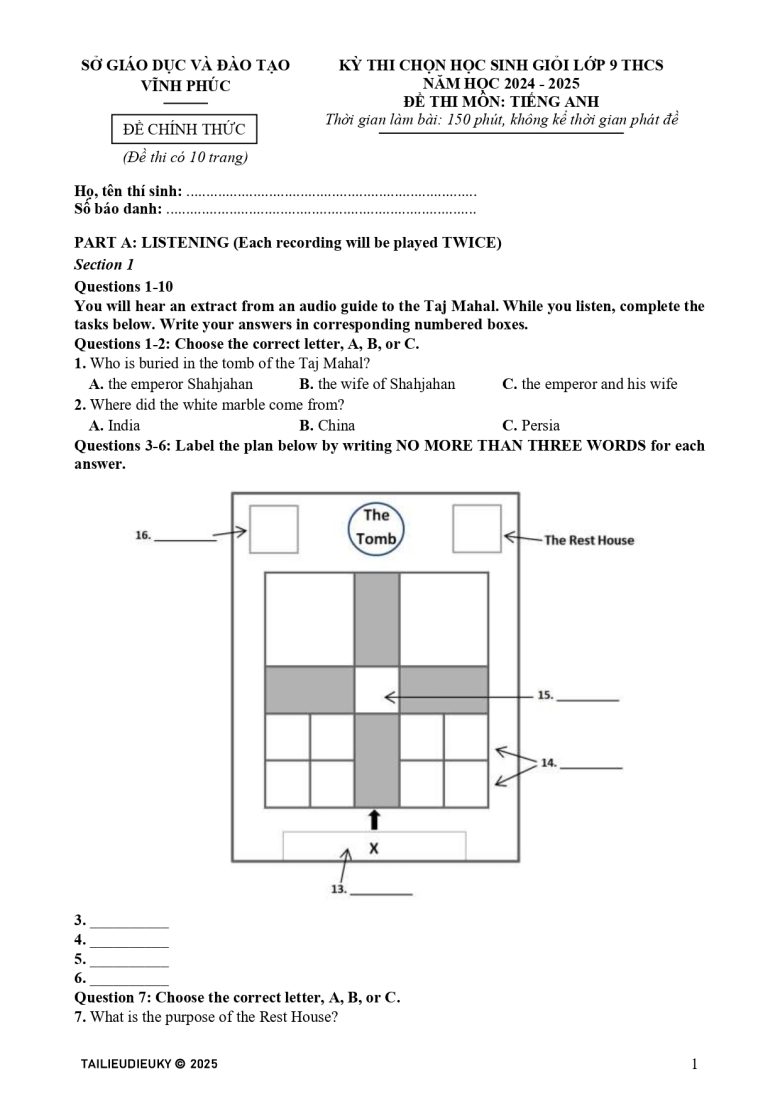
Questions 3-6: Label the plan below by writing NO MORE THAN THREE WORDS for each answer.
3. __________
4. __________
5. __________
6. __________
Question 7: Choose the correct letter, A, B, or C.
7. What is the purpose of the Rest House?
A. a place for the poor to stay
B. a meeting place for pilgrims
C. an architectural feature
Questions 8-10: Complete the flow chart below by writing NO MORE THAN TWO WORDS for each answer.
How running water is provided
Water taken from the 8. __________ by bullocks.
Water channelled into the 9. __________
Water piped to the 10. __________
Section 2
Questions 11-15
Listen to the recording and choose the correct letter, A, B, or C to complete the sentences or answer the questions that follow.
11. Dartfield House school used to be __________.
A. a tourist information centre
B. a private home
C. a local council building
12. What is planned with regard to the lower school?
A. All buildings on the main site will be improved.
B. The lower school site will be used for new homes.
C. Additional school buildings will be constructed on the lower school site.
13. The catering has been changed because of __________.
A. long queuing times
B. changes to the school timetable
C. dissatisfaction with the menus
14. Parents are asked to __________.
A. help their children to decide in advance which serving point to use
B. make sure their children have enough money for food
C. advise their children on healthy food to eat
15. What does the speaker say about the existing canteen?
A. Food will still be served there.
B. Only staff will have access to it.
C. Pupils can take their food into it.
Section 3
Questions 16-25
You will listen to part of a radio talk for young people about animals communicating with each other. For questions 16-25, write NO MORE THAN THREE WORDS taken from the recording for each answer in the space provided.
Bees do a (16) __________ to communicate where to find food.
Although parrots seem to speak, they are only (17) __________ the human sounds.
Primates can communicate a few (18) __________ using simple sounds.
Monkeys have not been observed to use any kind of (19) __________.
Although dolphins can make vowel sounds, they cannot accurately imitate our (20) __________.
Amazingly, dolphins demonstrate (21) __________ of when phrases should be used.
The sounds made by whales contain (22) __________ than human speech.
The songs of the bottle-nosed whale have many of the (23) __________ of human speech.
The unique grammatical nature of human language arose due to life in (24) __________.
Indeed, a young child needs enough (25) __________ with other people to develop speech.
PART B: LEXICO-GRAMMAR
Section 1: Choose the correct option marked A, B, C, or D to complete the following sentences. Write your answers in corresponding numbered boxes.
1. Mike would prefer to pursue his studies __________ to look for a job.
A. rather than starting B. to starting
C. rather than start D. than to start
2. __________ more carefully, he would not have had the accident yesterday.
A. If Peter driven B. If had Peter driven
C. Had Peter driven D. Unless Peter had driven
3. According to the fire chief, it still isn’t clear where the fire __________ but he believes that it might have started in the storeroom.
A. started B. starts C. had started D. has started
4. __________ a sharp bend ahead, Jack pressed hard on the brake pedal to slow down.
A. Having seen B. To have seen C. Seen D. To see
5. My father supposes, __________, that he will be retiring at 60.
A. like most people did B. like most people do
C. as do most people D. as most of people
6. David was deported on account of his expired visa. He __________ it renewed.
A. must have had B. should have had C. needn’t have had D. mightn’t have had
7. Of the two new teachers, one is experienced and __________.
A. the others are not B. another is inexperienced
C. the other is not D. other lack experience
8. If the size of the workforce can be easily and rapidly altered __________ market fluctuations, profits will be maximized.
A. in terms of B. in response to C. in reply to D. with respect to
9. __________ as taste is really a composite sense made up of both taste and smell.
A. That we refer to B. What we refer to C. To which we refer D. What do we refer to
10. __________, 70 per cent alcohol is more effective than 100 per cent alcohol.
A. An antiseptic used B. When used as an antiseptic
C. An antiseptic when used D. How an antiseptic is used
11. – Nancy: “Are you going to buy a new computer or just continue using the old one?”
– Mary: “__________”
A. That’s impossible. B. Yes, I’d like one. Thank you.
C. Yes, I am. D. Neither. I am going to lease one.
12. – Ken: “Didn’t you go to the conference?” – Rosie: “__________”
A. No, I went there with my friends. B. That sounds nice, but I can’t.
C. Don’t worry. I’ll go there. D. I did, but I didn’t stay long.
13. __________ individuals are those who share the same hobbies, interests, or points of view.
A. Light-hearted B. Like-minded C. Even-handed D. Open-minded
14. My daughter has a very sunny __________, unlike my son who is often moody and uncommunicative.
A. behaviour B. condition C. disposition D. nurture
15. My decision to leave university after a year is the one I now __________ regret.
A. harshly B. painfully C. keenly D. heavily
16. He __________ laughing when he realized his mistake.
A. held up B. turned down C. broke into D. burst out
17. It’s essential to __________ deadlines when we work in a fast-paced industry.
A. meet B. manage C. reach D. fulfil
18. It __________ me as strange that my front door was open when I got home.
A. seemed B. occurred C. appeared D. struck
19. The job requires excellent communication skills and an ability to think on your __________.
A. teeth B. feet C. hands D. lips
20. You will have to __________ if you want to pass the final exam.
A. pull your socks up B. work miracles
C. burn your fingers D. keep your hand in
Section 2. Supply the correct form of the word in brackets. Write your answers in corresponding numbered boxes.
21. I must say that Mike is __________. He has a great ability to make quick and effective decisions in very challenging situations. (DECIDE)
22. His boss told him off because he had behaved __________. (RESPONSIBLE)
23. The athlete strode __________ towards the starting line, knowing that he could win the race. (PURPOSE)
24. __________ children often have poor concentration and require very little sleep. (ACTIVE)
25. Police will have all of the pictures __________ in an attempt to identify the thieves. (LARGE)
26. The teacher gave the children a detailed __________ of the story. (EXPLAIN)
27. The bottled water is carefully checked to remove any __________. (PURE)
28. This statue __________ the soldiers who died in the war. (MEMORY)
29. The sun and the moon are often __________ in poetry. (PERSON)
30. It is hard to argue with the suggestion that happy workers are more productive or that cutting stress at work will reduce __________. (ABSENCE)
Section 3. Choose the underlined part that needs correction in each of the following questions, then correct them. Write your answers in corresponding numbered boxes.
31. Please (A) remain in (B) your seat until the plane (C) will come to a (D) complete stop.
32. I never let my sons (A) eat (B) many junk food (C) because it has some adverse effects (D) on their health.
33. There were a (A) number of excellent poems (B) entered for the competition, but the (C) better poem of (D) all was written by a ten-year-old boy.
34. The Green campaign has had (A) such great an impact on people around the world that they (B) have started to (C) clean up their surrounding (D) polluted areas.
35. (A) Some snakes have hollow teeth (B) they are called fangs that they (C) use to poison (D) their victims.
36. Police (A) said the thieves were (B) obviously well acquainted (C) of the alarm (D) system at the department store.
37. The (A) architects have made (B) imaginary use of glass and (C) transparent (D) plastic up to now.
38. Given its recent (A) cancellations of (B) numerous flights, many people have (C) expressed doubts about the (D) reliance of the airline.
39. It’s a very (A) permissible school where the (B) children are (C) allowed to do (D) whatever they want.
40. Public speaking is (A) quite a (B) frightening experience for many people as it can produce a (C) status of mind similar to (D) panic.
PART C. READING
Section 1. Read the following passage and decide which answer (A, B, C, or D) best fits each gap. Write your answers in corresponding numbered boxes.
THE VACUUM CLEANER
Until about 250 years ago, households did not take dirt (1) __________ they do now – it was a fact of life, and that was that. Cleaning often consisted of an annual ritual called ‘spring cleaning’ when the furniture was moved aside, and all the linen products in the house were cleaned. Carpets and rugs were taken outside, hung on ropes and had the dust (2) __________ out of them – an exhausting and messy process.
The industrial revolution brought about a major change – as new products became available to make homes cleaner, a corresponding interest in ‘domestic hygiene’ appeared in households. This in turn led to the development of further products, (3) __________ was the vacuum cleaner.
(4) __________ has it that when one of the first vacuum cleaners was demonstrated, a kindly scientist took the proud inventor aside and (5) __________ a bit of advice that was to become crucial to the future evolution of the product – ‘make it suck, not blow’.
The first vacuum cleaners appeared in the 1860s in the United States. They were operated by hand pumps and were almost as (6) __________ as spring cleaning. It was only when electric motors had become sufficiently (7) __________ to become portable that vacuum cleaners became common household items. Most of today’s major (8) __________- including Electrolux and Hoover – were born in the 1920s.
The household dirt that vacuum cleaners suck up is (9) __________ dead skin cells – humans shed millions of cells every day. A much smaller proportion comes from dust and soil (10) __________ into the house from outside.
1. A. as seriously as B. as serious as C. more serious than D. more seriously
2. A. cleaned B. taken C. beaten D. sucked
3. A. most of which B. one of them C. which D. one of which
4. A. Story B. Epic C. Legend D. Tale
5. A. offers B. offered C. offering D. to offer
6. A. laborious B. hard C. nefarious D. straining
7. A. scientific B. forward C. technological D. advanced
8. A. brand B. marks C. makes D. trademarks
9. A. much B. the most C. utmost D. mostly
10. A. that carried B. carried C. carrying D. carry
Section 2. Read the following passage and think of a word which best fits each space. Use only ONE word for each space. Write your answers in corresponding numbered boxes.
When does a word become a word? For the staff of the Oxford English Dictionary, it is not a philosophical question, (11) __________ a practical one. Words are space, time and money. A researcher at Kingston University, London, recently described his fascination at discovering a vault full of millions of “non words” (12) __________ failed to make the grade. They included “wurfing”, the act of (13) __________ the Internet at work; “polkadogde”, the awkward dance performed by pedestrians trying to pass (14) __________ other on the street; and “nonversation”, a pointless chat. “What you have to remember,” says Fiona McPherson, senior editor of the OED’s new words group, “is that once a word has gone into the dictionary, it never comes out. So words have to pass a (15) __________ basic tests before they can be deemed to have (16) __________ the language. They have to have been around a reasonable amount of time and be in (17) __________ use.”
First published in 1928, after a gestation (18) __________ of more than 50 years, the OED is authoritative, scholarly, but never complete. As soon as the original dictionary was completed, work began on a second edition, published in 1989. New editions keep on being scheduled for (19) __________ without delay. “The internet has made our work both easier and harder,” says McPherson. “Being able to store words electrically is godsend. On the other hand, there are (20) __________ many potential outlets for new words that it is far more difficult to keep track of changes in the language.”
Section 3. Read the following passage and mark the letter A, B, C or D on your answer sheet to indicate the correct answer to each of the questions. Write your answers in corresponding numbered boxes.
In the course of its history, human inventions have dramatically increased the average amount of energy available for use per person. Primitive peoples in cold regions burned wood and animal dung to heat their caves, cook food, and drive off animals by fire. The first step toward the developing of more efficient fuels was taken when people discovered that they could use vegetable oils and animal fats in lieu of gathered or cut wood. Charcoal gave off more intensive heat than wood and was more easily obtainable than organic fats. The Greeks first began to use coal for metal smelting in the 4th century, but it did not come into extensive use until the Industrial Revolution.
In the 1700s, at the beginning of the Industrial Revolution, most energy used in the United States and other nations undergoing industrialization was obtained from perpetual and renewable sources, such as wood, water streams, domesticated animal labor, and wind. These were predominantly locally available supplies. By mid-1800s, 91 percent of all commercial energy consumed in the United States and European countries was obtained from wood. However, at the beginning of the 20th century, coal became a major energy source and replaced wood in industrializing countries. Although in most regions and climate zones wood was more readily accessible than coal, the latter represents a more concentrated source of energy. In 1910, natural gas and oil firmly replaced coal as the main source of fuel because they are lighter and, therefore, cheaper to transport. They burned more cleanly than coal and polluted less. Unlike coal, oil could be refined to manufacture liquid fuels for vehicles, a very important consideration in the early 1900s, when the automobile arrived on the scene.
By 1984, non-renewable fossil fuels, such as oil, coal, and natural gas, provided over 82 percent of the commercial and industrial energy used in the world. Small amounts of energy were derived from nuclear fission, and the remaining 16 percent came from burning direct perpetual and renewable fuels, such as biomass. Between 1700 and 1986, a large number of countries shifted from the use of energy from local sources to a centralized generation of hydropower and solar energy converted to electricity. The energy derived from non-renewable fossil fuels has been increasingly produced in one location and transported to another, as is the case with most automobile fuels. In countries with private, rather than public transportation, the age of non-renewable fuels has created a dependency on a finite resource that will have to be replaced.
Alternative fuel sources are numerous, and shale oil and hydrocarbons are just two examples. The extraction of shale oil from large deposits in Asian and European regions has proven to be labor consuming and costly. The resulting product is sulfur-and nitrogen-rich, and large-scale extractions are presently prohibitive. Similarly, the extraction of hydrocarbons from tar sands in Alberta and Utah is complex. Semi-solid hydrocarbons cannot be easily separated from the sandstone and limestone that carry them, and modern technology is not sufficiently versatile for a large-scale removal of the material. However, both sources of fuel may eventually be needed as petroleum prices continue to rise and limitations in fossil fuel availability make alternative deposits more attractive.
21. What is the main topic of the passage?
A. Application of various fuels B. Natural resources and fossil fuels
C. A history of energy use D. A historical review of energy rates
22. It can be inferred from the first paragraph that __________.
A. coal mining was essential for primitive peoples
B. the Greeks used coal in industrial productions
C. the development of efficient fuel was a gradual process
D. the discovery of efficient fuels was mostly accidental
23. The phrase in lieu in paragraph 1 is closest in meaning to __________.
A. in spite B. in place C. in every way D. in charge
24. The phrase the latter in paragraph 2 refers to __________.
A. coal B. wood C. most regions D. climate zones
25. The author of the passage implies that in the 1700s, sources of energy were __________.
A. used for commercial purposes B. used in various combinations
C. not derived from mineral deposits D. not always easy to locate
26. According to the passage, what was the greatest advantage of oil as fuel?
A. It was a concentrated source of energy.
B. It was lighter and cheaper than coal.
C. It replaced wood and coal and reduced pollution.
D. It could be converted to automobile fuel.
27. According to the passage, the sources of fossil fuels will have to be replaced because __________.
A. they need to be transported B. they are not efficient
C. their use is centralized D. their supply is limited
28. It can be inferred from the passage that in the early 20th century, energy was obtained primarily from __________.
A. fossil fuels B. nuclear fission
C. hydraulic and solar sources D. burning biomass
29. The author of the passage implies that alternative sources of fuel are currently __________.
A. being used for consumption B. being explored
C. available in few locations D. examined on a large scale
30. The word prohibitive in paragraph 4 is closest in meaning to __________.
A. prohibited B. provided C. too expensive D. too expedient
Section 4. Read the passage and do the tasks that follow.
A HISTORY OF FINGERPRINTING
A
To detectives, the answers lie at the end of our fingers. Fingerprinting offers an accurate and infallible means of personal identification. The ability to identify a person from a mere fingerprint is a powerful tool in the fight against crime. It is the most commonly used forensic evidence, often outperforming other methods of identification. These days, older methods of ink fingerprinting, which could take weeks, have given way to newer, faster techniques like fingerprint laser scanning, but the principles stay the same. No matter which way you collect fingerprint evidence, every single person’s print is unique. So, what makes our fingerprints different from our neighbour’s?
B
A good place to start is to understand what fingerprints are and how they are created. A fingerprint is the arrangement of skin ridges and furrows on the tips of the fingers. This ridged skin develops fully during foetal development, as the skin cells grow in the mother’s womb. These ridges are arranged into patterns and remain the same throughout the course of a person’s life. Other visible human characteristics, like weight and height, change over time whereas fingerprints do not. The reason why every fingerprint is unique is that when a baby’s genes combine with environmental influences, such as temperature, it affects the way the ridges on the skin grow. It makes the ridges develop at different rates, buckling and bending into patterns. As a result, no two people end up having the same fingerprints. Even identical twins possess dissimilar fingerprints.
C
It is not easy to map the journey of how the unique quality of the fingerprint came to be discovered. The moment in history it happened is not entirely clear. However, the use of fingerprinting can be traced back to some ancient civilisations, such as Babylon and China, where thumbprints were pressed onto clay tablets to confirm business transactions. Whether people at this time actually realised the full extent of how fingerprints were important for identification purposes is another matter altogether. One cannot be sure if the act was seen as a means to confirm identity or a symbolic gesture to bind a contract, where giving your fingerprint was like giving your word.
D
Despite this uncertainty, there are those who made a significant contribution to the analysis of fingerprints. History tells us that a 14th-century Persian doctor made an early statement that no two fingerprints are alike. Later, in the 17th century, Italian physician Marcello Malpighi studied the distinguishing shapes of loops and spirals in fingerprints. In his honour, the medical world later named a layer of skin after him. It was, however, an employee for the East India Company, William Herschel, who came to see the true potential of fingerprinting. He took fingerprints from the local people as a form of signature for contracts, in order to avoid fraud. His fascination with fingerprints propelled him to study them for the next twenty years. He developed the theory that fingerprints were unique to an individual and did not change at all over a lifetime. In 1880 Henry Faulds suggested that fingerprints could be used to identify convicted criminals. He wrote to Charles Darwin for advice, and the idea had referred on to Darwin’s cousin, Sir Francis Galton. Galton eventually published an in-depth study of fingerprint science in 1892.
E
Although the fact that each person has a totally unique fingerprint pattern. It had been well documented and accepted for a long time, this knowledge did not exploit for criminal identification until the early 20th century. In the past, branding, tattooing and maiming was used to mark the criminal for what he was. In some countries, thieves would have their hands cut off. France branded criminals with the fleur-de-lis symbol. The Romans tattooed mercenary soldiers to stop them from becoming deserters.
F
For many years, police agencies in the Western world were reluctant to use fingerprinting, much preferring the popular method of the time. The Bertillon System, where dimensions of certain body parts had been recorded to identify a criminal. The turning point was in 1903 when a prisoner by the name of Will West was admitted into Leavenworth Federal Penitentiary. Amazingly, Will had almost the same Bertillon measurements as another prisoner residing at the very same prison, whose name happened to be William West. It was only their fingerprints that could tell them apart. From that point on, fingerprinting became the standard for criminal identification.
G
Fingerprinting was useful in identifying people with a history of crime and who listed on a database. However, in situations where the perpetrator was not on the database and the crime had no witnesses, the system fell short. Fingerprint chemistry is a new technology that can work alongside traditional fingerprinting to find more clues than ever before. From organic compounds left behind on a print, a scientist can tell if the person is a child, an adult, a mature person, or a smoker, and much more. It seems, after all these years, fingers continue to point the way.
Questions 31-36. The reading passage has seven paragraphs, A-G. Choose the correct heading for each paragraph from the list of headings below. Write the correct number i-x in spaces 31-36.
List of Heading
i. Key people that made a difference
ii. An alternative to fingerprinting
iii. The significance of prints
iv. How to identify a criminal
v. Patterns in the making
vi. Family connections
vii. Exciting new developments
viii. A strange coincidence
ix. Punishing a criminal
x. An uncertain past
Paragraph A iii
31. Paragraph B__________
32. Paragraph C__________
33. Paragraph D__________
34. Paragraph E__________
35. Paragraph F__________
36. Paragraph G__________
Questions 37-40. Do the following statements agree with the information given in reading passage?
Write
TRUE, if the statement agrees with the information
FALSE, if the statement contradicts the information
NOT GIVEN, if there is no information on this
37. Fingerprinting is the only effective method for identifying criminals.
38. Malpighi conducted his studies in Italy.
39. Roman soldiers tattooed to prevent them from committing violent crimes.
40. Fingerprint chemistry can identify if a fingerprint belongs to an elderly person.
PART D. WRITING
Section 1. Rewrite the sentences with the given word(s) or beginning in such a way that their meanings remain unchanged.
1. In the end, I felt I had been right to take an English course last summer. (REGRETS)
In the end, I had ________________________________________ an English course last summer.
2. Our two sons have a good relationship with each other. (GET)
Our two sons __________________________________________________________ each other.
3. We had to return home because we had no money left. (RUN)
We had to _____________________________________________________________________
4. She doesn’t know whether she should find a new job. (MINDS)
She ___________________________________________________________________ new job.
5. None of us was expecting to have a test this morning. (BLUE)
This morning’s test ______________________________________________ for every one of us.
6. They say this company was one of the most reliable in the country.
This company __________________________________________________________________
7. Absolute secrecy was crucial to the success of the mission.
Without _______________________________________________________________________
8. I am sure she didn’t do it on purpose.
She can’t ______________________________________________________________________
9. His love increases with his admiration for her.
The more ______________________________________________________________________
10. Whatever happens, I will never trust him again.
Under ________________________________________________________________________
Section 2. Write an essay within 250 words on the following topic.
“Electronic devices are destroying the quality of human interaction.”
Do you agree or disagree with this statement?
———- THE END ———-