
Vừa qua, Sở GD&ĐT Nam Định đã tổ chức thành công kỳ thi chọn học sinh giỏi cấp tỉnh năm học 2024–2025 dành cho học sinh lớp 9 THCS. Nhằm hỗ trợ học sinh ôn luyện hiệu quả, Tài liệu diệu kỳ gửi tới bạn Đề HSG Tiếng Anh 9 Nam Định 2024–2025 kèm đáp án chính thức và file nghe chuẩn, giúp luyện thi sát thực tế và nâng cao kỹ năng làm bài.
Cấu trúc đề thi
Đề HSG Tiếng Anh 9 Nam Định 2024–2025 – 120 phút – 10 trang – 4 phần – 85 câu
A. Listening (5.0 điểm)
• True/False: 5 câu – 1.0 điểm
• Short answer: 5 câu – 1.0 điểm
• Multiple choice: 5 câu – 1.0 điểm
• Note completion: 10 câu – 2.0 điểm
B. Grammar & Vocabulary (5.0 điểm)
• Multiple choice: 20 câu – 2.0 điểm
• Word form: 5 câu – 1.0 điểm
• Phrasal verbs: 5 câu – 1.0 điểm
• Error correction: 5 câu – 1.0 điểm
C. Reading (5.0 điểm)
• Cloze test: 10 câu – 1.0 điểm
• Reading MCQ: 10 câu – 2.0 điểm
• Matching headings: 5 câu – 1.0 điểm
• True/False/Not Given: 5 câu – 1.0 điểm
D. Writing (5.0 điểm)
• Sentence transformation: 5 câu – 1.0 điểm
• Sentence rewrite (key word): 5 câu – 1.0 điểm
• Sentence transformation nâng cao: 5 câu – 1.0 điểm
• Essay: 1 bài – 2.0 điểm
👇 Hãy tải xuống toàn bộ đề thi, đáp án Sở GD&ĐT Nam Định và File nghe tại đây:
📥 TẢI: Đề thi + Đáp án + File nghe
Chúc bạn chinh phục thành công mọi thử thách trong hành trình thi HSG!
Tags: #DeHSGTiengAnh9 #DeHSGTiengAnh9NamDinh #HSGTiengAnh9 #DeThiTiengAnh9 #OnThiHSG #DeThiCoDapAn #FileNgheTiengAnh
Đáp án Sở GD&ĐT
SỞ GIÁO DỤC VÀ ĐÀO TẠO NAM ĐỊNH
KỲ THI CHỌN HỌC SINH GIỎI CẤP TỈNH NĂM HỌC 2024 – 2025
ĐÁP ÁN & HƯỚNG DẪN CHẤM MÔN TIẾNG ANH 9
________________________________________
SECTION A: LISTENING (5.0 pts)
Part 1: True/False (1.0 pt)
1. F
2. T
3. F
4. F
5. T
Part 2: Short answers (1.0 pt)
6. (an) office manager
7. (a) special interview
8. (for) three / 3 hours
9. (a) suspected terrorist
10. (to) return home
Part 3: Multiple choice (1.0 pt)
11. B
12. A
13. C
14. A
15. C
Part 4: Note completion (2.0 pts)
16. gene
17. snowy fur
18. (the) old-growth rainforest
19. erosion
20. feeding habits
21. roads
22. fishing
23. reproduction
24. method(s)
25. expansion
________________________________________
SECTION B: GRAMMAR & VOCABULARY (5.0 pts)
Part 1: Multiple choice (2.0 pts)
1. A
2. C
3. C
4. D
5. A
6. C
7. C
8. B
9. B
10. A
11. B
12. B
13. D
14. C
15. D
16. C
17. B
18. D
19. A
20. D
Part 2: Word forms (1.0 pt)
1. inspiration
2. innovative
3. expand
4. immeasurably
5. misjudged
Part 3: Phrasal verbs (1.0 pt)
1. to keep off
2. put out
3. bring about
4. stepping down
5. taken in
Part 4: Error correction (1.0 pt)
1. that → those
2. them → whom
3. their → its
4. imaginary → imaginative
5. using → used
________________________________________
SECTION C: READING (5.0 pts)
Part 1: Gap fill (1.0 pt)
1. B
2. B
3. C
4. D
5. A
6. A
7. D
8. B
9. C
10. A
Part 2: Multiple choice (2.0 pts)
1. D
2. B
3. A
4. B
5. D
6. C
7. C
8. D
9. A
10. D
Part 3: Matching & True/False/NG (2.0 pts)
1. ii
2. i
3. v
4. vi
5. iii
6. True (T)
7. False (F)
8. True (T)
9. False (F)
10. Not Given (NG)
________________________________________
SECTION D: WRITING (5.0 pts)
Part 1: Sentence transformation (1.0 pt)
1. It’s about time you began thinking about your future.
2. Jane accused her brother of breaking / having broken her vase the previous day / the day before.
3. Such was his enthusiasm that he apparently ignored any warning signs.
4. Reserved as / though he looks, he has a marked sense of humour.
5. It can’t have been Mr. Phong you saw yesterday because he was in Hanoi.
Part 2: Sentence transformation (given word) (1.0 pt)
1. There is no possibility of his having finished before next week.
2. The use of the car park is restricted to official members.
3. My laptop is at your disposal whenever you want.
4. It never crossed my mind that we would have legal problems.
5. It is important to know how to draw the line between a joke and a lie.
Part 3: Sentence rewriting (1.0 pt)
1. If he had not always been late for work, he would not have lost his job.
2. He is thought to have invented the story to protect his girlfriend.
3. Unemployment is likely to rise in the next few years.
4. I was under the impression (that) you wanted me to invite him.
5. He couldn’t account for the difference between the two sets of instructions.
Part 4: Essay (2.0 pts)
Topic: Mass tourism poses a great threat to natural wonders.
Criteria:
• Bố cục (0.4)
• Phát triển ý (0.8)
• Ngôn ngữ (0.4)
• Ngữ pháp, chính tả (0.4)
________________________________________
— THE END —
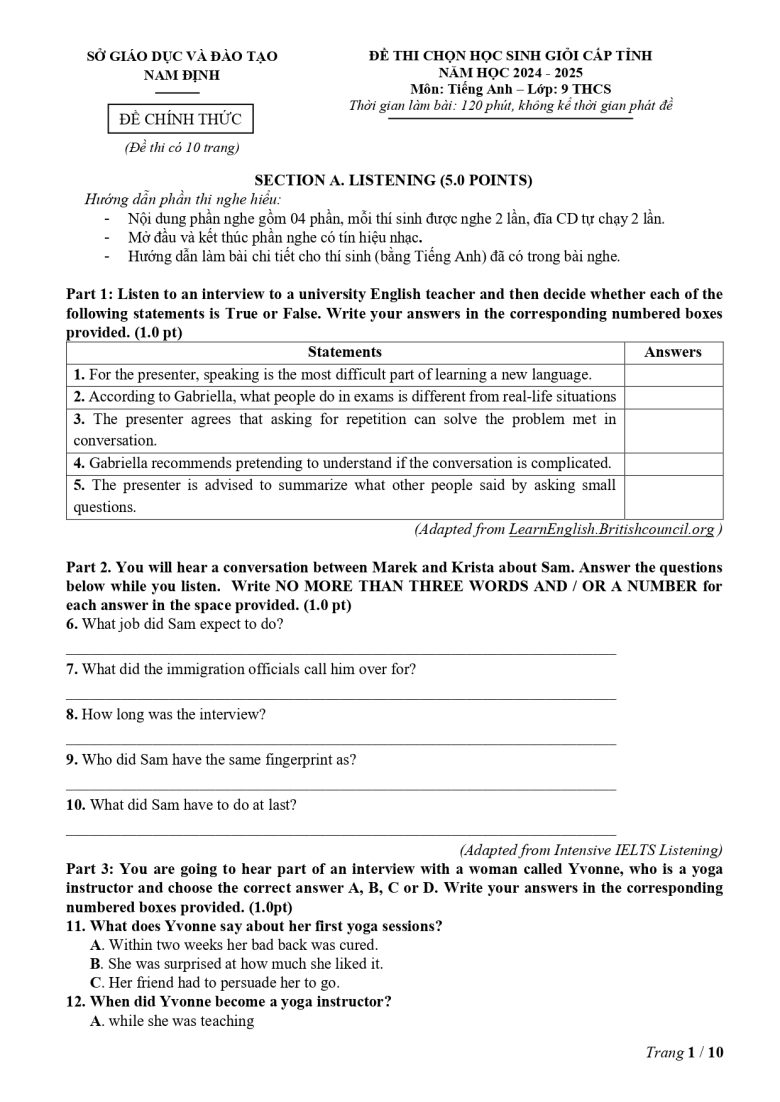
SỞ GIÁO DỤC VÀ ĐÀO TẠO
NAM ĐỊNH
(Đề thi có 10 trang) ĐỀ THI CHỌN HỌC SINH GIỎI CẤP TỈNH
NĂM HỌC 2024 – 2025
Môn: Tiếng Anh – Lớp: 9 THCS
Thời gian làm bài: 120 phút, không kể thời gian phát đề
SECTION A. LISTENING (5.0 POINTS)
Hướng dẫn phần thi nghe hiểu:
– Nội dung phần nghe gồm 04 phần, mỗi thí sinh được nghe 2 lần, đĩa CD tự chạy 2 lần.
– Mở đầu và kết thúc phần nghe có tín hiệu nhạc.
– Hướng dẫn làm bài chi tiết cho thí sinh (bằng Tiếng Anh) đã có trong bài nghe.
Part 1: Listen to an interview to a university English teacher and then decide whether each of the following statements is True or False. Write your answers in the corresponding numbered boxes provided. (1.0 pt)
Statements Answers
1. For the presenter, speaking is the most difficult part of learning a new language.
2. According to Gabriella, what people do in exams is different from real-life situations
3. The presenter agrees that asking for repetition can solve the problem met in conversation.
4. Gabriella recommends pretending to understand if the conversation is complicated.
5. The presenter is advised to summarize what other people said by asking small questions.
(Adapted from LearnEnglish.Britishcouncil.org )
Part 2. You will hear a conversation between Marek and Krista about Sam. Answer the questions below while you listen. Write NO MORE THAN THREE WORDS AND / OR A NUMBER for each answer in the space provided. (1.0 pt)
6. What job did Sam expect to do?
______________________________________________________________________
7. What did the immigration officials call him over for?
______________________________________________________________________
8. How long was the interview?
______________________________________________________________________
9. Who did Sam have the same fingerprint as?
______________________________________________________________________
10. What did Sam have to do at last?
______________________________________________________________________
(Adapted from Intensive IELTS Listening)
Part 3: You are going to hear part of an interview with a woman called Yvonne, who is a yoga instructor and choose the correct answer A, B, C or D. Write your answers in the corresponding numbered boxes provided. (1.0pt)
11. What does Yvonne say about her first yoga sessions?
A. Within two weeks her bad back was cured.
B. She was surprised at how much she liked it.
C. Her friend had to persuade her to go.
12. When did Yvonne become a yoga instructor?
A. while she was teaching
B. after she had graduated from university
C. after renting a room in a leisure center
13. How has Yvonne’s health benefited from doing yoga?
A. Her memory has improved.
B. Her stress levels have fallen.
C. Her blood pressure has improved.
14. What does Yvonne say about healthy eating?
A. We should take our time when eating.
B. We should avoid foods like biscuits and chocolate.
C. Local produce usually costs more.
15. According to Yvonne, where are you likely to get the best advice about yoga?
A. from a local school B. from an instructor C. from someone who has done yoga
(Adapted from Listening tests for B1)
Your answers:
11. 12. 13. 14. 15.
Part 4: Listen and complete the notes below. Write NO MORE THAN THREE WORDS for each answer in the space provided. There is an example at the beginning (0). (2.0pts)
THE SPIRIT BEAR
General facts
• It is a (0) white bear belonging to the black bear family.
• Its colour comes from an uncommon (16) ____________________.
• Local people believe that it has unusual power due to its (17) ____________________.
• They protect the bear from strangers.
Habitat
• The bear’s relationship with (18) ____________________ is complex.
• Tree roots prevent (19) ____________________ along salmon streams.
• The bear’s (20) ____________________ provide nutrients for forest vegetation.
• It is currently found on a small number of islands.
Threats
• Deforestation and construction of (21) ____________________ lead to the loss of many hibernation sites.
• Unlimited (22) ____________________ is affecting the salmon supply.
• The bears’ existence is also threatened by their low rate of (23) ____________________.
Going forward
• Interested parties are working together.
• Logging companies must improve their (24) ____________________ of logging.
• Maintenance and (25) ____________________ of the spirit bears’ habitat is needed.
(Adapted from IELTS Cambridge 10)
SECTION B. GRAMMAR AND VOCABULARY (5.0 POINTS)
Part 1. Choose the letter A, B, C or D to indicate the correct answer to each of the following sentences. Write your answers in the corresponding numbered boxes provided. (2.0 pts)
Question 1. Hoa said that they could buy ticket to “Anh trai say Hi” concert, _______?
A. didn’t she B. did she C. could they D. couldn’t they
Question 2. She joined the local tennis club, _______ members were teenagers.
A. most of B. most of its C. most of whose D. most of whom
Question 3. _______ have made communication faster and easier through the use of email and Internet is widely recognized.
A. That it is computers B. Computers that
C. That computers D. It is that computers
Question 4. Tim was forced to leave his job but he got a generous golden _______.
A. airlock B. guesswork C. scoreboard D. handshake
Question 5: There are _______ environmental problems that not only the governments but also individuals should join hands to tackle.
A. such a lot of B. too many C. so few D. such plenty
Question 6. There is no excuse for your late submission! You _______ have finished the assignment by last Monday.
A. must B. will C. should D. might
Question 7. _______ uncovered, the balcony will be ruined in this weather.
A. Leaving B. Having left C. Left D. To be left
Question 8. The idea for the latest novel _______ from a drawing the writer discovered in the attic.
A. agreed B. evolved C. managed D. transported
Question 9. Many a _______ it difficult to avoid the interference of mass media in their life.
A. pop star find B. pop star finds C. pop stars find D. pop stars finds
Question 10. I don’t like turning down work, but I’ll have to, I’m afraid I’ve got far too much _______ at the moment.
A. on my plate B. in my shoes C. on my mind D. up my sleeve
Question 11. It’s very _______ of you to offer me your seat, but really I’m quite happy to stand
A. sympathetic B. considerate C. expressive D. appreciative
Question 12. The company’s dedication _______ customer satisfaction has earned it a great reputation.
A. for B. to C. with D. on
Question 13. New York and Tokyo are two of the most _______ – populated cities in the world.
A. greatly B. deeply C. closely D. densely
Question 14. He can afford to buy _______ house next month.
A. a modern brick big B. a brick big modern
C. a big modern brick D. a modern big brick
Question 15. Mary has trouble _______ her homework.
A. to remember B. to remembering C. remember D. remembering
Question 16. The clients demanded that the post office _______ earlier.
A. opening B. opened C. open D. to open
Question 17. He didn’t know anyone at the wedding _______ than the bride and the groom.
A. except B. other C. apart D. rather
Question 18. There’s somebody behind us. I think we _______.
A. are following B. follow C. have followed D. are being followed
Question 19. This is _______ the most difficult job I’ve ever had to do.
A. by far B. by chance C. by heart D. by myself
Question 20: Circle the letter A, B, C or D to indicate the best arrangement of utterances or sentences to make a meaningful exchange or conversation.
a. That’s a great idea! Using flyers and posters is an effective way to capture students’ attention.
b. Hey John, we need to finalize how we will promote our upcoming concert. We want a good turnout, but it’s a small event aimed at students.
c. How about flyers and posters? We could put them up around the school.
d. Hmm, emails can be easily ignored.
e. You’re right. We needn’t spend a lot of money on advertising. We could send an email to everyone in the school.
A. b-c-d-e-a B. b-e-a-c-d C. b-c-a-d-e D. b-e-d-c-a
(Adapted from Global Success Speaking)
Your answers:
1. 2. 3. 4. 5. 6. 7. 8. 9. 10.
11. 12. 13. 14. 15. 16. 17. 18. 19. 20.
Part 2. Give the correct form of the words in the capital letters. Write your answers in the blanks.
(1.0pt)
Question 1. Dreams can be a rich source of ___________________ for an artist. (INSPIRE)
Question 2. The scientist was praised for her __________________ research on climate change. (INNOVATE)
Question 3. The company plans to ______________ its operations to new international markets. (EXPANSE)
Question 4. Housing standards improved __________________ after war. (MEASURE)
Question 5. He ____________________ the distance and his ball landed in the lake. (JUDGE)
Part 3. Fill in each space provided in each sentence below with the correct form of one phrasal verb given. Each phrasal verb can be used ONCE only. Write your answers in the blanks. (1.0 pt)
leave out step down bring about keep off
take in cut off put out
Question 1. The doctor advised Mr. Jones _________________ fatty foods in order to protect his heart.
Question 2. You have to ____________________ your cigarette because smoking isn’t allowed in here.
Question 3. Hard work can often ____________________ success.
Question 4. The CEO had every intention of _________________ after 10 years of leading the company.
Question 5. The man on the phone claimed to be a policeman, but the old woman ___________________.
Part 4. Each of the following sentences has 1 mistake that needs correction. Write the mistake and its correction in the provided box. There is an example at the beginning (0) (1.0 point)
Question 0. He collided with a car because he was driving too fastly.
Question 1. It is thought that the duties of a policeman are more dangerous than that of a teacher.
Question 2. There are 50 teachers at my school, many of them have a good command of English.
Question 3. An octopus has three hearts to pump blood throughout their body.
Question 4. His imaginary essay won the judges’ approval and the first prize in the school contest.
Question 5. For thousands of years, man has created sweet-smelling substances from herbs and using them for perfume.
Your answers:
Sentences Mistake Correction
Question 0 Fastly fast
Question 1
Question 2
Question 3
Question 4
Question 5
SECTION C. READING (5.0 POINTS)
Part 1. Read the following passage and decide which answer A, B, C or D best fits each gap. Write your answers in the corresponding numbered boxes provided. (1.0pt)
Those who opt for a vegetarian diet must usually weigh up a variety of aspects concerning the nutritional value of vegetables and the adequacy of vegetarian meals in terms of the number of (1) ______ provided to the body. Vegetarianism is not a new concept, rather an ancient custom which evolved in the Far East cultures on ethical or religious grounds.
In today’s world, it has been undertaken by many followers (2) ______ for a variety of reasons believe the vegetarian diet more preferable to that containing meat. For example, there’s the theory that animal meat wasn’t originally a component of the staple human diet (3) ______ mankind evolved from foragers who later (4) ______ a taste for flesh. Hence, our primeval ancestors are alleged to have had a substantial (5) ______ of proteins and vitamins from natural vegetation rather than from the meat of hunted game. What’s more, human teeth don’t (6) ______ much resemblance to those of animal carnivores, and neither is our digestive system (7)______ to the meat eaters’ one.
(8) ______ the enforced vegetarianism of underdeveloped communities where populations deprived of animal protein fall back on the natural vegetation, there’s a rising acceptance of the vegetarian diet which ceases to be regarded as an eccentricity. Abstention from animal food, be it for religious, economic or humanitarian reasons, has been a (9) ______ spreading custom as, surprisingly, the vegetarian diet needn’t be dull or deficient. Yet, it does involve taking good value to supply the body with a sufficient quantity of nutrients derived (10) ______ corn, seeds and cereals.
(Adapted from FCE-Use of English)
Question 1. A. nutrients B. servings C. cuisines D. products
Question 2. A. who B. whom C. which D. what
Question 3. A. so B. but C. and D. as
Question 4. A. received B. acquired C. denoted D. managed
Question 5. A. output B. offset C. upturn D. intake
Question 6. A. infer B. assume C. bear D. pertain
Question 7. A. equivalent B. consequential C. repetitive D. synonymous
Question 8. A. Contrary to B. Prior to C. Apart from D. Regardless of
Question 9. A. vastly B. quickly C. mainly D. largely
Question 10. A. to B. off C. from D. at
Your answers:
1. 2. 3. 4. 5. 6. 7. 8. 9. 10.
Part 2. Read the following passages and choose the letter A, B, C or D to indicate the correct answer to each question. Write your answers in the corresponding numbered boxes provided. (2.0pts)
Pollution is the degradation of natural environment by external substances introduced directly or indirectly. Human health, ecosystem quality and aquatic and terrestrial biodiversity may be affected and altered permanently by pollution. [I] In recent years, plastic pollution in the ocean has emerged as a severe environmental issue. [II] Each year, over eight million tons of plastic waste end up in our oceans, impacting marine life and ecosystems worldwide. [III] Single-use plastic items, such as bottles, bags, and packaging, are among the main culprits, as they break down into tiny particles known as microplastics. [IV]
One major consequence of ocean plastic pollution is its impact on marine animals. Sea creatures, including fish, turtles, and seabirds, often mistake plastic for food, leading to severe health problems or even death. Ingested plastic can block digestive tracts, reduce feeding, and ultimately cause starvation. Additionally, animals can become entangled in larger plastic debris like fishing nets and plastic rings, which restrict their movement and may lead to injuries or drowning. This not only affects individual animals but can also disrupt entire marine food chains and ecosystems.
Plastic pollution also has indirect effects on human health and economies. As fish and other marine animals ingest microplastics, these tiny particles move up the food chain and eventually reach humans. Consuming seafood contaminated with microplastics poses potential health risks, as harmful chemicals can accumulate in our bodies. Furthermore, polluted beaches and coastlines can deter tourism, impacting local economies that rely on these industries for jobs and income. Cleanup efforts are costly and challenging, often requiring substantial resources and funding.
To address ocean plastic pollution, governments, organizations, and individuals must work together. Policies such as banning single-use plastics, promoting recycling, and encouraging sustainable alternatives can help reduce the amount of plastic waste entering the ocean. Many individuals and organizations are already participating in beach cleanups and spreading awareness about the issue. By making conscious choices and taking responsibility, we can mitigate the impacts of plastic pollution and protect our oceans for future generations.
(Adapted from: https://www.biologicaldiversity.org)
Question 1: Where in paragraph 1 does the following sentence best fit?
These microplastics are now found in all ocean depths, from surface waters to the seafloor, posing a serious threat to marine biodiversity.
A. [I] B. [II] C. [III] D. [IV]
Question 2: Which of the following is TRUE according to the passage?
A. Most plastic waste ends up in our oceans, damaging marine life and the ecosystem.
B. Plastic pollution is a severe issue, impacting marine animals and humans’ health
C. Single-use plastics items break down into tiny biodegradable particles.
D. Microplastics accumulate only in shallow waters, affecting coastal marine life.
Question 3: Which of the following best summarises paragraph 2?
A. Sea creatures and the entire marine ecosystem are negatively affected by plastic pollution.
B. Plastic is mistaken for food, causing danger to sea creatures’ health or even death.
C. Sea creatures may be injured or drown when they are entangled in fishing nets
D. Ingested plastic can block digestive tracts of sea creatures, leading to a reduction in feeding.
Question 4: The phrase “entangled in” in paragraph 2 could be best replaced by _______
A. escaped from B. twisted in C. protected from D. engaged in
Question 5: The word “their” in paragraph 2 refers to _______.
A. plastic debris B. fishing nets C. plastic rings D. animals
Question 6: According to paragraph 3, which of the following is NOT a consequence of plastic pollution?
A. Microplastics ingested by marine animals encroach the food chain.
B. Seafood contaminated with microplastics poses health risks to humans.
C. Polluted beaches and coastlines do harm to tourists and local economies.
D. Plastic pollution leads to increased cleanup costs for coastal areas.
Question 7: The word “substantial” in paragraph 3 is OPPOSITE in meaning to _______
A. considerable B. noticeable C. negligible D. massive
Question 8: Which of the following best paraphrases the underlined sentence in paragraph 4?
A. Humans can reduce the causes of plastic pollution and make our oceans safe for future generations by increasing our awareness.
B. Taking immediate action for the environment will help protect future generations from plastic pollution and keep our oceans clean.
C. The influence of plastic pollution can be eliminated, and oceans can be defended when humans are responsible and sensible.
D. Taking responsibility and thoughtful actions enable humans to alleviate plastic pollution and safeguard oceans.
Question 9: Which of the following can be inferred from the passage?
A. Collective actions are essential to effectively reduce ocean plastic pollution.
B. Banning single-use plastics is the most effective action in resolving plastic pollution.
C. Reducing plastic waste in oceans mostly depends on cleanups campaigns.
D. Individuals and organizations share equal roles in spreading awareness about the issue.
Question 10: Which of the following best summarises the passage?
A. Plastic waste in oceans endangers marine species and impacts humans’ health through contaminated seafood, with cleanup efforts essential to managing the effects.
B. Ocean plastic pollution poses risks to marine animals, damages tourism, and leads to costly cleanup efforts, which can be addressed by increased awareness and individuals’ actions.
C. Plastic waste in oceans affects both marine life and coastal communities; individuals’ actions, like reducing single-use plastics, can help address the problem.
D. Ocean plastic pollution harms marine life and influences humans’ health and local economies, requiring collaborative efforts to promote sustainable practices.
Your answers:
1. 2. 3. 4. 5. 6. 7. 8. 9. 10.
Part 3. Read the following passage and do the tasks that follow. (2.0pts)
The City and the Natural Environment
A. While cities and their metropolitan areas have always interacted with and shaped the natural environment, it is only recently that historians have begun to consider this relationship. During our own time, the tension between natural and urbanized areas has increased, as the spread of metropolitan populations and urban land uses has reshaped and destroyed natural landscapes and environments.
B. The relationship between the city and the natural environment has actually been circular, with cities having massive effects on the natural environment, while the natural environment, in turn, has profoundly shaped urban configurations. Urban history is filled with stories about how city dwellers contended with the forces of nature that threatened their lives. Nature not only caused many of the annoyances of daily urban life, such as bad weather and pests, but it also gave rise to natural disasters and catastrophes such as floods, fires, and earthquakes. In order to protect themselves and their settlements against the forces of nature, cities built many defences including flood walls and dams, earthquake-resistant buildings, and storage places for food and water. At times, such protective steps sheltered urbanites against the worst natural furies, but often their own actions – such as building under the shadow of volcanoes, or in earthquake-prone zones – exposed them to danger from natural hazards.
C. City populations require food, water, fuel, and construction materials, while urban industries need natural materials for production purposes. In order to fulfill these needs, urbanites increasingly had to reach far beyond their boundaries. In the nineteenth century, for instance, the demands of city dwellers for food produced rings of garden farms around cities. In the twentieth century, as urban populations increased, the demand for food drove the rise of large factory farms. Cities also require fresh water supplies in order to exist – engineers built waterworks, dug wells deeper and deeper into the earth looking for groundwater, and dammed and diverted rivers to obtain water supplies for domestic and industrial uses. In the process of obtaining water from distant locales, cities often transformed them, making deserts where there had been fertile agricultural areas.
D. Urbanites had to seek locations to dispose of the wastes they produced. Initially, they placed wastes on sites within the city, polluting the air, land, and water with industrial and domestic effluents. As cities grew larger, they disposed of their wastes by transporting them to more distant locations. Thus, cities constructed sewerage systems for domestic wastes. They usually discharged the sewage into neighboring waterways, often polluting the water supply of downstream cities.
The air and the land also became dumps for waste disposal. In the late nineteenth century, coal became the preferred fuel for industrial, transportation, and domestic use. But while providing an inexpensive and plentiful energy supply, coal was also very dirty. The cities that used it suffered from air contamination and reduced sunlight, while the cleaning tasks of householders were greatly increased.
E. In the late nineteenth and early twentieth centuries, reformers began demanding urban environmental cleanups and public health improvements. Women’s groups often took the lead in agitating for clean air and clean water, showing a greater concern than men in regard to quality of life and health-related issues. The replacement of the horse, first by electric trolleys and then by the car, brought about substantial improvements in street and air sanitation. The movements demanding clean air, however, and reduction of waterway pollution were largely unsuccessful. On balance, urban sanitary conditions were probably somewhat better in the 1920s than in the late nineteenth century, but the cost of improvement often was the exploitation of urban hinterlands for water supplies, increased downstream water pollution, and growing automobile congestion and pollution.
F. In the decades after the 1940s, city environments suffered from heavy pollution as they sought to cope with increased automobile usage, pollution from industrial production, new varieties of chemical pesticides and the wastes of an increasingly consumer-oriented economy. Cleaner fuels and smoke control laws largely freed cities during the 1940s and 1950s of the dense smoke that they had previously suffered from. Improved urban air quality resulted largely from the substitution of natural gas and oil for coal and the replacement of the steam locomotive by the diesel-electric. However, great increases in automobile usage in some larger cities produced a new phenomenon of smog, and air pollution replaced smoke as a major concern.
(Adapted from https://www.ielts-writing.info/EXAM)
Questions 1-5. Reading Passage has six sections, A-F. Choose the correct heading for each section from the list of headings below. There are more headings than sections.
List of Headings
i. Legislation brings temporary improvements
ii. The increasing speed of suburban development
iii. A new area of academic interest
iv. The impact of environmental extremes on city planning
v. The first campaigns for environmental change
vi. Building cities in earthquake zones
vii. The effect of global warming on cities
viii. Adapting areas surrounding cities to provide resources
ix. Removing the unwanted by-products of city life
x. Providing health information for city dwellers
Your answers
Example: Paragraph A iii
1. Paragraph B _______
2. Paragraph C _______
3. Paragraph D _______
4. Paragraph E _______
5. Paragraph F _______
Questions 6-10: Do the following statements agree with the information given in Reading Passage? Write your answers in the boxes provided.
TRUE if the statement is true according to the passage
FALSE if the statement is false according to the passage
NOT GIVEN if the information is not given in the passage
Statements Answer
Question 6. Urbanites did nothing to defend themselves against natural disasters.
Question 7. In the nineteenth century, water was brought into the desert to create productive farming land.
Question 8. Women were often the strongest campaigners for environmental reform.
Question 9. Reducing urban air and water pollution in the early twentieth century was extremely expensive.
Question 10: The availability of cars led to increased pollution in urban areas.
SECTION D. WRITING (5.0 points)
Part 1. Finish each of the following sentences in such a way that it means exactly the same as the
first sentence, using the cues at the beginning of each sentence. Question (0) is an example. (1.0 pt)
Question 0. Our summer holiday lasts three months.
We have a three- month summer holiday.
Question 1. You really should begin thinking about your future.
It’s about ________________________________________________________________________.
Question 2. “It was your fault to break my vase yesterday” said Jane to her brother.
Jane accused _____________________________________________________________________.
Question 3. He was so enthusiastic that he apparently ignored any warning signs.
Such ____________________________________________________________________________.
Question 4. Although he looks reserved, he has a marked sense of humour.
Reserved _________________________________________________________________________.
Question 5. I am sure it wasn’t Mr. Phong you saw yesterday because he was in Hanoi.
It can’t __________________________________________________________________________.
Part 2. Complete the second sentence so that it has the same meaning as the first one, using the word given. Do not change the given words in brackets. You must use NO MORE THAN FIVE WORDS, including the given word. Question (0) is an example (1.0 pt)
Question 0. I would rather not go out this afternoon. (GOING)
I don’t feel like going out this afternoon.
Question 1. He certainly won’t have finished before next week. (POSSIBILITY)
There is _________________________________________________ finished before next week.
Question 2. He owed his success to his uncle. (INDEBTED)
He was ______________________________________________________________ his success.
Question 3. I have more work than I can manage at the moment. (SNOWED)
I am _______________________________________________________ at the moment.
Question 4. I never thought that we would have legal problems. (CROSSED)
It __________________________________________________ that we would have legal problems.
Question 5. It is important to know the difference between a joke and a lie. (DRAW)
It is important to know __________________________________________ between a joke and a lie.
Part 3. Rewrite the following sentence with the given words in such a way that the second sentence has the same meaning as the first one. Do not change the form of the words in brackets. Question (0) is an example (1.0 pt)
Question 0. They say Linda won a special prize. (HAVE)
Linda is said to have won a special prize.
Question 1. He was dismissed because he was always late for work. (LOST)
If he had not _____________________________________________________________________.
Question 2. People think he invented the story to protect his girlfriend. (HAVE)
He is ___________________________________________________________________________.
Question 3. Unemployment will probably rise in the next few years. (LIKELY)
Unemployment ___________________________________________________________________.
Question 4. I thought you wanted me to invite him. (IMPRESSION)
I was ___________________________________________________________________________.
Question 5. He couldn’t explain the difference between the two sets of instructions. (ACCOUNT)
He couldn’t ______________________________________________________________________.
Part 4. Write an essay (about 180 -200 words) on the following topic. (2.0 pts)
Some people think that students should learn with teachers all the time to achieve success. Others think that it is better for students to spend time learning by themselves.
What is your opinion? Use specific reasons to develop your essay.
—THE END—