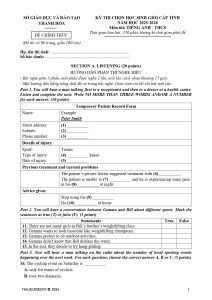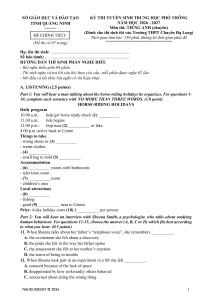

Kỳ thi tuyển sinh vào lớp 10 THPT tỉnh Lào Cai năm học 2026–2027 đã chính thức khép lại trong tháng 5/2026 với sự tham gia tranh tài của gần 24.000 thí sinh. Trong đó, đề thi môn Tiếng Anh chuyên luôn nhận được sự quan tâm đặc biệt từ học sinh, phụ huynh và giáo viên bởi tính phân loại cao.
Bài viết dưới đây sẽ phân tích chi tiết cấu trúc đề thi năm nay, đồng thời cung cấp link tải trọn bộ đề Chuyên Anh Lào Cai 2026-2027 có đáp án hoàn toàn miễn phí để các em học sinh khóa sau lấy làm tài liệu ôn tập hữu ích.
Đề Tuyển sinh vào lớp 10 THPT tỉnh Lào Cai – Tiếng Anh chuyên – 28/05/2026 – 08 trang – 4 phần – 106 câu
A. Listening – 2,0 điểm: 3 phần, 20 câu: hoàn thành ghi chú (10); ghép người nói với ý kiến (5); chọn đáp án A–D (5).
B. Language in Use – 3,0 điểm: 4 phần, 40 câu/lỗi: từ vựng & ngữ pháp (20); Word Formation (10); sửa lỗi sai (5); sắp xếp câu/đoạn (5).
C. Reading – 3,0 điểm: 4 phần, 35 câu: Multiple-choice Cloze (10); Open Cloze (10); đọc hiểu trắc nghiệm (5); True/False & Sentence Completion (10).
D. Writing – 2,0 điểm: 3 phần, 11 câu/bài: viết lại câu (5); viết lại với từ cho sẵn (5); Essay Writing khoảng 220 từ (1 bài).
Chúc các sĩ tử ôn thi hiệu quả và đạt được kết quả cao trong kỳ thi tuyển sinh lớp 10 sắp tới! Đừng quên chia sẻ bài viết này nếu bạn thấy hữu ích nhé!
Đáp án
I. LISTENING (2.0 điểm)
Part 1 (1-10):
1. 20 minutes
2. 15
3. actors
4. child
5. music
6. English
7. script
8. characters
9. comedy
10. Hyslop
Part 3 (1-5):
1. A
2. C
3. B
4. C
5. D
II. LANGUAGE IN USE (3.0 điểm)
Part 1 (1-20):
1. A
2. D
3. B
4. C
5. A
6. B
7. D
8. A
9. B
10. C
11. A
12. A
13. D
14. C
15. D
16. C
17. B
18. A
19. A
20. A
Part 2 (1-10):
1. culturally
2. noticeable
3. consumption
4. substantial
5. Additionally
6. contributors
7. exceptionally
8. increasingly
9. Fortunately
10. reliance
Part 3 (1-5):
1. who → which
2. 14-years-old → 14-year-old
3. addicted → addictive
4. automatic → automatically
5. provides → provide
Part 4 (1-5):
1. A
2. B
3. A
4. C
5. D
III. READING (3.0 điểm)
Part 1 (1-10):
1. A
2. B
3. C
4. D
5. B
6. D
7. C
8. D
9. B
10. C
Part 2 (1-10):
1. go
2. While / Although
3. given
4. based
5. with
6. cause / do
7. as
8. on
9. who
10. not
Part 3 (1-5):
1. D
2. A
3. C
4. A
5. B
Part 4:
1. FALSE
2. FALSE
3. TRUE
4. TRUE
5. FALSE
6. troposphere
7. arid deserts
8. mid-latitude rivers
9. specialized statistical technique
10. Africa’s rivers
IV. WRITING (2.0 điểm)
Part 1 (1-5):
1. The media is said to have a profound impact on teen behavior.
2. Not until the blackout occurred did he realize the importance of saving energy.
3. Exhausted as/though they were, the rescue team members kept on searching for survivors.
4. So ambitious is he that he will do anything to succeed in his career.
5. No sooner had the new law been passed than pollution levels started to drop.
Part 2 (1-5):
1. You should not have ignored the doctor’s advice.
2. The local authorities are looking into the cause of the landslide.
3. My dad is insistent on the heater being turned off before our bedtime // that the heater (should) be turned off before our bedtime.
4. Mary was green with envy when she saw her sister’s new doll.
5. There has been a significant increase in tourism in Viet Nam over the last decade.
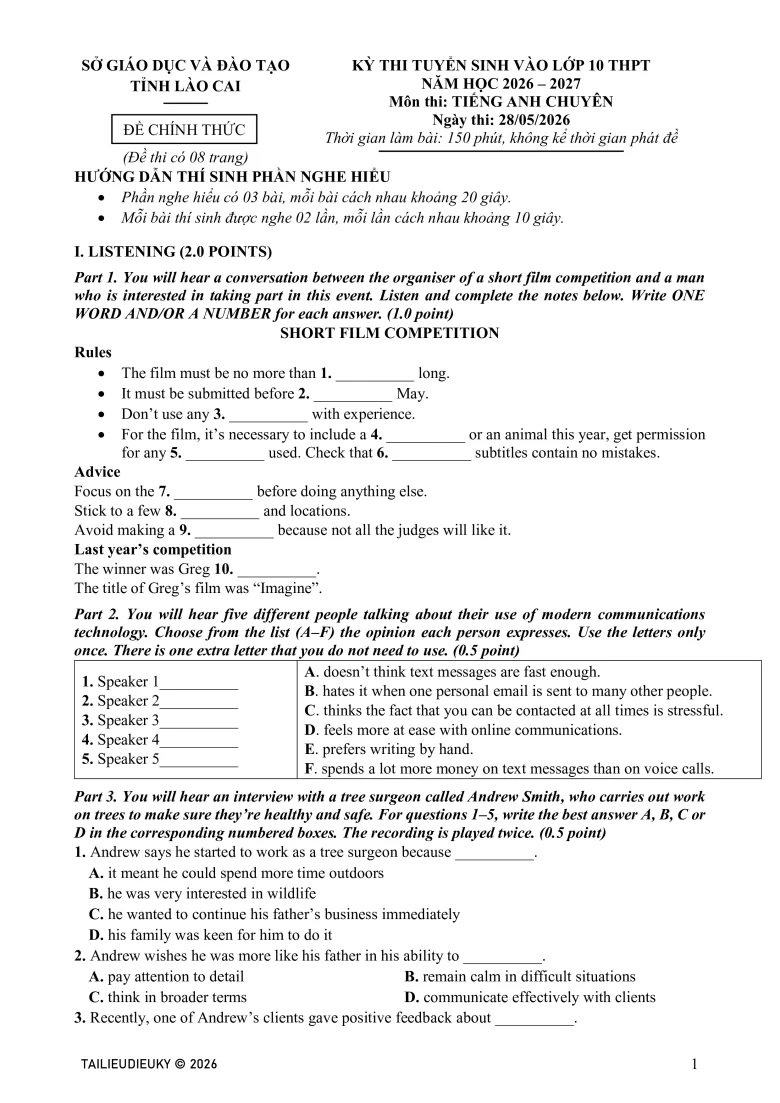
SỞ GIÁO DỤC VÀ ĐÀO TẠO
TỈNH LÀO CAI
(Đề thi có 08 trang) KỲ THI TUYỂN SINH VÀO LỚP 10 THPT
NĂM HỌC 2026 – 2027
Môn thi: TIẾNG ANH CHUYÊN
Ngày thi: 28/05/2026
Thời gian làm bài: 150 phút, không kể thời gian phát đề
HƯỚNG DẪN THÍ SINH PHẦN NGHE HIỂU
• Phần nghe hiểu có 03 bài, mỗi bài cách nhau khoảng 20 giây.
• Mỗi bài thí sinh được nghe 02 lần, mỗi lần cách nhau khoảng 10 giây.
I. LISTENING (2.0 POINTS)
Part 1. You will hear a conversation between the organiser of a short film competition and a man who is interested in taking part in this event. Listen and complete the notes below. Write ONE WORD AND/OR A NUMBER for each answer. (1.0 point)
SHORT FILM COMPETITION
Rules
• The film must be no more than 1. __________ long.
• It must be submitted before 2. __________ May.
• Don’t use any 3. __________ with experience.
• For the film, it’s necessary to include a 4. __________ or an animal this year, get permission for any 5. __________ used. Check that 6. __________ subtitles contain no mistakes.
Advice
Focus on the 7. __________ before doing anything else.
Stick to a few 8. __________ and locations.
Avoid making a 9. __________ because not all the judges will like it.
Last year’s competition
The winner was Greg 10. __________.
The title of Greg’s film was “Imagine”.
Part 2. You will hear five different people talking about their use of modern communications technology. Choose from the list (A–F) the opinion each person expresses. Use the letters only once. There is one extra letter that you do not need to use. (0.5 point)
1. Speaker 1__________
2. Speaker 2__________
3. Speaker 3__________
4. Speaker 4__________
5. Speaker 5__________ A. doesn’t think text messages are fast enough.
B. hates it when one personal email is sent to many other people.
C. thinks the fact that you can be contacted at all times is stressful.
D. feels more at ease with online communications.
E. prefers writing by hand.
F. spends a lot more money on text messages than on voice calls.
Part 3. You will hear an interview with a tree surgeon called Andrew Smith, who carries out work on trees to make sure they’re healthy and safe. For questions 1–5, write the best answer A, B, C or D in the corresponding numbered boxes. The recording is played twice. (0.5 point)
1. Andrew says he started to work as a tree surgeon because __________.
A. it meant he could spend more time outdoors
B. he was very interested in wildlife
C. he wanted to continue his father’s business immediately
D. his family was keen for him to do it
2. Andrew wishes he was more like his father in his ability to __________.
A. pay attention to detail B. remain calm in difficult situations
C. think in broader terms D. communicate effectively with clients
3. Recently, one of Andrew’s clients gave positive feedback about __________.
A. how clearly he communicated
B. how quickly the job was completed
C. how knowledgeable he was
D. how carefully he protected the neighbour’s property
4. What does Andrew like most about his job?
A. being part of a team
B. having the opportunity to keep learning
C. doing something useful for the local community
D. spending time in natural environments
5. Andrew says the worst part of his job is having to __________.
A. work in bad weather B. use heavy electrical equipment
C. tidy things up D. deal with paperwork
II. LANGUAGE IN USE (3.0 POINTS)
Part 1. Choose the best answer A, B, C, or D to complete the sentence in each of the following questions. Write your answers in the corresponding numbered boxes provided. (1 point)
1. By the time you get home tonight, I __________ dinner for the whole family.
A. will have cooked B. have cooked C. cook D. am cooking
2. Giant pandas __________ critically endangered in the wild, and breeding them in captivity has proved difficult.
A. considered B. consider C. have considered D. are considered
3. Living in a skyscraper __________ the park provides a sense of peace amidst the noise.
A. to overlook B. overlooking C. overlooked D. overlooks
4. Had it not been for your timely help, I __________ the deadline yesterday.
A. didn’t meet B. hadn’t met C. wouldn’t have met D. wouldn’t meet
5. I’ll call you __________ the final news about the result.
A. the moment I hear B. when I will hear C. until I hear D. after I heard
6. Among the students in my class, Peter is __________ not only in school subjects but also in outdoor activities.
A. most active B. the most active C. the more active D. as active
7. Many old customs have been __________ from generation to generation in this rural area.
A. given up B. broken out C. turned off D. passed down
8. Never before __________ such a spectacular firework display.
A. have I seen B. I have seen C. did I see D. I saw
9. __________ in 2024, the bridge is now the longest in the entire region.
A. Having completed B. Completed C. Completing D. To complete
10. Everything is ready for the upcoming field trip to the museum, __________?
A. aren’t they B. are they C. isn’t it D. is it
11. __________ you follow the instructions, you will be able to assemble the device easily.
A. Provided that B. Unless C. Even though D. While
12. Many schools now __________ digital tools into their teaching lessons to engage students.
A. incorporate B. eliminate C. separate D. ignore
13. The ideas __________ in this essay are not particularly original.
A. discussing B. are discussed C. are discussing D. discussed
14. I think you are __________ if you say this unrealistic plan will work.
A. making a scene B. speaking the truth C. pulling my leg D. giving a hand
15. I’d rather you __________ so much noise while I’m trying to study for the finals.
A. don’t make B. won’t make C. not make D. didn’t make
16. Environmentalists are __________ pressure on the government to ban single-use plastics.
A. giving B. doing C. putting D. making
17. In the past, the __________ tulips became so expensive that people exchanged their bulbs for houses.
A. Dutch fashionable red B. fashionable red Dutch
C. red fashionable Dutch D. fashionable Dutch red
18. Not only have e-buses reduced emissions, __________.
A. but they have improved air quality in densely populated urban areas as well
B. they also have improved air quality in densely populated urban areas
C. but as well they have improved air quality in densely populated urban areas
D. but also have they improved air quality in densely populated urban areas
19. Choose the word which is CLOSEST in meaning to the underlined and bold part:
Recent feedbacks of his work from many schoolmates have raised his esteem.
A. respect B. disregard C. disrespect D. guilt
20. Choose the word which is OPPOSITE in meaning to the underlined and bold part:
Hung is in a class of his own in our school because of his high proficiency in English.
A. ordinary B. outstanding C. different D. exceptional
Part 2. Give the correct form of each given word to complete the following text. Write your answers in the corresponding boxes provided. (1 point)
Many traditional and modern festivals, though 1. __________ (CULTURE) significant, often cause considerable harm to the environment. They are held in fragile natural environments, where the impact of large crowds is even more 2. __________ (NOTICE). These events typically attract large crowds, which lead to increased waste generation, higher energy 3. __________ (CONSUME), and significant carbon emissions. For instance, the widespread use of disposable plastics, single-use items, and non-recyclable materials at festivals results in a 4. __________ (SUBSTANCE) amount of waste, much of which ends up creating huge landfills or, worse, pollutes oceans and rivers. 5. __________ (ADD), the energy required to power stages, sound systems, and lighting is typically sourced from fossil fuels, which contribute to global warming through the release of greenhouse gases.
One of the main 6. __________ (CONTRIBUTE) to the environmental impact of festivals is transportation. Many attendees who travel long distances by car, bus, or even plane, create 7. __________ (EXCEPT) high amount of carbon footprint. The influx of attendees also strains local resources like water, food supplies, and waste management services. Festivals held in natural or rural environments can be 8. __________ (INCREASE) damaging, as large crowds trample fragile ecosystems, disturb wildlife, and leave behind litter. These ecosystems are often not resilient enough to recover quickly, leading to long-term consequences for local biodiversity and community sustainability. If festivals do not take responsibility for their impact, these consequences could worsen over time.
9. __________ (FORTUNE), there are several practical solutions to make festivals more environmentally friendly. One of the most effective strategies is to use renewable energy sources, such as solar or wind power, to run festival operations. This shift could drastically reduce carbon emissions compared to the 10. __________ (RELY) on traditional, non-renewable energy sources. Moreover, festival organisers can introduce stricter waste management system, encouraging visitors to reduce the waste left behind.
Part 3. There are FIVE mistakes in the following passage. Identify the mistakes and write the corrections in the corresponding numbered boxes. (0.5 point)
Parents already have controls over smartphones – they should use them.
Nick Price points out the features on Apple and Android phones that can help parents keep their children safe. A crucial facility seems to be missing from the coverage of smartphones in schools – and outside. Parental controls, who both Apple and Android have, enable downtimes to be set to ensure phones don’t work in school. They can also set downtimes for outside school and block inappropriate apps. We use these for our 14-years-old daughter to keep her safe and manage the addicted effects of phone use. Her phone automatic switches off in school time and closes down for the day at 6.30 pm. Maybe more effort should be put into supporting all parents to use available tools to manage their children’s phone use. It’s parents that provides them with phones after all.
Part 4. Choose the letter A, B, C, or D to indicate the best arrangement of utterances or sentences to make a meaningful exchanges or text in each of the following questions. Write your answers in the corresponding numbered boxes provided. (0.5 point)
1.
a. Tom’s Dad: No, you can’t. It’s late now.
b. Tom: Can I watch one more film, Dad?
c. Tom: Oh, please! Just this once?
A. b-a-c B. c-a-b C. a-b-c D. b-c-a
2.
a. Mark: Don’t worry! We’ll get there quickly.
b. Daisy: Oh, thank you so much, Mark! That would really help because I still have a long way to walk.
c. Mark: You are welcome! Where are you taking them?
d. Daisy: I have to bring them to the library before it closes. I was afraid that I couldn’t make it in time.
e. Mark: Hello Daisy, you look tired. Would you like me to help you carry those heavy books?
A. c-d-e-b-a B. e-b-c-d-a C. a-d-c-b-e D. e-d-a-b-c
3.
Dear Mom and Dad,
a. The teacher said this trip will help us improve teamwork skills and learn more about nature.
b. May I go on the trip? I promise to be careful and follow all the rules.
c. My class is planning a trip to the national park next Sunday.
d. I know you care about my safety, but everything has been arranged carefully.
e. There will be some team building activities and a guided tour.
Love,
Anna
A. c-a-e-d-b B. e-b-c-d-a C. a-d-c-b-e D. e-d-a-b-c
4.
a. Further, in addition to posing an electrical hazard, stretching wires across walkways creates a tripping hazard.
b. The most common types of injuries are slips, trips and fall.
c. Boxes, files and other items piled in walkways can create a tripping hazard.
d. Thus, make sure the wires are properly secured and covered.
e. Be certain that all the items are safely stored in their proper location to prevent build-up of clutter.
A. b-d-c-e-a B. b-d-e-a-c C. b-c-e-a-d D. b-a-d-c-e
5.
a. This in turn has an impact on how to process basic information mentally when the workers are at work.
b. For example, computers in one form or another perform many of the tasks that people used to do themselves such as office functions, opening and locking doors.
c. People generally are losing traditional practical skills which they need to function in everyday life.
d. This has come about, in my opinion, because people are now so over-reliant on machines.
e. Consequently, workers cannot do basic practical tasks in depth.
A. c-b-d-e-a B. c-d-e-a-b C. c-a-b-d-e D. c-d-b-e-a
III. READING (3.0 POINTS)
Part 1. Read the following passage and decide which answer (A, B, C, or D) best fits each gap. Write your answers in the corresponding numbered boxes. (0.5 points)
Everybody loves a joke, right? But what if the joke is on you? That is what nine unwitting “thrill-seekers” will eventually discover, having signed up for the experience of a 1. __________ – to be blasted off 2. __________ space in a new reality TV series, Space Cadets. It is, in fact, an elaborate and very expensive hoax. The nine contestants – 3. __________ three actors planted to help the action along – think that they are undergoing training in Russia, but in reality they’re in the south of England. They believe themselves to be 4. __________ against each other for four places on a Space Shuttle flight, but the truth is, they will not leave the ground. Their “spaceship” will be a prop from a science fiction film, and the flight itself just an illusion created by special 5. __________. But is watching a hoax of this kind legitimate entertainment or just exploitation? Practical jokes by their very nature tend to involve a certain amount of cruelty, 6. __________ they are designed to make the victim feel foolish. But where do you draw the line 7. __________ a bit of a laugh and something really nasty? British comedian Arthur Smith says that, in his opinion, drawn-out hoaxes go too 8. __________. “I quite like the idea of briefly fooling a friend, but on an enormous 9. __________ like this, it’s cruel. The greatest experience of your life is suddenly taken away from you, and you discover that you’ve been laughed at for weeks.” Although practical jokes are cruel, they remain popular because we 10. __________ pleasure in the misfortune of others, according to psychologists. Basically, we enjoy watching other people look stupid because that makes us feel clever.
1. A. lifetime B. life C. living D. livelihood
2. A. at B. into C. onto D. from
3. A. together B. altogether C. plus D. moreover
4. A. wrestling B. winning C. trying D. competing
5. A. results B. effects C. causes D. tricks
6. A. if B. although C. but D. as
7. A. among B. from C. between D. to
8. A. strong B. long C. big D. far
9. A. extent B. scale C. degree D. scope
10. A. do B. suffer C. take D. amuse
Part 2. Fill each of the following numbered blanks with ONE suitable word. Write your answers in the corresponding numbered boxes provided. (1.0 point)
Young people who seek support online being accused of ‘sadfishing’
Vulnerable young people who 1. __________ online to seek support can find themselves being bullied and accused of “sadfishing”, a report has said.
2. __________ many find comfort by sharing their experiences, some young people are being targeted and accused of exaggerating their problems in order to gain attention – a social media phenomenon that has been 3. __________ the mocking name of sadfishing.
A report by Digital Awareness UK (DAUK) 4. __________ on face-to-face interviews with 50,000 schoolchildren says young people are becoming tech-savvy and are increasingly using technology 5. __________ responsibility and common sense. But it says that accusations of so-called sadfishing could 6. __________ more harm to already vulnerable children and young people with mental health problems.
Sadfishing evolved as a term after celebrities such 7. __________ the reality star Kendall Jenner were accused of posting exaggerated claims about their problems in order to attract attention and followers 8. __________ social media.
“DAUK is concerned about the number of students 9. __________ are bullied for sadfishing, thus exacerbating what could be a serious mental health problem,” the report said. “We have noticed that students are often left feeling disappointed by 10. __________ getting the support they need online.”
Part 3. Read the passage below and choose the letter A, B, C or D to indicate the correct answer to each of the questions. Write your answers in the corresponding numbered boxes provided. (0.5 point)
An usual personal challenge
A few years ago, on a flight to New Zealand, I watched the film Everest, in which adventurers get stuck on the mountain in a tremendous snowstorm. I immediately knew I had to start climbing. It’s not the reaction most people have, because almost everyone in the film meets a tragic end; I think I just needed to do some adventurous things. And six months later I climbed my first mountain, Mount Whitney in California, 4,421m high.
In 2017, I decided to climb the highest peak in every European country – officially 49 mountains – in one year. Only a handful of people had ever managed this feat. Though I’d never been a serious adventurer, I’d always been encouraged by my father to be active outdoors. I just wanted to be a role model for girls and get across to them that someone ordinary like me could climb mountains. It seemed there was a good story for someone to tell.
In Holland, Belgium and Denmark, the highest peaks are really just small hills. It didn’t seem right to call it climbing but I hiked up them regardless. I didn’t do any special preparation for the most challenging mountain, which was Mount Elbrus in Russia, Europe’s highest at 5,642m. I knew that would be an exhausting climb, but I thought I’d get fit for it by climbing the others, and I did. I made an itinerary, starting in Switzerland with Dufourspitze (4,634m), but a snowstorm made me cancel. So I went to Spain instead. After that, I planned around the climate conditions. I did two big mountain tours around Europe and the rest I did on weekends.
Climbing mountains is an experience that’s hard to put into words. You’re in a beautiful environment and, when you reach the top, you feel incredible. But then you have to climb down, which is when most accidents happen – people are tired, it gets dark, it’s harder. I don’t climb mountains that I know I’m not really up to tackling. I wouldn’t climb Mount Everest tomorrow, but each mountain I climb takes me on to the next one.
I wanted to end the project at home, on Sweden’s Kebnekaise (2,095m). It has two peaks: the north is rocky and the south, which was always the higher one, is glacial. But with climate change, the south peak has been melting, and two days after I climbed it, the north became the higher summit, so I did that as my final climb, taking a photographer to record the moment. Once I reached the top he took a number of photos, and that in a way reminded me of being at work – I’m a fashion photographer. It didn’t feel as special as I’d hoped. But when I posted the results on social media and people congratulated me, I felt proud.
1. The word feat in paragraph 2 could be best replaced by __________?
A. peak B. adventure C. height D. achievement
2. What was Emma’s aim in climbing the highest peak in each European country?
A. to show young women that they could take on big challenges
B. to achieve something that hardly anyone had done before
C. to make her father feel that she had listened to his advice
D. to provide her with material for a book she was planning
3. In the third paragraph, Emma explains that she discovered the importance of __________.
A. making sure she was in good shape physically before she set out
B. sticking to her travel plan no matter what else was happening
C. taking the likely weather into account when arranging trips
D. starting with the highest mountains and working her way down
4. What do we learn about Emma in the fourth paragraph?
A. She is aware of her own limitations and will not go beyond them.
B. She is sad that she cannot describe her feelings more imaginatively.
C. She is very ambitious and wants to progress quickly to the highest peaks.
D. She is conscious of being careless sometimes when descending mountains.
5. What does it in the fifth paragraph mean?
A. the north peak B. the south peak
C. the summit which is rocky D. the higher summit after the ice melted
Part 4. Read the passage and do the tasks that follow. Write your answers in the corresponding numbered boxes provided. (1.0 point)
The Future of the Global Hydrological Cycle
A. Veteran climate modeler Syukuro Manabe and colleagues at Princeton University recently modelled what effect a quadrupling of atmospheric carbon dioxide (CO2) above pre-industrial levels would have on the global hydrological cycle over the next 300 years. While this simulation looks much further ahead than most conventional climate models, the researchers warn that this extreme scenario is fast becoming inevitable unless governments worldwide take drastic and immediate action to limit greenhouse gas emissions.
B. According to the Princeton team, rising CO2 levels will trigger higher temperatures not only at the Earth’s surface, but also deep within the troposphere. By factoring this atmospheric warming into their models, alongside projected changes to levels of water vapour, cloud cover, solar radiation, and ozone, the team predicted the precise effects that climate change would have on global evaporation and precipitation. The researchers discovered that both elements would increase, consequently causing the total discharge of fresh water from rivers around the world to rise by almost 15 per cent. However, while water is going to be more plentiful in regions that already possess an abundance, the net effect of this shift will be to take the world’s water further away from where human populations are actually concentrated.
C. “Water stresses will increase significantly in regions that are already relatively dry,” Manabe reports in the journal Climate Change. Evaporation will severely reduce the moisture content of soils in many semi-arid parts of the world, including north-east China, the grasslands of Africa, the Mediterranean, and the southern and western coasts of Australia. For example, soil moisture is projected to fall by up to 40 per cent in the southern states of the United States.
D. The effects on the world’s rivers will be just as dramatic, but highly unequal. The most substantial increases in river flow will occur in the thinly populated tropics and the far north of Canada and Russia. For instance, the flow of the river Ob in Siberia is projected to increase by 42 per cent by the end of the 23rd century. This particular prediction could encourage Russia’s historical plans to divert Siberian rivers in order to irrigate the arid deserts surrounding the Aral Sea. Similarly, such ecological changes could increase political pressure from the US for Canada to allow water transfers from its giant Pacific rivers to water the increasingly parched American West. Manabe’s model also predicts a 47 per cent increase in the flow of the Yukon river.
E. By contrast, there will be significantly lower flows in many mid-latitude rivers which run through heavily populated regions. Those that will start to decline include the Mississippi, the Mekong, and especially the Nile – one of the world’s most heavily utilized and politically contested rivers – where the Princeton model predicts an 18 per cent fall in water flow. These massive geographical shifts will present a “profound challenge” to the world’s water managers, Manabe says. They are also highly likely to fuel global calls for a new generation of engineering projects, such as super-dams and massive canals to move water round the planet, mirroring China’s current scheme to transfer water between its north and south.
F. Some of the team’s findings, however, remain controversial within the scientific community. The UK Met Office’s own climate model predicts that water flows in the Amazon could actually fall during this century, whereas Manabe’s team predicts greater rainfall could increase its flow by 23 per cent. Furthermore, while Manabe foresees a 49 per cent increase in the flow of the Ganges and Brahmaputra rivers that drain the Himalayas, a separate international study reported that the Ganges would eventually lose its flow as the mountain glaciers that feed it melt away entirely.
G. Meanwhile, a team of researchers in France argue that climate change is not just a future threat, but is already actively affecting the world’s rivers today. David Labat and his colleagues at the government’s CNRS research agency in Toulouse painstakingly reconstructed the monthly discharges of more than 200 of the world’s largest rivers dating back to 1875. They utilized historical discharge data held by the Global Runoff Data Centre in Germany and the UNESCO River Discharge Database, applying a specialized statistical technique to fill in historical gaps left by missing data or artificial changes to run-off caused by human dams and irrigation projects. Their findings reveal that changing global temperatures cause river flows to rise and fall after a specific time delay of about 15 years. The French team predicts that global river flows will increase by about 4 per cent for every 1°C rise in global temperature. However, climate change over the past few decades has already caused modern discharge from rivers in North America, South America, and Asia to increase. Conversely, while run-off in Europe has remained relatively stable, the flow of water from Africa’s rivers has already suffered a noticeable fall.
Questions 1–5
Do the following statements agree with the information given in the Reading Passage?
In boxes 1–5 on your answer sheet, write:
• TRUE if the statement agrees with the information
• FALSE if the statement contradicts the information
1. Manabe’s climate simulation examines a shorter time frame into the future than the majority of other models.
2. An increase in global river discharge will directly benefit the areas where most people live.
3. The moisture level of soil in the southern part of the US is expected to drop by up to 40 per cent.
4. The UK Met Office and Manabe’s team hold conflicting views regarding the future water flow of the Amazon.
5. According to the French research team, river flows respond immediately to changes in global temperatures.
Questions 6–10
Complete the sentences below.
Choose NO MORE THAN THREE WORDS AND/OR A NUMBER from the passage for each answer.
Write your answers in boxes 6–10 on your answer sheet.
6. Rising levels of carbon dioxide will lead to temperature increases on the Earth’s surface as well as in the __________.
7. Russia might revive its intentions to redirect Siberian rivers to provide water for the __________ near the Aral Sea.
8. Due to climate change, a decrease in flow is expected for a number of __________ located in regions which contain dense populations.
9. To resolve the issue of incomplete historical records, the French team employed a __________ to replace the missing data.
10. Although river discharge in Europe has shown no significant change, water flows of __________ have already decreased.
IV. WRITING (2.0 POINTS)
Part 1. Rewrite each of the following sentences in such a way that it has the same meaning as the printed above sentence. (0.5 point)
1. It is said that the media has a profound impact on teen behavior.
The media _____________________________________________________________________
2. He didn’t realize the importance of saving energy until the blackout occurred.
Not until ______________________________________________________________________
3. Although they were exhausted, the rescue team members kept on searching for survivors.
Exhausted _____________________________________________________________________
4. He is so ambitious that he will do anything to succeed in his career.
So ___________________________________________________________________________
5. As soon as the new law was passed, pollution levels started to drop.
No ___________________________________________________________________________
Part 2. Rewrite each of the following sentences with the given words in such a way that the second sentence has the same meaning as the first one. DO NOT CHANGE the form of the words given. (0.5 point)
1. It was a mistake for you to ignore the doctor’s advice. (SHOULD)
You __________________________________________________________ the doctor’s advice.
2. The local authorities are investigating the cause of the landslide. (LOOKING)
The local authorities ________________________________________ the cause of the landslide.
3. My dad demands that the heater should be turned off before our bedtime. (INSISTENT)
My dad _______________________________________________ the heater before our bedtime.
4. Mary was really jealous when she saw her sister’s new doll. (GREEN)
Mary ________________________________________________________ her sister’s new doll.
5. Tourism has increased significantly in Viet Nam over the last decade. (INCREASE)
There ______________________________________________ in Viet Nam over the last decade.
Part 3. Essay writing (1.0 point)
Some people say that members of a family now are not as close to each other as they were in the past. Do you agree or disagree with the statement?
You should write an essay of about 220 words. Give reasons for your answers and include any relevant examples from your own knowledge or experience.
———- THE END ———-