
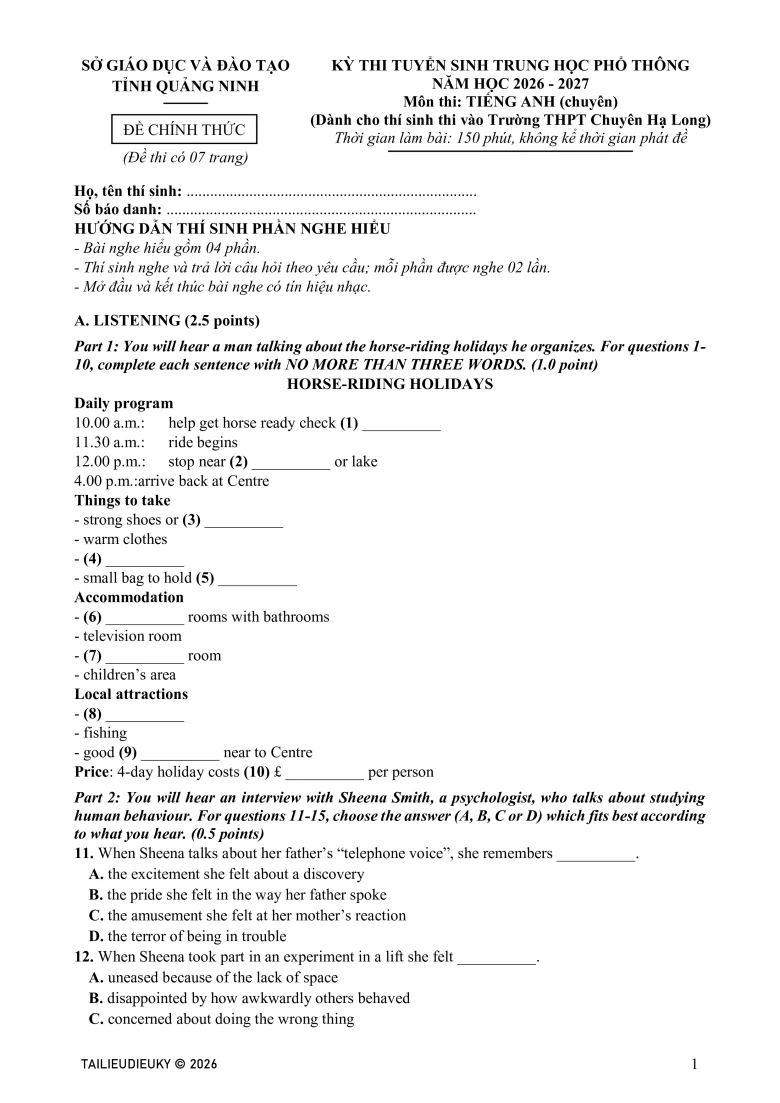
Kỳ thi tuyển sinh THPT tỉnh Quảng Ninh năm học 2026–2027 được tổ chức vào tháng 6/2026. Đối với hệ không chuyên, thí sinh dự thi 3 môn chung gồm Ngữ văn, Ngoại ngữ và Toán; riêng thí sinh thi vào THPT Chuyên Hạ Long dự thi thêm môn chuyên. Toàn tỉnh có 17.226 thí sinh đăng ký dự thi, với 19.615 chỉ tiêu tuyển sinh; trong đó hệ công lập có 12.380 chỉ tiêu cho 280 lớp. Tải xuống Đề Chuyên Anh Hạ Long, Quảng Ninh 2026-2027 & đáp án chính thức miễn phí tại bài viết.
Đề Tiếng Anh THPT chuyên Hạ Long 2026–2027
Đề Kỳ thi tuyển sinh THPT tỉnh Quảng Ninh – Năm học 2026–2027, môn Tiếng Anh (chuyên) – 150 phút – 07 trang – 04 phần
A. Listening (2,5đ): 10 Sentence Completion; 5 Multiple Choice; 5 True/False; 5 Matching.
B. Lexico-Grammar (2,0đ): 20 Multiple Choice; 5 Error Identification; 5 Particle; 10 Word Formation.
C. Reading (3,0đ): 7 Multiple Choice Cloze; 7 Open Cloze; 8 Reading Comprehension; 8 Matching Headings + T/F/NG.
D. Writing (2,5đ): 5 Sentence Transformation; 5 Key Word Transformation; 1 Paragraph (160–180 words).
👉 Xem toàn bộ Đề Chuyên Anh Hạ Long 2026–2027 và tải đáp án chính thức
Trọn bộ tài liệu gồm Đề Chuyên Anh Hạ Long 2026–2027, đáp án chính thức, file nghe và transcript đã được tổng hợp trong bài viết. Thí sinh có thể tải về để đối chiếu kết quả, xem lại nội dung Listening và sử dụng đề thi làm tài liệu luyện tập cho các kỳ thi chuyên Anh tiếp theo.
Đáp án chính thức
SỞ GIÁO DỤC VÀ ĐÀO TẠO
TỈNH QUẢNG NINH
ĐỀ THI CHÍNH THỨC
HƯỚNG DẪN CHẤM THI TUYỂN SINH TRUNG HỌC PHỔ THÔNG NĂM HỌC 2026 – 2027
Môn thi: Tiếng Anh (chuyên)
(Dành cho thí sinh thi vào trường THPT chuyên Hạ Long)
(Hướng dẫn này có 02 trang)
I. HƯỚNG DẪN CHUNG
1. Giám khảo chấm đúng theo hướng dẫn của Sở Giáo dục và Đào tạo.
2. Nếu thí sinh có cách trả lời khác đáp án nhưng đúng thì giám khảo vẫn chấm điểm theo biểu điểm của Hướng dẫn chấm thi.
3. Giám khảo không quy tròn điểm thành phần của từng câu, điểm của bài thi.
II. ĐÁP ÁN, BIỂU ĐIỂM
A. LISTENING (2.5 points)
Part 1. (1.0 point) (0.1 point/ each correct answer)
1. (the) (right) equipment
2. (a) beach
3. boots
4. swimwear
5. (a) (packed) lunch
6. double
7. games
8. golf
9. museum
10. 292
Part 2. (0.5 points) (0.1 point/ each correct answer)
11. A
12. D
13. B
14. A
15. C
Part 3. (0.5 points) (0.1 point/ each correct answer)
16. F
17. T
18. T
19. F
20. T
Part 4. (0.5 points) (0.1 point/ each correct answer)
21. D
22. G
23. F
24. B
25. A
B. LEXICO-GRAMMAR (2.0 points)
Part 1. (1.0 point) (0.05 points/ each correct answer)
1. C
2. A
3. C
4. D
5. B
6. C
7. A
8. D
9. D
10. A
11. C
12. B
13. B
14. C
15. A
16. D
17. C
18. A
19. B
20. D
Part 2. (0.25 points) (0.05 point/ each correct answer)
21. D
22. D
23. B
24. D
25. B
Part 3. (0.25 points) (0.05 points/ each correct answer)
26. up
27. within
28. at
29. on
30. away
Part 4. (0.5 points) (0.05 points/each correct answer)
31. visualize/visualise
32. timidity
33. upskilling
34. comparatively
35. interchangeable
36. afforestation
37. irresistibly
38. unputdownable
39. bygone
40. escapism
C. READING (3.0 points)
Part 1. (0.7 points) (0.1 point/ each correct answer)
1. B
2. A
3. B
4. D
5. C
6. B
7. C
Part 2. (0.7 points) (0.1 point/ each correct answer)
8. from
9. reach
10. goes
11. rather
12. therefore/ thus
13. out/ over
14. little/ no
Part 3. (0.8 points) (0.1 point/ each correct answer)
15. C
16. B
17. A
18. C
19. D
20. D
21. A
22. C
Part 4. (0.8 points) (0.1 point/ each correct answer)
23. iii
24. v
25. vi
26. i
27. iv
28. True/ T
29. Not Given/ NG
30. False/ F
D. WRITING (2.5 points)
Thí sinh phải viết đúng chính tả, đúng số lượng từ như đáp án (kể cả dấu phẩy) thì mới cho điểm.
Part 1. (0.5 points) (0.1 point/ each correct answer)
1. In no way will the school tolerate students cheating in examinations.
2. The manager reproached Leo for having leaked/ leaking the project details to the press.
3. The prestige of this school is believed to have improved immensely in the last few decades.
4. It dawned on me that I had left my homework at home.
5. The newly released smartphone is nowhere near as expensive as last year’s model.
Part 2. (0.5 points) (0.1 point/ each correct answer)
6. Students are under no obligation to attend the additional evening lectures.
7. I tried to have a word with Jack about the problem, but he was too busy.
8. After years of hard work, she made a name for herself as a scientist.
9. The story Ellie told us was beyond belief although it was true.
10. When the fire broke out, Jonathan had the presence of mind to guide everyone to the emergency exit.
Part 3. Paragraph writing. (1.5 points)
Write a paragraph of about 160 – 180 words discussing the negative effects of consuming fast food and sugary drinks on teenagers’ health.
Mô tả tiêu chí chấm đoạn văn
1. Bố cục — 0.3
– Câu chủ đề, giới hạn chủ đề mạch lạc
– Các câu phát triển ý
– Câu kết luận
2. Nội dung — 0.9
– Nêu được từ 2 câu bổ trợ cho câu chủ đề trở lên và nói rõ, giải thích thêm về các câu bổ trợ đó. — 0.6
– Phát triển ý có trình tự logic, đủ thuyết phục người đọc. — 0.2
– Độ dài: Số từ không nhiều hơn hoặc ít hơn so với quy định 5%. — 0.1
3. Sử dụng ngôn từ, ngữ pháp, dấu câu và chính tả — 0.3
– Sử dụng ngôn từ phù hợp nội dung, văn phong, thể loại.
– Sử dụng đúng dấu câu, ngữ pháp, chính tả. — 0.2
– 0.1
Tổng: 1.5
Thí sinh viết “lạc đề”: chỉ cho điểm Bố cục (tối đa 0.3 điểm)
____HẾT____
SỞ GIÁO DỤC VÀ ĐÀO TẠO
TỈNH QUẢNG NINH
(Đề thi có 07 trang) KỲ THI TUYỂN SINH TRUNG HỌC PHỔ THÔNG
NĂM HỌC 2026 – 2027
Môn thi: TIẾNG ANH (chuyên)
(Dành cho thí sinh thi vào Trường THPT Chuyên Hạ Long)
Thời gian làm bài: 150 phút, không kể thời gian phát đề
Họ, tên thí sinh: ………………………………………………………………..
Số báo danh: …………………………………………………………………….
HƯỚNG DẪN THÍ SINH PHẦN NGHE HIỂU
– Bài nghe hiểu gồm 04 phần.
– Thí sinh nghe và trả lời câu hỏi theo yêu cầu; mỗi phần được nghe 02 lần.
– Mở đầu và kết thúc bài nghe có tín hiệu nhạc.
A. LISTENING (2.5 points)
Part 1: You will hear a man talking about the horse-riding holidays he organizes. For questions 1-10, complete each sentence with NO MORE THAN THREE WORDS. (1.0 point)
HORSE-RIDING HOLIDAYS
Daily program
10.00 a.m.: help get horse ready check (1) __________
11.30 a.m.: ride begins
12.00 p.m.: stop near (2) __________ or lake
4.00 p.m.:arrive back at Centre
Things to take
– strong shoes or (3) __________
– warm clothes
– (4) __________
– small bag to hold (5) __________
Accommodation
– (6) __________ rooms with bathrooms
– television room
– (7) __________ room
– children’s area
Local attractions
– (8) __________
– fishing
– good (9) __________ near to Centre
Price: 4-day holiday costs (10) £ __________ per person
Part 2: You will hear an interview with Sheena Smith, a psychologist, who talks about studying human behaviour. For questions 11-15, choose the answer (A, B, C or D) which fits best according to what you hear. (0.5 points)
11. When Sheena talks about her father’s “telephone voice”, she remembers __________.
A. the excitement she felt about a discovery
B. the pride she felt in the way her father spoke
C. the amusement she felt at her mother’s reaction
D. the terror of being in trouble
12. When Sheena took part in an experiment in a lift she felt __________.
A. uneased because of the lack of space
B. disappointed by how awkwardly others behaved
C. concerned about doing the wrong thing
D. surprised by people’s lack of interest in conversation
13. What does Sheena think about the work she is currently doing?
A. It isn’t as interesting as her previous projects.
B. It isn’t as useful as she thought it might be.
C. It isn’t as easy to do as she had assumed.
D. It isn’t as unprovable as scientists reasoned
14. The project Sheena has most enjoyed working on __________.
A. had an unexpected outcome
B. helped her to progress in her career
C. changed her opinion about the value of research
D. provide insights in the mechanism of satisfaction
15. Sheena says that what she’d like to study in the future will be __________.
A. unlike anything she’s tried before B. rewarding for the participants
C. difficult to achieve D. challenging to find suitable participants
Part 3. You will hear a conversation between a tutor and two students, Anita and Lee. For questions 16-20, decide whether each of the statements is True or False.
16. Anita and Lee chose to talk about John Chapman because he was Lee’s childhood hero.
17. The students recorded their sources of information on a handout.
18. The tutor thinks the audience was not sure whether apples grew in America before Europeans arrived.
19. The tutor says the audience was particularly interested to hear about the cultivation of apples in Kazakhstan.
20. Anita and Lee will present their follow-up work on the department website.
Part 4: You will hear five short extracts in which people are talking about well-known individuals. For questions 21-25, choose from the list A-H each speaker’s view of the person (0.5 points)
A. scary
B. underrated
C. amusing
D. unintelligent
E. weird
F. sincere
G. lucky
H. unpredictable
21. Speaker 1 __________
22. Speaker 2 __________
23. Speaker 3 __________
24. Speaker 4 __________
25. Speaker 5 __________
B. LEXICO-GRAMMAR (2.0 points)
Part 1: Circle the letter A, B, C, or D to indicate the answer that best fits each of the blanks in the following questions. (1.0 point)
1. Any worker who fails to obey the regulations will be sacked on the __________.
A. spur B. house C. spot D. day
2. Parents should listen to their children instead of trying to __________ their own choices on them.
A. impose B. judge C. focus D. break
3. My job in Japan was really tiring. The sole redeeming __________ of this job was the salary.
A. aspect B. element C. feature D. factor
4. David is asking Lora to lend him her mobile phone.
– David: “Do you mind if I use your mobile phone for a while?”
– Lora: “__________.”
A. It serves you right B. Yes, here you are C. Don’t mention it D. Be my guest
5. When you go camping in a deep forest, you must __________ to avoid getting lost.
A. go to your head B. keep your wits about you
C. be out of your head D. gather your wists
6. My boss’s demand __________ at his house-warming party last month was really ridiculous.
A. for us to all present B. we all would be present
C. that we all be present D. whether we all were present
7. It was just a small change in the bus route, but some people made __________ about it.
A. a song and dance B. an album and show
C. a record and ballet D. a track and tango
8. Just because you’ve had a good year, it doesn’t mean that you can’t do better. You must not __________.
A. have your head in the clouds B. count your blessings
C. bury your head in the sand D. rest on your laurels
9. My father is getting old and forgetful. __________, he is experienced and helpful.
A. Regardless B. In as much as it is C. Consequently D. Be that as it may
10. I didn’t like that song when I first heard it, but it’s grown __________ me. I quite like it now.
A. on B. out C. up D. in
11. Even if you are rich, you should save some money for a __________ day.
A. windy B. foggy C. rainy D. snowy
12. Four miles off the southern coast of Massachusetts __________, a popular summer resort.
A. where the island of Martha’s Vineyard lie B. lies the island of Martha’s Vineyard
C. the island of Martha’s Vineyard lies there D. does the island of Martha’s Vineyard lie
13. For high school students, preparing for the final exams usually __________ precedence over playing sports.
A. make B. take C. give D. do
14. Jack’s parents would __________ architecture at university, but his mind was set on becoming a photographer.
A. sooner have studied B. wish he had studied
C. rather he had studied D. prefer it if he has studied
15. Anthony and Mary are discussing ways of learning English.
– Anthony: “I think that if I learn enough vocabulary, I won’t have any trouble using English.”
– Mary: “__________. Not only should we focus on vocabulary, but we should focus on grammar as well.”
A. It is not as simple as it seems B. I couldn’t agree with you more
C. There’s no doubt about that D. I don’t think so, neither
16. Unlike most birds, __________.
A. the heads and necks of vultures lack feathers
B. feathers are not found on the heads and necks of vultures
C. there are no feathers on vultures’ heads and necks
D. vultures do not have feathers on their heads and necks
17. They’ve torn down the old buildings __________ to renovating the whole neighbourhood.
A. in the hope B. on the question C. with a view D. with the aim
18. You and your big mouth! It was supposed to be a secret. You __________ her!
A. shouldn’t have told B. mightn’t have told
C. mustn’t have told D. couldn’t have told
19. Terry is an old __________ of mine. We split up nine years ago but we’ve stayed friends.
A. fire B. flame C. spark D. blaze
20. The boy was so __________; he cheated during the online exam and didn’t even feel sorry when the teacher caught him.
A. grim-faced B. faceless C. face-saving D. barefaced
Part 2: Circle the letter A, B, C or D to indicate the underlined part that needs correcting in each of the following sentences. (0.25 points)
21. (A) With their thick fur and white coat, polar bears blend so perfectly with the snow (B) in which they hunt (C) that it is almost impossible to see (D) themselves.
22. Many people (A) lost their jobs during the (B) economic crisis, and they just felt that life was (C) no longer (D) enduring.
23. That Damon Rayan’s stories (A) are considered humorous ones (B) are (C) mainly due to his character’s (D) use of slang.
24. Snowmobiles are capable (A) of damaging the land over (B) which they travel, (C) no matter how (D) cautious they are driven.
25. Safety (A) regulations are being (B) neglected by (C) company managers in the drive to (D) increase profits.
Part 3: Fill in each of the blanks with ONE suitable particle to make the correct sentences. (0.25 points)
26. Don’t worry about the presentation; I will be there to back you __________ if anyone asks difficult questions.
27. Luckily, the new office building is __________ walking distance of the subway station, so we don’t need to drive.
28. He’s sometimes bad-tempered but he’s a good fellow __________ heart.
29. Never trust people who easily go back __________ their promises when things get difficult.
30. Ha Long Bay is far and __________ the most beautiful place I have ever visited.
Part 4. Give the correct form of the words in capital letters. Write your answers in the spaces provided. (0.5 points)
31. The author gave a very detailed description, which helped the readers to __________ the scene. (VISUAL)
32. Wilson’s __________ prevented him from asking her out for a date. (TIMID)
33. Many companies are now __________ their employees so that they can keep pace with rapid technological changes. (SKILL)
34. You should use it as a study room. It’s __________ quiet. (COMPARE)
35. As these programmes are __________, they can be used with any computer system. (CHANGE)
36. Environmentalists believe that __________ is one of the most effective ways to combat climate change in the long term. (FOREST)
37. For some people, the use of social media has become __________ addictive to the extent that is threatening their mental and physical health. (RESIST)
38. How __________ the book was! It was so interesting that I was completely engrossed into it and continued reading it until the last page. (PUT)
39. Many elderly people enjoy looking through old photographs and talking about their __________ school years with friends. (GO)
40. For many people, social networking offers them the feeling of __________ from the real world. (ESCAPE)
C. READING (3.0 points)
Part 1: Read the following passage and circle the letter A, B, C, or D to indicate the correct word or phrase that best fits each of the numbered blanks. (0.7 points)
Words may be perceived as the most obvious part of any conversation, but they are in reality only the tip of the communication iceberg. Studies have consistently shown that body language, or non-verbal communication, has an enormous impact on our (1) __________ of others.
Is the person you are talking to actively leaning in or are they (2) __________ away from you? Is their head tilted? Are their hands buried deep in their pockets? Do they keep breaking eye (3) __________? Even if you are not fully aware of it, all of these subconscious things are likely to (4) __________ to your overall opinion of the person and of what they are telling you.
The exact meaning of particular (5) __________ can vary greatly from one culture to another. Having said that, the importance of non-verbal communication seems to be entirely universal. Indeed, all around the globe, in cases where words and body language (6) __________, people seem to give just as much credence to the non-verbal message that they are (7) __________ up on as they do to the speaker’s actual words.
1. A. realization B. perception C. insight D. outlook
2. A. edging B. verging C. dipping D. drooping
3. A. union B. contact C. hold D. connection
4. A. influence B. shape C. account D. contribute
5. A. deeds B. indications C. gestures D. directions
6. A. dispute B. conflict C. oppose D. dissent
7. A. reading B. taking C. picking D. letting
Part 2: Fill in each numbered blank in the following passage with ONE suitable word. (0.7 points)
Conflict Resolution
Conflict resolution is the art of managing a situation where two or more parties have a disagreement. The definition of a conflict itself can be anything (8) __________ a personal dispute to an international one, and the ultimate goal of conflict mediation is to ensure the sides (9) __________ an agreement that is acceptable for everybody concerned. It (10) __________ without saying that that conflict has to be resolved peacefully (11) __________ than through violence. In order to achieve that, a number of techniques can be implemented, but in the end, it all usually comes down to finding a compromise. This often involves a mediator – a third party that is impartial, and is (12) __________ not biased towards any side of the argument. They help establish a common ground for the opponents – a foundation on which to build a new, more friendly relationship.
While humanity has preferred the “eye for an eye” approach for ages, talking it (13) __________ rather than fighting is always the better option. All things considered, there is (14) __________ doubt that a skill like that will be increasingly useful in the trouble-ridden society of today.
Part 3: Read the following passage and circle the letter A, B, C or D to indicate the correct answer to each of the following questions. (0.8 points)
Among all the abilities with which an individual may be endowed, musical talent appears earliest in life. Very young children can exhibit musical precocity for different reasons. Some develop exceptional skill as a result of a well-designed instructional regime. Some have the good fortune to be born into a musical family. A musically gifted child has an inborn talent; however, the extent to which the talent is expressed publicly will depend upon the environment in which the child lives.
Musically gifted children master at an early age the principal elements of music, including pitch and rhythm. Pitch is more central in certain cultures, such as in Eastern societies while rhythm is emphasized in sub-Saharan Africa.
All children have some aptitude for making music. During infancy, normal children sing as well as babble, and they can produce individual sounds and sound patterns. Infants as young as two months can match their mother’s songs in pitch, loudness, and melodic shape, and infants at four months can match rhythmic structure as well. Infants are especially predisposed to acquire these core aspects of music, and they can also engage in sound play that clearly exhibits creativity.
Individual differences begin to emerge in young children as they learn to sing. Some children can match large segments of a song by the age of two or three. Many others can only approximate pitch at this age and may still have difficulty in producing accurate melodies by the age of five or six. However, by the time they reach school age, most children in any culture have a schema of what a song should be like and can produce a reasonably accurate imitation of the songs commonly heard in their environment.
The early appearance of superior musical ability in some children provides evidence that musical talent may be a separate and unique form of intelligence. There are numerous tales of young artists who have a remarkable “ear” or extraordinary memory for music and a natural understanding of musical structure. In many of these cases, the child is average in every other way but displays an exceptional ability in music. Even the most gifted child, however, takes about ten years to achieve the levels of performance or composition that would constitute mastery of the musical sphere.
Every generation in music history has had its famous prodigies. In the eighteenth century, Wolfgang Amadeus Mozart began composing and performing at the age of six. As a child, Mozart could play the piano like an adult. He had perfect pitch, and at age nine he was also a master of the art of modulation, which became one of the hallmarks of his style. By the age of eleven, he had composed three symphonies and 30 other major works.
Unusual musical ability is a regular characteristic of certain anomalies such as autism. In one case, an autistic girl was able to play “Happy Birthday” in the style of various composers, including Mozart, Beethoven, Verdi, and Schubert. When the girl was three, her mother called her by playing incomplete melodies, which the child would complete with the appropriate tone in the proper octave. For the autistic child, music may be the primary mode of communication, and the child may cling to music because it represents a haven in a world that is largely confusing and frightening.
15. The word precocity in paragraph 1 is closest in meaning to __________.
A. strong interest B. good luck C. advanced skill D. personal style
16. The author makes the point that musical elements such as pitch and rhythm __________.
A. distinguish music from other art forms B. vary in emphasis in different cultures
C. make music difficult to learn D. express different human emotions
17. According to the passage, when does musical talent usually begin to appear?
A. When children learn to sing at two or three years old
B. Between the ages of two and four months
C. When infants start to babble and produce sound patterns
D. Between ten years old and adolescence
18. According to the passage, which of the following suggests that musical talent is a separate form of intelligence?
A. The ability of all babies to acquire core elements of music
B. Recognition of the emotional power of music
C. Exceptional musical ability in an otherwise average child
D. Differences between learning music and learning language
19. The word they in paragraph 3 refers to __________.
A. aspects B. months C. songs D. infants
20. Why does the author mention Mozart in paragraph 6?
A. To compare past and present views of musical talent
B. To describe the development of individual musical skill
C. To list musical accomplishments of the eighteenth century
D. To give an example of a well-known musical prodigy
21. All of the following are given as examples of exceptional musical talent EXCEPT __________.
A. appreciation for a wide variety of musical styles
B. ability to compose major works at a young age
C. a remarkable “ear” or perfect memory for music
D. playing a single song in the style of various composers
22. Which of the following can be inferred from the passage about exceptional musical ability?
A. It has been documented and studied but is little understood.
B. It is evidence of a superior level of intelligence in other areas.
C. It is the result of natural talent and a supportive environment.
D. It occurs more frequently in some cultures than in others.
Part 4: Read the passage below and do the tasks that follow. (0.8 points)
A History of Fingerprinting
A. To detectives, the answers lie at the end of our fingers. Fingerprinting offers an accurate and infallible means of personal identification. The ability to identify a person from a mere fingerprint is a powerful tool in the fight against crime. It is the most commonly used forensic evidence, often outperforming other methods of identification. These days, older methods of ink fingerprinting, which could take weeks, have given way to newer, faster techniques like fingerprint laser scanning, but the principles stay the same. No matter which way you collect fingerprint evidence, every single person’s print is unique. So, what makes our fingerprints different from our neighbours’?
B. A good place to start is to understand what fingerprints are and how they are created. A fingerprint is the arrangement of skin ridges and furrows on the tips of the fingers. This ridged skin develops fully during fetal development, as the skin cells grow in the mother’s womb. These ridges are arranged into patterns and remain the same throughout the course of a person’s life. Other visible human characteristics, like weight and height, change over time whereas fingerprints do not. The reason why ever fingerprint is unique is that when a baby’s genes combine with environmental influences, such as temperature, it affects the way the ridges on the skin grow. It makes the ridges develop at different rates, buckling and bending into patterns. As a result, no two people end up having the same fingerprints. Even identical twins possess dissimilar fingerprints.
C. It is not easy to map the journey of how the unique quality of the fingerprint came to be discovered. The moment in history it happened is not entirely clear. However, the use of fingerprinting can be traced back to some ancient civilizations, such as Babylon and China, where thumbprints were pressed onto clay tablets to confirm business transactions. Whether people at this time actually realized the full extent of how fingerprints were important for identification purposes is another matter altogether. One cannot be sure if the act was seen as a means to confirm identity or a symbolic gesture to blind a contract, where giving your fingerprint was like giving your word.
D. Despite this uncertainty, there are those who made a significant contribution towards the analysis of fingerprinting. History tells us that a 14th century Persian doctor made an early statement that no two fingerprints are alike. Later, in the 17th century, Italian physician Marcello Malpighi studied the distinguishing shapes of loops and spirals in fingerprints. In his honour, the medical world later named a layer of skin after him. It was, however, an employee for the East India Company, William Herschel, who came to see the true potential of fingerprinting. He took fingerprints from the local people as a form of signature for contracts, in order to avoid fraud. His fascination with fingerprints propelled him to study them for the next twenty years. He developed the theory that fingerprints were unique to an individual and did not change at all over a lifetime. In 1880 Henry Faulds suggested that fingerprints could be used to identify convicted criminals. He wrote to Charles Darwin for advice, and the idea was referred on to Darwin’s cousin, Sir Francis Galton. Galton eventually published an in-depth study of fingerprint science in 1892.
E. Although the fact that each person has a totally unique fingerprint pattern had been well documented and accepted for a long time, this knowledge was not exploited for criminal identification until the early 20th century. In the past, branding, tattooing and maiming had been used to mark the criminal for what he was. In some countries, thieves would have their hands cut off. France branded criminals with the fleur-de-lis symbol. The Romans tattooed mercenary soldiers to stop them from becoming deserters.
Questions 23-27. The reading passage has five paragraphs, A-E. Choose the correct heading for each paragraph from the list of headings below. Write the correct number, i-vii, in the blanks.
List of Headings
i. Key people that made a difference
ii. An alternative to fingerprinting
iii. The significance of prints
iv. How to identify a criminal
v. Patterns in the making
vi. An uncertain past
vii. Family connections
23. Paragraph A __________
24. Paragraph B__________
25. Paragraph C__________
26. Paragraph D__________
27. Paragraph E__________
Questions 28-30. Do the following statements agree with the information given in the reading passage? Write:
TRUE if the statement agrees with the information
FALSE if the statement contradicts the information
NOT GIVEN if there is no information on this
28. The ridges and patterns that make up fingerprints develop before birth.
29. Malpighi conducted his studies in Italy.
30. Roman soldiers were tattooed to prevent them from committing violent crimes.
D. WRITING (2.5 points)
Part 1: Finish each of the sentences in such a way that it means the same as the sentence printed before it. You must use NO MORE THAN FIVE WORDS for each space provided. (0.5 points)
1. The school will not tolerate students cheating in examinations.
In no way __________________________________________ students cheating in examinations.
2. “You shouldn’t have leaked the project details to the press!” the manager told Leo.
The manager reproached _________________________________ the project details to the press.
3. They believe that the prestige of this school has improved immensely in the last few decades.
The prestige of this school is ___________________________ immensely in the last few decades.
4. I suddenly realised that I had left my homework at home.
It dawned _______________________________________________ left my homework at home.
5. The newly released smartphone is not nearly as expensive as last year’s model.
The newly released smartphone is nowhere _____________________________ last year’s model.
Part 2: Use the words in the brackets to complete the second sentence so that it has a similar meaning to the first sentence. Do not change the words given. Write between TWO AND SIX WORDS for each space provided. (0.5 points)
6. Attendance at the additional evening lectures is not obligatory for students. (UNDER)
Students are __________________________________________ the additional evening lectures.
7. I tried to talk to Jack about the problem, but he was too busy. (WORD)
I tried to _______________________________________ about the problem, but he was too busy.
8. After years of hard work, she became a well-known scientist. (NAME)
After years of hard work, she ______________________________________ herself as a scientist.
9. Nobody could believe the story Ellie told us although it was true. (BEYOND)
The story Ellie told us ____________________________________________ although it was true.
10. When the fire broke out, Jonathan kept his cool and guided everyone to the emergency exit. (MIND)
When the fire broke out, Jonathan had the ___________________ everyone to the emergency exit.
Part 3: Paragraph writing (1.5 points)
Write a paragraph of about 160 – 180 words discussing the negative effects of consuming fast food and sugary drinks on teenagers’ health.
Write your paragraph in the space below.
———- THE END ———-