Kỳ tuyển sinh vào lớp 10 THPT năm học 2026–2027 tại tỉnh Đắk Lắk có nhiều thay đổi khi đa số các trường THPT công lập áp dụng phương thức xét tuyển thay cho kỳ thi tuyển chung như các năm trước. Chỉ các trường THPT chuyên và một số trường chuyên biệt tổ chức thi tuyển theo kế hoạch của Sở Giáo dục và Đào tạo. Đối với các trường tổ chức thi tuyển, kỳ thi diễn ra trong 2 ngày 1–2/6/2026 với ba môn chung gồm Ngữ văn, Toán, Tiếng Anh, đồng thời thí sinh đăng ký vào lớp chuyên sẽ dự thi thêm môn chuyên tương ứng. Đề Chuyên Anh Đắk Lắk 2026–2027 có đáp án chính thức gồm 8 trang, kèm file nghe (Audio) tải miễn phí ngay trong bài viết.
Sau khi sáp nhập đơn vị hành chính, khu vực hiện có 2 trường THPT chuyên gồm:
• THPT Chuyên Nguyễn Du (trước thuộc tỉnh Đắk Lắk)
• THPT Chuyên Lương Văn Chánh (trước thuộc tỉnh Phú Yên) .
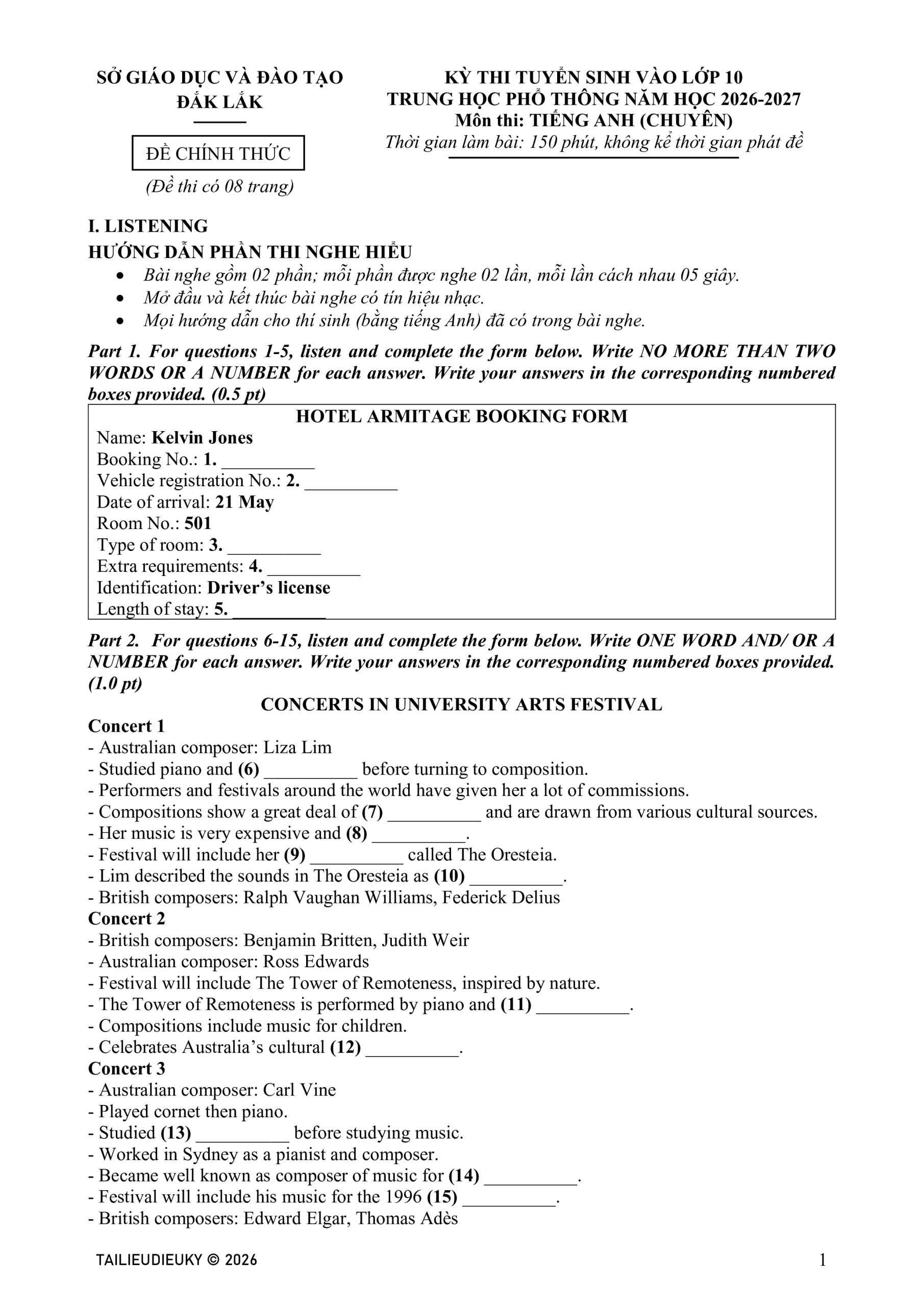
• Listening (1,5 điểm): 2 bài Form Completion về Armitage Hotel và University Arts Festival.
• Use of English (4,5 điểm): Ngữ pháp, từ vựng, Word Formation (10 câu), Error Identification (5 câu).
• Reading (3,0 điểm): Open Cloze, Reading Comprehension (Orientation and Navigation), IELTS Reading (Allelopathy).
• Writing (3,0 điểm): Sentence Ordering, Sentence Transformation, Word Transformation và bài luận ~250 từ về lòng biết ơn.
Nếu thấy bài viết hữu ích, hãy lưu lại để tải đề thi, đáp án và file nghe bất cứ lúc nào. Website sẽ tiếp tục cập nhật nhanh nhất các đề thi vào lớp 10 và đề thi chuyên Anh trên toàn quốc.
Đáp án chính thức
SỞ GIÁO DỤC VÀ ĐÀO TẠO ĐẮK LẮK
KỲ THI TUYỂN SINH VÀO LỚP 10 TRUNG HỌC PHỔ THÔNG NĂM HỌC 2026-2027
HƯỚNG DẪN CHẤM THI
MÔN: TIẾNG ANH (CHUYÊN) - ĐỀ CHÍNH THỨC
(Hướng dẫn chấm có 02 trang)
1. Hướng dẫn chung
- Nếu thí sinh làm bài không theo cách được trình bày trong đáp án mà vẫn đúng thì cho đủ điểm từng phần như hướng dẫn quy định;
- Việc chi tiết hóa thang điểm (nếu có) so với thang điểm chấm phải bảo đảm không sai lệch với hướng dẫn chấm và được thống nhất thực hiện trong Hội đồng chấm thi;
- Điểm bài thi không làm tròn số, có thể lẻ đến 0,1.
I. LISTENING (1.5 điểm)
Part 1. (0.5 điểm / 5 câu) - Mỗi câu đúng = 0.1 điểm
1. OOL 238 1420
2. HUV 3331
3. deluxe
4. (extra) pillows
5. 3 nights
Part 2. (1.0 điểm / 10 câu) - Mỗi câu đúng = 0.1 điểm
6. violin
7. energy
8. complex
9. opera
10. disturbing
11. clarinet
12. diversity
13. physics
14. dance
15. Olympics
II. USE OF ENGLISH (3.0 điểm)
Part 1. (1.5 điểm / 15 câu) - Mỗi câu đúng = 0.1 điểm
16. C
17. B
18. C
19. B
20. A
21. A
22. B
23. C
24. C
25. B
26. C
27. B
28. D
29. D
30. B
Part 2. (1.0 điểm / 10 câu) - Mỗi câu đúng = 0.1 điểm
31. dehydration
32. prematurely
33. unearth
34. misguided
35. self-evaluation
36. inalienably/unalienably
37. preoccupied
38. cyber-café
39. abnormalities
40. conceptualize
Part 3. (0.5 điểm / 5 câu) - Mỗi câu đúng = 0.1 điểm. (Phát hiện lỗi sai 0.05 điểm; Sửa đúng 0.05 điểm)
Exceptionally talented or just over-confident?
According with a study on what lies at the heart of success, it seems that the key is not what might be expected, in other words talent, hard work or a good education, but instead it’s total, adulterated confidence. Confident people tend not to be put out by their own shortcomings and often have larger than life personalities. This means they make themselves more visible in the workplace, pushing themselves forward at every opportunity and so getting promotion over those who may well be more competent but appear on the surface to be less talented. Confident people are often admired and their opinions valued; consequently, they are able to effect decisions made within a group. This could have implications for the recruitment procedures of many companies, as a typical job interview often involves a group task which unfair favours the over-confident. Such a display of confidence may carry too much weight with interviewers, and better, quieter candidates may be turned down, led to a less efficient workforce.
Questions | Mistakes | Corrections
0. with → to
41. adulterated → unadulterated
42. out → off
43. effect → affect
44. unfair → unfairly
45. led → leading
III. READING (3.0 điểm)
Part 1. (1.0 điểm / 10 câu) - Mỗi câu đúng = 0.1 điểm
46. as/though
47. consideration
48. provisions
49. turned
50. occasions
51. integrate
52. with
53. operation
54. exchanged
55. irrespective/regardless
Part 2. (1.0 điểm / 10 câu) - Mỗi câu đúng = 0.1 điểm
56. A
57. B
58. D
59. D
60. D
61. B
62. D
63. C
64. A
65. B
Part 3. (1.0 điểm / 10 câu) - Mỗi câu đúng = 0.1 điểm
66. Paragraph B - v
67. Paragraph C - vii
68. Paragraph D - ix
69. Paragraph E - viii
70. Paragraph F - iv
71. allelochemicals/chemicals/allelopathic chemicals
72. diversity
73. application
74. natural herbicides
75. bred into
IV. WRITING (2.5 điểm)
Part 1. (0.5 điểm / 5 câu) - Mỗi câu đúng = 0.1 điểm
76. A
77. B
78. A
79. D
80. D
Part 2. (0.5 điểm / 5 câu) - Mỗi câu đúng = 0.1 điểm
81. You explained the project so clearly that I had no difficulty finishing it.
→ Had it not been for your clear explanation of/for the project, I would have had difficulty (in) finishing it.
82. She is proud of her ability to solve complex problems.
→ She takes pride in her ability to solve complex problems.
83. The value of Sterling has fallen considerably in the past week.
→ There has been a considerable fall in the value of Sterling in the past week.
84. Just thinking about his face at the moment makes me laugh.
→ The very thought of his face at the moment makes me laugh.
85. The boy does whatever his father wants in an obedient way.
→ The boy dances to his father's tune.
Or
→ The boy dances attendance on/upon his father.
Part 3. (1.0 điểm / 5 câu) - Mỗi câu đúng = 0.1 điểm
86. Whenever there is a power cut, we sell a lot of candles. (TRADE)
→ Whenever there is a power cut, we do a roaring trade in candles.
87. There were empty lemonade bottles and half-eaten sandwiches all over his floor. (STREWN)
→ His floor was strewn with empty lemonade bottles and half-eaten sandwiches.
88. I think we ought to permit him to do whatever he chooses. (HAND)
→ I think we should give him a free hand.
89. Julia soon calmed down and explained her problem to her parents. (PULLED)
→ Julia soon pulled herself together and explained her problem to her parents.
90. I made her angry and upset when I said that her novel was amateurish and badly written. (KINDLY)
→ She didn’t take kindly to the way I described her novel.
Part 4. For question 91, write an essay of about 250 words on the following topic. (1.0 pt)
Đề nghị điểm thành phần của bài luận:
1. Bố cục và độ dài: (0.2 điểm)
- Đầy đủ 3 phần: Mở bài, thân bài, kết luận.
- Độ dài khoảng 250 từ.
2. Cấu trúc câu, ngữ pháp, từ vựng: (0.3 điểm)
- Câu không mắc lỗi ngữ pháp cơ bản.
- Sử dụng từ vựng tốt, câu đa dạng linh hoạt.
3. Nội dung: (0.3 điểm)
- Ý hay, phong phú.
- Biểu đạt nội dung liên quan chặt chẽ với chủ đề.
4. Kỹ năng viết tổng hợp: (0.2 điểm)
- Thể hiện viết mạch lạc, chặt chẽ.
- Nối kết câu, chuyển mạch tốt.
(Tùy mức độ thí sinh viết được, giám khảo dựa vào thang điểm để quyết định.)
-----HẾT-----
SỞ GIÁO DỤC VÀ ĐÀO TẠO
ĐẮK LẮK
(Đề thi có 08 trang) KỲ THI TUYỂN SINH VÀO LỚP 10
TRUNG HỌC PHỔ THÔNG NĂM HỌC 2026-2027
Môn thi: TIẾNG ANH (CHUYÊN)
Thời gian làm bài: 150 phút, không kể thời gian phát đề
I. LISTENING
HƯỚNG DẪN PHẦN THI NGHE HIỂU
• Bài nghe gồm 02 phần; mỗi phần được nghe 02 lần, mỗi lần cách nhau 05 giây.
• Mở đầu và kết thúc bài nghe có tín hiệu nhạc.
• Mọi hướng dẫn cho thí sinh (bằng tiếng Anh) đã có trong bài nghe.
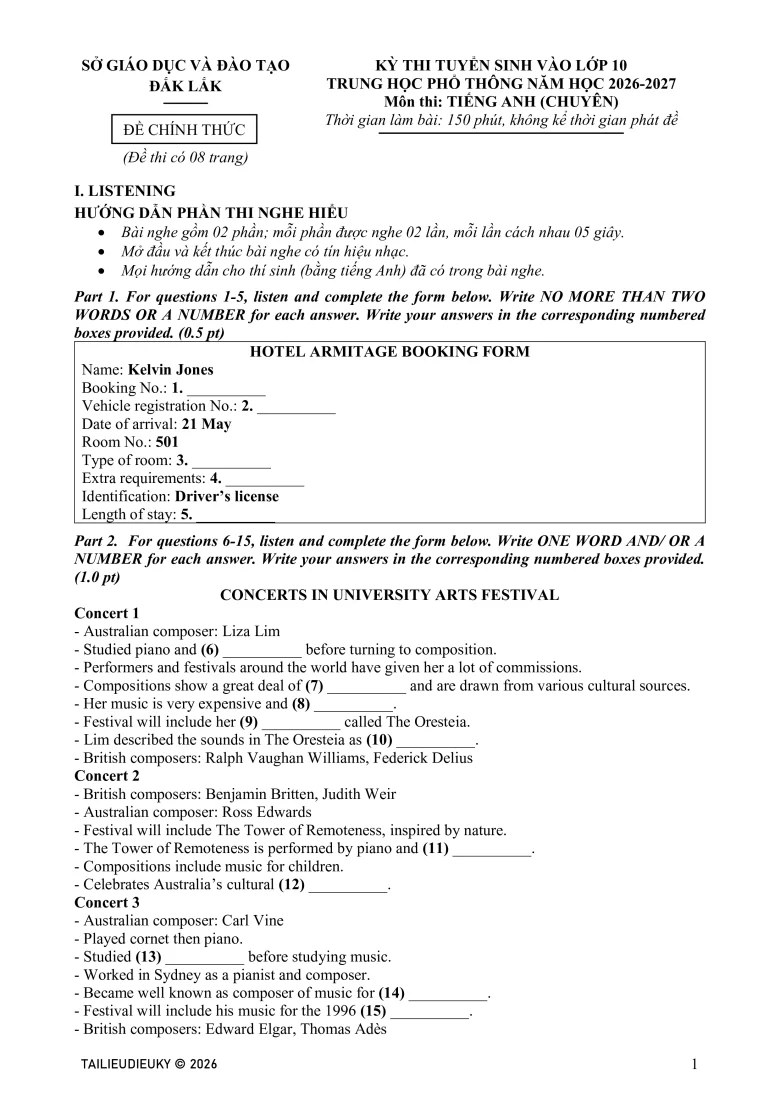
Part 1. For questions 1-5, listen and complete the form below. Write NO MORE THAN TWO WORDS OR A NUMBER for each answer. Write your answers in the corresponding numbered boxes provided. (0.5 pt)
HOTEL ARMITAGE BOOKING FORM
Name: Kelvin Jones
Booking No.: 1. __________
Vehicle registration No.: 2. __________
Date of arrival: 21 May
Room No.: 501
Type of room: 3. __________
Extra requirements: 4. __________
Identification: Driver’s license
Length of stay: 5. __________
Part 2. For questions 6-15, listen and complete the form below. Write ONE WORD AND/ OR A NUMBER for each answer. Write your answers in the corresponding numbered boxes provided. (1.0 pt)
CONCERTS IN UNIVERSITY ARTS FESTIVAL
Concert 1
- Australian composer: Liza Lim
- Studied piano and (6) __________ before turning to composition.
- Performers and festivals around the world have given her a lot of commissions.
- Compositions show a great deal of (7) __________ and are drawn from various cultural sources.
- Her music is very expensive and (8) __________.
- Festival will include her (9) __________ called The Oresteia.
- Lim described the sounds in The Oresteia as (10) __________.
- British composers: Ralph Vaughan Williams, Federick Delius
Concert 2
- British composers: Benjamin Britten, Judith Weir
- Australian composer: Ross Edwards
- Festival will include The Tower of Remoteness, inspired by nature.
- The Tower of Remoteness is performed by piano and (11) __________.
- Compositions include music for children.
- Celebrates Australia’s cultural (12) __________.
Concert 3
- Australian composer: Carl Vine
- Played cornet then piano.
- Studied (13) __________ before studying music.
- Worked in Sydney as a pianist and composer.
- Became well known as composer of music for (14) __________.
- Festival will include his music for the 1996 (15) __________.
- British composers: Edward Elgar, Thomas Adès
II. USE OF ENGLISH
Part 1. For questions 16-30, choose the correct answer A, B, C or D to each of the following questions and write your answer in the corresponding numbered boxes provided. (1.5 pts)
16. My friend’s house is packed with the most bizarre pieces of furniture. I saw her bring home a/an __________ table last week.
A. old weird wooden U-shaped B. weird U-shaped old wooden
C. weird old U-shaped wooden D. U-shaped weird old wooden
17. Just think! Next month you’ll be __________ and it seems like only yesterday you were a baby.
A. in your teenage B. in your teens
C. at your teens D. at your teenage
18. Jacques launched into a __________ explanation that left us just as confused as before.
A. far-fetched B. nerve-wrecking C. long-winded D. far-reaching
19. - Tom: “Hey, Jane __________”
- Jane: “Just the usual.”
A. Let’s go for a drink now. B. What have you been up to?
C. How often do you go to work? D. What do you do?
20. What she told me was a __________ of lies.
A. pack B. load C. herd D. flock
21. Last weekend, __________ nothing to watch on TV, we played chess together.
A. there being B. there having C. having had D. being
22. She __________ modern art. She visits all the local exhibitions.
A. looks down on B. goes in for C. fixes up with D. comes up against
23. - Mike: “Your brother is not interested in learning Spanish, is he?”
- Anna: “__________. I’m afraid!”
A. No, he is B. Yes, he is C. No, he isn’t D. Yes, he isn’t
24. She’s very __________ and isn’t at all worried about moving to a big city where she won’t know anybody.
A. self-conscious B. self-confessed C. self-contained D. self-centered
25. Luckily, the teacher __________ and was able to evacuate all of her students from the burning building.
A. went to her head B. had her wits about her
C. had her head in the clouds D. gathered her wits
26. The upper levels of the Sun’s atmosphere are of very low __________ heats the gases there to be very high temperatures.
A. dense and solar B. density, solar activity
C. density, but solar activity D. density and activity of the Sun is
27. On the island __________ the only representative of the Indian’s handicraft.
A. remains it B. remains C. did it remain D. does it remain
28. There was no one downstairs, so she turned off the lights again and decided that she __________ have imagined things.
A. needn’t B. should C. can’t D. must
29. Take the doctor’s advice into consideration. He’s in __________ earnest about the epidemic.
A. mortally B. fatally C. gravely D. deadly
30. Young children often ask many questions because they are naturally __________.
A. intriguing B. inquisitive C. ingenious D. captivating
Part 2. For questions 31-40, write the correct form of each bracketed word in the corresponding numbered boxes provided. (1.0 pt)
31. Many children die every day around the world because of __________ caused by diarrhoea. (HYDRATE)
32. The product was __________ launched since we hadn’t completed the quality assurance tests. (MATURITY)
33. Archaeologists hope to __________ significant artifacts from the ancient site that could shed light on early human civilizations. (EARTH)
34. The decision to invest heavily in outdated technology was __________ and led to significant financial loss. (GUIDE)
35. In Scotland, there is greater emphasis on __________ by each individual school. (VALUE)
36. Some things are __________ true: Water is wet, grass is green, dogs bark, and house prices rise. (ALIEN)
37. You look rather __________. Are you worried about something? (OCCUPY)
38. A __________ is a popular place for tourists and travelers to send and receive emails. (CAFÉ)
39. Tests are often carried out to detect genetic __________ before birth. (NORMAL)
40. Some people still do not __________ hunting as a violent act. (CONCEPT)
Part 3. For questions 41-45, read the passage below which contains 05 mistakes. Underline, write and correct the mistakes in the corresponding numbered boxes. There is ONE example at the beginning. (0.5 pt)
For example: with to
Exceptionally talented or just over-confident?
According with a study on what lies at the heart of success, it seems that the key is not what might be expected, in other words talent, hard work or a good education, but instead it’s total, adulterated confidence. Confident people tend not to be put out by their own shortcomings and often have larger than life personalities. This means they make themselves more visible in the workplace, pushing themselves forward at every opportunity and so getting promotion over those who may well be more competent but appear on the surface to be less talented. Confident people are often admired and their opinions valued; consequently, they are able to effect decisions made within a group. This could have implications for the recruitment procedures of many companies, as a typical job interview often involves a group task which unfair favours the over-confident. Such a display of confidence may carry too much weight with interviewers, and better, quieter candidates may be turned down, led to a less efficient workforce.
III. READING
Part 1. For questions 46-55, read the passage and write ONE suitable word for each blank in the boxes below. (1.0 pt)
Sad (46) __________ it is, a social misperception of the disabled is still prevalent in many communities. It is only in a few highly-civilised states where the problems and needs of people with physical or mental incapacities are given the proper (47) __________. In the remaining countries, the discrimination against the disabled is still practiced in many areas of social life. As in the past, they are ignored, denounced and forced to stay away from the normal community which, unfortunately, isn’t capable of making any (48) __________ for its less fit members. For decades, the hale and hearty part of every society has stripped the disabled of their fundamental rights as their job applications have been (49) __________ down, their active participation in business life has on most (50) __________ been disallowed and there has been little concern for their convenience in access to public transport. Equally little effort has been made to help the disabled fully (51) __________ with the able-bodied thus laying foundations for greater community awareness of the drawbacks that the handicapped have to wrestle (52) __________ daily. There’s an urgent need to offer the disabled more adequate assistance and support in their struggle for putting their basic rights into (53) __________. The key principle is that the stereotyped approach towards the impaired individuals ought to be (54) __________ for a more considerate one. Another pressing matter is that the disabled shouldn’t be appraised on the basis of their handicap, but society should rather focus on providing them with complete acceptance (55) __________ of any imperfections thus treating them as fully-fledged citizens.
Part 2. For questions 56-65, read the following passage and write in the boxes below the letter A, B, C, or D to indicate the correct answer to each of the questions. (1.0 pt)
ORIENTATION AND NAVIGATION
To South Americans, robins are birds that fly north every spring. To North Americans, the robins simply vacation in the south each winter. Furthermore, they fly to very specific places in South America and will often come back to the same trees in North American yards the following spring. The question is not why they would leave the cold of winter so much as how they find their way around. The question perplexed people for years, until, in the 1950’s, a German scientist named Gustave Kramer provided some answers and, in the process, raised new questions.
Kramer initiated important new kinds of research regarding how animals orient and navigate. Orientation is simply facing in the right direction: navigation involves finding one’s way from point A to point B.
Early in his research, Kramer found that caged migratory birds became very restless at about the time they would normally have begun migration in the wild. Furthermore, he noticed that as they fluttered around in the cage, they often launched themselves in the direction of their normal migratory route. He then set up experiments with caged starlings and found that their orientation was, in fact, in the proper migratory direction except when the sky was overcast, at which times there was no clear direction to their restless movements. Kramer surmised, therefore, that they were orienting according to the position of the Sun. To test this idea, he blocked their view of the Sun and used mirrors to change its apparent position. He found that under these circumstances, the birds oriented with respect to the new “Sun”. They seemed to be using the Sun as a compass to determine direction. At the time, this idea seemed preposterous. Now could a bird navigate by the Sun when some of us lose our way with road maps? Obviously, more testing was in order.
So, in another set of experiments, Kramer put identical food boxes around the cage, with food in only one of the boxes. [I] The boxes were stationary, and the one containing food was always at the same point of the compass. [II] However, its position with respect to the surroundings could be changed by revolving either the inner cage containing the birds or the outer walls, which served as the background. [III] As long as the birds could see the Sun, no matter how their surroundings were altered, they went directly to the correct food box. [IV] Whether the box appeared in front of the right wall or the left wall, they showed no signs of confusion. On overcast days, however, the birds were disoriented and had trouble locating their food box.
In experimenting with artificial suns, Kramer made another interesting discovery. If the artificial Sun remained stationary, the birds would shift their direction with respect to it at a rate of about 15 degrees per hour, the Sun’s rate of movement across the sky. Apparently, the birds were assuming that the “Sun” they saw was moving at that rate. When the real Sun was visible, however, the birds maintained a constant direction as it moved across the sky. In other words, they were able to compensate for the Sun’s movement. This meant that some sort of biological clock was operating - and a very precise clock at that.
What about birds that migrate at night? Perhaps they navigate by the night sky. To test the idea, caged night-migrating birds were placed on the floor of a planetarium during their migratory period. A planetarium is essentially a theater with a domelike ceiling onto which a night sky can be projected for any night of the year. When the planetarium sky matched the sky outside, the birds fluttered in the direction of their normal migration. But when the dome was rotated, the birds changed their direction to match the artificial sky. The results clearly indicated that the birds were orienting according to the stars.
There is accumulating evidence indicating that birds navigate by using a wide variety of environmental cues. Other areas under investigation include magnetism, landmarks, coastlines, sonar, and even smells. The studies are complicated by the fact that the data are sometimes contradictory and the mechanisms apparently change from time to time. Furthermore, one sensory ability may back up another.
56. The word perplexed in the passage could be best replaced by __________.
A. puzzled B. conciliated C. placated D. occupied
57. Which of the following can be inferred about bird migration from paragraph 1?
A. The destination of birds’ migration can change from year to year.
B. Bird migration generally involves moving back and forth between north and south.
C. The purpose of migration is to join with larger groups of birds.
D. Birds will take the most direct migratory route to their new habitat.
58. Which of the sentences below best expresses the essential information in the underlined sentence in paragraph 3?
A. Experiments revealed that caged starlings were unable to orient themselves in the direction of their normal migratory route.
B. Experiments revealed that caged starlings displayed a lack of directional sense and restless movements.
C. Experiments revealed that the restless movement of caged starlings had no clear direction.
D. Experiments revealed that caged starlings’ orientation was accurate unless the weather was overcast.
59. The word preposterous in paragraph 3 is OPPOSITE in meaning to ___________.
A. unbelievable B. exuberant C. precarious D. plausible
60. According to paragraph 3, why did Kramer use mirrors to change the apparent position of the Sun?
A. To test the effect of light on the birds’ restlessness.
B. To cause the birds to migrate at a different time than they would in the wild.
C. To simulate the shifting of light the birds would encounter along their regular migratory route.
D. To test whether birds were using the Sun to navigate.
61. Which of the following can be inferred from paragraph 4 about Kramer’s reason for filling one food box and leaving the rest empty?
A. He believed the birds would eat food from only one box.
B. He wanted to see whether the Sun alone controlled the birds’ ability to navigate toward the box with food.
C. He thought that if all the boxes contained food, this would distract the birds from following their migratory route.
D. He needed to test whether the birds preferred having the food at any particular point of the compass.
62. The experiment described in paragraph 5 caused Kramer to conclude that birds possess a biological clock because __________.
A. birds’ migration is triggered by natural environmental cues, such as the position of the Sun
B. birds shift their direction at a rate of 15 degrees per hour whether the Sun is visible or not
C. birds’ innate bearings keep them oriented in a direction that is within 15 degrees of the Sun’s direction
D. when birds navigate they are able to compensate for the changing position of the Sun in the sky
63. According to paragraph 6, how did the birds navigate in the planetarium’s nighttime environment?
A. By navigating randomly until they found the correct orientation.
B. By their position on the planetarium floor.
C. By orienting themselves to the stars in the artificial night sky.
D. By waiting for the dome to stop rotating.
64. Where in paragraph 4 does the following sentence best fit?
He arranged the food boxes at various positions on a compass.
A. [I] B. [II] C. [III] D. [IV]
65. Directions: An introductory sentence for a brief summary of the passage is provided below.
Gustave Kramer conducted important research related to the ability of birds to orient and navigate.
Which of the following DOES NOT belong in the summary?
A. Because caged birds become disoriented when the sky is overcast, Kramer hypothesized that birds orient themselves according to the Sun’s position.
B. The role of environmental cues in birds’ navigation is clear, for on overcast days, birds use objects besides the Sun to orient themselves.
C. Kramer demonstrated that an internal biological clock allows birds to compensate for the Sun’s movement.
D. Kramer showed that night-migrating birds use the sky to navigate by the stars.
Part 3. For questions 66-75, read the following extract and do the tasks that follow. (1.0 pt)
A. In forests and fields all over the world, plants are engaged in a deadly chemical war to suppress other plants and create conditions for their own success. But what if we could learn the secrets of these plants and use them for our own purposes? Would it be possible to use their strategies and weapons to help us improve agriculture by preventing weeds from germinating and encouraging growth in crops? This possibility is leading agricultural researchers to explore the effects plants have on other plants with the aim of applying their findings to farming.
B. The phenomenon by which an organism produces one or more chemicals that influence the growth, survival and reproduction of other organisms is called allelopathy. These chemicals are a subset of chemicals produced by organisms called secondary metabolites. A plant’s primary metabolites are associated with growth and development. Allelochemicals, however, are part of a plant’s defence system and have a secondary function in the life of the organism. The term allelopathy comes from the Greek: allelo and pathy meaning ‘mutual harm’. The term was first used by the Austrian scientist Hans Molisch in 1937, but people have been noting the negative effects that one plant can have on another for a long time. In 300 BC, the Greek philosopher Theophrastus noticed that pigweed had a negative effect on alfalfa plants. In China, around the first century AD, the author of Shennong Ben Cao Jing described 267 plants that have the ability to kill pests.
C. Allelopathy can be observed in many aspects of plant ecology. It can affect where certain species of plants grow, the fertility of competitor plants, the natural change of plant communities over time, which plant species are able to dominate a particular area, and the diversity of plants in an area. Plants can release allelopathic chemicals in several ways: their roots can release chemicals directly into the soil, and their bark and leaves can release chemicals into the soil as they rot. Initially, scientists were interested in the negative effects of allelopathic chemicals. Observations of the phenomenon included poor growth of some forest trees, damage to crops, changes in vegetation patterns and, interestingly, the occurrence of weed-free areas. It was also realised that some species could have beneficial effects on agricultural crop plants and the possible application of allelopathy became the subject of research.
D. Today research is focused on the effects of weeds on crops, the effects of crops on weeds, and how certain crops affect other crops. Agricultural scientists are exploring the use of allelochemicals to regulate growth and to act as natural herbicides, thereby promoting sustainable agriculture by using these natural chemicals as an alternative to man-made chemicals. For example, a small fast-growing tree found in Central America, sometimes called the ‘miracle tree’, contains a poison that slows the growth of other trees but does not affect its own seeds. Chemicals produced by this tree have been shown to improve the production of rice. Similarly, box elder - another tree - stimulates the growth of bluestem grass, which is a tall prairie grass found in the mid-western United States. Many weeds may use allelopathy to become ecologically successful; a study in China found that 25 out of 33 highly poisonous weeds had significant allelopathic properties.
E. There may be at least three applications of allelopathy to agriculture. Firstly, the allelopathic properties of wild or cultivated plants may be bred into crop plants through genetic modification or traditional breeding methods to improve the release of desired allelochemicals and thus improve crop yield. Secondly, a plant with strong allelopathic properties could be used to control weeds by planting it in rotation with an agricultural crop and then leaving it to rot and become part of the soil in order to inhibit the growth of weeds. Finally, naturally occurring allelopathic chemicals could be used in combination with man-made chemicals. Boosting the efficiency of man-made herbicides could lead to a reduction in the amount of herbicides used in agriculture, which is better for the environment.
F. Despite the promising uses of allelopathic chemicals, agricultural scientists are still cautious. Firstly, allelopathic chemicals may break down and disappear in the soil more easily than artificial chemicals. Secondly, allelopathic chemicals may be harmful to plants other than weeds. Thirdly, allelopathic chemicals could persist in the soil for a long time and may affect crops grown in the same field as the allelopathic plants at a later date. Because the effects of allelopathic chemicals are not yet fully known, agricultural scientists will need to continue to study the biological war between plants.
For questions 66-70, choose the correct heading for paragraphs B-F from the list of headings below. Write the correct number, i-ix in the numbered boxes.
List of Headings
i. What are metabolites?
ii. The negative effects of allelopathy
iii. Biological warfare in the plant world
iv. Why we cannot use allelopathic chemicals at present
v. What is allelopathy?
vi. The reasons why plants compete with other plants
vii. The effects of allelopathy and realisation of its possible uses
viii. How could we use allelopathic chemicals in farming?
ix. Specific examples of allelopathic plants Example: Paragraph A-iii
66. Paragraph B __________
67. Paragraph C __________
68. Paragraph D __________
69. Paragraph E __________
70. Paragraph F __________
For questions 71-75: Complete the summary below. Choose NO MORE THAN TWO WORDS from the passage for each answer. Write your answer in the numbered boxes.
Allelopathy is a phenomenon by which an organism produces (71) __________ that influence the growth, survival and reproduction of others. Plants can release these chemicals through their roots, bark and leaves, which affects the domination and the (72) __________ of plants in an area. Scientists were interested in the potential (73) __________ of allelopathy to agricultural crop plants. Today, they are exploring the use of allelochemicals to regulate growth and to act as (74) __________ in replacement of man-made chemicals in agricultural crops. Another application is that the ability to produce allelopathic chemicals could be (75) __________ agricultural crops. Besides, allelopathic plants could be planted in rotation with a crop. However, agriculturalists are still cautious as allelopathic plants may have negative effects on plants and the chemicals could remain in the ground for a long time, even after the plants themselves have died.
IV. WRITING
Part 1. For questions 76-80, choose the letter A, B, C, or D to indicate the best arrangement of utterances or sentences to make a cohesive and coherent exchange or text in each of the questions. Write your answer in the numbered boxes. (0.5 pt)
76.
Dear Noah,
Hope you’re doing well. Are your evening classes going okay?
a. The app even shows how much CO2 we save, which made my neighbors compete in a fun way.
b. Our building joined a “zero-waste” pilot, so we now scan a QR code before throwing anything away.
c. At first, I mixed up plastic and metal, and the bin flashed red in front of everyone.
d. After a week, I got used to rinsing containers and carrying a small box for reusable chopsticks.
e. Because fewer trucks come to collect trash, the street is quieter, and the rooftop garden smells fresher.
Yours,
Mia
A. b – c – d – a – e B. b – d – c – e – a C. b – d – a – c – e D. b – c – a – e– d
77.
a. Because the interruptions were fewer, I finished assignments earlier and started walking home with music instead of scrolling on the bus, which lowered my stress.
b. It showed nearly five hours a day, mostly short visits to videos, even in the library, that broke my focus while I was doing homework at night.
c. After two weeks, my eyes felt less tired in the morning and I talked more at dinner, which made me realise technology works best when I set clear limits.
d. For a long time, I thought checking my phone between classes and during lunch was harmless, but my screen-time report proved otherwise.
e. To change that, I moved the apps off my home screen, turned on Focus Mode, and asked my friend to send homework reminders as one message in the group chat, so I wouldn’t tap them.
A. d – b – c – e – a B. d – b – e – a – c C. d – a – b – c – e D. d – a – e – b – c
78.
a. The change brings more jobs and better buses, yet it also raises rents and makes long-time families feel invisible in their own area.
b. As new apartments and shopping streets appear, older parks and small markets are often moved or reduced to make room.
c. If planners protect green corners, add safe walking routes, and support affordable housing, growth can feel like real progress instead of a loss.
d. In my neighbourhood, a quiet field became a high-rise complex, and the new residents now queue for coffee where kids once played football.
e. Urbanisation has made my city busier every year, and it has even changed the way we share public space after school.
A. e – d – b – a – c B. b – e – d – c – a C. e – d – c – a – b D. b – e – a – c – d
79.
a. Does this affect the diversity of your talent pool?
b. I noticed many companies are shifting to AI-powered recruitment processes nowadays.
c. Actually, we’ve seen improved diversity as AI helps eliminate unconscious biases.
d. We’ve implemented AI screening, but we still value human interaction in final decisions.
e. That’s fascinating how technology is making hiring both efficient and more inclusive.
f. Absolutely, it’s all about balancing tech and people.
A. b – c – a – e – f – d B. b – d – c – a – f – e
C. b – a – c – d – e – f D. b – d – a – c – e – f
80.
a. She took evening online courses, practised with volunteers on weekends, and even learned to use an AI camera-trap app that sorts photos so rangers can react faster.
b. One life story I admire is my aunt’s decision to leave a stable office job and work in wildlife conservation in a small reserve near our city.
c. Watching her keep learning, changing careers, and cooperating with different communities has taught me that a ‘good job’ is not only about salary, but about purpose and growth.
d. After a documentary about endangered pangolins, she realised her marketing skills could help raise funds, but she first had to learn basic fieldwork and data recording.
e. The work is tiring and sometimes dangerous, yet she says it feels meaningful when a rescued animal is released and when local farmers join the protection team.
A. d – a – b – e – c B. d – b – a – e – c C. b – d – e – a – c D. b – d – a – e – c
Part 2. For questions 81-85, finish each of the following sentences in such a way that it means the same as the sentence printed before. (0.5 pt)
81. You explained the project so clearly that I had no difficulty finishing it.
Had it ________________________________________________________________________
82. She is proud of her ability to solve complex problems.
She takes ______________________________________________________________________
83. The value of Sterling has fallen considerably in the past week.
There has _____________________________________________________________________
84. Just thinking about his face at the moment makes me laugh.
The very ______________________________________________________________________
85. The boy does whatever his father wants in an obedient way.
The boy dances _________________________________________________________________
Part 3. For questions 86-90, complete the second sentence so that it has the similar meaning to the first one. Use BETWEEN THREE AND FIVE WORDS, including the word given in capitals, and this word must not be changed in any way. (0.5 pt)
86. Whenever there is a power cut, we sell a lot of candles. (TRADE)
Whenever there is a power cut, we ___________________________________________ candles.
87. There were empty lemonade bottles and half-eaten sandwiches all over his floor. (STREWN)
His _________________________________ empty lemonade bottles and half-eaten sandwiches.
88. I think we ought to permit him to do whatever he chooses. (HAND)
I think we should ________________________________________________________________
89. Julia soon calmed down and explained her problem to her parents. (PULLED)
Julia soon ________________________________________________ her problem to her parents.
90. I made her angry and upset when I said that her novel was amateurish and badly written. (KINDLY)
She __________________________________________________ the way I described her novel.
Part 4. For question 91, write an essay of about 250 words on the following topic. (1.0 pt)
In today’s world, many young people tend to take things for granted and forget to show gratitude. Why is practicing gratitude important, and what can families and schools do to teach this virtue to the young generation?
---------- THE END ----------