
Sáng 28/5, thí sinh Thái Nguyên đã hoàn thành bài thi môn Tiếng Anh trong kỳ thi tuyển sinh vào lớp 10 THPT công lập năm học 2026-2027. Dưới đây là đề thi chính thức và đáp án tham khảo mã đề 103. Bạn đọc có thể tải file Word, PDF chất lượng cao ngay tại bài viết.
Cấu trúc đề thi Tiếng Anh vào 10 Thái Nguyên 2026-2027
40 câu trắc nghiệm – 60 phút
• Phát âm: 5 câu (1–5)
• Trái nghĩa: 2 câu (6–7)
• Giao tiếp: 2 câu (8–9)
• Lỗi sai: 3 câu (10–12)
• Đồng nghĩa: 2 câu (13–14)
• Ngữ pháp & từ vựng: 13 câu (15–27) → Relative clause, wish, thì động từ, phrasal verbs, giới từ, mạo từ…
• Đọc hiểu 1: 5 câu (28–32) → Chủ đề: du lịch & sức khỏe
• Viết lại câu: 3 câu (33–35) → So sánh, câu gián tiếp, “It is + adj + to V”
• Điền từ đoạn văn: 5 câu (36–40) → Chủ đề: các biến thể tiếng Anh trên thế giới
📥 Download miễn phí đề thi Tiếng Anh vào lớp 10 Thái Nguyên năm 2026
Đề thi đã sẵn sàng, đáp án đầy đủ, transcript cũng đã được chuẩn bị. Phần còn lại phụ thuộc vào sự nỗ lực và tinh thần ôn luyện của bạn. Tài liệu diệu kỳ mong rằng Đề HSG Anh 9 Thanh Hóa 2025–2026 không chỉ là tài liệu luyện thi hữu ích, mà còn tiếp thêm hứng thú cho quá trình học tập mỗi ngày.
Đáp án
1. A
2. D
3. D
4. A
5. B
6. B
7. C
8. A
9. D
10. B
11. B
12. B
13. D
14. B
15. D
16. A
17. A
18. C
19. C
20. B
21. A
22. D
23. B
24. A
25. D
26. C
27. B
28. C
29. B
30. A
31. C
32. D
33. C
34. D
35. A
36. A
37. C
38. C
39. D
40. C
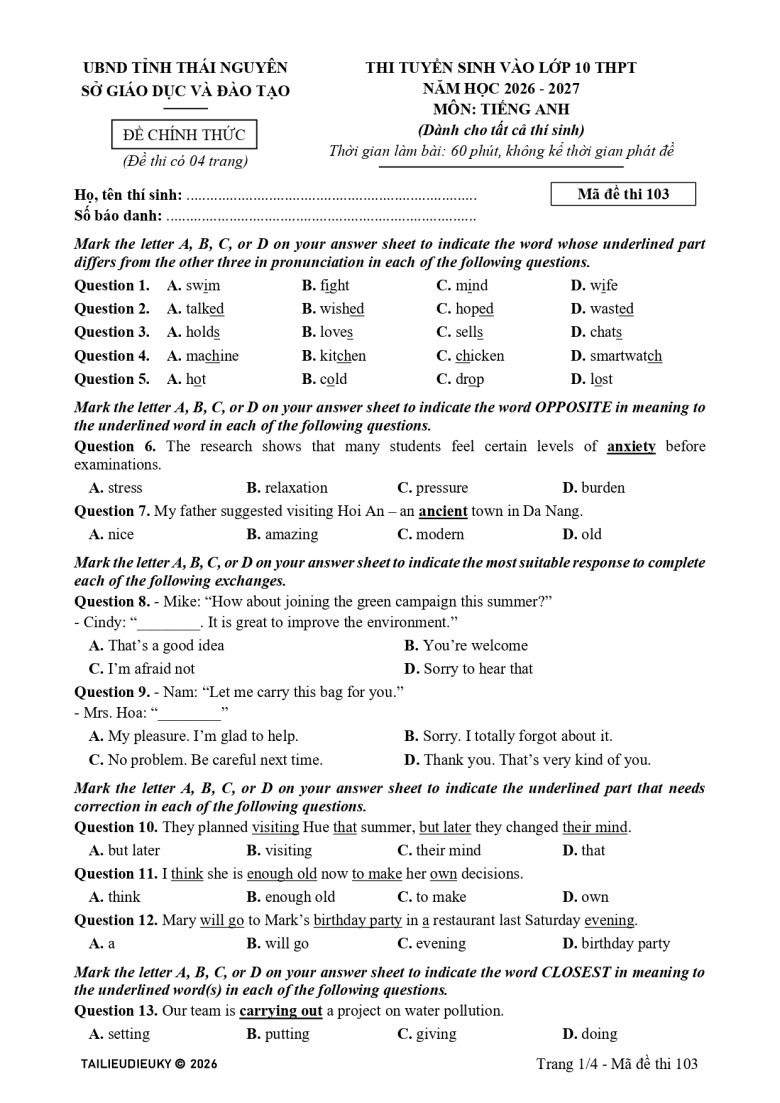
UBND TỈNH THÁI NGUYÊN
SỞ GIÁO DỤC VÀ ĐÀO TẠO
(Đề thi có 04 trang) THI TUYỂN SINH VÀO LỚP 10 THPT
NĂM HỌC 2026 – 2027
MÔN: TIẾNG ANH
(Dành cho tất cả thí sinh)
Thời gian làm bài: 60 phút, không kể thời gian phát đề
Họ, tên thí sinh: ………………………………………………………………..
Số báo danh: …………………………………………………………………….
Mark the letter A, B, C, or D on your answer sheet to indicate the word whose underlined part differs from the other three in pronunciation in each of the following questions.
Question 1. A. swim B. fight C. mind D. wife
Question 2. A. talked B. wished C. hoped D. wasted
Question 3. A. holds B. loves C. sells D. chats
Question 4. A. machine B. kitchen C. chicken D. smartwatch
Question 5. A. hot B. cold C. drop D. lost
Mark the letter A, B, C, or D on your answer sheet to indicate the word OPPOSITE in meaning to the underlined word in each of the following questions.
Question 6. The research shows that many students feel certain levels of anxiety before examinations.
A. stress B. relaxation C. pressure D. burden
Question 7. My father suggested visiting Hoi An – an ancient town in Da Nang.
A. nice B. amazing C. modern D. old
Mark the letter A, B, C, or D on your answer sheet to indicate the most suitable response to complete each of the following exchanges.
Question 8. – Mike: “How about joining the green campaign this summer?”
– Cindy: “________. It is great to improve the environment.”
A. That’s a good idea B. You’re welcome
C. I’m afraid not D. Sorry to hear that
Question 9. – Nam: “Let me carry this bag for you.”
– Mrs. Hoa: “________”
A. My pleasure. I’m glad to help. B. Sorry. I totally forgot about it.
C. No problem. Be careful next time. D. Thank you. That’s very kind of you.
Mark the letter A, B, C, or D on your answer sheet to indicate the underlined part that needs correction in each of the following questions.
Question 10. They planned visiting Hue that summer, but later they changed their mind.
A. but later B. visiting C. their mind D. that
Question 11. I think she is enough old now to make her own decisions.
A. think B. enough old C. to make D. own
Question 12. Mary will go to Mark’s birthday party in a restaurant last Saturday evening.
A. a B. will go C. evening D. birthday party
Mark the letter A, B, C, or D on your answer sheet to indicate the word CLOSEST in meaning to the underlined word(s) in each of the following questions.
Question 13. Our team is carrying out a project on water pollution.
A. setting B. putting C. giving D. doing
Question 14. People can entertain from various sources like TVs, computers, and smartphones.
A. rare B. many C. much D. little
Mark the letter A, B, C, or D on your answer sheet to indicate the correct answer to complete each of the following questions.
Question 15. My friend, _______ lives in Ho Chi Minh City, will go abroad next week.
A. which B. that C. whose D. who
Question 16. Tom is _______ about his final test tomorrow.
A. worried B. worry C. worries D. worriedly
Question 17. Jenny wishes she _______ a portable music player.
A. had B. has C. will have D. has had
Question 18. We have decided _______ to Nha Trang for our holiday.
A. be going B. go C. to go D. going
Question 19. She tries not to _______ mistakes when writing essays.
A. do B. get C. make D. take
Question 20. The restaurant was full, _______ we couldn’t get a table.
A. but B. so C. because D. despite
Question 21. You should _______ smoking; it is not good for your health.
A. give up B. turn on C. take off D. look after
Question 22. Elizabeth and her family often go skiing _______ winter.
A. at B. up C. of D. in
Question 23. The local people try to preserve their deep-rooted _______.
A. costume B. tradition C. cuisine D. landscape
Question 24. She had a loaf of bread and _______ apple for breakfast.
A. an B. a C. the D. Ø (no article)
Question 25. While I _______ an online article, the computer crashed.
A. will read B. am reading C. read D. was reading
Question 26. This is the first time I _______ this app for learning English.
A. am using B. used C. have used D. use
Question 27. Don’t make noise! Our leaders _______ an important plan.
A. discussed B. are discussing C. were discussing D. discuss
Read the following passage and mark the letter A, B, C, or D on your answer sheet to indicate the correct answer to each of the questions from 28 to 32.
Health Tips for Travellers
Travel is fun and exciting, but not if you get sick. You may think you won’t get sick on your vacation. However, for many people, that is what happens. You do not want to spend your vacation sick in bed, of course. What can you do to stay in good health? These are the three things to remember when you travel: relax, sleep, and eat well.
A vacation is supposed to be a time for relaxing, but tourists often forget that. There are so many places to visit: museums, churches, parks, and shops. You want to see as much as possible, of course, and so you spend most of your days on your feet. This is tiring. Your feet may start to hurt. You may get a headache or a backache. If this is the way you feel, you should take a rest.
Sleep is also important. If you want to stay healthy, you need to get enough sleep. That is not always easy when you are travelling. You may have a noisy hotel room or an uncomfortable bed. If you do, change rooms or even hotels. If you are young, you may want to stay out late at night because the nightlife is exciting in many cities. Then you should sleep during the day.
Finally, whatever age you are, you must eat well. That means eating the right kinds of foods. Your body needs fresh fruits and vegetables and some meat, milk, or fish. You also need to be careful about eating new foods. Try small amounts first to make sure they are okay for you, and limit eating too nutritious foods.
If you want to enjoy your vacation, take care of yourself. Give your body some rest. Get enough sleep and eat good, healthy food.
Question 28. According to the passage, a vacation is not fun if you _______.
A. remember three things B. stay out late
C. get sick D. are young
Question 29. The word supposed in paragraph 2 is CLOSEST in meaning to _______.
A. accidental B. meant C. willing D. happened
Question 30. The word they in paragraph 4 refers to _______.
A. new foods B. fresh fruits C. fresh vegetables D. nutritious foods
Question 31. During your vacation, it is a good idea to _______.
A. spend most of your days on foot B. forget all the places you visit
C. give your body some rest D. change rooms and hotels daily
Question 32. What does the passage mainly discuss?
A. Funny, exciting, and relaxing travels B. The importance of sleeping and eating
C. The amounts of foods we should eat D. How to stay healthy when you travel
Mark the letter A, B, C, or D on your answer sheet to indicate the sentence that is closest in meaning to each of the following questions.
Question 33. Life in the city is noisier than life in the countryside.
A. Life in the city is not as noisy as life in the countryside.
B. Life in the countryside is as noisy as life in the city.
C. Life in the countryside is not as noisy as life in the city.
D. Life in the city is as noisy as life in the countryside.
Question 34. “Do you want to go swimming this weekend?” she asked him.
A. She promised him if you want to go swimming that weekend.
B. She told him if you wanted to go swimming this weekend.
C. She advised him if he wanted to go swimming this weekend.
D. She asked him if he wanted to go swimming that weekend.
Question 35. Controlling smart devices remotely is convenient.
A. It is convenient to control smart devices remotely.
B. It isn’t convenient controlling smart devices remotely.
C. It isn’t convenient to control smart devices remotely.
D. It is convenient controlling smart devices remotely.
Read the following passage and mark the letter A, B, C, or D on your answer sheet to indicate the correct word or phrase that best fits each of the numbered blanks from 36 to 40.
If we read English language newspapers or listen to newsreaders who use English in different parts of the world, we may think that people use one form of English so widely that it will soon (36) _______ all the different existing varieties of English. Is there enough evidence to support this thought? It is in fact misleading in several ways. A version of English (37) _______ is exactly the same everywhere and has the same high status throughout the world does not exist. For one thing, people whose first language is English value their linguistic identity. (38)_______, they try to preserve it from the influence of other forms of English. New Zealanders, for example, do not want to speak like Australians. In addition, (39) _______ too many regional differences in vocabulary for the language to be the same everywhere. People need specialized words in order to discuss local politics, business, culture, and (40) _______ history. Lastly, there is the fact that people may learn either American or British forms in their educational settings.
Question 36. A. unite B. change C. conflict D. separate
Question 37. A. whose B. where C. which D. who
Question 38. A. Whereas B. Otherwise C. Therefore D. However
Question 39. A. they are B. it has been C. there has been D. there are
Question 40. A. naturally B. nature C. natural D. naturalize
———- THE END ———-