Bạn đang tìm Đề thi HSG Tiếng Anh 9 cấp tỉnh Cần Thơ năm 2024–2025? Tài liệu diệu kỳ trân trọng gửi tới quý thầy cô và các em học sinh bộ tài liệu đầy đủ gồm đề thi, đáp án chính thức, file nghe và audioscripts của kỳ thi diễn ra ngày 12/04/2025.
150 phút – 8 trang – 4 phần – 75 câu
A. Listening (15đ): Trắc nghiệm hội thoại (5) – Điền từ nghe (5) – Phỏng vấn chọn đáp án (5)
B. Lexico-Grammar (25đ): Chọn đáp án đúng (15) – Word formation (10)
C. Reading (25đ): Điền câu vào đoạn văn (7) – Đọc hiểu chọn đáp án (8) – Cloze test (10)
D. Writing (25đ): Viết lại câu (10) – Essay 250 từ (1)
Hãy lưu lại tài liệu để ôn luyện hiệu quả và cập nhật thêm nhiều đề HSG Tiếng Anh 9 mới nhất tại Tài liệu diệu kỳ.
Đáp án chính thức
SỞ GIÁO DỤC VÀ ĐÀO TẠO THÀNH PHỐ CẦN THƠ
KỲ THI CHỌN HỌC SINH GIỎI THCS CẤP THÀNH PHỐ
Năm học 2024-2025
Khóa ngày 12/4/2025
Môn: Tiếng Anh
Đáp án - Hướng dẫn chấm chính thức
________________________________________
I. LISTENING (15 điểm)
Part 1
Câu Đáp án
1 B
2 C
3 A
4 B
5 C
Part 2
Câu Đáp án
6 EXPEDITION
7 SILVER
8 SATISFYING
9 FIRST AID
10 SAFETY
Part 3
Câu Đáp án
11 C
12 A
13 B
14 C
15 A
________________________________________
II. LEXICO - GRAMMAR (25 điểm)
Part 1
Câu Đáp án
16 C
17 A
18 D
19 B
20 C
21 B
22 A
23 D
24 D
25 A
26 C
27 B
28 C
29 D
30 A
Part 2
Câu Đáp án
31 SIGNIFICANTLY
32 ELECTRONICALLY
33 EASE / EASINESS
34 ILLNESS / ILLNESSES
35 SENSIBLE
36 IRRELEVANT
37 CURRENTLY
38 VALUE
39 IDENTITY
40 INCONVENIENCE
________________________________________
III. READING (25 điểm)
Part 1
Câu Đáp án
41 H
42 F
43 B
44 G
45 D
46 A
47 E
Part 2
Câu Đáp án
48 D
49 A
50 D
51 A
52 C
53 B
54 B
55 C
Part 3
Câu Đáp án
56 B
57 D
58 B
59 A
60 D
61 C
62 C
63 A
64 A
65 B
________________________________________
IV. WRITING (25 điểm)
Part 1 (10 điểm)
66. “Sorry, we HAVE RUN OUT OF chocolate ice dream,” said the waiter.
67. Kathy WOULD RATHER NOT BE GIVEN a main part in the school play.
68. TO THE BEST OF MY KNOWLEDGE, no one’s talking about you behind your back.
69. NO SOONER HAD WE ARRIVED THAN the kids dived into the pool.
70. I quit the job because I DON’T SEE EYE TO EYE with my manager.
71. Minh KNOWS CANTHO INSIDE OUT so he’ll tell you where you should go.
72. The amount we’ve saved is A DROP IN THE OCEAN compared to how much we owe.
73. Which teacher did you MOST LOOK UP TO when you started school?
74. Widening the road HAS BEEN UNDER CONSIDERATION for some time now.
75. We were still able to win the games IN SPITE OF NOT BEING GIVEN any supports.
Part 2: Essay (15 điểm)
• Organization: Bố cục rõ ràng, đủ mở bài - thân bài - kết luận (2 điểm)
• Discourse: Mạch lạc, liên kết tốt, chuyển ý hợp lý (2 điểm)
• Sentence structure: Ngữ pháp, từ vựng, chính tả, cấu trúc linh hoạt (3 điểm)
• Ideas: Ý tưởng hay, phong phú, sát chủ đề (8 điểm)
________________________________________
Tổng điểm
TOTAL: 90/100
________________________________________
Lưu ý
• Cán bộ chấm thi rà soát, kiểm tra lời giải, thống nhất đáp án trước khi chấm.
• Mọi cách giải đúng đều được điểm tối đa.
------HẾT------
SỞ GIÁO DỤC VÀ ĐÀO TẠO
THÀNH PHỐ CẦN THƠ
(Đề thi có 08 trang) KỲ THI CHỌN HỌC SINH GIỎI THCS CẤP THÀNH PHỐ
NĂM HỌC 2024-2025
Khóa ngày 12 tháng 4 năm 2025
MÔN: TIẾNG ANH
Thời gian làm bài: 150 phút, không kể thời gian phát đề
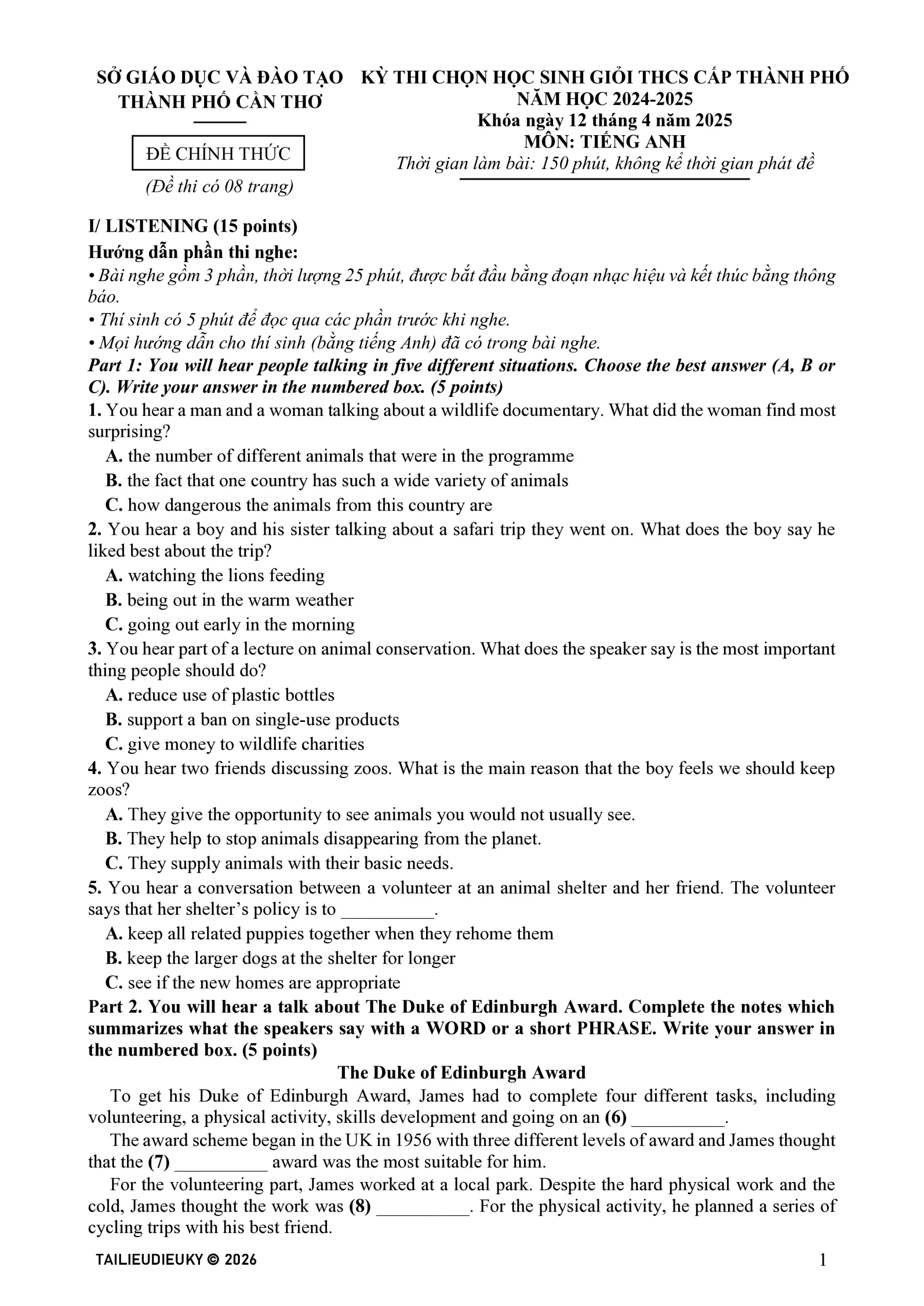
I/ LISTENING (15 points)
Hướng dẫn phần thi nghe:
• Bài nghe gồm 3 phần, thời lượng 25 phút, được bắt đầu bằng đoạn nhạc hiệu và kết thúc bằng thông báo.
• Thí sinh có 5 phút để đọc qua các phần trước khi nghe.
• Mọi hướng dẫn cho thí sinh (bằng tiếng Anh) đã có trong bài nghe.
Part 1: You will hear people talking in five different situations. Choose the best answer (A, B or C). Write your answer in the numbered box. (5 points)
1. You hear a man and a woman talking about a wildlife documentary. What did the woman find most surprising?
A. the number of different animals that were in the programme
B. the fact that one country has such a wide variety of animals
C. how dangerous the animals from this country are
2. You hear a boy and his sister talking about a safari trip they went on. What does the boy say he liked best about the trip?
A. watching the lions feeding
B. being out in the warm weather
C. going out early in the morning
3. You hear part of a lecture on animal conservation. What does the speaker say is the most important thing people should do?
A. reduce use of plastic bottles
B. support a ban on single-use products
C. give money to wildlife charities
4. You hear two friends discussing zoos. What is the main reason that the boy feels we should keep zoos?
A. They give the opportunity to see animals you would not usually see.
B. They help to stop animals disappearing from the planet.
C. They supply animals with their basic needs.
5. You hear a conversation between a volunteer at an animal shelter and her friend. The volunteer says that her shelter’s policy is to __________.
A. keep all related puppies together when they rehome them
B. keep the larger dogs at the shelter for longer
C. see if the new homes are appropriate
Part 2. You will hear a talk about The Duke of Edinburgh Award. Complete the notes which summarizes what the speakers say with a WORD or a short PHRASE. Write your answer in the numbered box. (5 points)
The Duke of Edinburgh Award
To get his Duke of Edinburgh Award, James had to complete four different tasks, including volunteering, a physical activity, skills development and going on an (6) __________.
The award scheme began in the UK in 1956 with three different levels of award and James thought that the (7) __________ award was the most suitable for him.
For the volunteering part, James worked at a local park. Despite the hard physical work and the cold, James thought the work was (8) __________. For the physical activity, he planned a series of cycling trips with his best friend.
The best part for James was taking part in an activity with a group of friends. They spent three days going camping and hiking in Scotland. Before they went, they were taught some basic things, such as (9) __________ skills and how to cook food on a camping stove,….
The Duke of Edinburgh Award was a challenging experience, but James enjoyed feeling independent and got many benefits from it. For example, when James was volunteering, he had to pay attention to (10) __________ rules.
Part 3: You will hear an interview with a student called Martin, who helped to organize an event for “Buy Nothing Day”. Choose the best answer (A, B or C). Write your answer in the numbered box. (5 points)
11. Martin first became interested in Buy Nothing Day when __________.
A. he was told about it by his parents
B. he read about it online
C. he heard about it through another pupil
12. How did Martin feel about the different activities suggested on the Buy Nothing Day website?
A. He thought most of them were dull.
B. He felt there were a lot to choose from.
C. He was surprised at how few there were.
13. What aspect of moving like a zombie did Martin find most challenging?
A. walking in a straight line
B. holding his arms out
C. avoiding keeping his head up
14. How did Martin feel during the zombie walk?
A. He felt proud that the spectators were so impressed.
B. He felt very embarrassed.
C. He was too busy concentrating to notice people’s reaction.
15. What does Martin say about participating in the walk next year?
A. He plans to do something more serious next time.
B. He thinks he will be too busy to attend.
C. He thinks it would be fun to be a zombie again.
II/ LEXICO - GRAMMAR (25 points)
Part 1: Choose the word or phrase that best completes each sentence. Write your answer (A, B, C, or D) in the numbered box. (15 points)
16. That new painting looks a bit out of __________ in our living room, don’t you think?
A. room B. space C. place D. spot
17. I wish my son wouldn’t behave so thoughtless all the time although I know that __________ can’t change its spot.
A. a leopard B. a tiger C. a giraffe D. a zebra
18. Due to the economic crisis, the company’s announced it’s going to __________ over 1,000 workers.
A. stop off B. take up C. set up D. lay off
19. The text doesn’t give you the answer explicitly. You have to __________ it from the evidence.
A. convert B. deduce C. reckon D. grasp
20. I was so surprised when Jason __________ the news that he was going to move to Canada for his study.
A. went in for B. put up with C. came out with D. cut back on
21. When teenagers have a problem, it is advisable that they get it off their __________ and tell their parents exactly what’s wrong with them.
A. shoulder B. chest C. head D. stomach
22. My manager asked me to tell you that she would like __________ by Friday at the latest.
A. the orders sent B. sending the orders C. that you sent D. sent the orders
23. I don’t want to __________ your hopes, but there’s a chance we might fly to America for this summer vacation.
A. grow B. feed C. rise D. raise
24. Lions are successful __________ which hunt other animals for food.
A. scavengers B. killers C. poachers D. predators
25. __________ the ending, the book would have been perfect for making films.
A. Had it not been for B. Had not it been for
C. Hadn’t been it for D. Hadn’t it been for
26. I’ll just call Jimmy to __________ certain that he can look after the dogs while I am going on my business.
A. get B. take C. make D. do
27. Minh’s manager retired and, __________ a consequence, he was promoted to this position.
A. of B. as C. in D. on
28. Tears __________ down on her cheek when the film reached its dramatic conclusion.
A. ploughed B. plummeted C. streamed D. leaked
29. The new computer software has been designed to __________ battery life.
A. sharpen B. enable C. upgrade D. optimize
30. After the crash, the victim was in __________ condition and had to be rushed to the nearest hospital.
A. critical B. crucial C. criminal D. central
Part 2: Read the text below. Use the word given in capitals at the end of some of the lines to form a word that fits in the gap in the same line. There is an example at the beginning (0). Write your answer in the numbered box. (10 points)
MONEY, MONEY, MONEY
It’s been around for a very long time, but perhaps not for much longer. (0. FINANCE) FINANCIAL experts believe that a cashless society could be just around the corner.
The use of notes and coins has been going down (31. SIGNIFICANT) __________ in recent years. Most people around the world buy and sell things (32. ELECTRICITY) __________ and we enjoy the (33. EASY) __________ of it. Meanwhile, cash can be heavy, notes get dirty and they can carry a range of (34. ILL) __________ and it can be lost. What’s more, cyber currencies are becoming more and more popular. Isn’t it (35. SENSE) __________ to go cash free?
But not everyone is convinced that cash will become completely (36. RELEVANT) __________ and believe that there will always be a place for it. Many people (37. CURRENT) __________ use cash because they don’t trust online transactions or simply do not use the internet. Others (38. INVALUABLE) __________ the safety that a cash deal gives them; there is less chance of (39. IDENTIFY) __________ theft. And if we went totally cash free, imagine the (40. CONVENIENT) __________ if the internet went down. For the moment, it seems that cash is important but in 10 or 20 years’ time, who knows?
III/ READING: (25 points)
Part 1: You are going to read an article about happiness in Netherlands. Seven sentences have been removed from the extract. Choose from the sentences A-H the one which fits each gap. There is one extra sentence which you do not need to use. Write your answers in the numbered box. (7 points)
List of sentences
A. Unusually, Dutch children do not appear to be overly affected by this concern.
B. This is reinforced by the Dutch education system.
C. Instead of this, the Dutch believe in inspiring children to explore the world around them.
D. Mums don’t do for their children things they are capable of doing themselves.
E. Perhaps the climate is good or maybe the standard of living is exceptional.
F. According to surveys, it reflects the claim that the Netherlands is a very happy nation.
G. They look after their kids on their days off and help put the little ones to bed.
H. A gang of older children comes racing along the bike path, laughing and joking.
Is it time we went Dutch?
Two toddlers have just chased each other to the top of a climbing frame and are pushing to get down the slide first. Their mothers are chatting on a nearby park bench. In the distance a little boy wobbles along on his bike, followed by his grandfather who is pushing a buggy. (41) __________. They overtake a young mum who is cycling more slowly, balancing a baby in a seat on the front of her bike and a toddler on the back. A group of girls is playing on the grass and not far away, some boys are perfecting their skateboarding moves. And none of the school-age children is accompanied by an adult.
This happy scene isn’t from a movie. It’s just a normal Springtime afternoon in the Netherlands. Is it too perfect? Realistic? Idealistic? (42) __________. Their teenagers are said to be among the happiest in the world and even newborn babies are supposed to be far more contented and smiling than their counterparts in different countries. Of course, the big question is why? And can Dutch parenting skills, the education system and their general priorities in life teach the rest of us anything important?
One significant factor could be the Dutch parents’ attitude towards achievement. For them achievement doesn’t necessarily lead to happiness, but happiness can lead to achievement. Success starts with happiness. They do not push their kids to learn quickly; the children are allowed to develop in their own time. (43) __________. Primary schoolchildren are not given homework, and reading and writing skills are not usually taught until the age of six. Learning to play together is of first importance. Carefree childhood lasts just that bit longer.
Security is vital for a happy child, and the Dutch try to forge strong family bonds. For example, it’s traditional for the whole family to eat breakfast together every single day. Dutch dads also play a big part in bringing up the children, taking an equal role in child-rearing and doing household chores. (44) __________. You’re just as likely to see a dad pushing a pram or wearing a baby-carrier as a mum!
Another interesting point is that independence in Dutch children is encouraged early on. (45) __________. They are taught to be self-sufficient and accept responsibility at an appropriate age. Playing outside unsupervised (often considered noisy and disruptive in other cultures) is seen as an important stage in the growing up process.
One common cause of dissatisfaction in many people today is an obsession with material things. (46) __________. For the Dutch, practicality usually tops luxury and children often grow up wearing second-hand clothes and playing with used toys. Check out King’s Day celebrations in Amsterdam - a major attraction is the enormous second-hand market where children become traders for the day, buying and selling old toys!
Of course, many countries claim to be “the happiest places to live” or “have the most contented people” for a variety of reasons. (47) __________. However, in the end, most happy adults start off as happy children. And while there may be some things about Dutch parenting or education that we do not completely agree with, they are undoubtedly doing something right!
Part 2. Read the passage about the green and innovative city of Curtiba in Brazil and choose the best answer for each question. Write your answer (A, B, C or D) in the numbered box. (8 points)
In today’s world, protecting the environment and sustainability are very important issues. Cities and councils throughout the world are working hard to improve the current situation and sustainability will be an important factor in all town and city development in the future. One city which has always had the environment as its top priority is the Brazilian city of Curtiba. It is in the south of the country and is one of the most innovative cities in the world. It is so environmentally-friendly, it is known as the ecological capital of Brazil. It is such a successful example of sustainable development that it is visited by delegates from all over the world. The people in Curtiba are very proud of their city and not only believe in a greener lifestyle but they really live it. Sustainable development is evident in all aspects of city life.
Residents have planted 1.6 million trees and over 70% of all waste is recycled. Curtiba has the highest rate of paper and glass recycling of anywhere in Brazil. Paper recycling in Curtiba saves over 1,000 trees a year. Like many cities in the, world Curtiba also faces many socio-economic problems but because it is such a unique and forward thinking city, the residents came up with a revolutionary idea to help poor families and reduce waste at the same time. Each family sorts its rubbish and then it is weighed and “sold” back to the city council in exchange for fruit and meat. This provides healthy food for those who can’t afford it and also encourages recycling and helps keep the city clean and tidy. Rubbish which cannot be recycled is burnt to make electricity.
The city’s public transport is also one of the greenest in the world. The bus service is cheap and efficient and saves millions of car journeys each year as you can use the buses to get anywhere in the city. There are over 70 kilometres of bus only routes through the city. Roads have 4 lanes, 2 for cars and lorries and 2 for buses only. This means buses can run freely through the city without getting stuck in traffic jams. As a result, millions of people use the bus every day rather than their cars. There are also special bus lines for students, the disabled and tourists. The best thing, though, is that the 1,200 buses which make up the network run on biodiesel; that is fuel made from plants like soya. Reduced car traffic and low consumption of traditional fuels means that Curtiba is one of the least polluted cities in Brazil. Curtiba was one of the first cities in the world to have completely car free areas in the city centre. Also their bus stops have been carefully designed so that they are level with the buses. They are tube shaped and have ramps to provide easy access for everyone.
Curtiba has grown dramatically over the years. In 1950, 300,000 people lived there, now the population is 1.8 million. However, even from the beginning, the needs of the city had to be balanced with the needs of the environment. Fortunately, this has had great economic benefits for the economy. Income per capita is 60% higher than the national average. The architect who led the city’s growth in the 1960s was so popular; he later became the city’s mayor. One big challenge that the city has faced throughout its development is flooding. The city has had to find ways to protect itself from flooding which has affected the city centre for many years. Curtiba wanted to find a solution which worked with nature. The solution they came up with involved creating a number of lakes in the city’s parks which could hold flood water. Also, no buildings were allowed to be built in areas which had a risk of flooding. One of the most beautiful buildings in the city is the university. It is called the free university of environment and was built using reclaimed eucalyptus poles. You can study a wide range of subjects there although of course it offers many different environmental courses, including bio-architecture.
48. Why is Curtiba known as the ecological capital of Brazil?
A. It is a very modern and innovative city with buses.
B. It has a lot of green spaces with 1.6 million trees.
C. People use electricity generated by recycled waste.
D. Local people do a lot to conserve the environment.
49. What does the author mean in paragraph 2 when it says the residents came up with a revolutionary idea?
A. Their idea was original and different.
B. Their idea made a lot of people angry.
C. Their idea caused a lot of political change.
D. Their idea made a lot of money for the city.
50. Which of the following does NOT happen in Curtiba?
A. Families separate their household waste.
B. Waste are sorted and exchanged for food.
C. Residents help to keep the city clean and tidy.
D. Recycled waste is used to produce electricity.
51. Why don’t many people in Curtiba use cars?
A. Because the public transport system is so efficient.
B. Because there are too many traffic jams in this city.
C. Because many roads in the city are for buses only.
D. Because the cost for fuel is extremely expensive.
52. Why does Curtiba have less pollution than other cities?
A. It is smaller than other cities in the country.
B. Cars use fuel which doesn’t cause pollution.
C. Buses run on environmentally friendly fuel.
D. There are only 1,200 buses in the city center.
53. According to paragraph 4, what does this refer to?
A. the large population of the city over the years
B. the balanced need between city and environment
C. the growth in population from 1950 in this city
D. the average income for each person in 1960s
54. How did the city solve the problem of flooding?
A. by constructing fewer buildings in risky areas
B. by building more reservoirs in city’s park
C. by creating more parks to hold flood water
D. by letting nature solve the problem itself
55. What is special about the city’s university?
A. People study environmental courses for free there.
B. It is the only university teaching bio-architecture.
C. It was constructed by very a special material.
D. People don’t have to pay any fees to study there.
Part 3: Read the following passage and decide which answer (A, B, C or D) best fits each gap. Gap (0) has been done as an example. Write your answer in the numbered box. (10 points)
Friend or burglar?
Users of well-known social networking (0) __________ have been warned they may have to pay more for their house (56) __________. This is because there is (57) __________ that burglars use the sites to find out personal details about potential targets and information like when people will be (58) __________ on holiday.
Burglars can use the networking sites to develop relationships with people who they can then (59) __________ as people to burgle. An experiment found that many users (60) __________ complete strangers as followers when they made a friend request. Also about 40% of users of the most popular social networking sites have such low (61) __________ settings that their personal information can be seen by anyone.
Users of these sites can’t help boasting about their holiday (62) __________ or expensive new home gadgets they’ve (63) __________. Users also give away information about when their house will be empty when they (64) __________ about working long hours or how long their journey to work takes. All this information makes life very easy for thieves. Graham Jones who works for an internet security company said he has seen people sending messages about what a wonderful time they’re having on holiday in the Caribbean on a website that has their home address. He says people need to be more (65) __________ of just who has access to the information they post on networking websites.
0. A. sites B. places C. webs D. locations
56. A. assurance B. insurance C. protection D. cover
57. A. findings B. research C. clues D. evidence
58. A. gone B. away C. out D. outside
59. A. target B. aim C. choose D. decide
60. A. acquired B. allowed C. agreed D. accepted
61. A. safety B. safe C. security D. secure
62. A. ideas B. hopes C. plans D. deals
63. A. purchased B. invented C. suggested D. offered
64. A. complain B. encourage C. compare D. maintain
65. A. capable B. aware C. willing D. devoted
IV/ WRITING (25 points)
Part 1: Complete the second sentence so that it has a similar meaning to the first sentence, using the word given. Do not change the word given. You must use between THREE and FIVE words, including the word given. Write your answer in the blank. (10 points)
Here is an example: What type of music do you like best? (FAVOURITE)
What IS YOUR FAVOURITE type of music?
66. “Sorry, we haven’t got any more chocolate ice cream,” said the waiter. (RUN)
“Sorry, we _______________________________________ chocolate ice cream,” said the waiter.
67. Kathy doesn’t want to be given a main part in the school play. (RATHER)
Kathy ________________________________________________ a main part in the school play.
68. As far as I know, no one’s talking about you behind your back. (BEST)
To _______________________________________, no one’s talking about you behind your back.
69. The kids dived straight into the pool when we arrived. (HAD)
No _____________________________________________________ the kids dived into the pool.
70. I quit the job because I don’t agree with my manager’s approach. (EYE)
I quit the job because I _____________________________________________ with my manager.
71. Minh has been living in Can Tho for 15 years so he’ll tell you where you should go. (INSIDE)
Minh ___________________________________________ so he’ll tell you where you should go.
72. The amount we’ve saved is very small compared to how much we owe. (OCEAN)
The amount we’ve saved is ______________________________ compared to how much we owe.
73. When you started school, which teacher did you most respect? (LOOK)
Which teacher did you _______________________________________ when you started school?
74. They have been considering widening the road for some time now. (UNDER)
Widening the road ______________________________________________ for some time now.
75. Although no one gave us any supports, we were still able to win the game. (GIVEN)
We were still able to win the game in _____________________________________ any supports.
Part 2: Write an essay of about 250 words: (15 points)
Nowadays, AI apps have become increasingly common. Many students think that AI apps are very effective for their studying. Do you agree or disagree with this idea? Use specific reasons and examples to support your opinion.
---------- THE END ----------