Tài liệu diệu kỳ trân trọng giới thiệu tới quý thầy cô và các em học sinh lớp 9 Đề thi HSG cấp tỉnh môn Tiếng Anh 9 THCS năm học 2024–2025 do Sở GD&ĐT Hà Nam tổ chức, kỳ thi diễn ra vào tháng 3/2025. Bộ tài liệu bao gồm đầy đủ đề thi, đáp án chính thức và file nghe, audioscripts.
Đề HSG 9 THCS Hà Nam 2024–2025 – 150 phút – 10 trang – 5 phần – 200 điểm
A. Listening (30đ): Note completion (10) – MCQ Africa trip (5) – Matching reasons (5)
B. Phonetics (10đ): Phát âm khác (5) – Trọng âm khác (5)
C. Lexico-Grammar (65đ): MCQ (15) – Word form (10) – Verb form (10) – Error correction (10) – Gap fill (10)
D. Reading (50đ): Gap fill (10) – Cloze test (10) – Reading comprehension (10) – Matching people (10)
E. Writing (45đ): Sentence transformation (5) – Rewrite with cue word (5) – Essay ~200 words (1)
Hy vọng bộ đề thi sẽ là
tài liệu ôn luyện hữu ích giúp thầy cô giảng dạy hiệu quả và các em lớp 9 tự
tin chinh phục kỳ thi sắp tới. Tài liệu diệu kỳ chúc các em học tốt và đạt kết
quả cao!
Đáp án chính thức
UBND TỈNH HÀ NAM
SỞ GIÁO DỤC VÀ ĐÀO TẠO
(Đề thi có 10 trang)
KỲ THI CHỌN HỌC SINH GIỎI LỚP 9 THCS CẤP TỈNH
NĂM HỌC 2024–2025
Môn: Tiếng Anh
Thời gian làm bài: 150 phút (không kể thời gian phát đề)
________________________________________
HƯỚNG DẪN CHẤM
________________________________________
SECTION A. LISTENING (30.0 points)
Part I (10 points)
1. harbour/habor
2. bridge
3. 3.30 / three thirty / half three
4. restaurant
5. sign
6. 289
7. prawns
8. samphire
9. spices
10. strawberry
________________________________________
Part II (10 points)
1. D
2. C
3. A
4. B
5. B
________________________________________
Part III (10 points)
1. E
2. B
3. H
4. A
5. C
________________________________________
SECTION B. PHONETICS (10.0 points)
Part I (5 points)
1. A
2. B
3. D
4. B
5. C
Part II (5 points)
1. B
2. B
3. A
4. C
5. C
________________________________________
SECTION C. LEXICO & GRAMMAR (65.0 points)
Part I (15 points)
1. D
2. B
3. A
4. C
5. C
6. A
7. B
8. D
9. C
10. B
11. C
12. A
13. D
14. A
15. B
________________________________________
Part II (10 points)
1. unreasonable
2. impassable
3. satisfaction
4. undernourished / malnourished
5. over-expenditure
6. misbehavior
7. enthusiastic
8. photogenic
9. computerize
10. technocracy
________________________________________
Part III (10 points)
1. (should) be canceled/cancelled
2. to have left
3. are always blaming
4. were/was she to know
5. should have seen
6. being bothered
7. to have been caused
8. repainted
9. Having spent
10. has risen
________________________________________
Part IV (20 points)
1. in → on
2. it created → it was created
3. included → including
4. his head → her head
5. and Bartholdi → but Bartholdi
6. of copper → from copper
7. so hard → too hard
8. its weight → their weight
9. exciting → excited
10. to November → until November
________________________________________
Part V (10 points)
1. into
2. in
3. favour
4. focus
5. keep
6. with
7. in
8. of
9. straw
10. fish
________________________________________
SECTION D. READING (50.0 points)
Part I (20 points)
1. away
2. rid
3. by
4. been
5. break
6. another/a
7. example/instance
8. that/which
9. and/then
10. centigrade
________________________________________
Part II (10 points)
1. A
2. D
3. C
4. B
5. A
6. C
7. D
8. C
9. A
10. B
________________________________________
Part III (10 points)
1. D
2. C
3. A
4. C
5. C
6. B
7. D
8. D
9. A
10. C
________________________________________
Part IV (10 points)
1. C
2. B
3. A
4. C
5. A
6. C
7. B
8. D
9. A
10. D
________________________________________
SECTION E. WRITING (45.0 points)
Part I (10 points)
1. He can’t have taken the money on purpose.
2. The older people grow, the more forgetful they become.
3. Against all expectations, she lost.
4. My parents would prefer me to go to university rather than start a job immediately.
5. There has been a considerable fall in the value of these goods in the past week.
________________________________________
Part II (10 points)
1. Don’t make a mountain out of a molehill.
2. On no account must this door be locked because it is an emergency exit.
3. He expressed disapproval of people who smoked.
4. The students did not take to their new lecturer.
5. I know I can bring Dave round to my way of thinking.
________________________________________
Part III (25 points)
Rubric chấm điểm:
• Content (0.4)
• Organization (0.2)
• Vocabulary (0.2)
• Grammar (0.2)
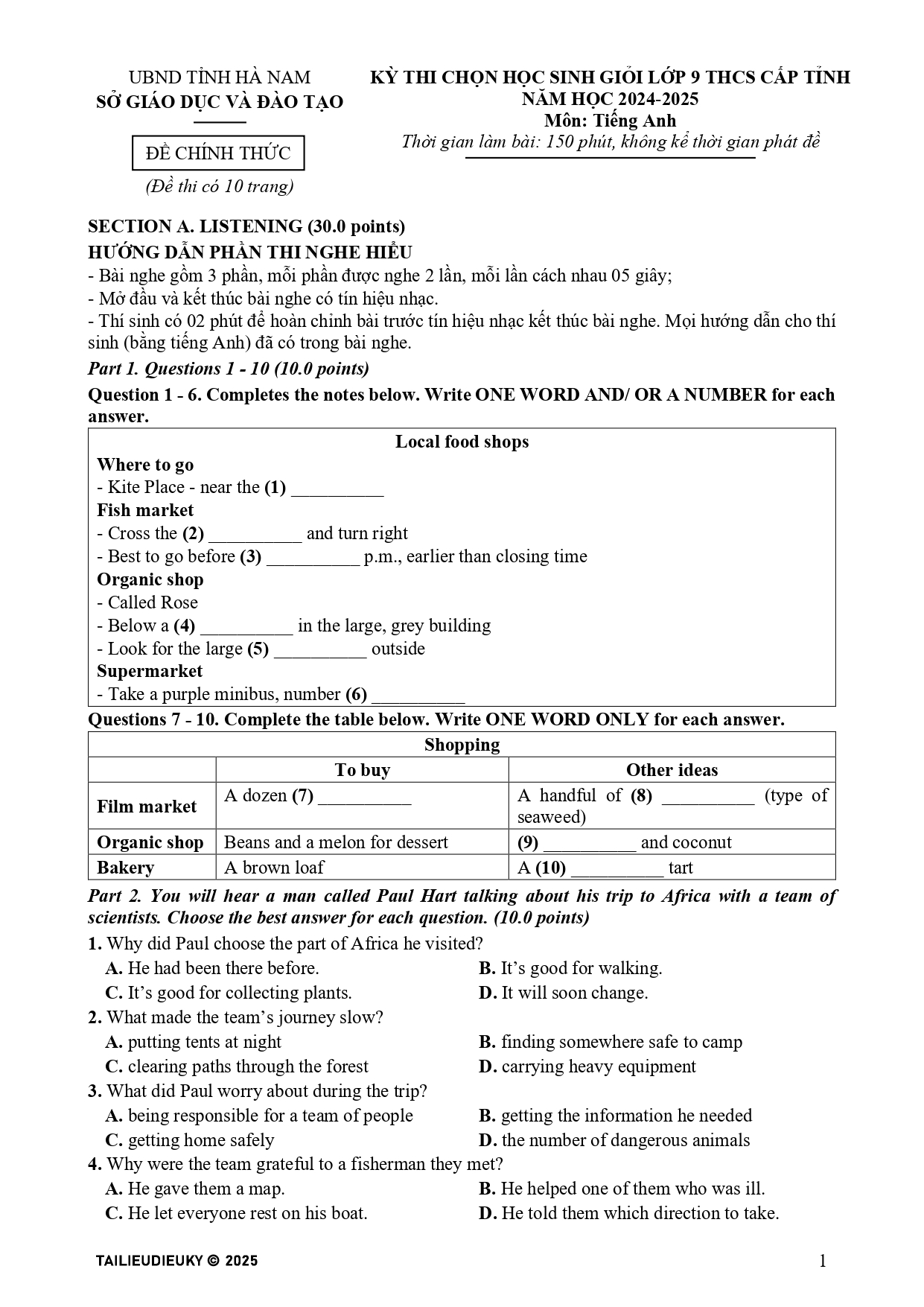
UBND TỈNH HÀ NAM
SỞ GIÁO DỤC VÀ ĐÀO TẠO
(Đề thi có 10 trang) KỲ THI CHỌN HỌC SINH GIỎI LỚP 9 THCS CẤP TỈNH
NĂM HỌC 2024-2025
Môn: Tiếng Anh
Thời gian làm bài: 150 phút, không kể thời gian phát đề
SECTION A. LISTENING (30.0 points)
HƯỚNG DẪN PHẦN THI NGHE HIỂU
- Bài nghe gồm 3 phần, mỗi phần được nghe 2 lần, mỗi lần cách nhau 05 giây;
- Mở đầu và kết thúc bài nghe có tín hiệu nhạc.
- Thí sinh có 02 phút để hoàn chỉnh bài trước tín hiệu nhạc kết thúc bài nghe. Mọi hướng dẫn cho thí sinh (bằng tiếng Anh) đã có trong bài nghe.
Part 1. Questions 1 - 10 (10.0 points)
Question 1 - 6. Completes the notes below. Write ONE WORD AND/ OR A NUMBER for each answer.
Local food shops
Where to go
- Kite Place - near the (1) __________
Fish market
- Cross the (2) __________ and turn right
- Best to go before (3) __________ p.m., earlier than closing time
Organic shop
- Called Rose
- Below a (4) __________ in the large, grey building
- Look for the large (5) __________ outside
Supermarket
- Take a purple minibus, number (6) __________
Questions 7 - 10. Complete the table below. Write ONE WORD ONLY for each answer.
Shopping
To buy Other ideas
Film market A dozen (7) __________ A handful of (8) __________ (type of seaweed)
Organic shop Beans and a melon for dessert (9) __________ and coconut
Bakery A brown loaf A (10) __________ tart
Part 2. You will hear a man called Paul Hart talking about his trip to Africa with a team of scientists. Choose the best answer for each question. (10.0 points)
1. Why did Paul choose the part of Africa he visited?
A. He had been there before. B. It’s good for walking.
C. It’s good for collecting plants. D. It will soon change.
2. What made the team’s journey slow?
A. putting tents at night B. finding somewhere safe to camp
C. clearing paths through the forest D. carrying heavy equipment
3. What did Paul worry about during the trip?
A. being responsible for a team of people B. getting the information he needed
C. getting home safely D. the number of dangerous animals
4. Why were the team grateful to a fisherman they met?
A. He gave them a map. B. He helped one of them who was ill.
C. He let everyone rest on his boat. D. He told them which direction to take.
5. How does Paul feel now he is back home?
A. He misses the people in the train. B. He thinks the trip was a valuable experience.
C. He is planning to do another trip. D. He’s going to visit Australia.
Part 3. You will hear five short extracts in which different people talk about doing without their mobile phones. For questions 1 - 5, choose from the list (A - H) what reason each speaker gives for doing without their mobile phone. There are three extra letters which you do not need to use.
A. It was too distracting.
B. It disappeared.
C. It was broken beyond repair.
D. It was someone else’s fault.
E. It was not waterproof.
F. It was stolen.
G. It was lost.
H. It needed expert attention 1. Speaker 1: __________
2. Speaker 2: __________
3. Speaker 3: __________
4. Speaker 4: __________
5. Speaker 5: __________
SECTION B. PHONETICS (10.0 points)
Part 1. Choose the word whose underlined part is pronounced differently from that of the rest. (5.0 points)
1. A. looked B. hatred C. crooked D. naked
2. A. breathtaking B. breathe C. mouth D. monthly
3. A. emergency B. prefer C. versatile D. operate
4. A. preferential B. celestial C. presidential D. essential
5. A. conscience B. shuttle C. bronchitis D. chauffeur
Part 2. Choose the word that has a different stress pattern from the others in the group. (5.0 points)
6. A. proceed B. welfare C. include D. provide
7. A. identify B. secondary C. luxuriously D. majority
8. A. committee B. interview C. dynamism D. excellent
9. A. accomplishment B. mechanical C. economic D. psychology
10. A. architectural B. cosmopolitan C. appreciative D. archeologist
SECTION C. LEXICO - GRAMMAR (65.0 points)
Part 1. Choose the word, phrase or expression which best completes each sentence. (15.0 points)
1. Shakespeare, a __________ writer, entertained audiences by writing many tragic and comic plays.
A. productive B. pervasive C. generic D. prolific
2. The company is famous for making sturdy work clothes that can __________ hard wear.
A. stand up for B. stand up to C. stand in for D. stand up against
3. Two students are discussing some measures to protect the environment.
- John: “Do you think we should use public transportation to protect our environment?”
- Laura: “__________”
A. There’s no doubt about it. B. Of course not. You bet!
C. Well, that’s very surprising. D. Yes, it’s an absurd idea.
4. I don’t suppose you’ll go, but __________ go, let me know.
A. should B. ought you to C. should you D. ought you
5. Round and round __________.
A. the wheels of the engine went B. did the wheels of the engine go
C. went the wheels of the engine D. going the wheels of the engine
6. To solve this problem, it is advisable __________.
A. that a drastic measure be adopted B. that to adopt a drastic measure
C. a drastic measure to be adopted D. that a drastic measure is adopted
7. When a fire broke out in the Louvre, at least twenty __________ paintings were destroyed, including two by Picasso.
A. worthless B. priceless C. valueless D. worthy
8. Donald Trump __________ when he found out that people disagreed with him about his speech.
A. made his blood boil B. brought the house down
C. saw pink elephants D. hit the roof
9. We will have to economize __________ heating or we won’t be able to pay the bill.
A. about B. in C. on D. over
10. About __________ of the employees in that advertising company are in their twenties.
A. four-fifth B. four-fifths C. fourth-fifths D. four-fives
11. Don’t waste your time telling Jim a joke. He is totally __________ of a sense of humor.
A. deficient B. missing C. devoid D. lacking
12. My brother’s been a __________ of strength through all the problems I’ve had.
A. tower B. heap C. mountain D. show
13. I’m very tired, __________ traveling all day yesterday and having a disturbed night.
A. what if B. whatnot C. whatever D. what with
Choose the word or phrase that is CLOSEST in meaning to the underlined part in each of the following questions.
14. She was like a cat on hot bricks before her driving test.
A. nervous B. comfortable C. depressed D. enjoyable
Choose the word or phrase that is OPPOSITE in meaning to the underlined part in each of the following questions.
15. My teacher tried to bolster my confidence by saying that I had an aptitude for English.
A. reinforce B. discourage C. clarify D. represent
Part 2. Give the correct form of the words in brackets to complete the sentences. (10.0 points)
1. Please don’t be so __________ I can’t do all the work by myself. (REASON)
2. The road is said to be __________ due to flooding. (PASS)
3. He had the __________ of seeing his book become a bestseller. (SATISFY)
4. Do you think these children are __________? They look very thin. (NOURISH)
5. Friend’s family has suffered from his __________. (EXPEND)
6. Some parents feel dismayed because of their children’s __________. (BEHAVE)
7. These young people are __________ supporters of the new plan of our city. (ENTHUSIASM)
8. Don’t you think she is __________. She always looks good in her photographs. (PHOTO)
9. Our school has just set up a project to __________ the library system. (COMPUTER)
10. We live in a __________ where progress involves the mastering of increasingly complex data. (TECHNOLOGY)
Part 3. Give the correct tense/ form of the verbs in brackets to complete the sentences. (10.0 points)
1. It is obligatory that the voyage (cancel) __________. There’s no point in telephoning him.
2. He’s certain (leave) __________ by now.
3. People always (blame) __________ their circumstances for what they are.
4. She (know) __________ your new address, she would come to see you.
5. He (see) __________ the doctor for his backache but he went on playing.
6. If you want to develop inner tranquility, you have to stop (bother) __________ by every little thing that happens.
7. The accident was reported (cause) __________ by a reckless motorist.
8. It’s high time you had the house (repaint) __________.
9. (Spend) __________ all his money, he decided to go home and ask his father for a job.
10. The number of people without jobs (rise) __________ up to now.
Part 4. There are TEN mistakes in this passage. Underlined and write them down, then give the correction. (20.0 points)
The Statue of Liberty is the famous statue that stands in Liberty Island in New York Harbor. At a height of 151 feet, it is extremely tall. The statue was a gift to the United States from the people of France, and over the years it has become a symbol of freedom. Many people think an American designed it, but in fact it created by a French artist, Frédéric Bartholdi.
The designer tried many designs and models, included children and animals before he chose a female figure, wearing a gown and cloak, holding a torch high above his head. The statue’s body looks like a Greek goddess. In the early drawings, the statue’s face was going to look like the president’s wife, and Bartholdi decided to copy the face of Charlotte Beysser, Bartholdi’s mother.
Bartholdi decided to make the skin of copper sheets. This was a good choice because the workmen were able to lift and work with the sheets with no difficulty. He considered other cheaper metals but thought they might be so hard to work with because of its weight.
On October 28th 1886, the President of the United States opened the Statue of Liberty in a ceremony in front of a huge, exciting crowd. The President gave a long speech, and Bartholdi was asked to give one too but he refused because he was a shy man. A fireworks display was delayed to November 1st because of poor weather, but the parade went ahead as planned.
Part 5. Fill in the gap with ONE suitable word to complete the following sentences. Write your answers in the numbered spaces given below. (10.0 points)
1. If he’s clumsy, he can bump __________ the desk.
2. Mike is not really __________ tune with the rest of the group.
3. I’m not in __________ of children leaving home at such an early age.
4. Most of these photos are terrible, they are out of __________.
5. Teenagers tend to __________ their relationship a secret if their parents are too strict to them.
6. My cousin George is obsessed __________ keeping fit.
7. Many frozen foods are deficient __________ vitamins.
8. The same rule applies, irrespective __________ how much you have paid.
9. The sixth time he called at night was the last __________.
10. In her new environment Lora was feeling like a __________ out of water.
SECTION D. READING COMPREHENSION (50.0 points)
Part 1. Fill in each gap with ONE suitable word to complete the following passage. (20.0 points)
DEALING WITH WASTE PLASTIC
Every year people throw (1) __________ millions of tones of plastic bottles, boxes and wrapping. These create huge mountains of waste that are extremely hard to get (2) __________ of. Now a new recycling process promises to reduce this problem (3) __________ turning old plastic into new.
Scientists have taken a long time to develop their ideas because waste plastic has always (4) __________ a bigger problem than substances like waste paper. You can bury plastic, but it takes many years to (5) __________ down. If you burn it, it just becomes (6) __________ form of pollution. A few products, for (7) __________, bottles, can be re-used, but it is expensive or difficult to do this with a lot of plastic products.
Now a group of companies has developed a new method of recycling (8) __________ could save almost all plastic waste. Nearly every type of waste plastic can be used: it does not have to be sorted. In addition, labels and ink may be left on the products. Everything is simply mixed together (9) __________ heated to more than 400 degrees (10) __________ so that it melts. It is then cooled, producing a waxy substance that can be used to make new plastic products, including computer hardware.
Part 2. Choose the best option A, B, C, or D to fill in spaces in the following passage. (10.0 points)
Our obsession with recording every detail of our happiness moments could be (1) __________ our ability to remember them, according to new research.
Dr Linda Henkel, from Fairfield University, Connecticut, (2) __________ this as the ‘photo-taking impairment effect’. She said, ‘People often whip out their cameras almost mindlessly to (3) __________ a moment, to the point that they are missing what is happening (4) __________ in front of them.’ When people rely on technology to remember for them, (5) __________ on the camera to record the event and thus not needing to (6) __________ to it fully themselves - it can have a negative (7) __________ on how well they remember their experiences.
In Dr Henkel’s experiment, a group of university students were (8) __________ on a tour of a museum and asked to either photograph or try to remember objects on display. The next day each student’s memory was tested. The results showed that people were less (9) __________ in recognizing the objects they had photographed (10) __________ with those they had only looked at.
1. A. damaging B. breaking C. injuring D. hurting
2. A. traced B. related C. painted D. described
3. A. seize B. grasp C. capture D. snatch
4. A. quite B. right C. merely D. barely
5. A. counting B. settling C. assuming D. swearing
6. A. engage B. apply C. attend D. dedicate
7. A. result B. aspect C. extent D. impact
8. A. steered B. run C. led D. conveyed
9. A. accurate B. faithful C. exact D. factual
10. A. measured B. compared C. matched D. confronted
Part 3. Read the following passage and select the best answer to each of the questions. (10.0 points)
One of the factors contributing to the intense nature of twenty-first-century stress is continual exposure to media - particularly to an overabundance of news. If you feel stressed out by the news, you are far from alone. Yet somehow many of us seem unable to prevent ourselves from tuning in to an extreme degree.
The further back we go in human history, the longer news took to travel from place to place, and the less news we had of distant people and lands altogether. The printing press obviously changed all that, as did every subsequent development in transportation and telecommunication.
When television came along, it proliferated like a population of rabbits. In 1950, there were 100,000 television sets in North American homes; one year later there were more than a million. Today, it’s not unusual for a home to have three or more television sets, each with cable access to perhaps over a hundred channels. News is the subject of many of those channels, and on several of them it runs 24 hours a day.
What’s more, after the traumatic events of September 11, 2001, live new-casts were paired with perennial text crawls across the bottom of the screen - so that viewers could stay abreast of every story all the time.
Needless to say, the news that is reported to us is not good news, but rather disturbing images and sound bytes alluding to disaster (natural and man-made), upheaval, crime, scandal, war, and the like. Compounding the problem is that when actual breaking news is scarce, most broadcasts fill in with waistline, hairline, or very existence in the future. This variety of story tends to treat with equal alarm a potentially lethal flu outbreak and the bogus claims of a wrinkle cream that overpromises smooth skin.
Are humans meant to be able to process so much trauma - not to mention so much overblown anticipation of potential trauma - at once? The human brain, remember, is programmed to slip into alarm mode when danger looms. Danger looms for someone, somewhere at every moment. Exposing ourselves to such input without respite and without perspective cannot be anything other than a source of chronic stress.
1. According to the passage, which of the following has contributed to the intense nature of twenty-first-century stress?
A. An overabundance of special news B. The degree to which stress affects our life
C. Our inability to control ourselves D. Our continual exposure to the media
2. In the past, we had less news of distant people and lands because __________.
A. means of communication and transportation were not yet invented
B. the printing press changed the situation to slowly
C. printing, transportation, and telecommunications were not developed
D. most people lived in distant towns and villages
3. The pronoun them in paragraph 3 refers to __________.
A. TV channels B. television sets C. TV news D. cable access
4. The word traumatic in paragraph 4 is closest in meaning to __________.
A. boring B. fascinating C. upsetting D. exciting
5. According to the passage, when there is not enough actual breaking news, broadcasts __________.
A. are full of dangerous diseases such as flu
B. send out live newscasts paired with text across the screen
C. send out frightening stories about potential dangers
D. are forced to publicize an alarming increase in crime
6. As stated in the passage, a flu outbreak and the bogus claims of a wrinkle cream tend to __________.
A. involve natural and man-made disasters B. be treated with equal alarm
C. be scarce breaking news D. be warmly welcomed by the public
7. Which of the following is NOT TRUE, according to the passage?
A. The news that is reported to us is not good news.
B. Many people are under stress caused by the media.
C. Many TV channels supply the public with breaking news.
D. The only source of stress in our modern life is the media.
8. The word slip in paragraph 6 is closest in meaning to __________.
A. release B. bring C. fail D. fall
9. According to the passage, our continual exposure to bad news without perspective is obviously __________.
A. a source of chronic stress B. the result of human brain’s switch to alarm mode
C. a source of defects in human brain D. the result of an overabundance of good news
10. What is probably the best title for this passage?
A. Effective Ways to Beat Stress B. More Modern Life - More Stress
C. The Media - A Major Cause of Stress D. Developments in Telecommunications
Part 4. You are going to read an article in which four people talk of their experiences of learning languages. For questions 1 - 10, choose from the people (A - D). The person may be chosen more than once. (10.0 points)
Which person
1. __________ had tried the same method of study when she was younger?
2. __________ thought her chosen form of study was reasonably priced?
3. __________ believes that she learned from her language mistakes?
4. __________ was aware of the need to stay safe?
5. __________ missed going out with people of her own age?
6. __________ eventually found the learning materials she needed?
7. __________ was once embarrassed when she was practicing the language?
8. __________ needed to learn the language as quickly as possible?
9. __________ made a change because she was disappointed with her progress?
10. __________ felt rather tired when she was studying?
LANGUAGE LEARNING
A. Laura
I was living with an English-speaking family and the idea was that I’d pick up a lot of language by being there with them, but it just wasn’t happening. Everyone watched television all the time and rarely spoke to me, so I might as well have been at home watching the same channels on satellite TV. After a week I left and moved in with a couple who had young children, and that was much better. They were all very friendly and I could chat with them anytime, really. When I got things wrong they would often correct me and I think that helped me improve my speaking a lot. They didn’t know much about grammar, though, so it was probably a mistake not to go to a language school every day and actually be taught it. I would also have liked to be nearer the city center, because the house was so far out of town that I couldn’t get to the kinds of places where other teenagers went in the evenings. Although often I was so tired after playing with the kids I was happy just to have an early night.
B. Chloe
I really want to learn Polish so I bought a course of language lessons as an MP3 to play on my iPod. That meant I could work on it anywhere I went, particularly at those times when you’ve got nothing to do, like standing at the bus stop, or in cinema queues. Once I was concentrating so hard on getting a grammar point right that I completely forgot I was on the bus and I started repeating restaurant phrases aloud. I felt a bit uncomfortable when I noticed everyone looking at me, so I didn’t do that again. Actually, one problem with learning on my own was not knowing when I was saying words properly and when I wasn’t. I could have done with someone to correct me, really. I don’t mean a teacher, just somebody who spoke Polish well. Overall, though, it was a useful course and I think it was good value for money. After I’d finished the beginner’s level I bought the intermediate level and I’m on that now
C. Amy
I used the Internet to improve my Spanish. It wasn’t the first time I’d tried this, but I enjoyed it much more this time, probably because I’m in my mid-teens now. It cost nothing, of course, and although at first I didn’t know quite where to look, in the end I came across some great websites where I could practice reading and listening and do grammar exercises. At the same time, I was joining social networking sites like MySpace and getting in touch with Spanish-speaking teenagers from various parts of the world. I was careful, though, not to give out my personal details because when you’re online you can never be quite sure who is contacting you, whatever the language is. I also tried online chat in Spanish, but I couldn’t keep up with people. All the time I was thinking about my grammar and it was taking me so long to reply to each sentence after I’d read it that I didn’t think it was fair on them, so I gave up. I’ll try again sometime, though.
D. Stacey
I had lessons in Hindi at a local language school. Our teacher was great and I really liked the book we were using, too, but unfortunately the only class available at my level was late in the evening. So after a long day at school, and then all the written homework we have to do, I didn’t have a lot of energy left for language learning. Also, some of my classmates were much older than me and I didn’t really get to know them. But that didn’t matter because whenever we did group activities, which I’d never done before, but took to straight away, I made sure I was with the younger ones. I was having lessons every evening and that was costing my parents quite a lot, but we’d booked to go to India later that year so there was no time to lose. It was really important to me that I could communicate with people there in their own language.
SECTION E: WRITING (45.0 points)
Part 1. Finish each of the following sentences in such a way that it means the same as the sentence printed before it. (10.0 points)
1. I am absolutely sure he took the money on purpose.
He can’t ______________________________________________________________________
2. As they grow older, they become more and more forgetful.
The __________________________________________________________________________
3. Nobody expected her to lose, but she did.
Against _______________________________________________________________________
4. My parents think I should go to university rather than start a job immediately.
My parents would prefer __________________________________________________________
5. The value of these goods has fallen considerably in the past week.
There has _____________________________________________________________________
Part 2. Rewrite each of the following sentences so that it means the same as the given one. Use the given word. Do not change the bold word.
1. Don’t panic about something so trivial. (MOUNTAIN)
_____________________________________________________________________________
2. This door is an emergency exit and must never be locked for any reason. (ACCOUNT)
_____________________________________________________________________________
3. He said he disapproved of people who smoked. (EXPRESSED)
_____________________________________________________________________________
4. The new lecturer was unpopular with his students. (TAKE)
_____________________________________________________________________________
5. I know I can convince David that I’m right about this matter. (BRING)
_____________________________________________________________________________
Part 3. Writing (25.0 points)
These days, many students or teenagers rely on AI-powered tools for study or work, which loses their creativity and autonomy.
To what extent, do you agree or disagree with this statement? In about 200 words, write a paragraph to express your viewpoint. Give reasons for your answer and include any relevant examples from your own knowledge and experience.
---------- THE END ----------