
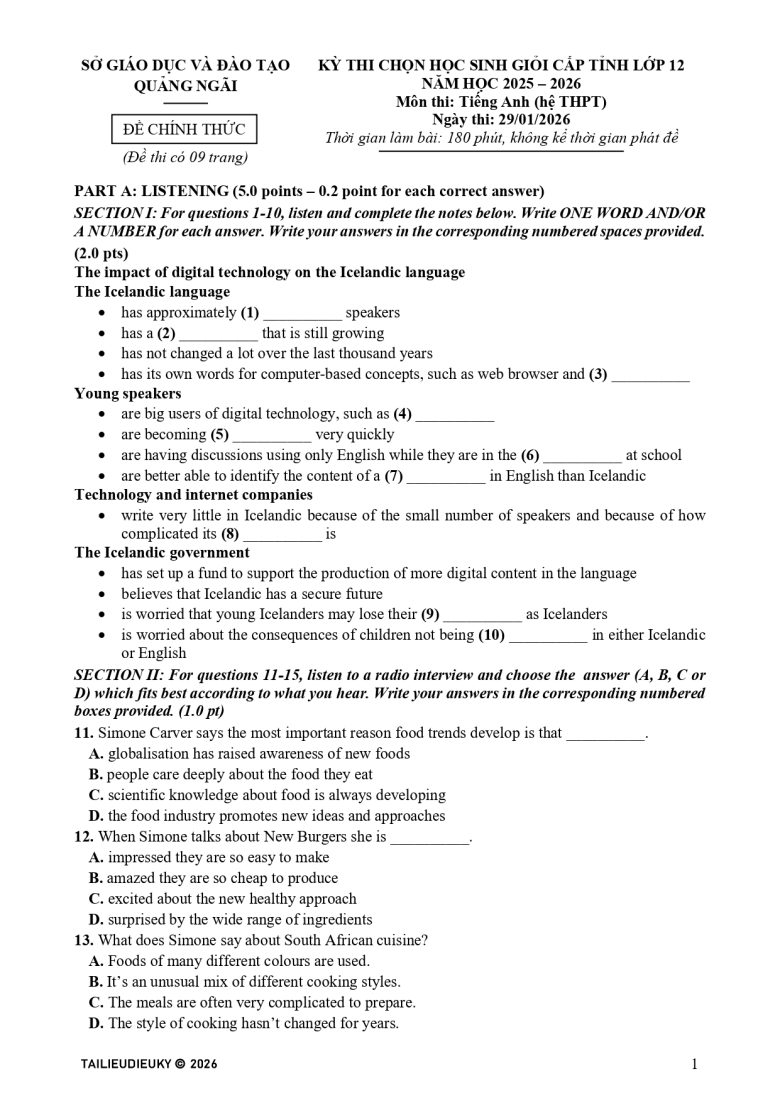
Sở GD&ĐT Quảng Ngãi vừa công bố kết quả Kỳ thi chọn HSG cấp tỉnh lớp 12 (2025 – 2026) với 1.461/2.467 học sinh đoạt giải. Đặc biệt, đây là kỳ thi mang tính lịch sử, đánh dấu sự cạnh tranh quy mô lớn sau khi sáp nhập hai tỉnh Quảng Ngãi và Kon Tum (từ ngày 01/7/2025). Cùng điểm qua cấu trúc đề thi Tiếng Anh 12 năm nay và tải trọn bộ đề kèm đáp án file word chính thức ngay dưới đây!.
Cấu trúc Đề thi HSG Tiếng Anh 12 Quảng Ngãi
Đề HSG Tiếng Anh 12 Quảng Ngãi – 29/01/2026 – 13 trang – 4 phần – 87 câu
A. Listening (5.0đ – 25c): Section I note completion 10c–2đ; Section II MCQ 5c–1đ; Section III gap fill 10c–2đ.
B. Lexico & Grammar (3.0đ – 30c): MCQ 20c–2đ; word formation 10c–1đ.
C. Reading (6.0đ – 30c): gap fill 10c–2đ; MCQ 10c–2đ; headings + Y/N/NG 10c–2đ.
D. Writing (6.0đ – 2bài): chart 150w–2đ; essay 250w–4đ.
Tải xuống trọn bộ đề thi miễn phí
📥 Tải xuống đề thi HSG Tiếng Anh 12 Quảng Ngãi 2025–2026
Tài liệu đã sẵn sàng, đáp án cũng có ngay, việc còn lại là của các bạn thôi đó! Cố gắng lên nhé những ‘chiến thần’ tiếng Anh tương lai. Mãi yêu! 🍭🌈
Đáp án chính thức
📘 SỞ GIÁO DỤC VÀ ĐÀO TẠO QUẢNG NGÃI
KỲ THI CHỌN HỌC SINH GIỎI CẤP TỈNH LỚP 12
Năm học 2025 – 2026
🔑 ANSWER KEYS AND MARKING SCHEMES
________________________________________
🟦 PART A: LISTENING (5.0 điểm)
(0.2 điểm cho mỗi câu đúng)
▶ SECTION I (2.0 điểm)
1. 321,000
2. vocabulary
3. podcast
4. smartphones
5. bilingual
6. playground
7. picture
8. grammar
9. identity
10. fluent
▶ SECTION II (1.0 điểm)
11. B
12. D
13. B
14. A
15. C
▶ SECTION III (2.0 điểm)
16. solar flare eruptions
17. coronal mass ejections
18. solar wind
19. magnetosphere
20. geomagnetic storms
21. Aurora Borealis
22. nitrogen, oxygen
23. solar maximum
24. spectacular light displays
25. solar system
________________________________________
🟩 PART B: LEXICO AND GRAMMAR (3.0 điểm)
(0.1 điểm cho mỗi câu đúng)
▶ SECTION I (2.0 điểm)
26. B | 27. A | 28. A | 29. C | 30. C
27. D | 32. A | 33. D | 34. A | 35. B
28. D | 37. B | 38. C | 39. A | 40. A
29. B | 42. C | 43. D | 44. B | 45. D
▶ SECTION II (1.0 điểm)
46. unconventional
47. incorporated
48. iconography
49. universally
50. expressionism
51. supremacy
52. pretentiousness
53. comprehensible
54. discriminatory
55. unfavourable / unfavorable
________________________________________
🟨 PART C: READING (6.0 điểm)
(0.2 điểm cho mỗi câu đúng)
▶ SECTION I (2.0 điểm)
56. lead
57. with
58. mental
59. where
60. not
61. attention
62. Combining
63. reliance / dependence
64. worse
65. balance
▶ SECTION II (2.0 điểm)
66. C | 67. A | 68. D | 69. A | 70. C
67. B | 72. D | 73. A | 74. A | 75. A
▶ SECTION III (2.0 điểm)
76. iii
77. vi
78. ii
79. i
80. vii
81. v
82. YES
83. NO
84. NOT GIVEN
85. YES
________________________________________
🟥 PART D: WRITING (6.0 điểm)
▶ SECTION I (2.0 điểm)
• Task achievement: 0.75 điểm
• Coherence and cohesion: 0.75 điểm
• Lexical resource: 0.25 điểm
• Grammatical range & accuracy: 0.25 điểm
▶ SECTION II (4.0 điểm)
• Task achievement: 1.5 điểm
• Organization: 1.0 điểm
• Language use: 1.0 điểm
• Punctuation, spelling & handwriting: 0.5 điểm
________________________________________
✨ THE END ✨
SỞ GIÁO DỤC VÀ ĐÀO TẠO
QUẢNG NGÃI
(Đề thi có 09 trang) KỲ THI CHỌN HỌC SINH GIỎI CẤP TỈNH LỚP 12
NĂM HỌC 2025 – 2026
Môn thi: Tiếng Anh (hệ THPT)
Ngày thi: 29/01/2026
Thời gian làm bài: 180 phút, không kể thời gian phát đề
PART A: LISTENING (5.0 points – 0.2 point for each correct answer)
SECTION I: For questions 1-10, listen and complete the notes below. Write ONE WORD AND/OR A NUMBER for each answer. Write your answers in the corresponding numbered spaces provided.
(2.0 pts)
The impact of digital technology on the Icelandic language
The Icelandic language
• has approximately (1) __________ speakers
• has a (2) __________ that is still growing
• has not changed a lot over the last thousand years
• has its own words for computer-based concepts, such as web browser and (3) __________
Young speakers
• are big users of digital technology, such as (4) __________
• are becoming (5) __________ very quickly
• are having discussions using only English while they are in the (6) __________ at school
• are better able to identify the content of a (7) __________ in English than Icelandic
Technology and internet companies
• write very little in Icelandic because of the small number of speakers and because of how complicated its (8) __________ is
The Icelandic government
• has set up a fund to support the production of more digital content in the language
• believes that Icelandic has a secure future
• is worried that young Icelanders may lose their (9) __________ as Icelanders
• is worried about the consequences of children not being (10) __________ in either Icelandic or English
SECTION II: For questions 11-15, listen to a radio interview and choose the answer (A, B, C or D) which fits best according to what you hear. Write your answers in the corresponding numbered boxes provided. (1.0 pt)
11. Simone Carver says the most important reason food trends develop is that __________.
A. globalisation has raised awareness of new foods
B. people care deeply about the food they eat
C. scientific knowledge about food is always developing
D. the food industry promotes new ideas and approaches
12. When Simone talks about New Burgers she is __________.
A. impressed they are so easy to make
B. amazed they are so cheap to produce
C. excited about the new healthy approach
D. surprised by the wide range of ingredients
13. What does Simone say about South African cuisine?
A. Foods of many different colours are used.
B. It’s an unusual mix of different cooking styles.
C. The meals are often very complicated to prepare.
D. The style of cooking hasn’t changed for years.
14. What worries Simone about foraging?
A. It is unrealistic in certain locations.
B. Few people would want to try doing it.
C. It might have unforeseen consequences.
D. Most people wouldn’t know what to eat.
15. Simone and the presenter conclude that ‘brinner’ __________.
A. might actually taste much better than it sounds
B. could one day replace another established meal
C. is a development of an old idea
D. would cause confusion among people who tried it
SECTION III: For questions 16-25, listen to a piece of news and fill in the missing information with NO MORE THAN THREE WORDS. Write your answers in the corresponding numbered spaces provided. (2.0 pts)
16. The vigorous outbursts on the sun surface are actually __________ that are quite rare but extremely enormous.
17. In the sun’s cycle, the above activities are also accompanied by __________.
18. These vigorous activities in the sun lead to the formation of __________ directed towards the Earth at huge speeds.
19. However, Earth has __________ to protect itself against the sun’s activities.
20. When this solar event is so strong that it is captured in the Poles, it will lead to the event called __________.
21. Despite its interruptive effects, this kind of solar event can produce __________ or the Northern Lights.
22. The colour in the lights stem from the reaction of the charged particles from the sun and __________ and __________ on the Earth.
23. May 2024 marks the __________ of the sun’s activities so it makes witnessing the Northern Lights become more likely.
24. This will create __________ across different countries.
25. However, contrary to what some may believe, this solar event is somehow universal across the __________.
PART B: LEXICO AND GRAMMAR (3.0 points – 0.1 point for each correct answer)
SECTION I: For questions 26-45, choose the correct answer (A, B, C or D) to each of the following questions. Write your answers in the corresponding numbered boxes provided. (2.0 pts)
26. Growth is of every immediate environmental concern because __________, the more pollutants we throw out into the atmosphere.
A. the more the world grows economy B. the more the world economy grows
C. the more economy the world grows D. the more grows the world economy
27. He is known to be __________ the money and doesn’t know how to spend all of that.
A. in B. at C. with D. on
28. __________ their heads in his direction, he knew they were interested.
A. Seeing them both turn B. On seeing they both turn
C. When he saw them both to turn D. After seeing them both to have turned
29. I’d rather you __________ television while I’m reading.
A. hadn’t watched B. don’t watch C. didn’t watch D. haven’t watched
30. In the current economic downturn, many companies have to cut their expenses by imposing a salary __________.
A. hoarding B. breakdown C. freeze D. flop
31. With the technological advances today, scientists anticipate that AI will dominate the market __________.
A. for a naught B. at one swoop C. above the tick D. down the road
32. A side job can help you __________ an extra hundred dollars a month.
A. bring in B. hold out C. jab out D. take down
33. I haven’t had a very __________ week. I seem to have done nothing at all.
A. economic B. enthusiastic C. extensive D. productive
34. They are unlikely to find any new evidence because so much time has __________ since the crime.
A. elapsed B. postponed C. lapsed D. spanned
35. The incredible thing about telephone __________ across the continents, but that you can recognize the other person’s voice.
A. is it allow people to talk instantly
B. is not that people can instantly talk to each other
C. is it provides instant talking to each other
D. is that people can talk instantly
36. That __________ Nick that you saw. He has gone to London.
A. needn’t have been B. mustn’t have been
C. shouldn’t have been D. can’t have been
37. __________ warfare duties primarily to males was imperative when combat was hand-to-hand.
A. Assigned B. Assigning
C. That they were assigning D. They who assigned
38. It is mandatory that smoking in public __________.
A. prohibited B. prohibit C. be prohibited D. is prohibited
39. How much longer do we have to wait? This is starting to get __________ my nerves.
A. on B. at C. back D. off
40. __________ towards shore, its shape is changed by its collision with the shallow sea bottom.
A. As a wave rolls B. During a wave rolls
C. A wave rolls D. A wave’s rolling
41. In spite of working their fingers to the __________, all the staff were made redundant.
A. nail B. bone C. flesh D. edge
42. In geometry, an ellipse may be defined as the locus of all points __________ distances from two fixed points is constant.
A. which as the sum of B. of the sum which
C. the sum of whose D. whose sum that the
43. He came __________ a lot of criticism for the remarks he made in a television interview.
A. out of B. off C. over D. in for
44. I’ve searched __________ for that old photo album, but I can’t find it anywhere.
A. long and short B. high and low C. straight and narrow D. thick and thin
45. I said that I’d stay at home this evening, but __________ I think I’ll come out with you instead.
A. bearing in mind B. having a lot on my mind
C. without a second thought D. on second thoughts
SECTION II: For questions 46-55, give the correct form of the words in brackets to complete the passage. Write your answers in the corresponding numbered spaces provided. (1.0 pt)
Pop art was a(n) (46. CONVENTION) __________ art style in which commonplace objects such as comic strips, soup cans and road signs were used as subject matter, and were often (47. CORPORATE) __________ into the work. The pop art movement was largely a British and American cultural phenomenon of the late 1950s and 1960s. Art critic Lawrence Alloway, referring to the boring (48. ICON) __________ of its painting and sculpture, named the movement pop art. It represented an attempt to return to a more objective and (49. UNIVERSE) __________ accepted form of art after the dominance in both the United States and Europe of the highly personal abstract (50. EXPRESS) __________. The art form was iconoclastic, rejecting the (51. SUPREME) __________ of the high art of the past and the
(52. PRETEND) __________ of other contemporary avant-garde art. Pop art became a cultural institution because of its close reflection of a particular social situation and because its easily (53. COMPREHEND) __________ images were immediately exploited by the mass media. Although the critics of pop art describe it as sensational and non-aesthetic, its proponents saw it as an art that was democratic and not (54. DISCRIMINATE) __________, bringing together both connoisseurs and untrained inexperienced viewers. Even though public reaction to pop art was (55. FAVOUR) __________, it found critical acceptance as a form of art suited to the highly technological, mass media-oriented society of western countries.
PART C: READING (6.0 points – 0.2 point for each correct answer)
SECTION I: For questions 56-65, read the text below and fill in each blank with ONE suitable word. Write your answers in the corresponding numbered spaces provided. (2.0 pts)
In today’s digital age, many drivers rely heavily on GPS devices to navigate unfamiliar routes. However, this dependence may have unintended consequences on our cognitive abilities. Studies suggest that over-reliance on GPS can (56) __________ to a decline in our natural sense of direction and spatial awareness. Research conducted at University College London found that when individuals use GPS to find their way, the hippocampus – a region of the brain associated (57) __________ navigation and memory – shows reduced activity. This suggests that by outsourcing our navigational skills to technology, we may be weakening the (58) __________ processes that are crucial for spatial orientation. Furthermore, there have been instances (59) __________ blind trust in GPS directions has led drivers into hazardous situations, such as driving into bodies of water or getting stranded in remote areas. These cases highlight the importance of maintaining our innate navigational abilities and (60) __________ relying solely on technology. Experts recommend that individuals occasionally practice traditional navigation methods, such as using physical maps or paying closer (61) __________ to landmarks, to keep their spatial skills sharp. (62) __________ the use of GPS with these practices can help ensure that we retain our natural ability to navigate the world around us. Moreover, scientists warn that continued (63) __________ on GPS could lead to long-term changes in brain structure, making people less capable of independent navigation. Some studies have shown that those who regularly use GPS perform (64) __________ in spatial memory tests compared to those who navigate using their own sense of direction. While GPS technology has undoubtedly improved travel efficiency, it is essential to strike a (65) __________ between convenience and maintaining cognitive skills.
SECTION II: For questions 66-75, read the passage and choose the correct option A, B, C, or D to answer the questions. Write your answers in the corresponding numbered boxes provided. (2.0 pts)
To South Americans, robins are birds that fly north every spring. To North Americans, the robins simply vacation in the south each winter. Furthermore, they fly to very specific places in South America and will often come back to the same trees in North American yards the following spring. The question is not why they would leave the cold of winter so much as how they find their way around. The question perplexed people for years, until, in the 1950s, a German scientist named Gustavo Kramer provided some answers and in the process, raised new questions.
Kramer initiated important new kinds of research regarding how animals orient and navigate. Orientation is simply facing in the right direction; navigation involves finding one way from point A to point B.
Early in his research, Kramer found that caged migratory birds became very restless at about the time they would normally have begun migration in the wild. Furthermore, he noticed that as they fluttered around in the cage, they often launched themselves in the direction of their normal migratory route. He then set up experiments with caged starlings and found that their orientation was, in fact, in the proper migratory direction except when the sky was overcast, at which times there was no clear direction to their restless movements. Kramer surmised, therefore, that they were orienting according to the position of the Sun. They seemed to be using the Sun as a compass to determine direction. At the time, this idea seemed preposterous. How could a bird navigate by the Sun when some of us lose our way with road maps? Obviously, more testing was in order.
So, in a set of experiments, Kramer put identical food boxes around the cage, with food in only one of the boxes. The boxes were stationary, and the one containing food was always at the same point of the compass. However, its position with respect to the surroundings could be changed by revolving either the inner cage containing the birds or the outer walls, which served as the background. As long as the birds could see the Sun, no matter how their surroundings were altered, they went directly to the correct food box. On overcast days, however, the birds were disoriented and had trouble locating their food box.
In experimenting with artificial suns, Kramer made another interesting discovery. If the artificial Sun remained stationary, the birds would shift their direction with respect to it at a rate of about 15 degrees per hour, the Sun’s rate of movement across the sky. Apparently, the birds were assuming that the “Sun” they saw was moving at that rate. When the real Sun was visible, however, the birds maintained a constant direction as it moved across the sky. In other words, they were able to compensate for the Sun’s movement. This meant that some sort of biological clock was operating and a very precise clock at that.
66. The word perplexed in paragraph 1 is closest in meaning to __________.
A. defeated B. gripped C. baffled D. grizzled
67. Which of the following can be inferred about bird migration from paragraph 1?
A. Bird migration generally involves moving back and forth between north and south.
B. Birds will take the most direct migratory route to their new habitat.
C. The destination of birds’ migration can change from year to year.
D. The purpose of migration is to join with larger groups of birds.
68. Which of the sentences below best expresses the essential information in the bold sentence in paragraph 3?
A. Experiments revealed that caged starlings displayed a lack of directional sense and restless movements.
B. Experiments revealed that caged starlings were unable to orient themselves in the direction of their normal migratory route.
C. Experiments revealed that the restless movement of caged starlings had no clear direction.
D. Experiments revealed that caged starlings’ orientation was accurate unless the weather was overcast.
69. The word surmised in paragraph 3 is closest in meaning to __________.
A. guessed B. spread C. shocked D. confused
70. According to paragraph 3, which statement is NOT TRUE about caged starlings?
A. It was likely that they used the Sun to determine direction.
B. They were able to identify their normal migratory route.
C. Their orientation was accurate when the weather was overcast.
D. They became restless when their normal time for migration arrived.
71. Which of the following can be inferred from paragraph 4 about Kramer’s reason for filling one food box and leaving the rest empty?
A. He thought that if all the boxes contained food, this would distract the birds from following their migratory route.
B. He wanted to see whether the Sun alone controlled the birds’ ability to navigate toward the box with food.
C. He believed the birds would eat food from only one box which was stationary.
D. He needed to test whether the birds preferred having the food at any particular point of the compass.
72. The word they in paragraph 4 refers to __________.
A. surroundings B. experiments C. walls D. birds
73. According to paragraph 5, how did the birds fly when the real Sun was visible?
A. They kept the direction of their flight constant.
B. They changed the direction of their flight at a rate of 15 degrees per hour.
C. They kept flying toward the Sun.
D. They flew in the same direction as the birds that were seeing the artificial Sun.
74. The experiment described in paragraph 5 caused Kramer to conclude that birds possess a biological clock because __________.
A. when birds navigate they are able to compensate for the changing position of the Sun in the sky
B. birds’ innate bearings keep them oriented in a direction that is within 15 degrees of the Sun’s direction
C. birds’ migration is triggered by natural environmental cues, such as the position of the Sun
D. birds shift their direction at a rate of 15 degrees per hour whether the Sun is visible or not
75. Which of the following best describes the author’s presentation of information in the passage?
A. A number of experiments are described to support the idea that birds use the Sun to navigate.
B. A structured argument about the importance of internal versus external cues for navigation is presented.
C. The opposing points of view about bird migration are clarified through the study of contrasting experiments.
D. The author uses logic to show that the biological clock in birds is inaccurate.
SECTION III: For questions 76-85, read the passage and do the tasks that follow. (2.0 pts) Attitudes towards artificial intelligence
A. Artificial intelligence (AI) can already predict the future. Police forces are using it to map when and where crime is likely to occur. Doctors can use it to predict when a patient is most likely to have a heart attack or stroke. Researchers are even trying to give AI imagination so it can plan for unexpected consequences. Many decisions in our lives require a good forecast, and AI is almost always better at forecasting than we are. Yet for all these technological advances, we still seem to deeply lack confidence in AI predictions. Recent cases show that people don’t like relying on AI and prefer to trust human experts, even if these experts are wrong. If we want AI to really benefit people, we need to find a way to get people to trust it. To do that, we need to understand why people are so reluctant to trust AI in the first place.
B. Take the case of Watson for Oncology, one of technology giant IBM’s supercomputer programs. Their attempt to promote this program to cancer doctors was a PR disaster. The AI promised to deliver top-quality recommendations on the treatment of 12 cancers that accounted for 80% of the world’s cases. But when doctors first interacted with Watson, they found themselves in a rather difficult situation. On the one hand, if Watson provided guidance about a treatment that coincided with their own opinions, physicians did not see much point in Watson’s recommendations. The supercomputer was simply telling them what they already knew, and these recommendations did not change the actual treatment. On the other hand, if Watson generated a recommendation that contradicted the experts’ opinion, doctors would typically conclude that Watson wasn’t competent. And the machine wouldn’t be able to explain why its treatment was plausible because its machine learning algorithms were simply too complex to be fully understood by humans. Consequently, this has caused even more suspicion and disbelief, leading many doctors to ignore the seemingly outlandish AI recommendations and stick to their own expertise.
C. This is just one example of people’s lack of confidence in AI and their reluctance to accept what AI has to offer. Trust in other people is often based on our understanding of how others think and having experience of their reliability. This helps create a psychological feeling of safety. AI, on the other hand, is still fairly new and unfamiliar to most people. Even if it can be technically explained (and that’s not always the case), AI’s decision-making process is usually too difficult for most people to comprehend. And interacting with something we don’t understand can cause anxiety and give us a sense that we’re losing control. Many people are also simply not familiar with many instances of AI actually working, because it often happens in the background. Instead, they are acutely aware of instances where AI goes wrong. Embarrassing AI failures receive a disproportionate amount of media attention, emphasizing the message that we cannot rely on technology. Machine learning is not foolproof, in part because the humans who design it aren’t.
D. Feelings about AI run deep. In a recent experiment, people from a range of backgrounds were given various sci-fi films about AI to watch and then asked questions about automation in everyday life. It was found that, regardless of whether the film they watched depicted AI in a positive or negative light, simply watching a cinematic vision of our technological future polarized the participants’ attitudes. Optimists became more extreme in their enthusiasm for AI and sceptics became even more guarded. This suggests people use relevant evidence about AI in a biased manner to support their existing attitudes, a deep-rooted human tendency known as “confirmation bias”. As AI is represented more and more in media and entertainment, it could lead to a society split between those who benefit from AI and those who reject it. More pertinently, refusing to accept the advantages offered by AI could place a large group of people at a serious disadvantage.
E. Fortunately, we already have some ideas about how to improve trust in AI. Simply having previous experience with AI can significantly improve people’s opinions about the technology, as was found in the study mentioned above. Evidence also suggests the more you use other technologies such as the internet, the more you trust them. Another solution may be to reveal more about the algorithms which AI uses and the purposes they serve. Several high-profile social media companies and online marketplaces already release transparency reports about government requests and surveillance disclosures. A similar practice for AI could help people have a better understanding of the way algorithmic decisions are made.
F. Research suggests that allowing people some control over AI decision-making could also improve trust and enable AI to learn from human experience. For example, one study showed that when people were allowed the freedom to slightly modify an algorithm, they felt more satisfied with its decisions, more likely to believe it was superior and more likely to use it in the future. We don’t need to understand the intricate inner workings of AI systems, but if people are given a degree of responsibility for how they are implemented, they will be more willing to accept AI into their lives.
For questions 76-81, read the passage and choose the correct heading i – viii from the list of headings below for each section A-F. Write the correct number (i-viii) in corresponding numbered boxes from 76-81.
List of Headings
i. An increasing divergence of attitudes towards AI
ii. Reasons why we have more faith in human judgement than in AI
iii The superiority of AI projections over those made by humans
iv. The process by which AI can help us make good decisions
v. The advantages of involving users in AI processes
vi. Widespread distrust of an AI innovation
vii. Encouraging openness about how AI functions
viii. A surprisingly successful AI application
76. Section A __________
77. Section B __________
78. Section C __________
79. Section D __________
80. Section E __________
81. Section F __________
For questions 82-85, read the passage and decide whether the following statements agree with the claims of the writer in the reading passage. Write your answers in the corresponding numbered boxes from 82-85.
Write:
YES if the statement agrees with the claims of the writer
NO if the statement contradicts the claims of the writer
NOT GIVEN if it is impossible to say what the writer thinks about this
82. Some people are reluctant to accept AI because its complexity makes them feel that they are at a disadvantage.
83. Subjective depictions of AI in sci-fi films make people change their opinions about automation.
84. Portrayals of AI in media and entertainment are likely to become more positive.
85. AI applications which users are able to modify are more likely to gain consumer approval.
PART D: WRITING (6.0 points)
SECTION I: (2.0 pts)
The chart shows the percentage of people accessing news from four sources between 1995 and 2025.
Summarize the information by selecting and reporting the main features, and make comparisons where relevant. You should write about 150 words. Write your answer in the space provided.
SECTION II: (4.0 pts)
Write an essay of about 250 words on the following topic:
The phenomenon of “virtual living” and the excessive use of social media are becoming increasingly prevalent among young people.
In your opinion, what negative consequences does this trend result in, and what potential solutions can be offered?
———- THE END ———-