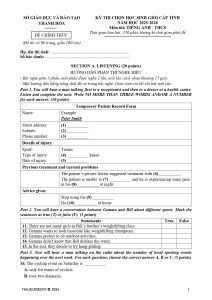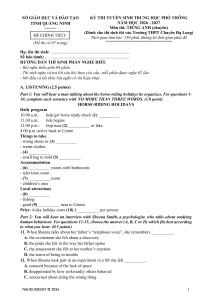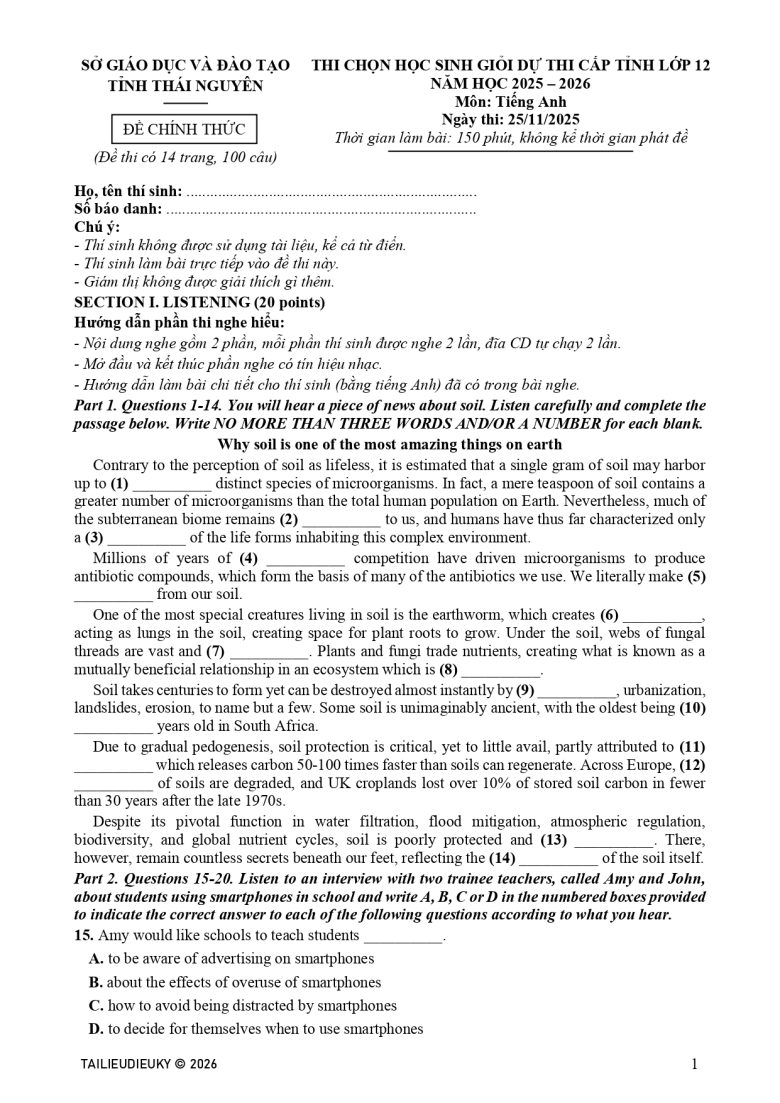
Vừa qua, vào ngày 25/11/2025, Sở GD&ĐT tỉnh Thái Nguyên đã chính thức tổ chức Kỳ thi chọn học sinh giỏi cấp tỉnh lớp 12. Đây là một trong những kỳ thi quan trọng nhằm đánh giá và tuyển chọn những học sinh xuất sắc nhất bộ môn Tiếng Anh trên địa bàn toàn tỉnh. Nhằm giúp các bạn học sinh và quý thầy cô có nguồn tài liệu ôn tập chất lượng, Tài liệu diệu kỳ xin cung cấp toàn bộ tài liệu về kỳ thi này, bao gồm: đề thi word (.docx) chất lựng, đáp án chính thức, file nghe (audio) và audioscripts chi tiết nhất.
Đề HSG lớp 12 tỉnh Thái Nguyên 2025–2026 – 150 phút – 14 trang – 4 phần – 100 câu
A. Listening: 20 câu – 20 điểm
• Điền từ: 14 câu
• Trắc nghiệm: 6 câu
B. Lexico-Grammar: 25 câu – 25 điểm
• Trắc nghiệm: 10 câu
• Word form: 10 câu
• Sửa lỗi: 5 câu
C. Reading: 30 câu – 30 điểm
• Cloze: 8 câu
• Điền từ: 7 câu
• Heading + summary: 10 câu
• Đọc hiểu: 5 câu
D. Writing: 25 điểm
• Viết lại câu: 5 điểm
• Task 1: 8 điểm
• Task 2: 12 điểm
Tổng: 100 câu – 100 điểm
Link tải file Word đề thi + đáp án + transcript
Các bạn có thể tải xuống trọn bộ tài liệu Kỳ thi HSG Tiếng Anh 12 tỉnh Thái Nguyên 2025-2026 ngay tại các đường link dưới đây:
Đáp án chính thức
Đáp Án Đề HSG Tiếng Anh 12 Tỉnh Thái Nguyên 2025–2026
Môn: Tiếng Anh
Ngày thi: 25/11/2025
Thời gian làm bài: 150 phút
Số trang: 14 trang – 100 câu
________________________________________
SECTION I. LISTENING (20 điểm)
Part 1: Questions 1–14 (14 điểm)
1. 50,000
2. alien
3. tiny fraction
4. evolutionary
5. medicine
6. breathing holes
7. intricate
8. interconnected
9. (chemical) contamination
10. three billion / 3 billion
11. intensive farming
12. 60–70%
13. regulated
14. untapped potential
Part 2: Questions 15–20 (6 điểm)
15. D
16. C
17. B
18. C
19. A
20. C
________________________________________
SECTION II. LEXICO – GRAMMAR (25 điểm)
Part 1: Questions 21–30 (10 điểm)
21. B
22. A
23. A
24. D
25. B
26. C
27. D
28. B
29. C
30. D
Part 2: Questions 31–40 (10 điểm)
31. dramatically
32. demanding
33. executives
34. disorientation
35. acquisition
36. outset
37. designated
38. accompany
39. sleepiness
40. enhancement
Part 3: Error Correction (Questions 41–45) – 5 điểm
Câu Lỗi sai Sửa thành
41 dated dating
42 much many
43 so nor / neither
44 conceitedly conceivably
45 in of
________________________________________
SECTION III. READING (30 điểm)
Part 1: Questions 46–53 (8 điểm)
46. B
47. C
48. D
49. A
50. C
51. B
52. D
53. A
Part 2: Questions 54–60 (7 điểm)
54. carrying
55. inherited
56. coming
57. without
58. lived
59. infancy
60. odds
Part 3: Matching Headings (Questions 61–67) – 7 điểm
61. iii
62. viii
63. vi
64. v
65. vii
66. i
67. iv
Questions 68–70 (3 điểm)
68. speed
69. fifty / 50
70. strict
Part 4: Questions 71–75 (5 điểm)
71. B
72. C
73. A
74. B
75. D
________________________________________
SECTION IV. WRITING (25 điểm)
Part 1: Sentence Transformation (Questions 76–80) – 5 điểm
76. I’ve got a lot of money at stake in this venture.
77. It’s all the same to me which flavour ice cream you choose.
78. None of the staff can be expected to remember all the security codes.
79. The answer is on the tip of my tongue – don’t tell me!
80. It’s hard to keep a straight face when she does her silly walk.
________________________________________
Part 2: Graph Description (Questions 81–88) – 8 điểm
Yêu cầu: Viết khoảng 150 từ mô tả biểu đồ về số lượng cửa hàng đóng cửa và mở mới từ 2011–2018.
Thang điểm:
• Task Achievement: 2.0
• Coherence & Cohesion: 2.0
• Lexical Resource: 2.0
• Grammar: 2.0
________________________________________
Part 3: Essay Writing (Questions 89–100) – 12 điểm
Đề bài:
Nhiều người hiện nay dựa vào Internet để tìm lời khuyên y tế thay vì gặp bác sĩ chuyên môn. Vì sao điều này xảy ra? Đây là xu hướng tích cực hay tiêu cực?
Yêu cầu: Viết bài luận 200–250 từ.
Thang điểm:
• Task Achievement: 3.0
• Coherence & Cohesion: 3.0
• Lexical Resource: 3.0
• Grammar: 3.0
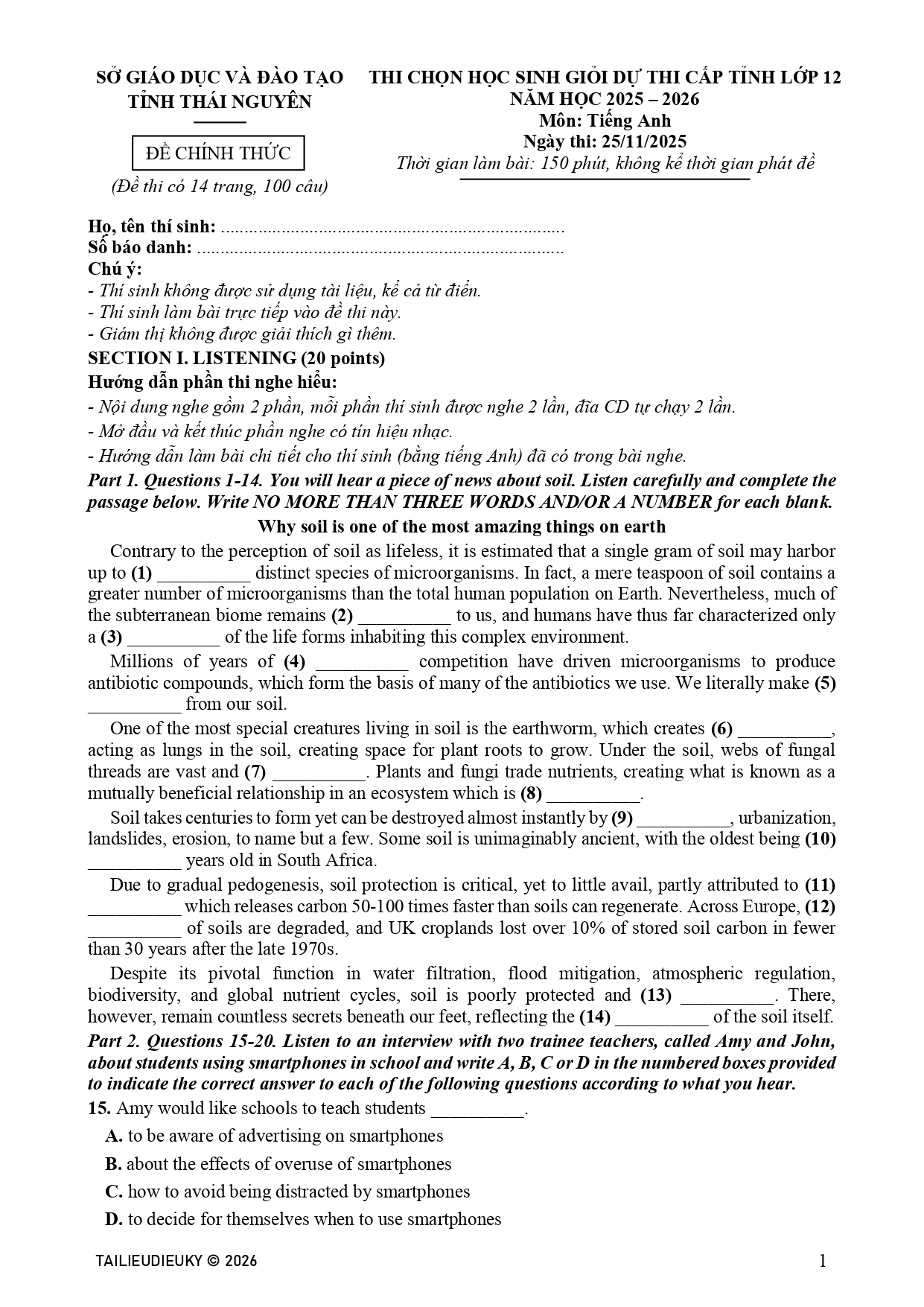
SỞ GIÁO DỤC VÀ ĐÀO TẠO
TỈNH THÁI NGUYÊN
(Đề thi có 14 trang, 100 câu) THI CHỌN HỌC SINH GIỎI DỰ THI CẤP TỈNH LỚP 12 NĂM HỌC 2025 – 2026
Môn: Tiếng Anh
Ngày thi: 25/11/2025
Thời gian làm bài: 150 phút, không kể thời gian phát đề
Họ, tên thí sinh: ..........................................................................
Số báo danh: ...............................................................................
Chú ý:
- Thí sinh không được sử dụng tài liệu, kể cả từ điển.
- Thí sinh làm bài trực tiếp vào đề thi này.
- Giám thị không được giải thích gì thêm.
SECTION I. LISTENING (20 points)
Hướng dẫn phần thi nghe hiểu:
- Nội dung nghe gồm 2 phần, mỗi phần thí sinh được nghe 2 lần, đĩa CD tự chạy 2 lần.
- Mở đầu và kết thúc phần nghe có tín hiệu nhạc.
- Hướng dẫn làm bài chi tiết cho thí sinh (bằng tiếng Anh) đã có trong bài nghe.
Part 1. Questions 1-14. You will hear a piece of news about soil. Listen carefully and complete the passage below. Write NO MORE THAN THREE WORDS AND/OR A NUMBER for each blank.
Why soil is one of the most amazing things on earth
Contrary to the perception of soil as lifeless, it is estimated that a single gram of soil may harbor up to (1) __________ distinct species of microorganisms. In fact, a mere teaspoon of soil contains a greater number of microorganisms than the total human population on Earth. Nevertheless, much of the subterranean biome remains (2) __________ to us, and humans have thus far characterized only a (3) __________ of the life forms inhabiting this complex environment.
Millions of years of (4) __________ competition have driven microorganisms to produce antibiotic compounds, which form the basis of many of the antibiotics we use. We literally make (5) __________ from our soil.
One of the most special creatures living in soil is the earthworm, which creates (6) __________, acting as lungs in the soil, creating space for plant roots to grow. Under the soil, webs of fungal threads are vast and (7) __________. Plants and fungi trade nutrients, creating what is known as a mutually beneficial relationship in an ecosystem which is (8) __________.
Soil takes centuries to form yet can be destroyed almost instantly by (9) __________, urbanization, landslides, erosion, to name but a few. Some soil is unimaginably ancient, with the oldest being (10) __________ years old in South Africa.
Due to gradual pedogenesis, soil protection is critical, yet to little avail, partly attributed to (11) __________ which releases carbon 50-100 times faster than soils can regenerate. Across Europe, (12) __________ of soils are degraded, and UK croplands lost over 10% of stored soil carbon in fewer than 30 years after the late 1970s.
Despite its pivotal function in water filtration, flood mitigation, atmospheric regulation, biodiversity, and global nutrient cycles, soil is poorly protected and (13) __________. There, however, remain countless secrets beneath our feet, reflecting the (14) __________ of the soil itself.
Part 2. Questions 15-20. Listen to an interview with two trainee teachers, called Amy and John, about students using smartphones in school and write A, B, C or D in the numbered boxes provided to indicate the correct answer to each of the following questions according to what you hear.
15. Amy would like schools to teach students __________.
A. to be aware of advertising on smartphones
B. about the effects of overuse of smartphones
C. how to avoid being distracted by smartphones
D. to decide for themselves when to use smartphones
16. Amy and John both say that some parents __________.
A. aren’t consistent in applying rules about using smartphones
B. buy smartphones for quite young children
C. fail to set a good example of smartphone use
D. don’t know which sites their children use on their smartphones
17. John approves of students using smartphones in class in order to __________.
A. take photos of their work B. look up information
C. record a conversation D. use the calculator
18. What happened when smartphones were banned in one school?
A. The police spent less time on smartphone thefts.
B. Teachers spent more time on the content of lessons.
C. Students soon accepted the situation.
D. Most parents welcomed the decision.
19. John mentions workplaces to point out that company rules regarding smartphone use __________.
A. vary according to the type of work done
B. should be reviewed regularly
C. are difficult to enforce
D. acknowledge that phones are valuable tools
20. What does Amy conclude about the debate on the topic of using smart phones in school?
A. It shows parents and teachers hold very different views from each other.
B. It is being used to hide more serious matters.
C. It reflects significant changes in society.
D. It will soon seem outdated.
SECTION II: LEXICO - GRAMMAR (25 points)
Part 1. Questions 21-30. Choose the correct answer A, B, C, or D to each of the following questions. Write your answers in the corresponding numbered boxes provided.
21. The recycling scheme __________ to be implemented this month. However, there were serious financial setbacks.
A. is going B. was going C. is certain D. were
22. Strange as it __________, I’m not the least bit hurt by his tactless remarks.
A. may seem B. will seem C. seemed D. may have seemed
23. __________ that the government is concerned about future epidemics, practical measures have been implemented.
A. Considering B. As C. For as D. As far as
24. After killing some wild geese, the poachers are now facing legal __________.
A. methods B. techniques C. procedures D. proceedings
25. It was the middle of the winter and the room was chilly so I turned the heating up a __________.
A. nick B. notch C. stitch D. snick
26. Parts of the mountain road have been washed __________ after the floods.
A. through B. off C. away D. out
27. I’m not a serious investor, but I like to __________ in the stock market.
A. splash B. splatter C. paddle D. dabble
28. It is believed that __________ students will pass the exam with flying colors.
A. each and every B. each one of the C. all of D. every
29. In order to recover from the sadness, he threw himself into a __________ of activities.
A. cyclone B. typhoon C. whirlwind D. hurricane
30. They’ve been working hard on the project for a month, so they decide to go out and __________.
A. face the music B. steal the show
C. read between the lines D. paint the town red
Part 2. Questions 31-40. Complete the following passage by supplying the correct form of the word to fill in the blank.
Power napping is an effective and under-used tool. It is a quick, intense sleep which (31. DRAMA) __________ improves alertness. These naps are especially useful for those whose sleep is constrained by a (32. DEMAND) __________ schedule; for example, members of small children or travelling business (33. EXECUTE) __________. However, the conditions must be right and patience is required for maximum effect.
Power naps should be short, between ten and twenty-five minutes, to prevent (34. ORIENTATE) __________ on awakening. Some people believe it is impossible to fall asleep in such a short time, but (35. ACQUIRE) __________ shows that it is simply a matter of practice. At the (36. OUT) __________, it is more important to relax for a while than actually fall asleep.
Power napping is not a good idea if you find it difficult to wake up at the (37. DESIGN) __________ time or have problems sleeping at night after a power nap in the day. The kind of dozing that can (38. COMPANY) __________ a sensation of overwhelming (39. SLEEP) __________ is not a true power nap, but a desperate attempt to compensate for a poor sleep routine.
However, with practice, you will find that power naps can lead to a welcome (40. ENHANCE) __________ of your performance when you need it most.
Part 3. Questions 41-45. There are FIVE mistakes in the following passage, except for the example. Identify and correct them. Write your answers in the corresponding numbered boxes provided.
Example: millions million
Volcanoes threaten the lives of 500 millions people, but scientists still know so little about them. If we consider that mankind first recorded a volcanic eruption in a wall painting dated back more than 9,000 years, we still treat them with extraordinary complacency. While it is true that scientists now understand how much of the different types work, they still don’t understand all the factors that ultimately lead to the eruption itself. Despite technological advances, they can’t even predict, closer than to within a few hours or days, when a volcano is going to erupt, and so can they forecast its behavior. Even if we could isolate all the forces that could conceitedly trigger an eruption, we would still have difficulty in understanding the signals in advance.
A volcano’s history of eruptions, the pattern of underlying earthquakes, ground deformation and the escape of various oxide gases are all indicative in future eruptive activity, but are not always easy to read early enough for appropriate steps to be taken.
SECTION III. READING (30 points)
Part 1. Questions 46-53. Read the passage below and decide which answer A, B, C or D best fits each space. Write the letter A, B, C or D in the numbered boxes provided.
Smart shoes
Smart shoes that adjust their size throughout the day could soon be available. A prototype has already been produced and a commercial (46) __________ may be in production within a few years. The shoe contains sensors that constantly check the amount of room left in it. If the foot has become too large, a tiny valve opens and the shoe (47) __________ slightly. The entire control system is about 5mm square and is located inside the shoe. This radical shoe meets a need because the volume of the (48) __________ foot can change by as much as 8% during the course of the day. The system is able to learn about the wearer’s feet and (49) __________ up a picture of the size of his or her feet throughout the day. It will allow the shoes to change in size by up to 8% so that they always fit (50) __________. They are obviously more comfortable and less likely to cause blisters. From an athlete’s point of view, they can help improve (51) __________ a little, and that is why the first use for the system is likely to be in a sports shoe.
Eventually, this system will find a (52) __________ in many other household items, from beds that automatically change to fit the person sleeping in them, to power tools that (53) __________ themselves to the user’s hand for better grip.
46. A. assortment B. version C. style D. variety
47. A. amplifies B. develops C. expands D. increases
48. A. general B. usual C. medium D. average
49. A. build B. pick C. grow D. set
50. A. absolutely B. completely C. exactly D. totally
51. A. achievement B. performance C. success D. winning
52. A. function B. part C. way D. place
53. A. shape B. change C. respond D. convert
Part 2. Questions 54-60. Fill each of the following numbered blanks with ONE suitable word and write your answers in the corresponding boxes provided below the passage.
The discovery of the structure of DNA in 1953 gave rise to the field of modern molecular biology. The DNA molecule, (54) __________ the code of life in conveniently packaged sequences called genes, scientifically proved that only genetic characteristics such as eye color and to some extent behavioral traits were (55) __________. Talents or skills, in other words, were irrelevant. The possibility that they could play a role in heredity had been completely ruled out. However, a diverse group of scientists is now (56) __________ up with convincing evidence to suggest that inheritance may not be quite so cut- and-dried as classical geneticists would have us believe. This idea is called epigenetics.
Epigenetics is the idea that, in terms of inheritance, the gene has a ‘biological memory’ of an experience. A person could be exposed to trauma in their external environment that changes how or when a gene is expressed (57) __________ altering the DNA sequence or genes themselves. This change could then exist for four or five generations, maybe more. Studies carried out in the 1980s, for example, indicated that if food was limited at a key point in a grandparent’s life, it could epigenetically affect how long their grandchildren (58) __________. Another study found that people who had been exposed to something really appalling in their life, such as living through a terrible war, showed a marker of a stress hormone, cortisol, in their saliva. It was then discovered that many of their children already had abnormally high levels of cortisol in (59) __________. From this finding, it could be deduced that their children inherited vulnerability.
The implications of epigenetic changes to DNA are significant and are completely at (60) __________ with traditional genetics, generating heated debates. Although scientists still have yet to figure out exactly how epigenetic inheritance occurs, it may be that our legacy to future generations is greater than we ever imagined.
Part 3. Read the following passage and do the tasks that follow. Questions 61-67
The reading passage has seven paragraphs, A-G.
Choose the correct heading for each paragraph from the list of headings below. Write the correct number, i-viii, in the numbered boxes provided.
List of Headings
i. A period in cold conditions before the technology is assessed
ii. Marketing issues lead to failure
iii. Good and bad aspects of steam technology are passed on
iv. A possible solution to the issues of today
v. Further improvements lead to commercial orders
vi. Positive publicity at last for this quiet, clean, fast vehicle
vii. A disappointing outcome for customers
viii. A better option than the steam car arises
61. Paragraph A __________
62. Paragraph B __________
63. Paragraph C __________
64. Paragraph D __________
65. Paragraph E __________
66. Paragraph F __________
67. Paragraph G __________
The steam car
The successes and failures of the Doble brothers and their steam cars
A. When primitive automobiles first began to appear in the 1800s, their engines were based on steam power. Steam had already enjoyed a long and successful career in the railways, so it was only natural that the technology evolved into a miniaturized version which was separate from the trains. But these early cars inherited steam’s weaknesses along with its strengths. The boilers had to be lit by hand, and they required about twenty minutes to build up pressure before they could be driven. Furthermore, their water reservoirs only lasted for about thirty miles before needing replenishment. Despite such shortcomings, these newly designed self- propelled carriages offered quick transportation, and by the early 1900s it was not uncommon to see such machines shuttling wealthy citizens around town.
B. But the glory days of steam cars were few. A new technology called the Internal Combustion Engine soon appeared, which offered the ability to drive down the road just moments after starting up. At first, these noisy gasoline cars were unpopular because they were more complicated to operate and they had difficult hand-crank starters, which were known to break arms when the engines backfired. But in 1912 General Motors introduced the electric starter, and over the following few years steam power was gradually phased out.
C. Even as the market was declining, four brothers made one last effort to rekindle the technology. Between 1906 and 1909, while still attending high school, Abner Doble and his three brothers built their first steam car in their parents’ basement. It comprised parts taken from a wrecked early steam car but reconfigured to drive an engine of their own design. Though it did not run well, the Doble brothers went on to build a second and third prototype in the following years. Though the Doble boys’ third prototype, nicknamed the Model B, still lacked the convenience of an internal combustion engine, it drew the attention of automobile trade magazines due to its numerous improvements over previous steam cars. The Model B proved to be superior to gasoline automobiles in many ways. Its high-pressure steam drove the engine pistons in virtual silence, in contrast to clattering gas engines which emitted the aroma of burned hydrocarbons. Perhaps most impressively, the Model B was amazingly swift. It could accelerate from zero to sixty miles per hour in just fifteen seconds, a feat described as ‘remarkable acceleration’ by Automobile magazine in 1914.
D. The following year Abner Doble drove the Model B from Massachusetts to Detroit in order to seek investment in his automobile design, which he used to open the General Engineering Company. He and his brothers immediately began working on the Model C, which was intended to expand upon the innovations of the Model B. The brothers added features such as a key-based ignition in the cabin, eliminating the need for the operator to manually ignite the boiler. With these enhancements, the Dobles’ new car company promised a steam vehicle which would provide all of the convenience of a gasoline car, but with much greater speed, much simpler driving controls, and a virtually silent powerplant. By the following April, the General Engineering Company had received 5,390 deposits for Doble Detroits, which were scheduled for delivery in early 1918.
E. Later that year Abner Doble delivered unhappy news to those eagerly awaiting the delivery of their modern new cars. Those buyers who received the handful of completed cars complained that the vehicles were sluggish and erratic, sometimes going in reverse when they should go forward. The new engine design, though innovative, was still plagued with serious glitches.
F. The brothers made one final attempt to produce a viable steam automobile. In early 1924, the Doble brothers shipped a Model E to New York City to be road-tested by the Automobile Club of America. After sitting overnight in freezing temperatures, the car was pushed out into the road and left to sit for over an hour in the frosty morning air. At the turn of the key, the boiler lit and reached its operating pressure inside of forty seconds. As they drove the test vehicle further, they found that its evenly distributed weight lent it surprisingly good handling, even though it was so heavy. As the new Doble steamer was further developed and tested, its maximum speed was pushed to over a hundred miles per hour, and it achieved about fifteen miles per gallon of kerosene with negligible emissions.
G. Sadly, the Dobles’ brilliant steam car never was a financial success. Priced at around $18,000 in 1924, it was popular only among the very wealthy. Plus, it is said that no two Model Es were quite the same, because Abner Doble tinkered endlessly with the design. By the time the company folded in 1931, fewer than fifty of the amazing Model E steam cars had been produced. For his whole career, until his death in 1961, Abner Doble remained adamant that steam-powered automobiles were at least equal to gasoline cars, if not superior. Given the evidence, he may have been right. Many of the Model E Dobles which have survived are still in good working condition, some having been driven over half a million miles with only normal maintenance. Astonishingly, an unmodified Doble Model E runs clean enough to pass the emissions laws in California today, and they are pretty strict. It is true that the technology poses some difficult problems, but you cannot help but wonder how efficient a steam car might be with the benefit of modern materials and computers. Under the current pressure to improve automotive performance and reduce emissions, it is not unthinkable that the steam car may rise again.
Questions 68-70. Complete the summary below.
Choose ONE WORD AND/OR A NUMBER from the passage for each answer. Write your answers in numbered boxes provided.
The Model E
The Model E was road-tested in 1924 by the Automobile Club of America. They found it easy to drive, despite its weight, and it impressed the spectators. A later version of the Model E raised its (68) __________, while keeping its emissions extremely low.
The steam car was too expensive for many people and its design was constantly being altered. Under (69) __________ cars were produced before the company went out of business. However, even today, there are Model Es on the road in the US. They are straightforward to maintain, and they satisfy California’s (70) __________ emissions laws. Perhaps today’s technology and materials would help us revive the steam car.
Part 4. Questions 71-75. Read the passage and choose the best answer A, B, C or D to each of the questions. Write your answers in the corresponding numbered boxes provided.
Many primates live in an organized troop in which all ages and both sexes are included, and in which members always move compactly together as a stable social unit. There is a ranking hierarchy among troop males, although the strictness with which the hierarchy is enforced varies. The ranking relationship is recognized among them and the hierarchy functions to ameliorate conflict. The highest- ranking male or males defend, control, and lead the troop; the strong social bond among members and their safety is maintained.
On the other hand, chimpanzees lack a stable social troop. Even members of a regional population, who are acquainted with each other, rarely move en masse but move in temporarily formed parties that usually consist of less than ten animals. Such parties maintain associative and friendly contact through their rich vocal and behavioral communication. Chimpanzee society ensures that the free and independent movement of each individual is based on highly developed individuality without the restriction of either territoriality or hierarchy. On the other hand, a chimpanzee enjoys the benefits of group life in that it can avoid the enemy and find fruits with less effort.
Although there is a loose dominant and subordinate relationship among individuals, chimpanzees are rarely placed under the restraint of the ranking hierarchy. The rigidly organized troop characteristic of most primates must be an adaptation for avoiding enemies like man and carnivores and for defense against these enemies. In this context, a group of monkeys is more likely to survive than a single individual. The group provides a social mechanism for survival. Females and young monkeys, especially a female with a baby, must be protected by others. As their food, fruits, nuts, leaves, and some kinds of insects, is scattered in a wide area in the natural habitat, a dominant animal does not control the entire food source, nor does a subordinate animal starve when the former is satiated. An important problem in the rigid hierarchical social organization is that each animal must adjust its movements and behaviors to those of the troop. A rigidly organized troop cannot be maintained when individuals do not subordinate their personal desires for the good of troop unity or solidarity. The flexible social organization of the chimpanzee may be one resolution of this problem. This kind of social organization may be one of the original factors raising individuality to the level of personality. Chimpanzees have not rejected group life, but they have rejected individual uniformity and the pressure of a dominance hierarchy.
That a number of experienced big males can serve as leader, appropriately coping with critical situations, and that followers can appropriately react to a leader’s behavior, prove that chimpanzee society is not a simple chaotic gathering but a developed society based on highly developed psychological processes and individuality. The identity of fellow chimpanzees is formed in the mind of those chimpanzees who utilize the same range. The size of the regional population must be restricted by the upper limit of members that an animal can identify and have friendly relations with.
Another factor restricting population size must be environmental conditions, that is, the volume and the distribution of food and shelter and the geophysical condition of the habitat. The latter may influence the moving pattern, moving range, and the grouping pattern of each individual and group of individuals. Chimpanzees form regional populations even in continuous habitats such as those found in the Budongo Forest.
71. In many primate troops, the social hierarchy consists of __________.
A. females only B. males only
C. males of all ages D. both males and females of all ages
72. According to the passage, primate societies are __________.
A. flexible B. extremely competitive
C. dominated by adult males D. frequently in conflict with each other
73. The author believes that primates establish strong bonds within a troop in order to __________.
A. protect the members of the troop
B. facilitate food gathering
C. keep other troops from encroaching on their territory
D. establish loyalty to the group
74. Unlike other primates, chimpanzees __________.
A. lack a strict hierarchy within their troops
B. are not bound to troops
C. are hostile to chimpanzees from alien populations
D. share the raising of their young
75. The author compares chimpanzees to other primates mainly to emphasize the point that __________.
A. great variations in behavior exist among primates of different species
B. all primates have man as their common enemy
C. primate behavior is well understood
D. chimpanzees are different
SECTION IV. WRITING (25 points)
Part 1. Questions 76-80. Complete the second sentence so that it has a similar meaning to the first sentence, using the word given. DO NOT CHANGE THE WORD GIVEN.
76. There’s a lot of money depending on the success of this venture. (STAKE)
I’ve ______________________________________________________________ in this venture.
77. I don’t mind which flavour ice cream you choose. (SAME)
It’s _____________________________________________ which flavour ice cream you choose.
78. We can’t expect any of the staff to remember all the security codes. (EXPECTED)
None of the staff _______________________________________________ all the security codes.
79. Don’t tell me the answer – it’s coming to me! (TONGUE)
The answer _______________________________________________________ – don’t tell me!
80. It’s hard not to smile when she does her silly walk. (STRAIGHT)
It’s hard _______________________________________________ when she does her silly walk.
Part 2. Questions 81-88: The graph below shows the number of shops that closed and the number of new shops that opened in one country between 2011 and 2018.
Write about 150 words to summarise the information by selecting and reporting the main features, and make comparisons where relevant.
Part 3. Questions 89-100. Write an essay of about 200-250 words on the following topic.
Nowadays, many people rely on the Internet for medical advice instead of consulting qualified healthcare professionals. Why is this happening? Do you think it is a positive or negative development?
Use reasons and include any relevant examples from your own knowledge or experience to support your answer.
---------- THE END ----------