
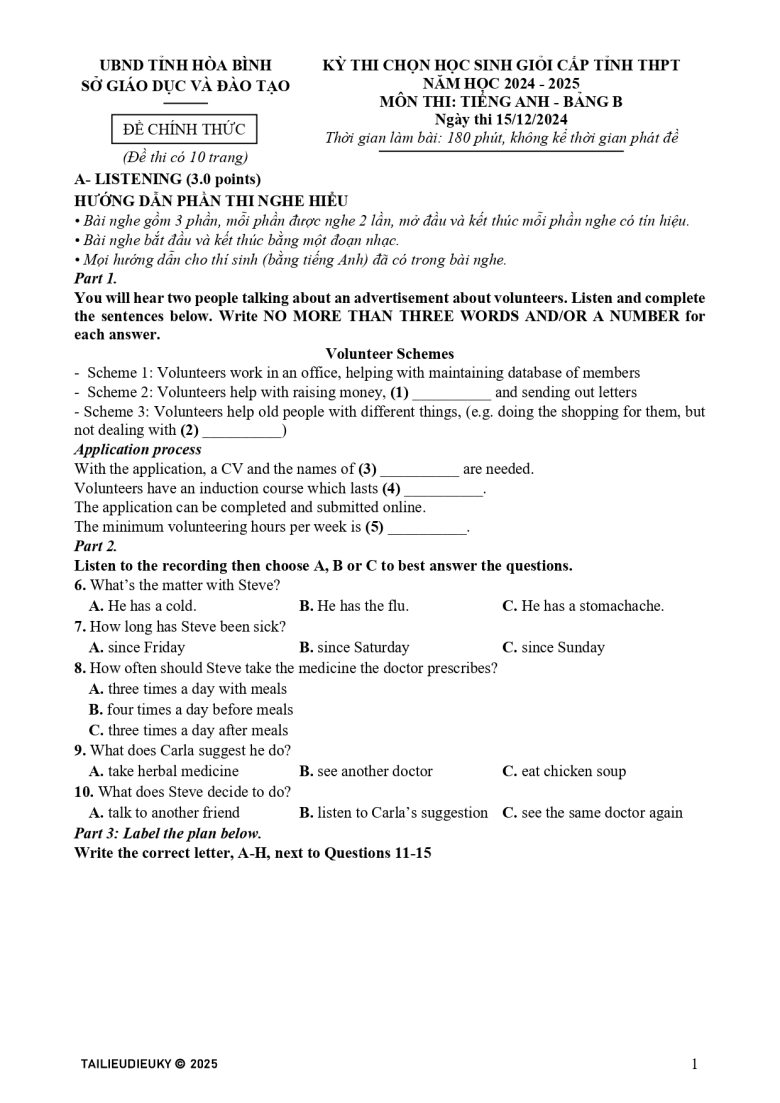
Kỳ thi chọn học sinh giỏi cấp tỉnh Hòa Bình năm học 2024–2025 (THPT) môn Tiếng Anh đã diễn ra chính thức vào ngày 15/12/2024. Đây là một trong những kỳ thi quan trọng nhằm đánh giá năng lực học sinh giỏi cấp tỉnh, đặc biệt ở khối 12 chương trình THPT. Trong bài viết này, bạn có thể xem đầy đủ cấu trúc đề thi, tóm tắt nội dung và thông tin tải đề HSG Tiếng Anh 12 cấp tỉnh Hòa Bình 2024–2025 kèm định hướng đáp án tham khảo.
🧾 Tóm tắt đề thi HSG Tiếng Anh 12 Hòa Bình 2024–2025
Đề thi chọn HSG cấp tỉnh THPT môn Tiếng Anh (Bảng B – Hòa Bình 2024–2025) – 180 phút – 10 trang – 4 phần – 84 câu + 2 bài viết
A. Listening (3.0 điểm): Part 1–3: điền khuyết (5 câu) – chọn đáp án (5 câu) – nối/ghép thông tin (5 câu)
B. Lexical Grammar (6.0 điểm): Phonetics (5 câu – 1.0đ) – Vocabulary & Grammar (15 câu – 3.0đ) – Reading quảng cáo (5 câu – 1.0đ) – Announcement (5 câu – 1.0đ)
C. Reading (6.0 điểm): Cloze passage (5 câu – 1.0đ) – Cloze dài (10 câu – 2.0đ) – Reading comprehension (7 câu – 1.4đ) – Passage phân tích (7 câu – 1.6đ)
D. Writing (5.0 điểm): Error correction (10 câu – 2.0đ) – Viết thư (1 bài – 1.0đ) – Viết luận (1 bài – 2.0đ)
Tải xuống đề thi chính thức
📥 Full đề HSG Tiếng Anh 12 Hòa Bình 2024–2025 + đáp án + file nghe
Bạn nên tải ngay đề thi và luyện tập thường xuyên để làm quen với cấu trúc đề. Đừng quên tham khảo đáp án để tự đánh giá năng lực và cải thiện điểm số.
Đáp án
1. running events
2. their medication
3. two referees
4. a morning
5. two hours
6. A
7. C
8. C
9. A
10. B
11. G
12. I
13. B
14. E
15. A
16. A
17. A
18. B
19. B
20. A
21. A
22. C
23. B
24. C
25. A
26. C
27. D
28. D
29. A
30. A
31. B
32. D
33. C
34. A
35. A
36. D
37. A
38. B
39. B
40. A
41. A
42. C
43. A
44. A
45. B
46. A
47. C
48. A
49. B
50. A
51. A
52. C
53. D
54. C
55. B
56. A
57. D
58. C
59. D
60. B
61. C
62. A
63. D
64. D
65. C
66. A
67. C
68. B
69. A
70. B
71. B
72. B
73. C
74. C
75. A
76. B
77. C
78. D
79. C
80. A
81. A
82. C
83. D
84. D
85. D
UBND TỈNH HÒA BÌNH
SỞ GIÁO DỤC VÀ ĐÀO TẠO
(Đề thi có 10 trang) KỲ THI CHỌN HỌC SINH GIỎI CẤP TỈNH THPT
NĂM HỌC 2024 – 2025
MÔN THI: TIẾNG ANH – BẢNG B
Ngày thi 15/12/2024
Thời gian làm bài: 180 phút, không kể thời gian phát đề
A- LISTENING (3.0 points)
HƯỚNG DẪN PHẦN THI NGHE HIỂU
• Bài nghe gồm 3 phần, mỗi phần được nghe 2 lần, mở đầu và kết thúc mỗi phần nghe có tín hiệu.
• Bài nghe bắt đầu và kết thúc bằng một đoạn nhạc.
• Mọi hướng dẫn cho thí sinh (bằng tiếng Anh) đã có trong bài nghe.
Part 1.
You will hear two people talking about an advertisement about volunteers. Listen and complete the sentences below. Write NO MORE THAN THREE WORDS AND/OR A NUMBER for each answer.
Volunteer Schemes
– Scheme 1: Volunteers work in an office, helping with maintaining database of members
– Scheme 2: Volunteers help with raising money, (1) __________ and sending out letters
– Scheme 3: Volunteers help old people with different things, (e.g. doing the shopping for them, but not dealing with (2) __________)
Application process
With the application, a CV and the names of (3) __________ are needed.
Volunteers have an induction course which lasts (4) __________.
The application can be completed and submitted online.
The minimum volunteering hours per week is (5) __________.
Part 2.
Listen to the recording then choose A, B or C to best answer the questions.
6. What’s the matter with Steve?
A. He has a cold. B. He has the flu. C. He has a stomachache.
7. How long has Steve been sick?
A. since Friday B. since Saturday C. since Sunday
8. How often should Steve take the medicine the doctor prescribes?
A. three times a day with meals
B. four times a day before meals
C. three times a day after meals
9. What does Carla suggest he do?
A. take herbal medicine B. see another doctor C. eat chicken soup
10. What does Steve decide to do?
A. talk to another friend B. listen to Carla’s suggestion C. see the same doctor again
Part 3: Label the plan below.
Write the correct letter, A-H, next to Questions 11-15
11. Vegetable beds __________
12. Bee hives __________
13. Seating __________
14. Adventure playground __________
15. Pond __________
B- LEXICAL GRAMMAR (6.0 points)
* PHONETICS (1.0 point)
I. Identify the word whose underlined part is pronounced differently from that of the others.
16. A. ploughed B. learned C. naked D. aged
17. A. variety B. varied C. variable D. variation
II. Identify the word whose stressed pattern is different from that of the others.
18. A. advice B. contact C. mature D. maintain
19. A. archaeology B. itinerary C. unforgettable D. authenticity
20. A. comfortable B. preservative C. relationship D. significant
* VOCABULARY AND GRAMMAR (5.0 points)
I. Choose the best word or phrase to complete the following sentences. (3.0 points)
21. The team’s dedication __________ achieving their goals is evident __________ their continuous efforts throughout the project.
A. to / in B. for / at C. with / for D. in / at
22. __________ impact of __________ new policy on __________ economy has been widely debated among experts.
A. The / a / the B. A / the / no article
C. The / the / the D. The / no article / the
23. He was excited to present his findings, __________ he had spent months conducting research, __________ he was eager to share the results with the team.
A. as / yet B. since / and C. although / and D. because / but
24. Considering the evidence available, he __________ the truth, but he chose to remain silent about it.
A. might have known B. should have known
C. could have known D. would have known
25. __________ they had anticipated the challenges, they would have been better prepared to handle the situation.
A. Had they fully understood B. Should they have realized
C. Were they to have expected D. Had they not overlooked
26. Your blue shirt has been washed, but it still needs __________. Why do you insist __________ it today anyway?
A. to be ironed – wearing B. to have ironed – to wear
C. ironing – on wearing D. being ironed – to be wearing
27. Although her idea, at first, met with __________ from the parents of the disabled children, more children attended her class later.
A. opposite B. oppositional C. oppositeness D. opposition
28. – “When are you going to get rid of those __________ trousers?”
– “Hmmm I don’t know but I like them a lot.”
A. short nylon dreadful French B. short dreadful French nylon
C. dreadful French nylon short D. dreadful short French nylon
29. Untreated __________ is being pumped into the sea, from where it pollutes our beaches.
A. sewage B. litter C. rubbish D. garbage
30. Please cut my hair __________ the style in this magazine.
A. the same length as B. the same length like
C. the same long like D. the same long as
31. He told me that __________.
A. his father has sold the house that day
B. his father had sold the house the previous day
C. his father would sell the house the previous day
D. his father didn’t sold the house
32. In this school, __________ the children are from the Chinese community.
A. most B. almost C. mostly D. most of
33. She worked like a __________ to empty the house as the new tenant will be moving in tomorrow.
A. horse B. bee C. beaver D. pig
Mark the letter A, B, C, or D on your answer sheet to indicate the word(s) CLOSEST in meaning to the underlined word(s) in each of the following questions.
34. The company’s hands are tied when it comes to making further investments in the project due to financial constraints.
A. limited options B. unlimited freedom C. taking charge D. full authority
Mark the letter A, B, C, or D on your answer sheet to indicate the word(s) OPPOSITE in meaning to the underlined word(s) in each of the following questions.
35. Despite all her efforts to stay above board, there were still some doubts about her business practices.
A. deceitful actions B. transparent behavior
C. fair conduct D. honest dealings
II. Read the following advertisement and mark the letter A, B, C or D on your answer sheet to indicate the correct option that best fits each of the numbered blanks. (1.0 point)
ADVERTISING FOR A NEW BOOKSTORE
Welcome to The Book Nook, your new favorite reading haven! We are thrilled to announce the opening of our store on 15th November. Whether you are an avid reader or a casual browser, our wide selection of books will surely have something for you. From (36) __________ fiction to classic literature and inspiring non-fiction, there’s a world waiting to be explored.
At The Book Nook, we value education and creativity. Our shelves feature not only books but also (37) __________ merchandise such as notebooks, bookmarks, and tote bags, all crafted by local artists. To celebrate our opening, we are offering a (38) __________ on all purchases made during the first week!
We believe in the power of reading to bring people together. Join us for exciting book launches, author talks, and creative events, where you can meet fellow book lovers and share your thoughts. The Book Nook is not just a bookstore; it’s a (39) __________ community space for all who love to read, write, and create.
Come visit us soon and discover your next great read at The Book Nook, where stories come (40) __________!
36. A. thrilling B. endless C. modern D. exciting
37. A. stationery B. stationary C. station D. stasis
38. A. 15% off B. 15% discount C. discount 15% D. sale 15%
39. A. comfort B. cozy C. warmth D. homely
40. A. alive B. lively C. live D. living
III. Read the following announcement and mark the letter A, B, C or D on your answer sheet to indicate the correct option that best fits each of the numbered blanks. (1.0 point)
How to Attend a Concert of My Favorite MC!
o Attending a concert by a famous MC I admire is an exhilarating experience. (41) __________ exciting aspect is the vibrant atmosphere created by fans and music. Tickets for popular shows often (42) __________ quickly, so it’s crucial to act fast.
o Research the venue and familiarize yourself with the seating (43) __________ to enhance your experience. Arrive early to enjoy the opening acts and soak up the ambiance.
o (44) __________ social media, staying updated on ticket releases and concert (45) __________ has never been easier. The quantity of merchandise available at the concert can be overwhelming, so plan what you’d like to purchase in advance.
o Get ready for an unforgettable night filled with energy and passion!
41. A. Another B. Other C. Others D. The other
42. A. hook on B. sell off C. sell out D. fall off
43. A. arrangements B. tickets C. charts D. capacities
44. A. Thanks to B. With regard to C. Irrespective of D. For the sake of
45. A. schedule B. news C. tour D. hall
C- READING (6.0 points)
I. Mark the letter A, B, C, or D on your answer sheet to indicate the correct option that best fits each of the numbered blanks. (1.0 point)
Tony Wu’s lifelong association with the sea started when he was a child, intrigued when a crab pinched his toe. His first photography projects were the tropical reefs of Southeast Asia, followed by long-term projects centered upon large cetaceans and spawning aggregations. He has now turned his attention to the oceans of Japan, (46) __________, as well as many unique habitats in between. Wu’s philosophy is encapsulated in his motto ars gratia scientiae, which (47) __________. He views himself as a translator—interpreting and communicating on behalf of the underwater world by using photographs, scientific information, and writing. Wu’s work has been published widely, and (48) __________, including Grand Prize in Japan’s largest underwater photography contest, the award for Best Book of the Year at the Festival of Marine Images in Antibes, and first place in both the Underwater and Behaviour: Mammals categories of the annual Wildlife Photographer of the Year contest. (49) __________. His goal is to inspire people to understand and respect the marine environment because (50) __________.
46.
A. which encompass everything from tropical to Arctic environments, highlight Japan’s marine diversity
B. encompass only tropical environments, show limited diversity
C. that include a variety of ecosystems, focus only on Arctic habitats
D. where Arctic habitats are the only environments included, lack diversity
47.
A. was translated from Latin to mean art for the sake of knowledge
B. has been translated from Latin to convey art for the sake of knowledge
C. is translated from Latin as art for the sake of knowledge
D. Wu’s guiding principle ars gratia scientiae translates in Latin to art for the sake of knowledge
48.
A. he has received a number of prestigious awards for his work in marine photography
B. his achievements in marine photography helped him to be given many awards
C. his expertise in marine photography was recognized with several prestigious awards
D. his dedication to his field received numerous accolades and awards
49.
A. One of Tony Wu’s goals was to win the 2024 Wayfinder Award, provided by Kia
B. Tony Wu received the 2024 Wayfinder Award presented by Kia for his contributions to marine conservation
C. Tony Wu did all work only to be presented Wayfinder Award for 2024 by Kia
D. Kia gave Tony Wu the 2024 Wayfinder Award for his commitment to environmental education
50.
A. the marine environment is crucial for the survival of countless species and requires immediate protection
B. the conservation and protection of the marine environment is too difficult for humans
C. this natural marine habitat supports numerous species and is an environment in need of preservation
D. many countries in the world are having difficulty in finding an effective way to saving the marine habitat
II. Mark the letter A, B, C or D on your answer sheet to indicate the correct option that best fits each of the numbered blanks. (2.0 points)
THE VACUUM CLEANER
Until about 250 years ago, households did not take dirt as seriously as they do now – it was a fact of life, and that was that. Cleaning often consisted of an annual (51) __________ called ‘spring cleaning’ when the furniture was moved aside, and all the linen products in the house were cleaned. Carpets and rugs were taken outside, hung on ropes and had the dust (52) __________ out of them – an exhausting and messy process.
The industrial revolution brought about a major change – as new products became available to make homes cleaner, a corresponding interest in ‘domestic hygiene’ appeared in households. This in turn led to the (53) __________ of further products, one of which was the vacuum cleaner.
(54) __________ has it that when one of the first vacuum cleaners was demonstrated, a kindly scientist took the proud inventor (55) __________ and offered a bit of advice that was to become crucial to the future evolution of the product – ‘make it suck, not blow’.
The first vacuum cleaners appeared in the 1860s in the United States. They were operated by hand pumps and were almost as (56) __________ as spring cleaning. It was only when electric motors had become sufficiently (57) __________ to become portable that vacuum cleaners became common household items. Most of today’s major (58) __________ – including Electrolux and Hoover – were born in the 1920s.
The household dirt that vacuum cleaners suck up is mostly dead skin cells – humans (59) __________ millions of cells every day. A much smaller proportion comes from dust and soil carried into the house from (60) __________.
51. A. ritual B. result C. resolution D. scrub
52. A. cleaned B. taken C. beaten D. sucked
53. A. fabrication B. appearing C. recreation D. development
54. A. Story B. Epics C. Legend D. Tale
55. A. away B. aside C. aback D. along
56. A. laborious B. hard C. nefarious D. straining
57. A. scientific B. forward C. technological D. advanced
58. A. brand B. marks C. makes D. trademarks
59. A. lose B. outgrow C. omit D. shed
60. A. external B. outside C. beyond D. indoors
III. Read the following passage and mark the letter A, B, C, or D on your answer sheet to indicate the correct answer to each of the questions (1.4 points)
HISTORY OF THE CHICKENPOX VACCINE
Chickenpox is a highly contagious infectious disease caused by the Varicella zoster virus; sufferers develop a fleeting itchy rash that can spread throughout the body. The disease can last for up to 14 days and can occur in both children and adults, though the young are particularly vulnerable. Individuals infected with chickenpox can expect to experience a high but tolerable level of discomfort and a fever as the disease works its way through the system. The ailment was once considered to be a “rite of passage” by parents in the U.S. and thought to provide children with greater and improved immunity to other forms of sickness later in life. This view, however, was altered after additional research by scientists demonstrated unexpected dangers associated with the virus. Over time, the fruits of this research have transformed attitudes toward the disease and the utility of seeking preemptive measures against it.
A vaccine against chickenpox was originally invented by Michiaki Takahashi, a Japanese doctor and research scientist, in the mid-1960s. Dr. Takahashi began his work to isolate and grow the virus in 1965 and in 1972 began clinical trials with a live but weakened form of the virus that caused the human body to create antibodies. Japan and several other countries began widespread chickenpox vaccination programs in 1974. However, it took over 20 years for the chickenpox vaccine to be approved by the U.S. Food & Drug Administration (FDA), finally earning the U.S. government’s seal of approval for widespread use in 1995. Yet even though the chickenpox vaccine was available and recommended by the FDA, parents did not immediately choose to vaccinate their children against this disease. Mothers and fathers typically cited the notion that chickenpox did not constitute a serious enough disease against which a person needed to be vaccinated.
Strong belief in that view eroded when scientists discovered the link between Varicella zoster, the virus that causes chickenpox, and shingles, a far more serious, harmful, and longer-lasting disease in older adults that impacts the nervous system. They reached the conclusion that Varicella zoster remains dormant inside the body, making it significantly more likely for someone to develop shingles. As a result, the medical community in the U.S. encouraged the development, adoption, and use of a vaccine against chickenpox to the public. Although the appearance of chickenpox and shingles within one person can be many years apart – generally many decades – the increased risk in developing shingles as a younger adult (30-40 years old rather than 60-70 years old) proved to be enough to convince the medical community that immunization should be preferred to the traditional alternative.
Another reason that the chickenpox vaccine was not immediately accepted and used by parents in the U.S. centered on observations made by scientists that the vaccine simply did not last long enough and did not confer a lifetime of immunity. In other words, scientists considered the benefits of the vaccine to be temporary when given to young children. They also feared that it increased the odds that a person could become infected with chickenpox later as a young adult, when the rash is more painful and prevalent and can last up to three or four weeks. Hence, allowing young children to develop chickenpox rather than take a vaccine against it was believed to be the “lesser of two evils.” This idea changed over time as booster shots of the vaccine elongated immunity and countered the perceived limits on the strength of the vaccine itself.
Today, use of the chickenpox vaccine is common throughout the world. Pediatricians suggest an initial vaccination shot after a child turns one year old, with booster shots recommended after the child turns eight. The vaccine is estimated to be up to 90% effective and has reduced worldwide cases of chickenpox infection to 400,000 cases per year from over 4,000,000 cases before vaccination became widespread. In light of such statistics, most doctors insist that the potential risks of developing shingles outweigh the benefits of avoiding rare complications associated with inoculations. Of course, many parents continue to think of the disease as an innocuous ailment, refusing to take preemptive steps against it. As increasing numbers of students are vaccinated and the virus becomes increasingly rarer, however, even this trend among parents has failed to halt the decline of chickenpox among the most vulnerable populations.
61. According to paragraph 1, which of the following is true of the chickenpox virus?
A. It leads to a potentially deadly disease in adults.
B. It is associated with a possibly permanent rash.
C. It is easily transmittable by an infected individual.
D. It has been virtually eradicated in the modern world.
62. Which of the following best expresses the essential information in the highlighted sentence?
A. U.S. parents believed that having chickenpox benefited their children.
B. U.S. parents believed that chickenpox led to immunity against most sickness.
C. U.S. parents wanted to make sure that their children developed chickenpox.
D. U.S. parents did not think that other vaccinations were needed after chickenpox.
63. Which of the following can be inferred from paragraph 2 about the clinical trials for the chickenpox vaccine?
A. They took longer than expected. B. They cost a lot of money to complete.
C. They took a long time to finish. D. They were ultimately successful.
64. The word notion in the 2nd passage is closest in meaning to __________.
A. history B. findings C. fact D. belief
65. According to paragraph 3, all of the following is true about the chickenpox virus EXCEPT __________
A. It causes two distinct yet related ailments.
B. People did not view it as a serious public health threat.
C. It tended to quickly become dormant and remain inoperative over time.
D. Vaccination against it would help prevent the onset of shingles.
66. The author uses booster shots as an example of __________.
A. a way to increase the effectiveness of the chickenpox vaccine
B. a preferred method of chickenpox rash and fever treatment
C. a scientifically approved medicine to eliminate chickenpox
D. a strategy for parents to avoid vaccinating their child altogether
67. According to paragraph 4, many parents did not choose the chickenpox vaccine because __________.
A. they believed that the virus was weak and not especially harmful
B. they thought that scientists did not have enough data to reach a conclusion
C. they were unsure about the utility of the vaccine given its expected duration
D. they were convinced it was potentially very toxic, particularly for older children
IV. Read the following extract and choose the option (A, B, C or D) which best answers each of the following questions. (1.6 points)
In today’s rapidly evolving job market, choosing the right career path is a complex and often daunting process. The traditional approach of pursuing a stable, long-term job is being replaced by a more dynamic perspective, where flexibility and adaptability are prioritized. This shift reflects the profound changes brought about by technological advancements and globalization, which have transformed industries and created entirely new sectors. Consequently, individuals must now approach career decisions with a forward-thinking mindset, considering not only their skills and interests but also future trends and societal demands.
While self-awareness is crucial in identifying a suitable career, it is no longer sufficient in isolation. Market research has become an essential component of career planning. Analyzing industry projections, understanding the economic landscape, and recognizing skills shortages in specific sectors can provide valuable insights. For instance, fields such as cybersecurity, renewable energy, and biotechnology are currently experiencing exponential growth, offering lucrative opportunities for those with the right expertise. However, these opportunities often require continuous learning and the ability to quickly adapt to new technologies.
Furthermore, career planning is now intertwined with the concept of lifelong learning. Unlike in the past, when formal education was considered the pinnacle of one’s academic journey, the modern professional must remain open to acquiring new skills and knowledge throughout their career. This might involve enrolling in short courses, obtaining certifications, or even pursuing additional degrees. Flexibility in learning has become a prerequisite for remaining competitive in a world where automation and artificial intelligence are rapidly reshaping the workforce.
Ultimately, success in career planning lies in balancing passion, practicality, and foresight. While pursuing one’s interests can lead to satisfaction, an overly idealistic approach may overlook crucial market realities. Thus, a nuanced and adaptable strategy is essential to navigating the complexities of the modern career landscape.
68. What is the main focus of the passage?
A. The importance of self-awareness in career success
B. The shift in career planning approaches due to modern trends
C. The challenges of staying competitive in traditional industries
D. The role of education in career decision-making
69. The word daunting in the first paragraph is closest in meaning to __________.
A. discouraging B. satisfying C. straightforward D. overwhelming
70. Why does the author mention fields like cybersecurity and biotechnology?
A. To argue for the importance of formal education in career success
B. To highlight industries where adaptability and learning are crucial
C. To suggest they are the most stable career options available today
D. To criticize careers that require advanced technical skills
71. What does the author suggest about lifelong learning in the modern job market?
A. It is optional for those with strong formal education.
B. It is a critical factor in maintaining career competitiveness.
C. It primarily benefits individuals in traditional industries.
D. It only applies to those pursuing technical careers.
72. Which of the following could best replace the word nuanced in the last paragraph?
A. straightforward B. balanced C. idealistic D. cautious
73. According to the passage, how has technology influenced career planning?
A. By eliminating the need for formal education
B. By emphasizing the importance of short-term skills over long-term planning
C. By creating new sectors and necessitating adaptability
D. By limiting opportunities in traditional industries
74. The author’s tone in the passage is best described as __________.
A. critical B. optimistic C. analytical D. skeptical
75. What is implied about traditional career planning methods?
A. They are less relevant in a fast-changing job market.
B. They are superior to modern strategies in terms of stability.
C. They focus exclusively on technological skills.
D. They discourage creativity and adaptability.
D- WRITING (5.0 points)
I. Each sentence has four underlined words or phrases. Circle the letter of the underlined word or phrase that is NOT CORRECT and WRITE THE CORRECTION in the numbered boxes. (2.0 points)
76. (A) Like everyone else, Sue has her (B) up-and-down, of course, but (C) on the whole, she’s quite (D) satisfied with life.
77. The (A) maintenance of strong social relationships, (B) volunteering, and other social activities (C) are linked to positive mental health and (D) even increased longevity.
78. (A) The cultural diversity of India (B) can be understood by means of the languages, festivals, religions, foods, (C) dressing styles, and many (D) others noticeable facts.
79. Volunteerism (A) refers to all forms of (B) voluntary activity, whether (C) formally or informally, full-time or part-time, (D) at home or abroad.
80. (A) After writing it, the essay must be duplicated by the student (B) himself and (C) handed in to the department secretary before (D) the end of the semester.
81. Not only (A) men and women (B) have many differences, but (C) they also (D) have many similarities.
82. It is (A) necessary (B) that young children (C) are taken care of by (D) their parents.
83. We (A) should remember that all these things (B) have been discovered by way of (C) rigorous analysis and (D) exhausted experience, not by intuition.
84. She (A) got up (B) early; (C) otherwise, she (D) would miss her bus.
85. I (A) have been able to (B) calculate quotations for customers (C) since the company procedure (D) explained to me.
II. Writing a letter (1 point)
The students in your school use smartphones so much at breaktime that they do not interact with each other. The headmaster of your school wishes to change this situation and expects to get suggestions from the students to solve the problem.
In about 150 – 200 words, write a letter to the headmaster to give some suggestions.
You are required not to include your personal information in the letter.
Begin and finish your letter as followed:
Dear Mr. Headmaster,
Yours sincerely,
Ha Khang Minh
Class 12 A
III. Writing an essay (2.0 points)
Artificial intelligence (AI) is gradually transforming the way people acquire knowledge. Some believe that AI will bring significant benefits, especially in studying. However, others worry that it may limit the creativity of students.
In about 250 – 300 words, write an essay expressing your viewpoint, using real-life examples to support your argument.
———- THE END ———-