
Chào mừng quý phụ huynh và các em học sinh đến với Tài liệu diệu kỳ. Ngay sau khi môn thi chuyên kết thúc vào ngày 4/6, chúng tôi đã nhanh chóng cập nhật trọn bộ Đề thi Chuyên Anh Khánh Hòa năm học 2025-2026 kèm đáp án chi tiết. Bài viết cung cấp cấu trúc đề thi bám sát thực tế và link tải file Word bản chuẩn để các em dễ dàng đối chiếu kết quả.
Kỳ thi vào lớp 10 Trường THPT Chuyên Lê Quý Đôn Khánh Hòa năm học 2025–2026 có 540/542 thí sinh dự thi (vắng 2). Trong đó, Tiếng Anh đông nhất với 180 thí sinh, tiếp theo là Ngữ văn 88, Toán 87, Hóa 55, Vật lý 48, Tin học 42 và Sinh học 40. Tổng chỉ tiêu tuyển sinh là 280 học sinh cho 8 lớp chuyên, riêng Chuyên Anh có 2 lớp (70 học sinh).
Cấu trúc đề Chuyên Anh Khánh Hòa 2025–2026
I. Use of English (30đ)
• Trắc nghiệm 20 câu (từ vựng, collocations, idioms, ngữ pháp)
• Word formation (10 câu – chủ đề air-conditioners)
• Tìm & sửa 10 lỗi ngữ pháp (đoạn deep fake)
II. Reading (40đ)
• Điền từ (10 câu – punctuation)
• Trắc nghiệm điền từ (10 câu – cycling)
• Đọc hiểu 1: Chamonix & du lịch xanh
o Match đoạn, chọn ý, điền từ
• Đọc hiểu 2: Exoplanets
o True/False/NG + matching methods
III. Writing (30đ)
• Viết lại câu (5 câu)
• Sentence transformation dùng từ cho sẵn (5 câu)
• Essay ≥250 từ: Ảnh hưởng của du lịch đến cộng đồng địa phương
Đáp án
1. D
2. C
3. C
4. D
5. A
6. B
7. B
8. C
9. D
10. A
11. B
12. C
13. A
14. A
15. D
16. B
17. C
18. B
19. A
20. D
21. popularity
22. inability
23. likelihood
24. privacy
25. considerably
26. stabilise
27. presence
28. efficiency
29. variety
30. materialistic
31. Therefore However
32. which where / at which
33. due to because / since / as
34. deceasing deceased
35. possibility possibilities
36. creating to create
37. our your / their
38. relative relatively
39. stay here here to stay
40. in future in the future
41. words
42. where
43. see / tell / know
44. indirect / reported
45. the / all
46. but
47. exclamation
48. on
49. intonation / tone
50. showing / indicating / meaning / implying
51. A
52. C
53. D
54. A
55. D
56. B
57. B
58. D
59. C
60. B
61. C
62. G
63. A
64. H
65. E
66. D
67. E
68. explorers
69. ice rink
70. melting glaciers
71. F
72. T
73. NG
74. F
75. T
76. T
77. C
78. B
79. A
80. D
81. as it may seem, he’s learned that long poem by heart.
82. as you promise not to do anything wrong, you are allowed to play in my garden.
83. his new occupation terribly boring.
84. was made to study Latin by his father.
85. more regular practice / practicing more regularly, you will not become more skilful.
86. didn’t mean to break
87. have turned down
88. cut short their picnic
89. has succeeded in cutting
90. herself on her ability
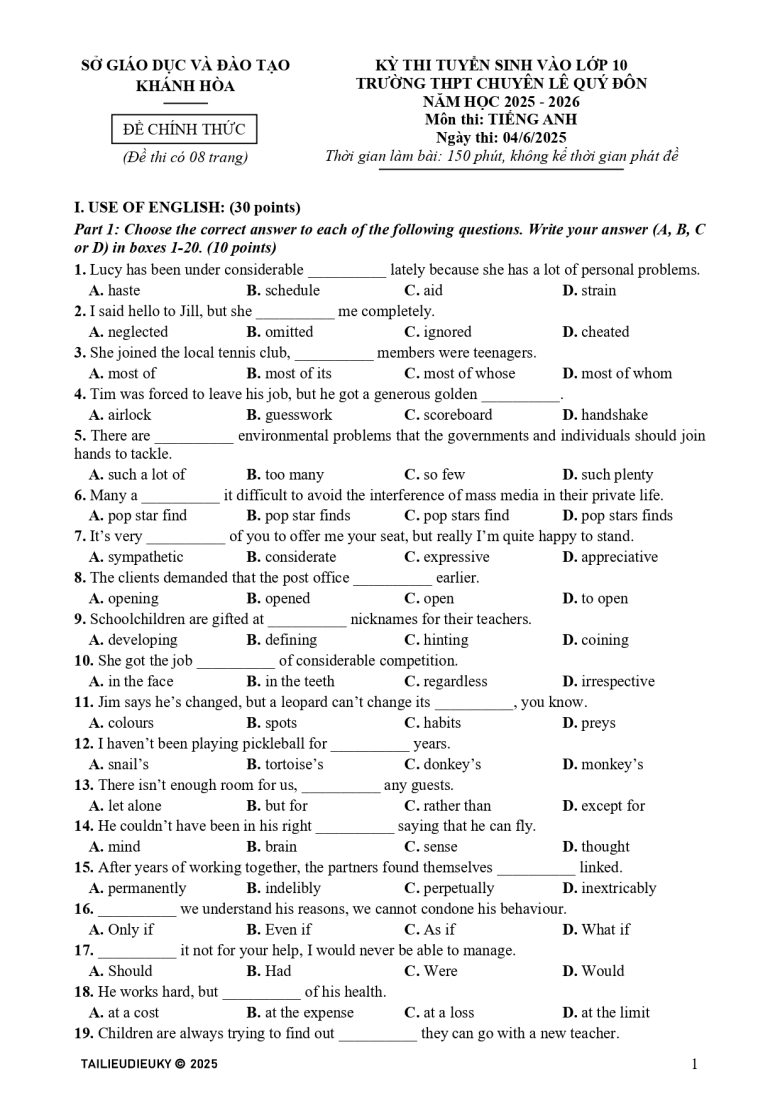
SỞ GIÁO DỤC VÀ ĐÀO TẠO
KHÁNH HÒA
(Đề thi có 08 trang) KỲ THI TUYỂN SINH VÀO LỚP 10
TRƯỜNG THPT CHUYÊN LÊ QUÝ ĐÔN
NĂM HỌC 2025 – 2026
Môn thi: TIẾNG ANH
Ngày thi: 04/6/2025
Thời gian làm bài: 150 phút, không kể thời gian phát đề
I. USE OF ENGLISH: (30 points)
Part 1: Choose the correct answer to each of the following questions. Write your answer (A, B, C or D) in boxes 1-20. (10 points)
1. Lucy has been under considerable __________ lately because she has a lot of personal problems.
A. haste B. schedule C. aid D. strain
2. I said hello to Jill, but she __________ me completely.
A. neglected B. omitted C. ignored D. cheated
3. She joined the local tennis club, __________ members were teenagers.
A. most of B. most of its C. most of whose D. most of whom
4. Tim was forced to leave his job, but he got a generous golden __________.
A. airlock B. guesswork C. scoreboard D. handshake
5. There are __________ environmental problems that the governments and individuals should join hands to tackle.
A. such a lot of B. too many C. so few D. such plenty
6. Many a __________ it difficult to avoid the interference of mass media in their private life.
A. pop star find B. pop star finds C. pop stars find D. pop stars finds
7. It’s very __________ of you to offer me your seat, but really I’m quite happy to stand.
A. sympathetic B. considerate C. expressive D. appreciative
8. The clients demanded that the post office __________ earlier.
A. opening B. opened C. open D. to open
9. Schoolchildren are gifted at __________ nicknames for their teachers.
A. developing B. defining C. hinting D. coining
10. She got the job __________ of considerable competition.
A. in the face B. in the teeth C. regardless D. irrespective
11. Jim says he’s changed, but a leopard can’t change its __________, you know.
A. colours B. spots C. habits D. preys
12. I haven’t been playing pickleball for __________ years.
A. snail’s B. tortoise’s C. donkey’s D. monkey’s
13. There isn’t enough room for us, __________ any guests.
A. let alone B. but for C. rather than D. except for
14. He couldn’t have been in his right __________ saying that he can fly.
A. mind B. brain C. sense D. thought
15. After years of working together, the partners found themselves __________ linked.
A. permanently B. indelibly C. perpetually D. inextricably
16. __________ we understand his reasons, we cannot condone his behaviour.
A. Only if B. Even if C. As if D. What if
17. __________ it not for your help, I would never be able to manage.
A. Should B. Had C. Were D. Would
18. He works hard, but __________ of his health.
A. at a cost B. at the expense C. at a loss D. at the limit
19. Children are always trying to find out __________ they can go with a new teacher.
A. how far B. what length C. what distance D. how long
20. __________ what he says, observe what he does.
A. Although B. Contrary C. In contrast D. Never mind
Part 2. For questions 21-30, use the word given in capitals at the end of the line to form a word that fits in the blank in the same line. Write your answers in the numbered boxes provided. There is an example at the beginning (0). (10 points)
AIR-CONDITIONERS
The American inventor W.H. Carrier (0. DEVELOPMENT) developed the first air-conditioning unit in 1902. Since then the (21. POPULAR) __________ of air-conditioners has increased rapidly. Given people’s (22. ABLE) __________ to function in the heat, air-conditioners provide them with a feeling of comfort. That is why the (23. LIKELY) __________ of even more people installing air-conditioners for personal use in the (24. PRIVATE) __________ of their own home will increase (25. CONSIDER) __________.
But what do they do? The aim is to (26. STABLE) __________ the temperature in a room. This is accomplished by the (27. PRESENT) __________ of a fan, which also removes dusts and odours from the air and controls the humidity. The (28. EFFICIENT) __________ of an air-conditioner depends on the power of its fan. Nowadays there is a great (29. VARY) __________ of air-conditioners on the market which are bound to cover each person’s (30. MATERIAL) __________ needs.
Part 3. The passage below contains 10 grammatical mistakes. For questions 31-40, IDENTIFY the mistakes and WRITE YOUR CORRECTIONS in the numbered boxes provided. There is an example at the beginning (0). (10 points)
Example: with by
DEEP FAKES
The term “deep fake” describes videos or images that are edited with artificial intelligence (AI). Essentially, deep fakes are media created by AI that convincingly place a person, or part of a person, such as his or her face, into an image or video. Originally, this produced poor-quality images. Therefore, deep-fake technology has now reached the point which it has many practical uses. Ad companies, in particular, are interested in the technology due to it can give them a competitive edge. One obvious application of deep fakes for advertisers is to recreate living and deceasing celebrities. Doing so can run a company into legal issues, but when permission is granted, there are countless possibility. Advertisers have even added deep-fake advertisements to television programs. The fashion industry is joining in as well, looking to use deep-fake programs creating fashion ads in which runway models’ faces are replaced with our own. Social-media apps such as Snapchat have also added filters that utilize the technology. Although relative new, deep-fake media is definitely stay here. Companies are already discovering its advantages in terms of development costs and accessibility. Perhaps in future, deep-fake ads will become a regular form of advertisement.
II. READING (40 points)
Part 1. For questions 41-50, read the passage and fill in each blank with ONE suitable word. Write your answers in the numbered boxes provided. (10 points)
Who needs punctuation? Everyone does. If you remove all the punctuation marks from any passage of writing, you will be left with a long string of (41) __________ that is very hard to understand or read aloud. Without full stops and capital letters, you would not know (42) __________ one sentence ended and the next one began. Without commas and quotation marks you might not be able to (43) __________ the difference between direct speech and (44) __________ speech. Here is an example: ‘Tom said, “I have no friends.”‘ This means that Tom thinks he does not have any friends. Take away (45) __________ punctuation and you are left with ‘Tom said I have no friends’, which has a different meaning altogether.
You may think you do not use punctuation when you speak, (46) __________ you do. Read this sentence aloud: ‘She ate a worm.’ If you replace the full stop with an (47) __________ mark and say it again, in a disgusted tone of voice, you will probably put more stress (48) __________ the words “ate” and “worm”. If you replace the full stop with a question mark instead, your (49) __________ will change. Your voice will go up on the word “worm” (50) __________ that you cannot believe anyone would do such a thing.
Part 2. For questions 51-60, read the passage and choose the answer which best fits each blank. Write your answers in the numbered boxes provided. (10 points)
On your bike!
If you are getting fed up wasting time looking for parking space, my (51) __________ to you is to consider the bicycle as an alternative (52) __________ of transport. Cycling is probably the cheapest and healthiest way of getting (53) __________ in our congested city centers. Although it is convenient and environmentally desirable, it can be an unattractive (54) __________ on a cold wintry morning. It is much easier to (55) __________ onto a nice warm bus or jump into your car, though the sight of cyclists as they weave their way in and out of the traffic may fill you with (56) __________ as you sit waiting in yet another traffic jam. In spite of the fact that worsening pollution is getting many people (57) __________, causing more and more health problems, and while it is fashionable to express one’s (58) __________ of the environmentally safe bicycle, it is hard to (59) __________ the danger cyclists face in sharing the road with cars. Although cycling is not as (60) __________ as it looks at first sight, there are more and more accidents involving cyclists.
51. A. advice B. warning C. plan D. solution
52. A. method B. way C. means D. instrument
53. A. on B. through C. over D. about
54. A. choice B. advice C. propose D. transport
55. A. enter B. be C. travel D. get
56. A. approval B. envy C. joy D. criticism
57. A. round B. down C. over D. together
58. A. favour B. agreement C. belief D. approval
59. A. refuse B. criticize C. deny D. think
60. A. cautious B. risky C. harmful D. endangered
Part 3. Read the passage and do the tasks that follow. (10 points)
White Mountain, Green Tourism
The French Alpine town of Chamonix has been a magnet for tourists since the 18th century. But today, tourism and climate change are putting pressure on the surrounding environment.
Marc Grainger reports.
A. The town of Chamonix-Mont-Blanc sits in a valley at 1,035 metres above sea level in the Haute-Savoie department in south-eastern France. To the northwest are the red peaks of the Aiguilles Rouges massif; to the south-east are the permanently white peaks of Mont Blanc, which at 4,810 metres is the highest mountain in the Alps. It’s a typical Alpine environment, but one that is under increasing strain from the hustle and bustle of human activity.
B. Tourism is Chamonix’s lifeblood. Visitors have been encouraged to visit the valley ever since it was discovered by explorers in 1741. Over 40 years later, in 1786, Mont Blanc’s summit was finally reached by a French doctor and his guide, and this gave birth to the sport of alpinism, with Chamonix at its centre. In 1924, it hosted the first Winter Olympics, and the cable cars and lifts that were built in the years that followed gave everyone access to the ski slopes.
C. Today, Chamonix is a modern town, connected to the outside world via the Mont Blanc Road Tunnel and a busy highway network. It receives up to 60,000 visitors at a time during the ski season, and climbers, hikers and extreme-sports enthusiasts swarm there in the summer in even greater numbers, swelling the town’s population to 100,000. It is the third most visited natural site in the world, according to Chamonix’s Tourism Office and, last year, it had 5.2 million visitor bed nights – all this in a town with fewer than 10,000 permanent inhabitants.
D. This influx of tourists has put the local environment under severe pressure, and the authorities in the valley have decided to take action. Educating visitors is vital. Tourists are warned not to drop rubbish, and there are now recycling points dotted all around the valley, from the town centre to halfway up the mountains. An internet blog reports environmental news in the town, and the ‘green’ message is delivered with all the tourist office’s activities.
E. Low-carbon initiatives are also important for the region. France is committed to reducing its carbon emissions by a factor of four by 2050. Central to achieving this aim is a strategy that encourages communities to identify their carbon emissions on a local level and make plans to reduce them. Studies have identified that accommodation accounts for half of all carbon emissions in the Chamonix valley. Hotels are known to be inefficient operations, but those around Chamonix are now cleaning up their act. Some are using low-energy lighting, restricting water use and making recycling bins available for guests; others have invested in huge projects such as furnishing and decorating using locally sourced materials, using geothermal energy for heating and installing solar panels.
F. Chamonix’s council is encouraging the use of renewable energy in private properties too, by making funds available for green renovations and new constructions. At the same time, public- sector buildings have also undergone improvements to make them more energy efficient and less wasteful. For example, the local ice rink has reduced its annual water consumption from 140,000 cubic metres to 10,000 cubic metres in the space of three years.
G. Improving public transport is another feature of the new policy, as 80 percent of carbon emissions from transport used to come from private vehicles. While the Mont Blanc Express is an ideal way to travel within the valley – and see some incredible scenery along the route – it is much more difficult to arrive in Chamonix from outside by rail. There is no direct line from the closest airport in Geneva, so tourists arriving by air normally transfer by car or bus. However, at a cost of 3.3 million euros a year, Chamonix has introduced a free shuttle service in order to get people out of their cars and into buses fitted with particle filters.
H. If the valley’s visitors and residents want to know why they need to reduce their environmental impact, they just have to look up; the effects of climate change are there for everyone to see in the melting glaciers that cling to the mountains. The fragility of the Alpine environment has long been a concern among local people. Today, 70 percent of the 805 square kilometres that comprise Chamonix-Mont-Blanc is protected in some way. But now, the impact of tourism has led the authorities to recognise that more must be done if the valley is to remain prosperous: that they must not only protect the natural environment better, but also manage the numbers of visitors better, so that its residents can happily remain there.
Questions 61-65. The reading passage has eight paragraphs, A-H. Which paragraph contains the following information? Write your answers (A-H) in the numbered boxes 61-65. You may use any letter more than once.
61. a list of the type of people who enjoy going to Chamonix
62. reference to a system that is changing the way visitors reach Chamonix
63. the geographical location of Chamonix
64. mention of the need to control the large tourist population in Chamonix
65. reference to a national environmental target
Questions 66-67. The writer mentions several ways that hotels are reducing their carbon emissions. Which TWO of the following ways (A-E) are mentioned? Write your answers (A-E) in numbered boxes 66-67.
A. using natural cleaning materials
B. recycling water
C. limiting guest numbers
D. providing places for rubbish
E. harnessing energy from the sun
Questions 68-70. Complete the sentences below. Choose NO MORE THAN TWO WORDS from the passage for each answer.
68. The first people to discover the Chamonix valley were __________.
69. Public areas, such as the __________ in Chamonix, are using fewer resources.
70. The __________ on the mountains around Chamonix provide visual evidence of global warming.
Part 4. Read the passage and do the tasks that follow. (10 points)
The Search for Other Earths
Within the last hundred years we have reached the limits of the Solar System, identifying, plotting and mapping the planets which revolve around our sun.
Today the search is on for planets beyond our small pocket of the galaxy, and astronomers are coming up with new ways to locate and describe these exoplanets. The results have come in thick and fast, astounding scientists and capturing the imagination of the public and researchers alike.
By the 2nd century BC, Babylonian astronomers had already identified the inner planets, Mercury, Venus, and Mars, as well as the outer planets, Jupiter and Saturn, although at that time it was still believed that these celestial bodies, as well as the Sun, revolved around the Earth. These discoveries were achieved through direct observation of the night sky. In 1781, Herschel observed what he initially believed to be a comet, but it was later identified as the seventh planet, Uranus. The discovery of Neptune, in 1846, marked the first time that a planet was found through mathematical prediction, rather than direct observation.
Exoplanets, planets which are beyond the Solar System and in orbit around another star, are notoriously hard to observe. The main problem is that the amount of light reflected by the planet is tiny in comparison with that of the star it orbits. Imagine trying to see the glow of a firefly sitting next to a car headlight and you have some idea of the magnitude of the challenge faced by astronomers. Even our best telescopes, which are able to see far-away objects in detail, have difficulty separating the observable light from planets from that of their parent star, which may be one million times brighter. Although a few large planets outside the Solar System have been found by direct imaging, the vast majority have been discovered indirectly.
One of the main methods used is known as the transit method. In this method, which is used by the Kepler orbital telescope, the candidate stars are observed over an extended period. The telescope remains static and monitors the amount of light from a large number of stars at the same time. If a planet in orbit around a candidate star passes directly in front of it, the light level will drop by a fractional amount. This drop in light level can be detected by the telescope, and further analysis can be done to determine the size and orbital period of the planet.
Another method is known as the Doppler wobble method. This refers to a technique which relies on observing the movement of the star as the planet orbits around it, pulling the star from side to side. This allows astronomers to observe the planet indirectly and obtain information about its size, mass, and orbit.
A third method is known as gravitational lensing. This technique makes use of the gravity of a star to magnify the observable light of a second star directly behind it. Small changes in the magnification of the rearmost star allow much smaller planets to be detected than with the transit method. It can also detect planets which orbit further away from their parent star.
Although it has been suggested that planets may exist in orbit around other stars for centuries, these new methods of proving their existence have yielded some surprising results. Based on observations of our own solar system, it was predicted that exoplanets would follow a similar pattern in terms of their size, composition and distribution. Since the discovery of the first exoplanet in 1992, however, thousands of exoplanets have been discovered in just a few decades, radically changing our understanding of planetary systems and the galaxy itself.
One of the most surprising discoveries was that of the so-called “hot Jupiters.” These are large gas giants which orbit very closely to their parent star. Using our own system as a model, we would expect that such large bodies would only form far away from the star, but early discoveries by the Kepler telescope changed our understanding of this.
Astronomers have also been shocked by the wide range of planetary types. Again, based on our own solar system, it was assumed that most planetary systems would be made up of small rocky inner planets and large outer gas giants, but observations have revealed a cornucopia of exoplanets. Rocky planets the size of Neptune, for example, have been identified and dubbed “super-Earths” by both scientists and the media.
Of course, the discovery of exoplanets naturally draws us to speculate on the existence of life beyond our solar system. Focusing on this, scientists look at planets which orbit within what is known as the habitable zone. This region varies with the type of star, and is often called the “Goldilocks Zone” because it is not too hot, not too cold, but just right to support life. Researchers have been able to detect atmosphere on some of the exoplanets, and the presence of gases, such as oxygen, hydrogen and methane, as well as water has been proven through spectrographic analysis. Other planetary features, such as volcanoes, tectonic plate movements and magnetic fields, have also been conjectured to exist on a number of exoplanets.
Of course, given the distance to these exoplanets, travelling to them may well prove to be beyond the ability of humans for the next hundreds of years. Yet, by exploring through these techniques, we have expanded our understanding of planetary formation and of the observable universe. So, next time you gaze up at the night sky in wonder at the billions of stars, remember that there are planets orbiting those stars too, and just perhaps an undiscovered form of intelligent life is staring down back at you.
For questions 71-76, do the following statements agree with the information given in the reading passage? In the numbered boxes provided, write
TRUE/ T if the statement agrees with the information
FALSE/ F if the statement contradicts the information
NOT GIVEN/ NG if there is no information about the statement
71. The Babylonians discovered five planets in the Solar System after the second century B.C.
72. Neptune was the first planet that was not discovered through direct observation.
73. Astronomers were surprised to find planets outside the Solar System.
74. It is impossible to see exoplanets with our best telescopes.
75. Thousands of exoplanets have been discovered since the first was found in 1992.
76. Most of the exoplanets found so far have been identified using indirect methods.
For questions 77-80, choose one of the following options A-D to match the features mentioned. Write your answers A-D in numbered boxes 77-80 on your answer sheet.
A. Transit method
B. Doppler wobble method
C. Gravitational lensing
D. Direct imaging
77. uses a star to detect the presence of an exoplanet orbiting another star
78. uses the movement of a star to detect an orbiting planet
79. uses changes in the amount of detectable light from a star to identify an orbiting planet
80. is hard to achieve due to the amount of light emitted by the parent star
III. WRITING (30 points)
Part 1. For questions 81-85, complete the second sentence in such a way that it has a similar meaning to the sentence printed before it. (5 points)
81. It seems unbelievable, but he’s learned that long poem by heart.
Unbelievable __________________________________________________________________
82. You are allowed to play in my garden if you promise not to do anything wrong.
So long _______________________________________________________________________
83. Andy is terribly bored with his new occupation.
Andy finds ____________________________________________________________________
84. His father made him study Latin at the age of three.
At the age of three, he ____________________________________________________________
85. If you practise more regularly, you will become more skilful.
Without _______________________________________________________________________
Part 2. For questions 86-90, complete the second sentence so that it has a similar meaning to the first one, using the word given unchanged. You must use between THREE and FIVE words, including the word given. (5 points)
86. My son broke the teapot by accident. (MEAN)
My son _______________________________________________________________ the teapot.
87. It was a mistake not to accept her offer. (DOWN)
I shouldn’t _____________________________________________________________ her offer.
88. The heavy downpour brought their picnic to an abrupt end. (SHORT)
They had to __________________________________________ because of the heavy downpour.
89. The factory has been able to reduce its CO2 emissions by 50% in the last year. (SUCCEEDED)
The factory ______________________________ back its CO2 emissions by 50% in the last year.
90. She is proud of being able to write persuasive essays. (ABILITY)
She prides ________________________________________________ to write persuasive essays.
Part 3. Write an essay about the following topic. (20 points)
Tourism is an important industry which has developed the economies of countries in many parts of the world. What effect has tourism had on local communities?
Give reasons for your answer and include any relevant examples from your own knowledge or experience. Write at least 250 words.
———- THE END ———-