Kỳ thi Tốt nghiệp THPT từ 2026 dự kiến diễn ra trong hai ngày 11 và 12/6. Để giúp các em học sinh 2k8, 2k9 làm quen với định dạng mới, THPT Chuyên Bắc Giang, Sở GD&ĐT Bắc Ninh đã tổ chức kỳ thi thử lần 1 với bộ đề chất lượng. Dưới đây là link tải đề thi file word và phân tích chi tiết các chủ đề "hot" xuất hiện trong đề.
Đề thi được thiết kế bám sát cấu trúc định dạng đề thi mới của Bộ GD&ĐT áp dụng cho chương trình GDPT 2018 (thi từ năm 2025).
- Thời gian làm bài: 50 phút.
- Số lượng câu hỏi: 40 câu trắc nghiệm.
| Số câu | Dạng bài | Chủ đề chính | Nội dung / Kỹ năng kiểm tra |
|---|---|---|---|
| 1 - 6 | Điền từ vào đoạn văn (Leaflet) | Du lịch chữa bệnh (Medical Tourism) (Quảng cáo Bệnh viện YouMec) |
- Từ vựng (unrivaled, giants) - Cụm từ cố định (in line with) - Ngữ pháp (lượng từ, so sánh) |
| 7 - 12 | Điền từ vào đoạn văn (Instructions) | Mẹo du lịch một mình (Solo Travelling) | - Từ vựng (pursuit, overwhelmed) - Giới từ (mindful of) - Trật tự từ (practical safety advice) - Dạng từ (meaningfully) |
| 13 - 17 | Sắp xếp câu/đoạn văn | Giao tiếp & Văn bản | - Hội thoại đời sống (Cafe, ôn thi) - Thư tín (Xin tổ chức sự kiện) - Đoạn văn (Du lịch, Thị trường việc làm) Kỹ năng: Logic, mạch văn |
| 18 - 22 | Điền câu/cụm từ hoàn thành đoạn văn | Môi trường & Thiên văn (Ô nhiễm ánh sáng & Bảo tồn bầu trời đêm) |
- Cấu trúc câu phức - Mệnh đề quan hệ - Liên từ và sự mạch lạc |
| 23 - 30 | Đọc hiểu (8 câu) | Xu hướng việc làm (Job Hugging vs. Job Hopping) |
- Từ đồng nghĩa/trái nghĩa - Ý chính & Chi tiết - Suy luận (Inference) - Tìm quy chiếu (Reference) |
| 31 - 40 | Đọc hiểu (10 câu) | Công nghệ & Tư duy (Tác động của AI lên nhận thức con người) |
- Mục đích tác giả (Socrates example) - Tóm tắt ý chính - Paraphrase câu văn - Vị trí câu (Sentence insertion) - Thái độ/Giải pháp ("AI literacy") |
Link tải Đề thi thử Tiếng Anh Bắc Giang 2026 (Word + PDF)
Để đạt hiệu quả ôn luyện cao nhất, các em nên bấm giờ làm bài nghiêm túc trong 50 phút trước khi tham khảo đáp án.
Chúc các em ôn tập tốt và chinh phục kỳ thi Tốt nghiệp THPT với điểm số cao nhất! Đừng quên theo dõi website Tài liệu diệu kỳ để cập nhật các đề thi thử form mới nhất.
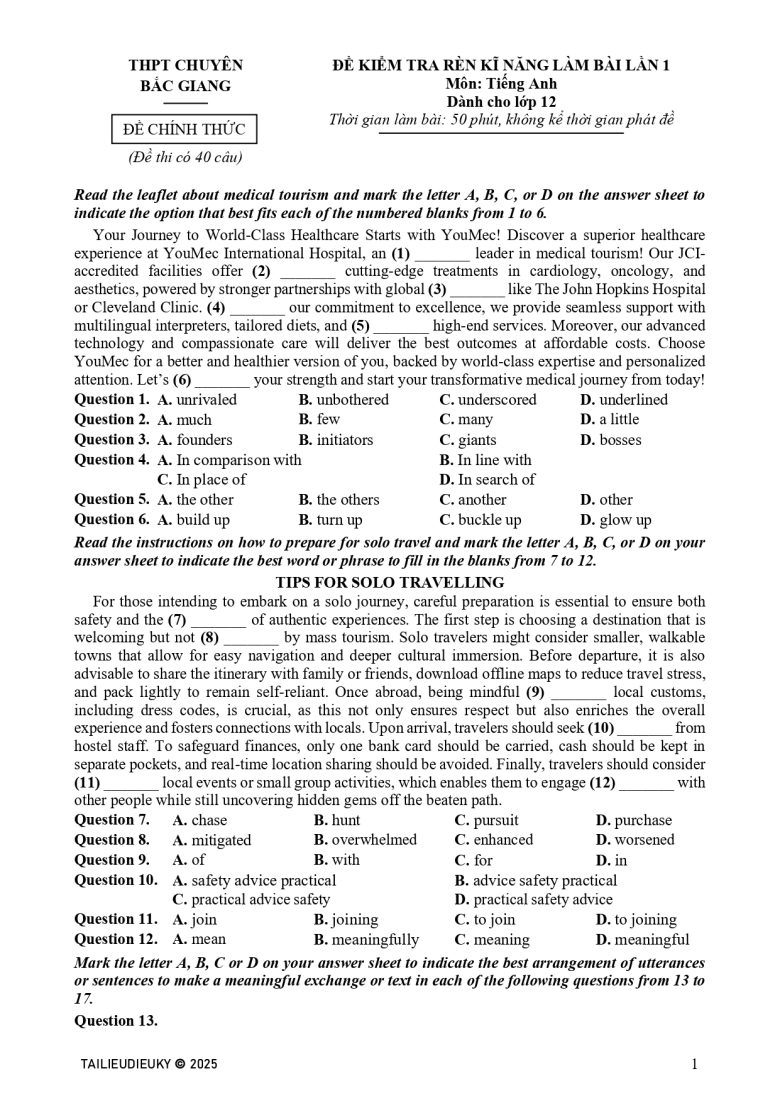
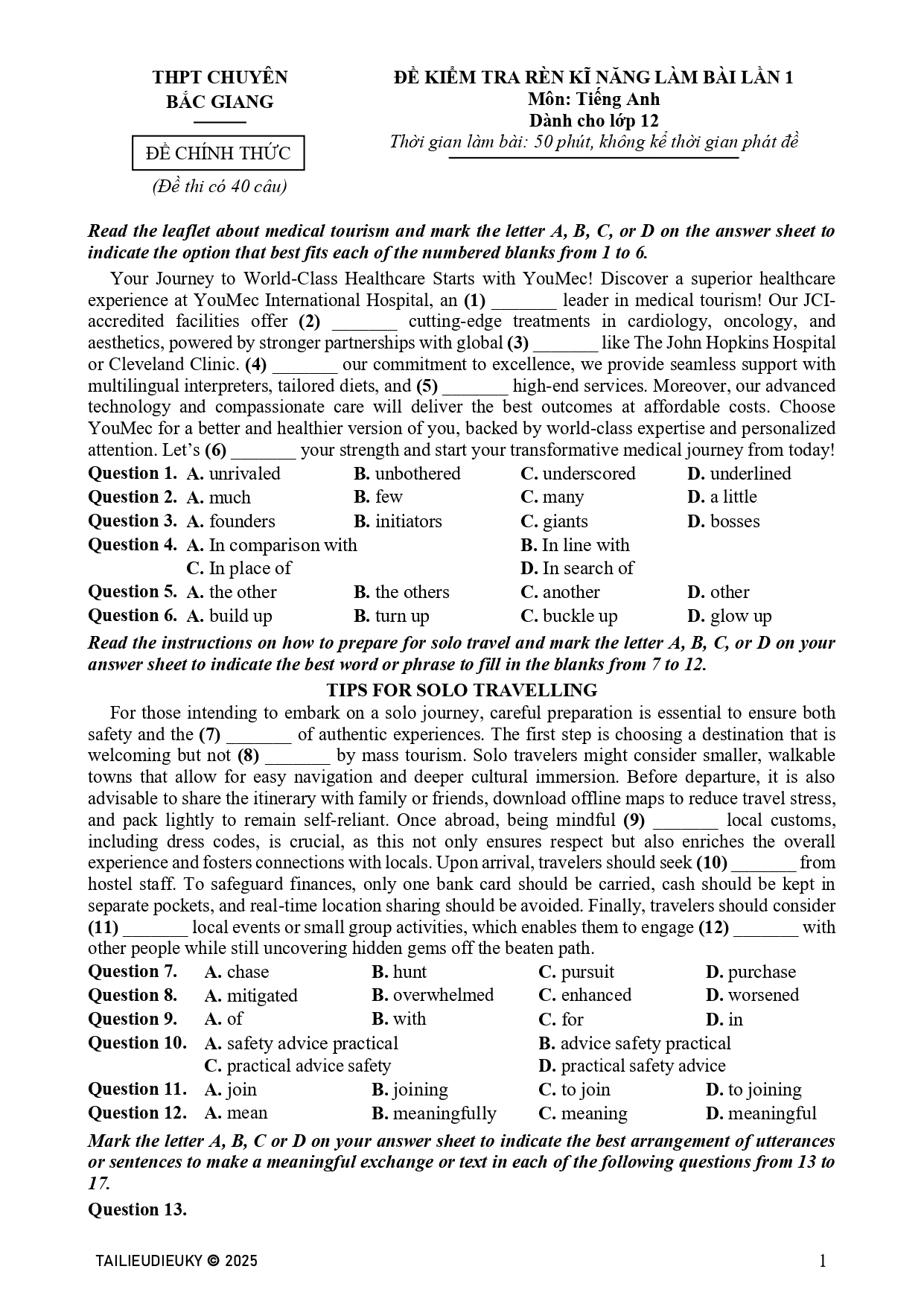
THPT CHUYÊN
BẮC GIANG
(Đề thi có 40 câu) ĐỀ KIỂM TRA RÈN KĨ NĂNG LÀM BÀI LẦN 1
Môn: Tiếng Anh
Dành cho lớp 12
Thời gian làm bài: 50 phút, không kể thời gian phát đề
Read the leaflet about medical tourism and mark the letter A, B, C, or D on the answer sheet to indicate the option that best fits each of the numbered blanks from 1 to 6.
Your Journey to World-Class Healthcare Starts with YouMec! Discover a superior healthcare experience at YouMec International Hospital, an (1) _______ leader in medical tourism! Our JCI-accredited facilities offer (2) _______ cutting-edge treatments in cardiology, oncology, and aesthetics, powered by stronger partnerships with global (3) _______ like The John Hopkins Hospital or Cleveland Clinic. (4) _______ our commitment to excellence, we provide seamless support with multilingual interpreters, tailored diets, and (5) _______ high-end services. Moreover, our advanced technology and compassionate care will deliver the best outcomes at affordable costs. Choose YouMec for a better and healthier version of you, backed by world-class expertise and personalized attention. Let’s (6) _______ your strength and start your transformative medical journey from today!
Question 1. A. unrivaled B. unbothered C. underscored D. underlined
Question 2. A. much B. few C. many D. a little
Question 3. A. founders B. initiators C. giants D. bosses
Question 4. A. In comparison with
C. In place of B. In line with
D. In search of
Question 5. A. the other B. the others C. another D. other
Question 6. A. build up B. turn up C. buckle up D. glow up
Read the instructions on how to prepare for solo travel and mark the letter A, B, C, or D on your answer sheet to indicate the best word or phrase to fill in the blanks from 7 to 12.
TIPS FOR SOLO TRAVELLING
For those intending to embark on a solo journey, careful preparation is essential to ensure both safety and the (7) _______ of authentic experiences. The first step is choosing a destination that is welcoming but not (8) _______ by mass tourism. Solo travelers might consider smaller, walkable towns that allow for easy navigation and deeper cultural immersion. Before departure, it is also advisable to share the itinerary with family or friends, download offline maps to reduce travel stress, and pack lightly to remain self-reliant. Once abroad, being mindful (9) _______ local customs, including dress codes, is crucial, as this not only ensures respect but also enriches the overall experience and fosters connections with locals. Upon arrival, travelers should seek (10) _______ from hostel staff. To safeguard finances, only one bank card should be carried, cash should be kept in separate pockets, and real-time location sharing should be avoided. Finally, travelers should consider (11) _______ local events or small group activities, which enables them to engage (12) _______ with other people while still uncovering hidden gems off the beaten path.
Question 7. A. chase B. hunt C. pursuit D. purchase
Question 8. A. mitigated B. overwhelmed C. enhanced D. worsened
Question 9. A. of B. with C. for D. in
Question 10. A. safety advice practical
C. practical advice safety B. advice safety practical
D. practical safety advice
Question 11. A. join B. joining C. to join D. to joining
Question 12. A. mean B. meaningfully C. meaning D. meaningful
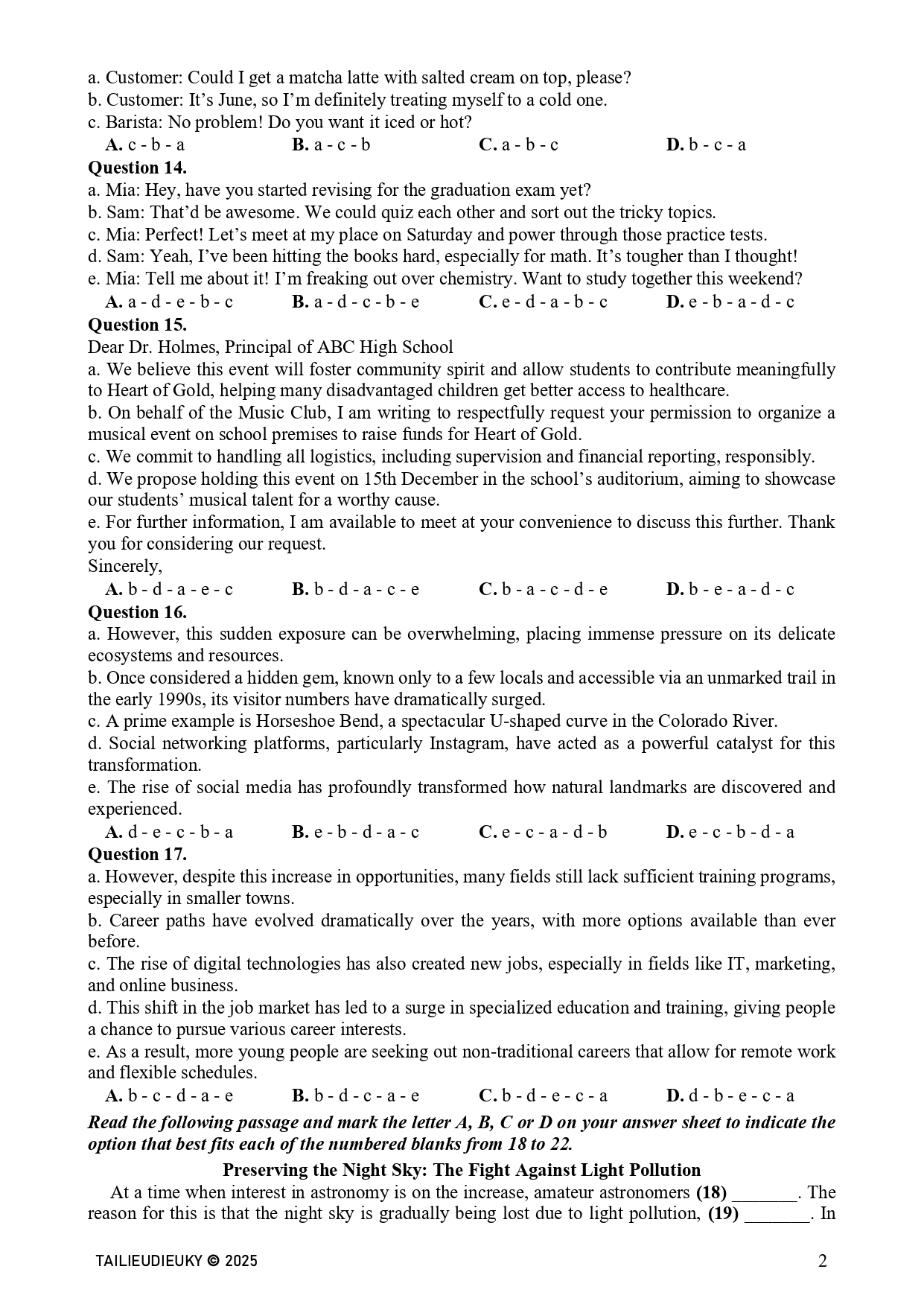
Mark the letter A, B, C or D on your answer sheet to indicate the best arrangement of utterances or sentences to make a meaningful exchange or text in each of the following questions from 13 to 17.
Question 13.
a. Customer: Could I get a matcha latte with salted cream on top, please?
b. Customer: It’s June, so I’m definitely treating myself to a cold one.
c. Barista: No problem! Do you want it iced or hot?
A. c - b - a B. a - c - b C. a - b - c D. b - c - a
Question 14.
a. Mia: Hey, have you started revising for the graduation exam yet?
b. Sam: That’d be awesome. We could quiz each other and sort out the tricky topics.
c. Mia: Perfect! Let’s meet at my place on Saturday and power through those practice tests.
d. Sam: Yeah, I’ve been hitting the books hard, especially for math. It’s tougher than I thought!
e. Mia: Tell me about it! I’m freaking out over chemistry. Want to study together this weekend?
A. a - d - e - b - c B. a - d - c - b - e C. e - d - a - b - c D. e - b - a - d - c
Question 15.
Dear Dr. Holmes, Principal of ABC High School
a. We believe this event will foster community spirit and allow students to contribute meaningfully to Heart of Gold, helping many disadvantaged children get better access to healthcare.
b. On behalf of the Music Club, I am writing to respectfully request your permission to organize a musical event on school premises to raise funds for Heart of Gold.
c. We commit to handling all logistics, including supervision and financial reporting, responsibly.
d. We propose holding this event on 15th December in the school’s auditorium, aiming to showcase our students’ musical talent for a worthy cause.
e. For further information, I am available to meet at your convenience to discuss this further. Thank you for considering our request.
Sincerely,
A. b - d - a - e - c B. b - d - a - c - e C. b - a - c - d - e D. b - e - a - d - c
Question 16.
a. However, this sudden exposure can be overwhelming, placing immense pressure on its delicate ecosystems and resources.
b. Once considered a hidden gem, known only to a few locals and accessible via an unmarked trail in the early 1990s, its visitor numbers have dramatically surged.
c. A prime example is Horseshoe Bend, a spectacular U-shaped curve in the Colorado River.
d. Social networking platforms, particularly Instagram, have acted as a powerful catalyst for this transformation.
e. The rise of social media has profoundly transformed how natural landmarks are discovered and experienced.
A. d - e - c - b - a B. e - b - d - a - c C. e - c - a - d - b D. e - c - b - d - a
Question 17.
a. However, despite this increase in opportunities, many fields still lack sufficient training programs, especially in smaller towns.
b. Career paths have evolved dramatically over the years, with more options available than ever before.
c. The rise of digital technologies has also created new jobs, especially in fields like IT, marketing, and online business.
d. This shift in the job market has led to a surge in specialized education and training, giving people a chance to pursue various career interests.
e. As a result, more young people are seeking out non-traditional careers that allow for remote work and flexible schedules.
A. b - c - d - a - e B. b - d - c - a - e C. b - d - e - c - a D. d - b - e - c - a
Read the following passage and mark the letter A, B, C or D on your answer sheet to indicate the option that best fits each of the numbered blanks from 18 to 22.
Preserving the Night Sky: The Fight Against Light Pollution
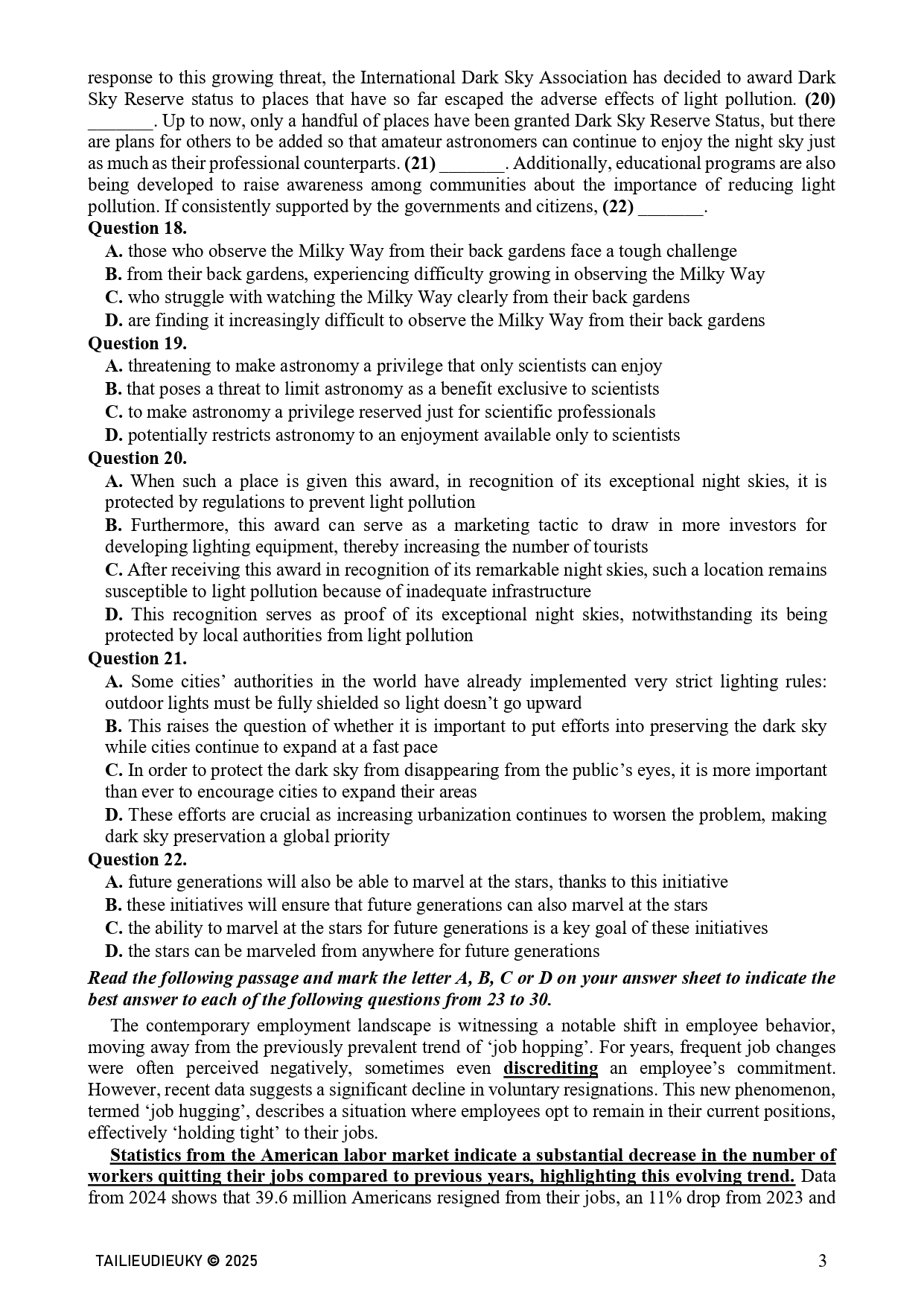
At a time when interest in astronomy is on the increase, amateur astronomers (18) _______. The reason for this is that the night sky is gradually being lost due to light pollution, (19) _______. In response to this growing threat, the International Dark Sky Association has decided to award Dark Sky Reserve status to places that have so far escaped the adverse effects of light pollution. (20) _______. Up to now, only a handful of places have been granted Dark Sky Reserve Status, but there are plans for others to be added so that amateur astronomers can continue to enjoy the night sky just as much as their professional counterparts. (21) _______. Additionally, educational programs are also being developed to raise awareness among communities about the importance of reducing light pollution. If consistently supported by the governments and citizens, (22) _______.
Question 18.
A. those who observe the Milky Way from their back gardens face a tough challenge
B. from their back gardens, experiencing difficulty growing in observing the Milky Way
C. who struggle with watching the Milky Way clearly from their back gardens
D. are finding it increasingly difficult to observe the Milky Way from their back gardens
Question 19.
A. threatening to make astronomy a privilege that only scientists can enjoy
B. that poses a threat to limit astronomy as a benefit exclusive to scientists
C. to make astronomy a privilege reserved just for scientific professionals
D. potentially restricts astronomy to an enjoyment available only to scientists
Question 20.
A. When such a place is given this award, in recognition of its exceptional night skies, it is protected by regulations to prevent light pollution
B. Furthermore, this award can serve as a marketing tactic to draw in more investors for developing lighting equipment, thereby increasing the number of tourists
C. After receiving this award in recognition of its remarkable night skies, such a location remains susceptible to light pollution because of inadequate infrastructure
D. This recognition serves as proof of its exceptional night skies, notwithstanding its being protected by local authorities from light pollution
Question 21.
A. Some cities’ authorities in the world have already implemented very strict lighting rules: outdoor lights must be fully shielded so light doesn’t go upward
B. This raises the question of whether it is important to put efforts into preserving the dark sky while cities continue to expand at a fast pace
C. In order to protect the dark sky from disappearing from the public’s eyes, it is more important than ever to encourage cities to expand their areas
D. These efforts are crucial as increasing urbanization continues to worsen the problem, making dark sky preservation a global priority
Question 22.
A. future generations will also be able to marvel at the stars, thanks to this initiative
B. these initiatives will ensure that future generations can also marvel at the stars
C. the ability to marvel at the stars for future generations is a key goal of these initiatives
D. the stars can be marveled from anywhere for future generations
Read the following passage and mark the letter A, B, C or D on your answer sheet to indicate the best answer to each of the following questions from 23 to 30.
The contemporary employment landscape is witnessing a notable shift in employee behavior, moving away from the previously prevalent trend of ‘job hopping’. For years, frequent job changes were often perceived negatively, sometimes even discrediting an employee’s commitment. However, recent data suggests a significant decline in voluntary resignations. This new phenomenon, termed ‘job hugging’, describes a situation where employees opt to remain in their current positions, effectively ‘holding tight’ to their jobs.
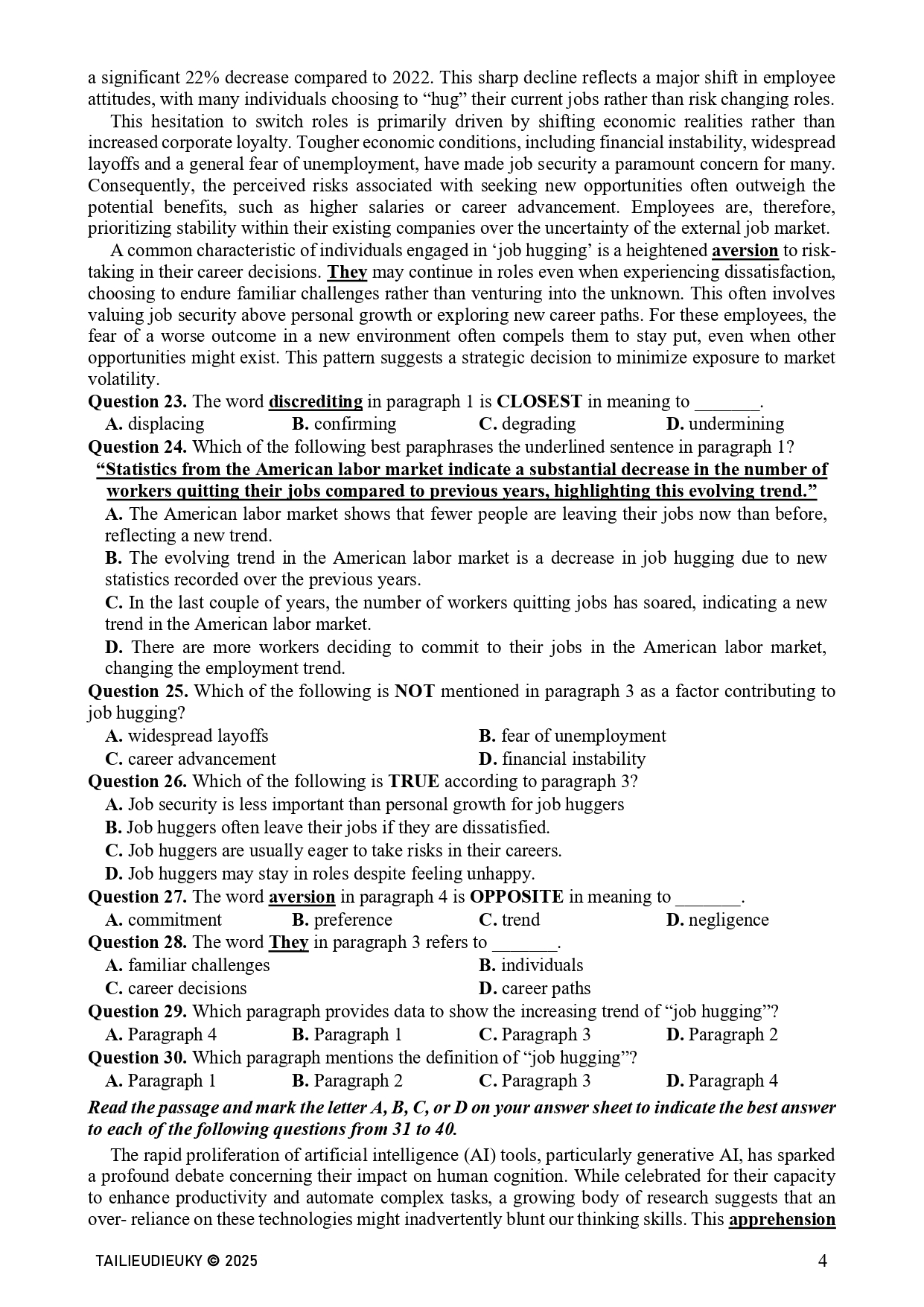
Statistics from the American labor market indicate a substantial decrease in the number of workers quitting their jobs compared to previous years, highlighting this evolving trend. Data from 2024 shows that 39.6 million Americans resigned from their jobs, an 11% drop from 2023 and a significant 22% decrease compared to 2022. This sharp decline reflects a major shift in employee attitudes, with many individuals choosing to “hug” their current jobs rather than risk changing roles.
This hesitation to switch roles is primarily driven by shifting economic realities rather than increased corporate loyalty. Tougher economic conditions, including financial instability, widespread layoffs and a general fear of unemployment, have made job security a paramount concern for many. Consequently, the perceived risks associated with seeking new opportunities often outweigh the potential benefits, such as higher salaries or career advancement. Employees are, therefore, prioritizing stability within their existing companies over the uncertainty of the external job market.
A common characteristic of individuals engaged in ‘job hugging’ is a heightened aversion to risk- taking in their career decisions. They may continue in roles even when experiencing dissatisfaction, choosing to endure familiar challenges rather than venturing into the unknown. This often involves valuing job security above personal growth or exploring new career paths. For these employees, the fear of a worse outcome in a new environment often compels them to stay put, even when other opportunities might exist. This pattern suggests a strategic decision to minimize exposure to market volatility.
Question 23. The word discrediting in paragraph 1 is CLOSEST in meaning to _______.
A. displacing B. confirming C. degrading D. undermining
Question 24. Which of the following best paraphrases the underlined sentence in paragraph 1?
“Statistics from the American labor market indicate a substantial decrease in the number of workers quitting their jobs compared to previous years, highlighting this evolving trend.”
A. The American labor market shows that fewer people are leaving their jobs now than before, reflecting a new trend.
B. The evolving trend in the American labor market is a decrease in job hugging due to new statistics recorded over the previous years.
C. In the last couple of years, the number of workers quitting jobs has soared, indicating a new trend in the American labor market.
D. There are more workers deciding to commit to their jobs in the American labor market, changing the employment trend.
Question 25. Which of the following is NOT mentioned in paragraph 3 as a factor contributing to job hugging?
A. widespread layoffs B. fear of unemployment
C. career advancement D. financial instability
Question 26. Which of the following is TRUE according to paragraph 3?
A. Job security is less important than personal growth for job huggers
B. Job huggers often leave their jobs if they are dissatisfied.
C. Job huggers are usually eager to take risks in their careers.
D. Job huggers may stay in roles despite feeling unhappy.
Question 27. The word aversion in paragraph 4 is OPPOSITE in meaning to _______.
A. commitment B. preference C. trend D. negligence
Question 28. The word They in paragraph 3 refers to _______.
A. familiar challenges B. individuals
C. career decisions D. career paths
Question 29. Which paragraph provides data to show the increasing trend of “job hugging”?
A. Paragraph 4 B. Paragraph 1 C. Paragraph 3 D. Paragraph 2
Question 30. Which paragraph mentions the definition of “job hugging”?
A. Paragraph 1 B. Paragraph 2 C. Paragraph 3 D. Paragraph 4
Read the passage and mark the letter A, B, C, or D on your answer sheet to indicate the best answer to each of the following questions from 31 to 40.
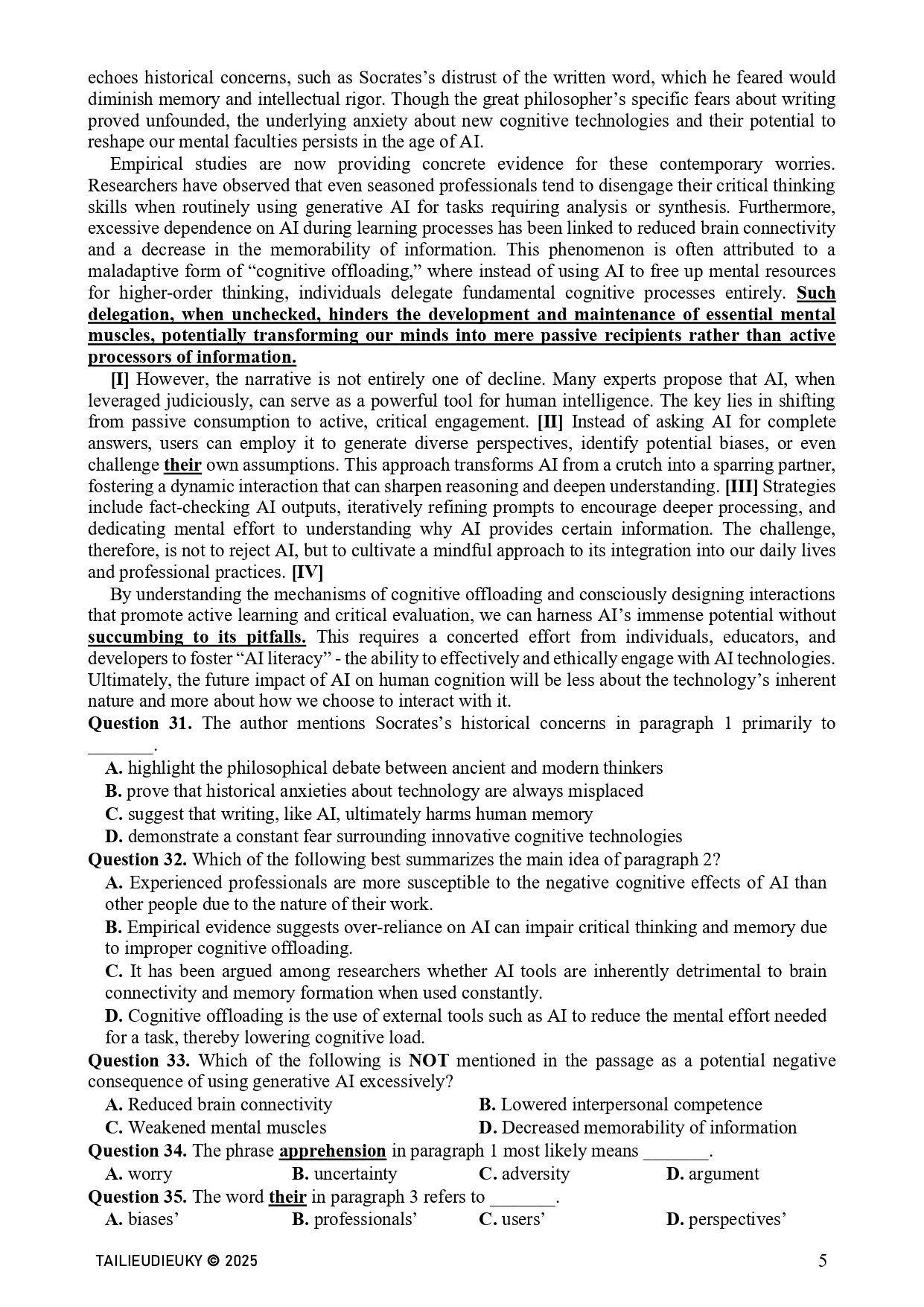
The rapid proliferation of artificial intelligence (AI) tools, particularly generative AI, has sparked a profound debate concerning their impact on human cognition. While celebrated for their capacity to enhance productivity and automate complex tasks, a growing body of research suggests that an over- reliance on these technologies might inadvertently blunt our thinking skills. This apprehension echoes historical concerns, such as Socrates’s distrust of the written word, which he feared would diminish memory and intellectual rigor. Though the great philosopher’s specific fears about writing proved unfounded, the underlying anxiety about new cognitive technologies and their potential to reshape our mental faculties persists in the age of AI.
Empirical studies are now providing concrete evidence for these contemporary worries. Researchers have observed that even seasoned professionals tend to disengage their critical thinking skills when routinely using generative AI for tasks requiring analysis or synthesis. Furthermore, excessive dependence on AI during learning processes has been linked to reduced brain connectivity and a decrease in the memorability of information. This phenomenon is often attributed to a maladaptive form of “cognitive offloading,” where instead of using AI to free up mental resources for higher-order thinking, individuals delegate fundamental cognitive processes entirely. Such delegation, when unchecked, hinders the development and maintenance of essential mental muscles, potentially transforming our minds into mere passive recipients rather than active processors of information.
[I] However, the narrative is not entirely one of decline. Many experts propose that AI, when leveraged judiciously, can serve as a powerful tool for human intelligence. The key lies in shifting from passive consumption to active, critical engagement. [II] Instead of asking AI for complete answers, users can employ it to generate diverse perspectives, identify potential biases, or even challenge their own assumptions. This approach transforms AI from a crutch into a sparring partner, fostering a dynamic interaction that can sharpen reasoning and deepen understanding. [III] Strategies include fact-checking AI outputs, iteratively refining prompts to encourage deeper processing, and dedicating mental effort to understanding why AI provides certain information. The challenge, therefore, is not to reject AI, but to cultivate a mindful approach to its integration into our daily lives and professional practices. [IV]By understanding the mechanisms of cognitive offloading and consciously designing interactions that promote active learning and critical evaluation, we can harness AI’s immense potential without succumbing to its pitfalls. This requires a concerted effort from individuals, educators, and developers to foster “AI literacy” - the ability to effectively and ethically engage with AI technologies. Ultimately, the future impact of AI on human cognition will be less about the technology’s inherent nature and more about how we choose to interact with it.
Question 31. The author mentions Socrates’s historical concerns in paragraph 1 primarily to _______.
A. highlight the philosophical debate between ancient and modern thinkers
B. prove that historical anxieties about technology are always misplaced
C. suggest that writing, like AI, ultimately harms human memory
D. demonstrate a constant fear surrounding innovative cognitive technologies
Question 32. Which of the following best summarizes the main idea of paragraph 2?
A. Experienced professionals are more susceptible to the negative cognitive effects of AI than other people due to the nature of their work.
B. Empirical evidence suggests over-reliance on AI can impair critical thinking and memory due to improper cognitive offloading.
C. It has been argued among researchers whether AI tools are inherently detrimental to brain connectivity and memory formation when used constantly.
D. Cognitive offloading is the use of external tools such as AI to reduce the mental effort needed for a task, thereby lowering cognitive load.
Question 33. Which of the following is NOT mentioned in the passage as a potential negative consequence of using generative AI excessively?
A. Reduced brain connectivity B. Lowered interpersonal competence
C. Weakened mental muscles D. Decreased memorability of information
Question 34. The phrase apprehension in paragraph 1 most likely means _______.
A. worry B. uncertainty C. adversity D. argument
Question 35. The word their in paragraph 3 refers to _______.
A. biases’ B. professionals’ C. users’ D. perspectives’
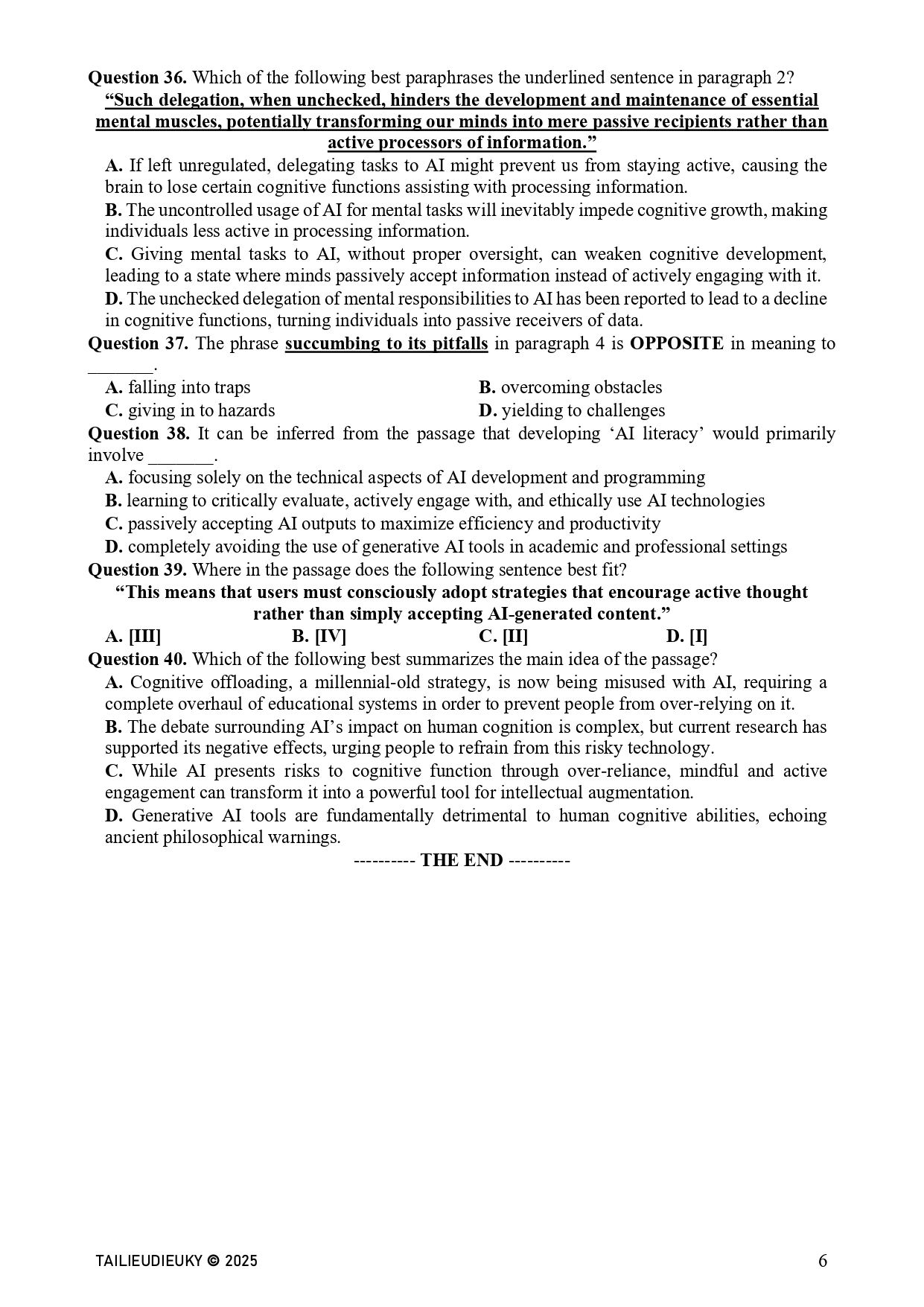
Question 36. Which of the following best paraphrases the underlined sentence in paragraph 2?
“Such delegation, when unchecked, hinders the development and maintenance of essential mental muscles, potentially transforming our minds into mere passive recipients rather than active processors of information.”
A. If left unregulated, delegating tasks to AI might prevent us from staying active, causing the brain to lose certain cognitive functions assisting with processing information.
B. The uncontrolled usage of AI for mental tasks will inevitably impede cognitive growth, making individuals less active in processing information.
C. Giving mental tasks to AI, without proper oversight, can weaken cognitive development, leading to a state where minds passively accept information instead of actively engaging with it.
D. The unchecked delegation of mental responsibilities to AI has been reported to lead to a decline in cognitive functions, turning individuals into passive receivers of data.
Question 37. The phrase succumbing to its pitfalls in paragraph 4 is OPPOSITE in meaning to _______.
A. falling into traps B. overcoming obstacles
C. giving in to hazards D. yielding to challenges
Question 38. It can be inferred from the passage that developing ‘AI literacy’ would primarily involve _______.
A. focusing solely on the technical aspects of AI development and programming
B. learning to critically evaluate, actively engage with, and ethically use AI technologies
C. passively accepting AI outputs to maximize efficiency and productivity
D. completely avoiding the use of generative AI tools in academic and professional settings
Question 39. Where in the passage does the following sentence best fit?
“This means that users must consciously adopt strategies that encourage active thought rather than simply accepting AI-generated content.”
A. [III] B. [IV] C. [II] D. [I]
Question 40. Which of the following best summarizes the main idea of the passage?
A. Cognitive offloading, a millennial-old strategy, is now being misused with AI, requiring a complete overhaul of educational systems in order to prevent people from over-relying on it.
B. The debate surrounding AI’s impact on human cognition is complex, but current research has supported its negative effects, urging people to refrain from this risky technology.
C. While AI presents risks to cognitive function through over-reliance, mindful and active engagement can transform it into a powerful tool for intellectual augmentation.
D. Generative AI tools are fundamentally detrimental to human cognitive abilities, echoing ancient philosophical warnings.
---------- THE END ----------
THPT CHUYÊN
BẮC GIANG
(Đề thi có 40 câu) ĐỀ KIỂM TRA RÈN KĨ NĂNG LÀM BÀI LẦN 1
Môn: Tiếng Anh
Dành cho lớp 12
Thời gian làm bài: 50 phút, không kể thời gian phát đề
1. A
2. C
3. C
4. B
5. D
6. A
7. C
8. B
9. A
10. D
11. B
12. B
13. B
14. A
15. B
16. D
17. B
18. D
19. A
20. A
21. A
22. B
23. D
24. A
25. C
26. D
27. B
28. B
29. D
30. A
31. D
32. B
33. B
34. A
35. C
36. C
37. B
38. B
39. C
40. C