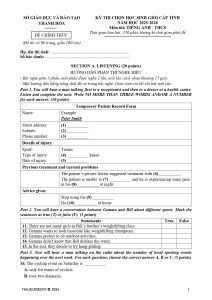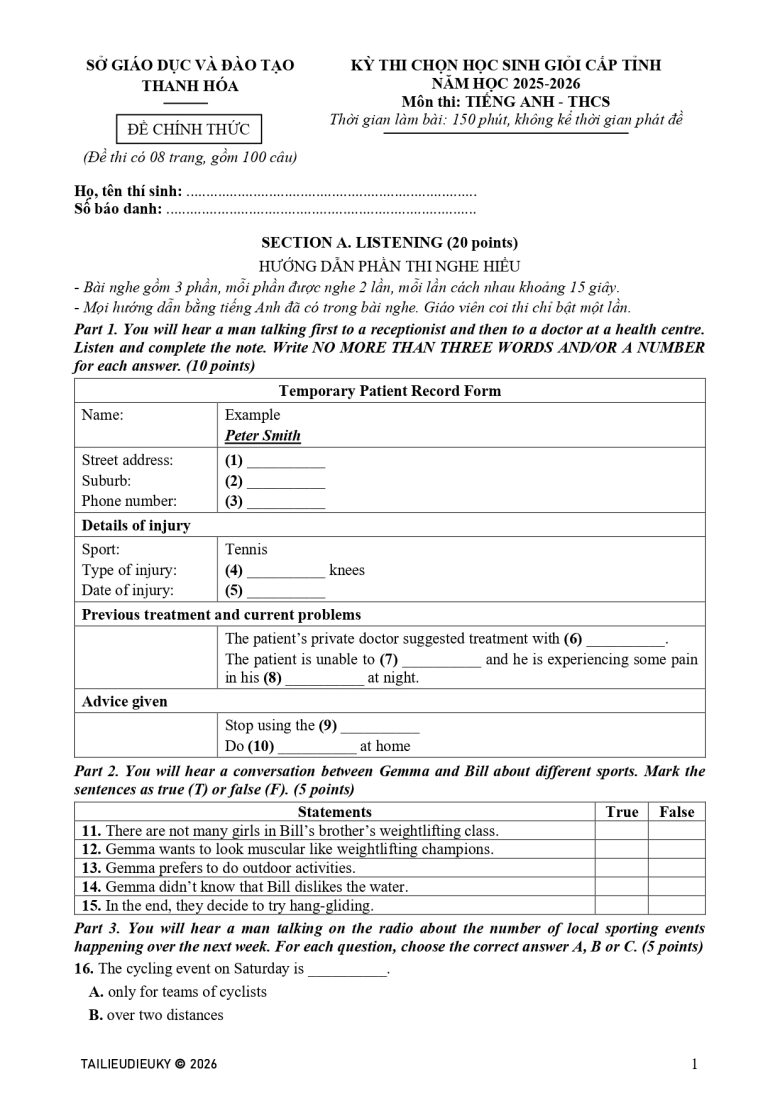
Kỳ thi chọn học sinh giỏi THCS cấp tỉnh năm học 2025–2026 do Sở GD&ĐT tỉnh Ninh Bình tổ chức với quy mô lớn, thu hút 430 trường THCS và 6.518 thí sinh tham gia. Đối tượng dự thi là học sinh lớp 8 và lớp 9; riêng khối lớp 8 thi 3 môn gồm Toán, Ngữ văn và Tiếng Anh. Nhằm giúp các thầy cô giáo và các em học sinh có thêm nguồn tư liệu ôn tập chất lượng, Tài liệu diệu kỳ xin cập nhật chi tiết Đề thi HSG Tiếng Anh 8 cấp tỉnh Ninh Bình năm 2025 & đáp án chính thức (File Word).
Cấu trúc đề thi được thiết kế toàn diện 4 kỹ năng:
A. Listening (4.0 điểm)
• Nghe trắc nghiệm (MCQ): 5 câu – 1.0 điểm
• True/False/Not Given: 5 câu – 1.0 điểm
• Điền từ (Notes): 10 câu – 2.0 điểm
B. Language (4.0 điểm)
• Ngữ pháp – Từ vựng (MCQ Cloze): 10 câu – 2.0 điểm
• Word form: 5 câu – 1.0 điểm
• Tìm lỗi sai: 5 câu – 1.0 điểm
C. Reading (5.0 điểm)
• Điền từ vào đoạn văn: 5 câu – 1.0 điểm
• Đọc hiểu trắc nghiệm: 10 câu – 2.0 điểm
• Matching + Summary: 10 câu – 2.0 điểm
D. Writing (5.0 điểm)
• Viết email: 1 bài – 2.0 điểm
• Viết đoạn văn: 1 bài – 3.0 điểm
 Tổng quan đề thi:
• ~67 câu trắc nghiệm + 2 bài viết
• Có thêm phần Speaking (2 điểm)
Hy vọng bộ đề HSG Tiếng Anh 8 Ninh Bình 2025–2026 này sẽ “buff” nhẹ kỹ năng cho bạn trước ngày thi 😆📚 Ôn chắc – làm gọn – tự tin lên trình! Nhớ follow Tài liệu diệu kỳ để không bỏ lỡ thêm nhiều bộ đề xịn xò khác nha ✨
Đáp án chính thức
SỞ GIÁO DỤC VÀ ĐÀO TẠO
TỈNH NINH BÌNH
(Hướng dẫn chấm có 02 trang) HƯỚNG DẪN CHẤM PHẦN THI VIẾT
ĐỀ THI CHỌN HỌC SINH GIỎI THCS CẤP TỈNH
NĂM HỌC 2025 - 2026
Môn: Tiếng Anh - Lớp 8
Ngày thi: 10/03/2026
Thời gian làm bài: 150 phút, không kể thời gian phát đề
– Total mark: 18,0
– The mark given is based on the following scheme.
SECTION A. LISTENING (4.0 points) - 0.2 points for one correct answer
I. Listen to 5 different conversations and choose answer A, B or C for each question. (1.0 point)
1. B
2. B
3. C
4. C
5. B
II. Listen to a conversation between two students, Peter and Mai, discussing their new eating plan. Decide which of the statements are TRUE (T), FALSE (F), or NOT GIVEN (NG) according to the recording. (1.0 point)
1. FALSE (F)
2. TRUE (T)
3. TRUE (T)
4. FALSE (F)
5. NOT GIVEN (NG)
III. Listen to a talk about hand knitting and complete the notes below. Write ONE WORD AND/OR A NUMBER taken from the recording for each answer. (2.0 points)
1. vanish
2. instruction
3. hardship
4. rewarding
5. stress
6. round
7. two/2
8. wood
9. style
10. communities
SECTION B. LANGUAGE IN USE (4.0 points) - 0.2 points for one correct answer
I. Read the text below and decide which answer A, B, C or D best fits each gap. (2.0 points)
1. B
2. A
3. A
4. C
5. C
6. D
7. B
8. A
9. B
10. A
II. Give the correct form of bold words in CAPITAL to complete the following passage. (1.0 point)
1. undergone
2. inaccuracy/inaccuracies
3. threatening
4. tendency
5. negative
III. There are 5 mistakes in the following passage. Underline the mistakes and write the correct answers in the numbered spaces given below. (1.0 point)
Line Mistake Correction
(Example) 1 kind kinds
2 on at
3 hundreds hundred
5 mysteriously mysterious
8 rushes rushing / which rushes
10 object objects
SECTION C. READING (5.0 points) - 0.2 points for one correct answer
I. Fill in each gap with ONE suitable word to complete the following passage. (1.0 point)
1. There
2. last/past
3. would/could/might
4. However/Nevertheless/Nonetheless
5. blame
II. Read the following passage and choose the best answer A, B, C or D for each of the questions. (2.0 points)
1. B
2. D
3. C
4. A
5. B
6. C
7. C
8. A
9. C
10. D
III. Read the following passage and do the tasks that follow. (2.0 points)
1. ix
2. viii
3. ii
4. vi
5. iv
6. reproductive
7. prey
8. gullible
9. liquid
10. headlights
SECTION D. WRITING (5.0 points)
1. Email writing (2.0 points)
1. Structure and Contents: 1.0 point
• Introduction: an informal opening, reason/goal of the letter. (0.1 point)
• Body: Answer all the three suggested ideas (0.8 point)
o time and place of the party (0.2 points)
o at least 2 activities to take part in (0.4 points)
o requirements about costumes (0.2 points)
• Conclusion: wrapping up the letter in an appropriate style or tone. (0.1 point)
2. Language: 1.0 point
a. Variety of appropriate vocabulary. (0.4 points)
b. Good use of grammatical structures. (0.4 points)
c. Correct punctuation and no spelling mistakes. (0.2 points)
2. Paragraph writing (3.0 points)
1. Organization (0.5 pt)
• The paragraph is well-structured:
o The topic sentence is clearly stated. (0.1 pt)
o The body is written with unity, coherence and cohesion. Each main idea must be stated clearly and explained with supporting details and examples when necessary. (0.3 pt)
o The conclusion summarizes the main points. (0.1 pt)
2. Content (1.5 pt)
• All requirements of the task are sufficiently addressed. (0.5 pt)
• Ideas are adequately supported and elaborated with relevant and reliable explanations, examples, evidence,... (1.0 pt)
3. Language use (1.0 pt)
• Demonstration of a variety of topic-related vocabulary. (0.5 pt)
• Good use and control of grammatical structures (verb tenses, word forms, voice...) and mechanics (spelling, punctuations...). (0.5 pt) (Sai 3 lỗi trừ 0.1đ)
Markers should discuss the suggested answers and marking scale thoroughly and add more possible answers before marking the papers.
TRANSCRIPTS
Part 1.
1.
Man: I’d like to send a parcel to Hong Kong please. How much will it cost?
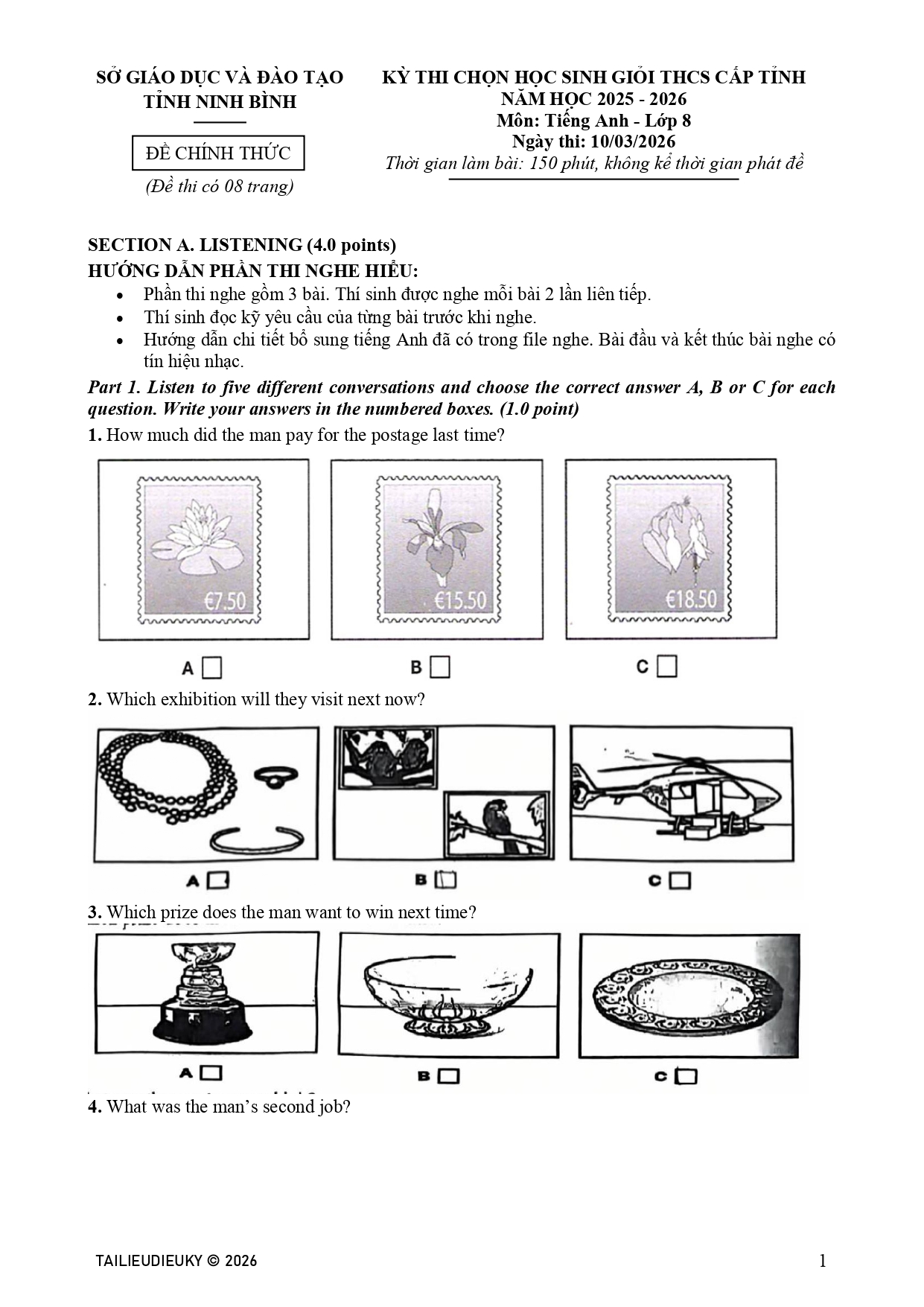
Woman: I’ll need to weigh it before I can tell you … Okay … If you send this by air, which is more expensive than by sea, it’ll be 18 euros and 50 cents. By sea, it’ll be about half that … erm … 7 euros 50 cents.
Man: I need to send it by air, so I’ll pay the extra. But last time, I think I only paid 15 euros 50 cents for the same weight! Have prices increased?
Woman: Yes. Sorry!
2.
Man: We haven’t got much time left now. There’s still so much to see in this museum.
Woman: We’ll just have to choose one more exhibition. Can I have a look at the plan?
Man: What about Jewellery from the Ancient World?
Woman: But look at the queue. We’ll spend half our time waiting if we go in there. Why not try The Rainforest in Photos? You can wander round and see all the forest animals.
Man: OK – then we won’t have time to visit Rescue by Helicopter. There’s a real one in there.
Woman: Maybe next time.
3.
Int: And in second place, Tim Davidson. Tim, would you like to say a few words?
Tim: Well, I want to thank everyone who has helped me to do so well today, because it’s not just about me the player, there’s my trainer, my manager, and my wife Jane. I know she’ll love this beautiful glass bowl, so it won’t be up on a dusty shelf with the cups I’ve won in the past. We’ll enjoy looking at it every day. And I’ll be back next year to win that silver plate! Thank you.
4.
Man: I know you think being a postman’s not a very good job – long hours and not a lot of money – but I enjoy it. Better than some things I’ve done. When I first left school I spent a month or two cleaning windows, and then I got a job building houses. Now that was hard! Of course, when I was at school, I dreamt of becoming a pilot, but I failed to get on a training course.
5.
Boy: Drink up your coffee – we’ll be late for class. What are you looking for now? Don’t tell me you’ve left your essay at home. You said you were working on it till midnight.
Girl: Don’t worry, it was the first thing I put in my bag – look, here it is. I won’t be a second ... just checking everything. Pen ... now where did I ...? Oh dear, you’ll be able to lend me one, won’t you? Keys? – oh, here they are, in my pocket as usual ...
Part 2.
Peter: Okay Mary, I know I’m putting on weight with all my bad eating habits.
Mary: That’s right. Chocolate bars, pizzas, and all washed down with litres of soft drink. And with all the sugar in soft drink, I think we can say you’re definitely overindulging, don’t you think?
Peter: I know, I know. I intend to definitely stop drinking that from now on.
Mary: And that’s part of the sensible eating plan that we have agreed we need to formulate—one that we can both follow.
Peter: That’s right, sensible, and practical — allowing us to indulge in some sweet foods on occasions.
Mary: On rare occasions, and we’re going to cut out all the pizzas and hamburgers.
Peter: Well, not totally. I thought you said pizzas could be eaten once a week. You know how I like pizzas.
Mary: No. I said once every two months. Once a week was ice cream, not pizza.
Peter: Yeah, that’s because you like ice cream. I prefer pizza.
Mary: Peter, if you want to lose weight, you need to be disciplined, in both what you eat, and what you do, which brings us to the issue of exercise.
Peter: That’s right. So, jogging twice a week, and hiking on Saturdays, right?
Mary: No, hiking is Sundays, allowing Saturdays for the light walking exercise. I’ve investigated, and discovered there are a lot of walking trails around this suburb, with many beautiful places if you just look around.
Peter: So what’s happening this Saturday? A walk around the city?
Mary: That’s later in the month. This Saturday we’ll visit Pine Park.
Peter: Hill Park is nicer, with great views, too.
Mary: Yes, but we have to travel too far to reach Hill Park, so I ruled that out, and I love the smell of pines.
Peter: And what about the weekday meals? Salads every night, I suppose?
Mary: No, it’s important to vary the meals so that the food remains interesting and fun. The only common factor is the fruit juice, but otherwise we’ll have a variety of healthy fare, from salads, to fish, to lean meat.
Peter: I’d rather have meat every night, but you’re the boss.
Mary: If you want to lose weight, you’ll have to accept this program, okay?
Peter: Okay.
Part 3.
Good morning everyone. So today we’re going to look at an important creative activity and that’s hand knitting. Ancient knitted garments have been found in many different countries, showing that knitting is a global activity with a long history.
When someone says the word ‘knitting’ we might well picture an elderly person – a grandmother perhaps – sitting by the fire knitting garments for themselves or other members of the family. It’s a homely image, but one that may lead you to feel that knitting is an activity of the past – and, indeed, during the previous decade, it was one of the skills that was predicted to vanish from everyday life. For although humans have sewn and knitted their own clothing for a very long time, many of these craft-based skills went into decline when industrial machines took over – mainly because they were no longer passed down from one generation to another. However, that’s all changing and interest in knitting classes in many countries is actually rising, as more and more people are seeking formal instruction in the skill. With that trend, we’re also seeing an increase in the sales figures for knitting equipment.
So why do people want to be taught to knit at a time when a machine can readily do the job for them? The answer is that knitting, as a handicraft, has numerous benefits for those doing it. Let’s consider what some of these might be. While many people knitted garments in the past because they couldn’t afford to buy clothes, it’s still true today that knitting can be helpful if you’re experiencing economic hardship. If you have several children who all need warm winter clothes, knitting may save you a lot of money. And the results of knitting your own clothes can be very rewarding, even though the skills you need to get going are really quite basic and the financial outlay is minimal.
But the more significant benefits in today’s world are to do with well-being. In a world where it’s estimated that we spend up to nine hours a day online, doing something with our hands that is craft-based makes us feel good. It releases us from the stress of a technological, fast-paced life.
Now, let’s look back a bit to early knitting activities. In fact, no one really knows when knitting first began, but archaeological remains have disclosed plenty of information for us to think about.
One of the interesting things about knitting is that the earliest pieces of clothing that have been found suggest that most of the items produced were round rather than flat. Discoveries from the 3rd and 4th centuries in Egypt show that things like socks and gloves, that were needed to keep hands and feet warm, were knitted in one piece using four or five needles. That’s very different from most knitting patterns today, which only require two. What’s more, the very first needles people used were hand carved out of wood and other natural materials, like bone, whereas today’s needles are largely made of steel or plastic and make that characteristic clicking sound when someone’s using them. Ancient people knitted using yarns made from linen, hemp, cotton and wool, and these were often very rough on the skin. The spinning wheel, which allowed people to make finer yarns and produce much greater quantities of them, led to the dominance of wool in the knitting industry – often favoured for its warmth.
Another interesting fact about knitting is that because it was practised in so many parts of the world for so many purposes, regional differences in style developed. This visual identity has allowed researchers to match bits of knitted clothing that have been unearthed over time to the region from which the wearer came or the job that he or she did.
As I’ve mentioned, knitting offered people from poor communities a way of making extra money while doing other tasks. For many centuries, it seems, men, women and children took every opportunity to knit, for example, while watching over sheep, walking to market or riding in boats. So, let’s move on to take a …
SECTION A. LISTENING (4.0 points)
HƯỚNG DẪN PHẦN THI NGHE HIỂU:
• Phần thi nghe gồm 3 bài. Thí sinh được nghe mỗi bài 2 lần liên tiếp.
• Thí sinh đọc kỹ yêu cầu của từng bài trước khi nghe.
• Hướng dẫn chi tiết bổ sung tiếng Anh đã có trong file nghe. Bài đầu và kết thúc bài nghe có tín hiệu nhạc.
Part 1. Listen to five different conversations and choose the correct answer A, B or C for each question. Write your answers in the numbered boxes. (1.0 point)
1. How much did the man pay for the postage last time?
2. Which exhibition will they visit next now?
3. Which prize does the man want to win next time?
4. What was the man’s second job?
5. What does the girl often put in her pocket?
Part 2. Listen to a conversation between two students, Peter and Mary, discussing their new eating plan. Decide which of the statements are TRUE (T), FALSE (F), or NOT GIVEN (NG) according to the recording. Write your answers in the numbered boxes. (1.0 point)
1. Mary believes that Peter is consuming a moderate amount of soft drink.
2. Peter and Mary’s diet will have to be sensible as well as feasible.
3. Mary emphasizes the importance of being disciplined in eating and working out.
4. The long distance to the Hill Park does not discourage Mary from visiting it.
5. Peter promises to stick to the eating plan suggested by Mary.
Part 3. Listen to a talk about hand knitting and complete the notes below. Write ONE WORD AND/OR A NUMBER taken from the recording for each answer. Write your answers in the numbered boxes. (2.0 points)
Hand Knitting
General facts about knitting
• Knitting has a long history around the world.
• A decade ago, knitting was expected to (1) __________.
• The number of knitting classes is now increasing as a result of the demand for formal (2) __________.
• People are buying more equipment for knitting nowadays.
Benefits of knitting
• giving support in times of economic (3) __________.
• requiring only basic skills but producing (4) __________ results.
• reducing (5) __________ in a busy life.
Early knitting
• The origin is not known.
• Findings show early knitted items to be (6) __________ in shape.
• Socks and gloves were knitted with four or five needles (modern knitting uses only (7) __________).
• The first needles were made of natural materials like (8) __________ and bone.
• Each region had their own (9) __________ of knitting.
• Knitting allowed those from (10) __________ struggling to make ends meet to earn more money.
SECTION B. LANGUAGE IN USE (4.0 points)
Part 1. Read the text below and decide which answer A, B, C or D best fits each gap. Write your answers in the numbered boxes. (2.0 points)
Research has shown that over half of the children in Britain who take their own lunches to school do not eat (1) __________ in the middle of the day. In Britain, schools have to provide meals at lunchtime. Children can choose (2) __________ to bring their own food or to have lunch at the school canteen.
One shocking finding of this research is that school meals are much healthier than lunches prepared by parents. There are strict (3) __________ for the preparation of school meals, which have to include one portion of fruit and one of vegetables, (4) __________ meat, a dairy item and starchy food like bread or pasta. Lunchboxes (5) __________ by researchers contained sweet drinks, crisps and chocolate bars. Children consume twice as (6) __________ sugar as they should at lunchtime.
The research will (7) __________ new light on the reasons why the number of overweight students in Britain (8) __________ recently. Unfortunately, the government cannot criticize parents, but it can remind them (9) __________ the nutritional value of milk, fruit and vegetables. Small changes in their children’s diet can affect their future health. Children can easily develop bad eating habits at this age, and parents are the only ones (10) __________ can prevent it.
1. A. particularly B. properly C. probably D. productively
2. A. either B. neither C. both D. as
3. A. standards B. profits C. prices D. benefits
4. A. in spite of B. because of C. as well as D. except for
5. A. examining B. were examined C. examined D. have been examined
6. A. many B. few C. little D. much
7. A. catch B. throw C. work D. switch
8. A. has increased B. would increase C. had increased D. is going to increase
9. A. on B. of C. with D. at
10. A. who B. which C. what D. whom
Part 2. Give the correct form of the bold words in capital to complete the following passage. Write your answers in the numbered boxes. (1.0 point)
It was not so long ago that we dealt with colleagues through face-to-face interaction and with counterparts and customers by phone or letter. But the world of communication has (1. GO) __________ a dramatic transformation, not for all the good. Email, while undoubtedly a swift means of communication providing your server is fully functional and that the address you have contains no (2. ACCURATE) __________ has had a significant effect on certain people’s behaviour, both at home and business. For those people, the use of email has become addictive to the extent that it is (3. THREAT) __________ their mental and physical health. Addicts often spend their day checking for emails. They also have a (4. TEND) __________ to panic if their server goes down. It is estimated that one in six people spend four hours a day sending and receiving messages. The (5. NEGATE) __________ effect on productivity is something employers are well aware of.
Part 3. There are 5 mistakes in the following passage. Underline the mistakes and write the correct answers in the numbered spaces. One example (0) has been done for you. (1.0 point)
Example: kind kinds
Tornados are one of the most dangerous kind of storm on Earth. Although they do not last long, they can strike with extreme violence travelling on a speed of up to fifty miles per hour. The width of most tornados is about five hundreds feet, but in exceptional circumstances, they can be up to a mile wide and travel huge distances, possibly hundreds of miles. The reasons why they spin remain mysteriously, but we know that tornados can form when columns of air below thunderclouds start to rise. Their strength is increased by circular winds. In the Southern hemisphere, they always spin in a clockwise direction, while in the North it is the opposite. At the centre of the tornado, the air pressure is extremely low, so the wind rushes in at hundreds of miles an hour can have the effect of an incredibly powerful vacuum cleaner on dirt and solid object on the ground below.
SECTION C. READING (5.0 points)
Part 1. Fill in each gap with ONE suitable word to complete the following passage. Write your answers in the numbered boxes. (1.0 point)
Global Warming
Most scientists agree that global warming presents the greatest threat to the environment.
(1) __________ is little doubt that the Earth is getting warmer. In the last century, the average temperature rose about 0.6 degrees Celsius around the world. Many experts warn that global warming will cause sea levels to rise dramatically. In the (2) __________ 100 years, the oceans have risen 10 to 20 centimeters - but that’s nothing compared to what (3) __________ happen if, for example, Greenland’s massive ice sheet were to melt.
Just as the evidence is clear that temperatures have risen in the last century, it’s also well established that carbon dioxide in the Earth’s atmosphere has increased about 30 per cent, allowing the atmosphere to trap too much heat. (4) __________, the exact link, if any, between the increase in carbon dioxide emissions and the higher temperatures is still being disputed. Most scientists believe that humans, by burning fossil fuels such as coal and petroleum, are largely to (5) __________ for the increase in carbon dioxide. But some scientists also point to natural causes, such as volcanic activity.
Part 2. Read the following passage and choose the best answer A, B, C or D for each of the questions. Write your answers in the numbered spaces. (2.0 points)
In today’s digital world, personal data protection has become an increasingly important issue. With the exponential expansion of the Internet, social media platforms, and online services, individuals are now sharing more personal information than ever before. This data includes not only basic details like names, email addresses, and birthdates but also highly sensitive information such as health records, financial transactions, and location history. Although sharing data online can provide convenience, it also makes users vulnerable to various privacy risks. Cybercriminals can exploit this information for identity theft, fraud, or other malicious purposes, while companies sometimes mishandle data, leading to accidental leaks or misuse.
In response to these risks, governments and organizations have introduced regulations to protect personal data. One major regulation is the General Data Protection Regulation (GDPR), implemented by the European Union in 2018. The GDPR enforces strict rules on how a company collects, stores, and uses personal data. It grants individuals greater control over their information, including the right to access, correct, or delete it. The regulation requires companies to obtain explicit consent from users before collecting any data and mandates that they report data breaches within 72 hours. Violating these rules can result in significant financial penalties, emphasizing the EU’s commitment to data privacy.
Despite these regulations, challenges persist. Cybercriminals continuously develop sophisticated methods to bypass security measures, and data breaches remain frequent, affecting millions of users worldwide. Even large, well-protected organizations are vulnerable to breaches, as seen in recent high-profile cases involving major technology companies. Experts recommend that individuals take additional steps to protect themselves, such as restricting the personal information they share online, using strong passwords, enabling two-factor authentication, and being cautious about clicking on suspicious links or attachments.
As technology evolves, the importance of data protection will only increase. Emerging technologies like artificial intelligence, the Internet of Things (IoT), and block chain have the potential to improve data security but also introduce new privacy concerns. Striking a balance between convenience, innovation, and privacy is crucial as we navigate this digital landscape. Personal data protection is not only a regulatory issue but a shared responsibility, involving users, companies, and governments working together to create a safer online environment.
1. Which of the following serves as the best title for the passage?
A. The Digital Age - A Golden Age for Commerce
B. Protecting Online Users - An Ongoing Battle
C. Laws to Protect Personal Data in the Digital Age
D. Cybercriminals’ Methods to Exploit Personal Data
2. Which of the following is NOT mentioned in paragraph 1 as a consequence of sharing data online?
A. identity theft B. fraud C. data leaks D. cyber bullying
3. According to paragraph 1, individuals in the digital world __________.
A. are not sharing their personal data online as much as previously
B. do not share information about their well-being on the Internet
C. are prone to a number of dangers involving privacy
D. do most of their transactions over the Internet
4. The word exponential in paragraph 1 is CLOSEST in meaning to __________.
A. rapid B. gradual C. diverse D. normal
5. The word It in paragraph 2 refers to __________.
A. personal data B. The GDPR C. European Union D. company
6. The word consent in paragraph 2 is OPPOSITE to __________.
A. loyalty B. assurance C. disapproval D. replacement
7. The word restricting in paragraph 3 is CLOSEST in meaning to __________.
A. publishing B. deleting C. limiting D. confirming
8. Which of the following is NOT TRUE, according to the passage?
A. Regulations have succeeded in eliminating risks regarding personal data leaks.
B. Companies refusing to comply with the GDPR may have to pay a heavy fine.
C. Data breaches are still happening on a regular basis all over the world.
D. Data protection will become increasingly crucial along with technological developments.
9. Which paragraph mentions advice from specialists for online users to better protect their personal data?
A. Paragraph 1 B. Paragraph 2 C. Paragraph 3 D. Paragraph 4
10. Which paragraph mentions specific novel technologies?
A. Paragraph 1 B. Paragraph 2 C. Paragraph 3 D. Paragraph 4
Part 3. Read the following passage and do the tasks that follow. Write your answers in the numbered boxes. (2.0 points)
Questions 1-5: Match paragraphs 1-5 with the correct headings i-ix
List of Headings
i. Glowing mushrooms
ii. Myriad uses of bioluminescence in the wild
iii. Breeding luminescent pets
iv. Future prospects for biological engineering
v. Organisms inhabiting caves
vi. Application in medicine
vii. Bioluminescence in humans
viii. Diversity of bioluminescent organisms
ix. Evolutionary adaptation to a hostile habitat
Bioluminescence
Paragraph 1
In the pitch-black waters of the ocean’s aphotic zone – depths from 1,000m to the sea floor – Rood eyesight does not count for very much on its own. Caves, in addition, frequently present a similar problem: the complete absence of natural light at any time of the day. This has not stopped some organisms from turning these inhospitable environments into their homes, and in the process many have created their own forms of light by developing one of the stunning visual marvels of the biological universe – bioluminescence.
Paragraph 2
Many people will encounter bioluminescence at some point in their life, typically in some form of glowworm, which is found on most continents. North and South America are home to the "firefly", a glowing beetle which is known as a glow-worm during its larvae stage. Flightless glowing beetles and worms are also found in Europe, Asia, Australia, and New Zealand. Less common flies, centipedes, mollusks, and snails have bioluminescent qualities as well, as do some mushrooms. The most dramatic examples of bioluminescence, however, are found deep below the ocean’s surface, where no sunlight can penetrate at all. Here, anglerfish, cookie-cutter sharks, flashlight fish, lantern fish, gulper eels, viperfish, and many other species have developed bioluminescence in unique and creative ways to facilitate their lives.
Paragraph 3
The natural uses of bioluminescence vary widely, and organisms have learnt to be very creative with its use. Fireflies employ bioluminescence primarily for reproductive means – their flashing patterns advertise a firefly’s readiness to breed. Some fish use it as a handy spotlight to help them locate prey. Others use it as a lure; the anglerfish, for example, dangles a luminescent flare that draws in gullible, smaller fishes which get snapped up by the anglerfish in an automated reflex. Sometimes, bioluminescence is used to resist predators. Vampire squids eject a thick cloud of glowing liquid from the tip of its arms when threatened, which can be disorientating. Other species use a single, bright flash to temporarily blind their attacker, with an effect similar to that of an oncoming car which has not dipped its headlights.
Paragraph 4
Humans have captured and utilized bioluminescence by developing, over the last decade, a technology known as Bioluminescence Imaging (BLI). BLI involves the extraction of a DNA protein from a bioluminescent organism, and then the integration of this protein into a laboratory animal through transgeneticism. Researchers have been able to use luminized pathogens and cancer cell lines to track the respective spread of infections and cancers. Through BLI, cancers and infections can be observed without intervening in a way that affects their independent development. In other words, while an ultrasensitive camera and bioluminescent proteins add a visual element, they do not disrupt or mutate the natural processes. As a result, when testing drugs and treatments, researchers are permitted a single perspective of a therapy’s progression.
Paragraph 5
Once scientists learn how to engineer bioluminescence and keep it stable in large quantities, a number of other human uses for it will become available. Glowing trees have been proposed as replacements for electric lighting along busy roads, for example, which would reduce our dependence on non-renewable energy sources. The same technology used in Christmas trees for the family home would also eliminate the fire danger from electrical fairy lights. It may also be possible for crops and plants to luminesce when they require watering, and for meat and dairy products to "tell us" when they have become contaminated by bacteria. In a similar way, forensic investigators could detect bacterial species on corpses through bioluminescence. Finally, there is the element of pure novelty. Children’s toys and stickers are often made with glow-in-the dark qualities, and a biological form would allow rabbits, mice, fish, and other pets to glow as well.
Questions 6-10: Complete the summary below by using ONE WORD taken from the passage
Wildlife uses bioluminescence in various creative ways. For example, it mainly serves (6) __________ purposes for fireflies. In the world of fish, it can assist them in identifying (7) __________, or enticing fishes that are smaller and (8) __________, as in the case of anglerfish. As for vampire squids, bioluminescent (9) __________ is released with a view to resisting predators. Similarly, certain species blind their attacker with light, which resembles a vehicle approaching without lowering the (10) __________.
SECTION D. WRITING (5.0 points)
Part 1. Email writing (2.0 points)
Your neighborhood is going to hold a big Halloween party for all of the residents and their friends. Write an email (about 120 words) to invite your best friend to the party with you.
In your email, you should mention:
• time and place of the party
• activities to take part in
• requirements about costumes
Begin and end your email as follows:
Dear Linda,
Part 2. Paragraph writing (3.0 points)
In about 150-180 words, write a paragraph about the positive and negative effects of peer pressure on teenagers.
---------- THE END ----------