Kỳ thi tuyển sinh lớp 10 THPT công lập tại tỉnh Đắk Lắk năm học 2025–2026 diễn ra trong hai ngày 5–6/6/2025 với hơn 22.000 thí sinh đăng ký dự thi tại 53 hội đồng coi thi trên toàn tỉnh. Kỳ thi đã thu hút sự quan tâm lớn của học sinh và phụ huynh, đặc biệt là các thí sinh dự thi vào lớp chuyên Tiếng Anh. Trong bài viết này, chúng tôi chia sẻ đề thi chuyên Anh Đắk Lắk 2025-2026 kèm đáp án chính thức (file Word) để các bạn học sinh tham khảo và luyện tập.
Thời gian làm bài: 150 phút.
·
Listening: 3 bài (điền thông tin, trắc nghiệm,
điền từ).
·
Use of English: trắc nghiệm từ vựng–ngữ
pháp, word formation, sửa lỗi.
·
Reading: 4 bài đọc (cloze test, điền từ, đọc
hiểu học thuật, T/F/NG & matching).
·
Writing: viết lại câu + essay ~250 từ về
việc học sinh sử dụng AI trong học tập.
Để thuận tiện cho quý thầy cô trong việc biên soạn giáo án và các em học sinh tự luyện đề tại nhà, Tài liệu diệu kỳ cung cấp file tải hoàn toàn miễn phí dưới định dạng Word (.docx).
Kỳ thi vào lớp 10 chuyên luôn là một cột mốc đầy thử thách nhưng cũng vô cùng tự hào. Hy vọng rằng bộ đề thi chuyên Anh Đắk Lắk 2025-2026 này sẽ là nguồn tư liệu quý giá giúp các em học sinh lớp 9 ôn tập hiệu quả và chinh phục thành công ngôi trường mơ ước.
Đừng quên thường xuyên truy cập Tài liệu diệu kỳ để cập nhật thêm nhiều đề thi HSG và tuyển sinh lớp 10 chuyên bộ môn Tiếng Anh mới nhất trên toàn quốc nhé!
Nội dung đề thi
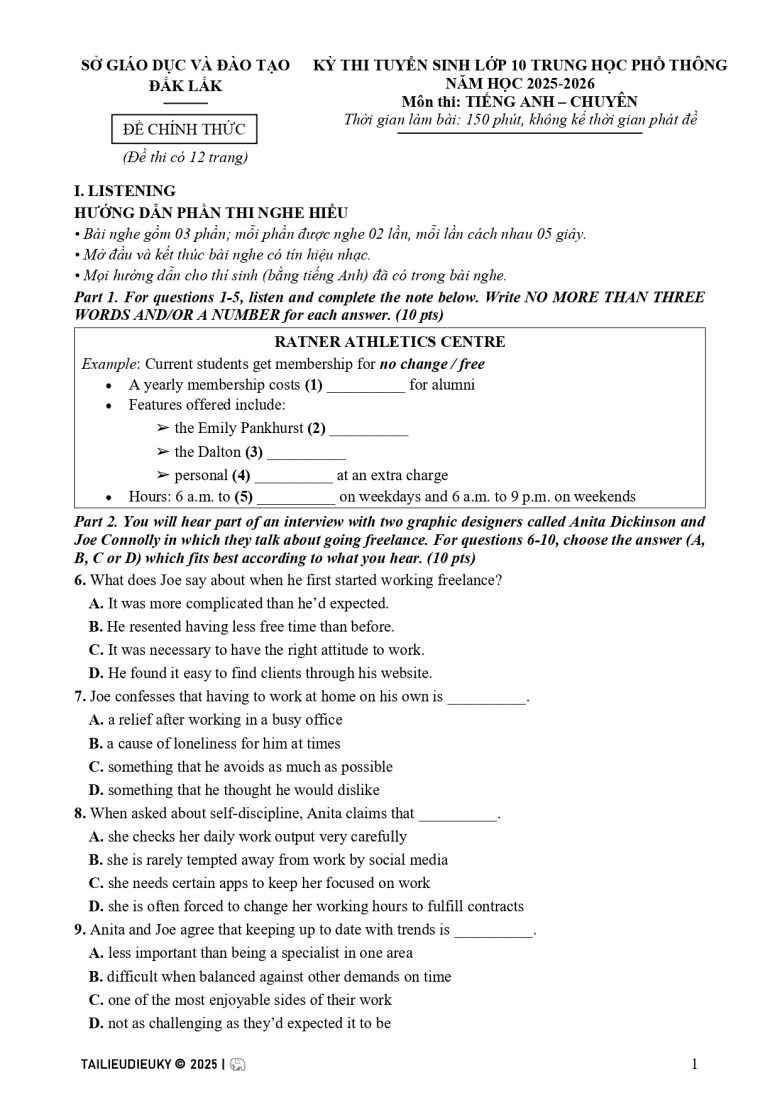
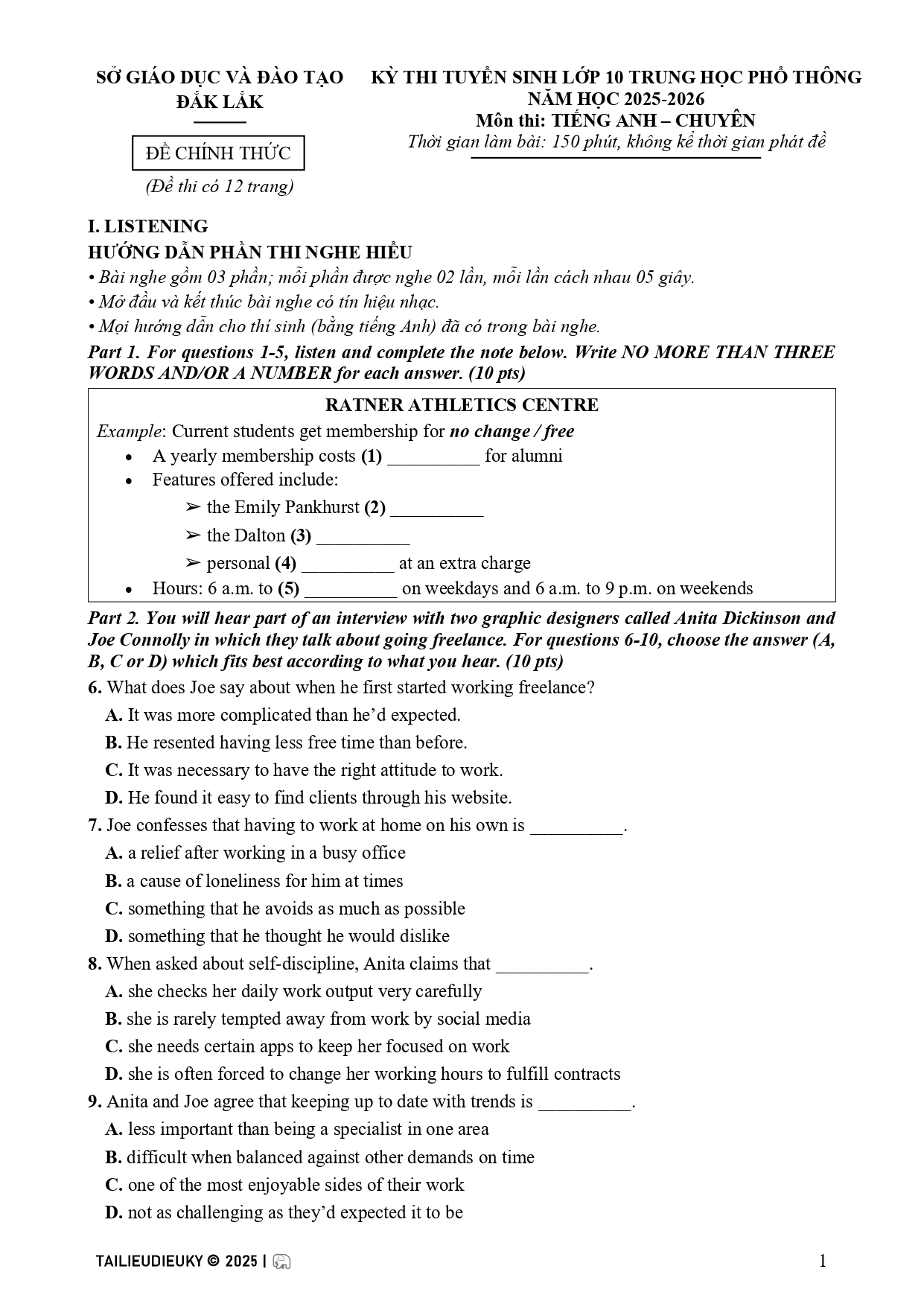
SỞ GIÁO DỤC VÀ ĐÀO TẠO
ĐẮK LẮK
(Đề thi có 12 trang) KỲ THI TUYỂN SINH LỚP 10 TRUNG HỌC PHỔ THÔNG
NĂM HỌC 2025-2026
Môn thi: TIẾNG ANH – CHUYÊN
Thời gian làm bài: 150 phút, không kể thời gian phát đề
I. LISTENING
HƯỚNG DẪN PHẦN THI NGHE HIỂU
• Bài nghe gồm 03 phần; mỗi phần được nghe 02 lần, mỗi lần cách nhau 05 giây.
• Mở đầu và kết thúc bài nghe có tín hiệu nhạc.
• Mọi hướng dẫn cho thí sinh (bằng tiếng Anh) đã có trong bài nghe.
Part 1. For questions 1-5, listen and complete the note below. Write NO MORE THAN THREE WORDS AND/OR A NUMBER for each answer. (10 pts)
RATNER ATHLETICS CENTRE
Example: Current students get membership for no change / free
• A yearly membership costs (1) __________ for alumni
• Features offered include:
➢ the Emily Pankhurst (2) __________
➢ the Dalton (3) __________
➢ personal (4) __________ at an extra charge
• Hours: 6 a.m. to (5) __________ on weekdays and 6 a.m. to 9 p.m. on weekends
Part 2. You will hear part of an interview with two graphic designers called Anita Dickinson and Joe Connolly in which they talk about going freelance. For questions 6-10, choose the answer (A, B, C or D) which fits best according to what you hear. (10 pts)
6. What does Joe say about when he first started working freelance?
A. It was more complicated than he’d expected.
B. He resented having less free time than before.
C. It was necessary to have the right attitude to work.
D. He found it easy to find clients through his website.
7. Joe confesses that having to work at home on his own is __________.
A. a relief after working in a busy office
B. a cause of loneliness for him at times
C. something that he avoids as much as possible
D. something that he thought he would dislike
8. When asked about self-discipline, Anita claims that __________.
A. she checks her daily work output very carefully
B. she is rarely tempted away from work by social media
C. she needs certain apps to keep her focused on work
D. she is often forced to change her working hours to fulfill contracts
9. Anita and Joe agree that keeping up to date with trends is __________.
A. less important than being a specialist in one area
B. difficult when balanced against other demands on time
C. one of the most enjoyable sides of their work
D. not as challenging as they’d expected it to be
10. What does Joe think is the reason for his success as a freelancer?
A. He has effective negotiating skills.
B. He makes sure he has good relations with clients.
C. He gets plenty of personal recommendations.
D. He offers his services at the right price.
Part 3. For questions 11-20, complete the summary by writing NO MORE THAN THREE WORDS in each gap. Write your answers in the corresponding numbered boxes provided. (2.0 pts)
In 2013, a study of mouse brains revealed that when the mice slept, neurotoxic (11) __________ were got rid of. Overnight, accumulated substances like beta amyloid, a (12) __________ peptide that can form plaques and disrupt brain function are removed. It is also found that as the mice slept, their glymphatic (13) __________ opened up, which allowed a big wash of cerebrospinal fluid, or CSF. CSF surrounding our brain and (14) __________ serves as a protective cushion and a source of (15) __________ for our brain.
A team at Boston University successfully induced human participants to fall asleep inside an fMRI machine in order to measure the blood (16) __________ in their brain and observe the flow of CSF. It is shown that during our deepest state of sleep, slow (17) __________, electrical activity decelerates and syncs up.
That our brain was (18) __________ by waves of cerebrospinal fluid is comparable to a free nighttime spa for it. This study identified a clear correlation between brain electrical activity and the CSF (19) __________ and confirmed that an increase in CSF is linked to increased clearing toxic buildup, which can help us (20) __________ neurodegenerative diseases in a novel and innovative ways.
II. USE OF ENGLISH
Part 1. For questions 21-45, choose the correct answer A, B, C or D to each of the following questions and write your answer in the corresponding numbered boxes provided. (2.5 pts)
21. Tom is so smart! He quickly learned the __________ of the job in his new company.
A. ins and outs B. ups and downs C. pros and cons D. white lie
22. - David: You should never have agreed to help mend her motorbike! - Mary: “__________”
A. Famous last words. B. Well, you live and learn.
C. Win or lose. D. You can’t win them all.
23. Sue handed in the test and awaited the results __________.
A. in the same breath B. out of breath
C. with bated breath D. under her breath
24. I get so stressed at a tremendous amount of work. It’s hard to __________ in the evening.
A. untie B. undo C. unwrap D. unwind
25. - Tom: “Do you think I should ask Andy for help?”
- Mary: “ I’m sure he’ll be only __________ willing to help you with the project”
A. just B. too C. that D. so
26. The speaker felt confused when she failed to get her message __________ to her audience.
A. around B. in C. across D. out
27. My old hometown has been a sight for __________ eyes since I was away so long.
A. injured B. hurting C. painful D. sore
28. To get his proposal accepted highly, the Finance Manager must have __________ heavy pressure from his colleagues.
A. pushed off B. laughed at C. sent for D. fended off
29. __________, the garden tables have been ruined in this weather.
A. Leaving uncovered B. Having left uncovered
C. Left uncovered D. Were left uncovered
30. The play wasn’t very good but it wasn’t very bad either. __________, I’d say.
A. Medium B. Mediocre C. Metric D. Mellow
31. When the couples entered the room, the children were __________ over the last orange.
A. consulting B. discussing C. squabbling D. participating
32. __________ I’d like to help you out, I’m afraid I just haven’t got any spare money at the moment.
A. Even as B. Such as C. Much as D. Try as
33. The lecture’s explanation was so __________ that it left his students more confused than before.
A. convoluted B. precise C. lucid D. coherent
34. Mary __________ the reason for her absence from that international conference in a long letter.
A. put out B. set about C. set out D. put on
35. We knew the concert was sold out, but we still went to the stadium __________ the off chance that someone might want to sell us their tickets.
A. with B. on C. by D. in
36. Breaking his leg __________ a blow to his chances of becoming a professional footballer.
A. struck B. caused C. dealt D. brought
37. My elder brother was all set to take the job in Japan, but at the last minute he __________ and decided to stay in Britain.
A. got cold feet B. pulled his finger out
C. held his horses D. called it a day
38. It was __________ a victory that even Smith’s fans couldn’t believe it.
A. such surprising B. so surprising C. too surprising D. surprising enough
39. The difficulty they are facing is __________ their intentions into concrete action.
A. translating B. communicating C. conveying D. interpreting
40. My teacher gave me detention today after school but luckily there was a fire alarm and she let me off the __________.
A. peg B. nail C. hook D. curve
41. You have to go through a number of __________ stages before you become an expert.
A. medium B. average C. moderate D. intermediate
42. I always clean the flat before my mom comes round, but she always finds at least one __________ of dust and says it’s filthy.
A. scrap B. gust C. speck D. blade
43. It is desirable that everyone __________ a happy family and a satisfactory job.
A. is having B. has C. have D. has had
44. Can you get the aspirins that __________ in water, because I can’t take the others.
A. dilute B. dissolve C. diminish D. dispense
45. This test is not expected __________ as difficult as the last one.
A. almost B. nearly C. closely D. totally
Part 2. For questions 46-55, write the correct form of each bracketed word in the corresponding numbered boxes provided. (1.0 pt)
46. It is an __________ fact that people often regret things they have done. (ESCAPE)
47. It was not until the government __________ the papers that we could find out what really had happened. (CLASS)
48. When confronted with a mass of red tape, many people feel a sense of __________. (POWER)
49. To the couple’s expectation, the birth of their __________ baby lighted up the house with laughter. (LONG)
50. The new manager is __________ polite and tries desperately to understand other people’s views. (FAIL)
51. At the dawn of the Internet, many believed that it would enable a more __________, pluralist, and really personalized platform, particularly with politics. (PARTICIPATE)
52. The attack in the city center last night __________ the kind of behaviour amongst young people that many individuals object to. (EXAMPLE)
53. Do you really think your plans are going to come to __________? (FRUIT)
54. There’s a __________ difference between photography and still-life drawing. (QUALITY)
55. I used to think I could change the world, but then __________ set in when I reached my early thirties. (ILLUSION)
Part 3. For questions 56-60, read the passage below which contains 05 mistakes. Identify the mistakes and write the corrections in the corresponding numbered boxes. There is ONE example at the beginning. (0.5 pt)
0. When Although
WILLPOWER
When willpower does not shape our decisions, it determines whether and how long we can follow through on them. It rarely single-handedly determines life outcomes. Interestingly, research suggests the general population is indeed aware about how essential willpower is to their wellbeing. Survey participants routinely identify a ‘lack of willpower’ as the major impediment to doing beneficial life changes. There are, however, misunderstandings surrounding the nature of willpower and how we can acquire more of it. There is a widespread perception, for example, that increased leisure time would result to subsequent increases in willpower.
III. READING
Part 1. For questions 61-70, read the following passage and decide which answer (A, B, C or D) best fits each gap. Write your answers in the corresponding numbered boxes. (1.0 pt)
Since 2020, remote learning has expanded to protect students as well as staff. Many students, (61) __________ from friends and family, experience heightened anxiety, leading to more frequent conflicts on learning platforms and social media. Some students may (62) __________ engage in harmful behaviors, making it crucial for parents and educators to teach appropriate online conduct.
While cyberbullying and harassment are not new, their impact has (63) __________ with virtual learning. Students who previously had little (64) __________ to digital platforms now rely on them for education, further amplifying existing social inequalities - often a root cause of bullying.
Another growing concern is virtual sexual harassment and cyberstalking, (65) __________ the spread of nonconsensual explicit images. The anonymity of online platforms enables students to engage in misconduct more easily. Many schools (66) __________ proper systems to prevent and address these issues, despite reports from the National Center for Education Statistics showing a nationwide rise in cyberbullying. Alarmingly, girls are three times more likely than boys to experience online harassment.
It is important for educators and bystander students to take the time to (67) __________ misconceptions, misstatements, and other harmful behaviors online. Cyberbullying and harassment are just as harmful as other forms of bullying and harassment, and in some cases, can have significant effects on the victim. Harassment on virtual platforms is hard to (68) __________ and can reach an overwhelming number of people in a matter of minutes. This is particularly true for students who are compelled to attend classes virtually. Being constantly connected to technology may mean that bullies and harassers can sneak (69) __________ the lives of students and make them feel like there is no safe space to be.
Many victims of cyberbullying and cyber sexual harassment do not (70) __________ incidents to their family or educators. Therefore, when incidents occur, they may suffer in silence. Educators and student colleagues must be extra vigilant in these times to protect vulnerable student populations.
(Adapted from https://www.equalrights.org/issue/covid-cyberbullying)
61. A. activated B. isolated C. triggered D. defeated
62. A. purposefully B. intentionally C. unknowingly D. knowingly
63. A. decreased B. intensified C. minimized D. denitrified
64. A. exposure B. dedication C. devotion D. contribution
65. A. including B. included C. includes D. include
66. A. boost B. reach C. drop D. lack
67. A. attract B. ignore C. address D. bewitch
68. A. improve B. achieve C. escape D. betray
69. A. onto B. into C. along D. upon
70. A. disclose B. enclose C. beware D. belong
Part 2. For questions 71-80, read the passage and write ONE suitable word for each blank in the boxes below. (2.0 pts)
ENVIRONMENTAL ISSUES IN THE DEVELOPING WORLD
The issues for emerging economies are little more straightforward. The desire to build on undeveloped land is not born out of desperation or necessity, (71) __________ is a result of the relentless march of the progress. Cheap labour and a relatively highly- skilled workforce make these countries highly competitive and there is a flood of inward investment, (72) __________ from multinationals looking to take advantage of the low wages before the cost and standard of living begin to rise. It is factors such as these that are (73) __________ many Asian economies extremely attractive when viewed as investment opportunities at the moment. Similarly, in Africa, the (74) __________ abundance of precious metals and natural resources (75) __________ to attract a lot of exploration companies and a whole sub-industry develops around and is completely dependent on this foreign-direct investment. It is understandable that countries that are the focus of this sort of attention can lose sight (76) __________ the environmental implications of large-scale industrial development, and this can have devastating consequences for the natural world. And it is a vicious cycle because the (77) __________ industrially active a nation becomes, the greater the demand for and harvesting of natural resources. For some, the environment issues, though they can hardly be ignored, are viewed as a peripheral concern. Indeed, having an environmental conscience or taking environmental matters into (78) __________ when it comes to decisions on whether or not to build rubbertree plantations or grow biofuel crops would be quite prohibitive indeed. For those involved in (79) __________ schemes it is a pretty black-and-white issue. And, for vast tracts of land in Latin America, for example, it is clear that the welfare of the rainforests matters (80) __________ to local government when vast sums of money can be made from cultivating the land.
Part 3. For questions 81-90, read the following passage and write in the boxes below the letter A, B, C, or D to indicate the correct answer to each of the questions. (2.0 pts)
The secrets of how sharks survived so many of Earth’s mass extinctions
Vegetarianism and underwater volcanoes have helped sharks survive for half a billion years. But can they use their skills to cope with climate change?
The beach at Muizenberg outside Cape Town is a Mecca for wannabe surf bums. But when the beach siren sounds, surfers and swimmers alike tend to lose their cool. That distinctive rolling wail is a warning that sharks may be nearby. Everyone knows the drill – get out of the water as quickly as you can.
[I] The mere suggestion of a shark is enough to conjure fear in many of us. [II] But sharks also inspire awe. [III] It isn’t just their elegance or physicality; equally impressive is their tenacity. [IV] That makes them older than humanity, older than Mount Everest, older than dinosaurs, older even than trees.It is possible that sharks just got lucky in the lottery of life. But over the past few years, scientists have discovered that the fish possess some unusual qualities that allow them to be super-adaptable in the face of change, including a fondness for hanging out around underwater volcanoes. The big question now is whether these qualities will help sharks survive the current sixth mass extinction, triggered by human activities. Today, sharks face a new challenge, far deadlier than any they have ever encountered.
Sharks, along with rays, skates and chimaeras, make up a group of fish known as chondrichthyes, characterised by a cartilaginous skeleton. Fossil scales found in Siberia indicate that sharks originated in the Silurian period, which began about 440 million years ago. It was a time when the world was warm, sea levels were high and corals reefs were starting to appear. Since then, thousands of shark species have existed, culminating in a golden age about 360 million years ago, when they dominated the oceans, taking many weird and wonderful forms. Today, there are more than 450 shark species, ranging from well-known ones such as great whites and hammerheads to the exotic and bizarre, including goblin sharks, cookiecutter sharks and Japanese wobbegong.
Of course, many shark species are now extinct, but that is to be expected. It is estimated that extinction has been the fate of more than 99 percent of all plants and animals that have ever lived. The puzzle instead is how sharks as a group have survived for so long. Palaeoecologist Sora Kim at the University of California, Merced, who studies ancient and modern sharks, sees one clue in their faeces. “When a shark poops, there’s hardly any solids,” she says. “It’s more of a clearish goo.” This indicates that they possess a highly efficient digestive system able to process almost all of what they eat. That can be helpful if food gets scarce, says Kim, which is likely to happen during a mass extinction event. Earth’s third and biggest mass extinction, for example, which happened about 252 million years ago, saw upwards of 96 percent of all marine life disappear.
As well as letting very few nutrients go to waste, sharks are also surprisingly unfussy eaters. A few years ago, Kim and her colleagues studied the diet of great white sharks by analysing chemical signatures in their backbones. “When I started the project, I thought, well, white sharks devour seals and sea lions,” she says. That was the received wisdom. “I was really surprised that that’s not what I saw.” They don’t turn their nose up at these animals, but they seem just as happy consuming other prey such as squid. “Even though we think of them as being apex predators at the top of the food chain, they definitely aren’t that all of the time,” says Kim. In fact, research published last year reveals one shark species, the bonnethead, is omnivorous, consuming copious amounts of seagrass along with shellfish. Such dietary flexibility would have worked in sharks’ favour when the going got tough.
More evidence of shark adaptability comes from their teeth. Unlike their cartilaginous skeleton, the teeth are extremely hard, which gives them a good chance of being preserved in the fossil record. In Canada’s Northwest Territories, teeth belonging to sand tiger sharks litter ancient sediments near the Muskox and Eames rivers. They are between 53 and 38 million years old, dating from the Eocene, an epoch when Earth was about 9°C to 14°C warmer than it is today. Ice caps melt in warmer worlds, and their freshwater drains into the oceans. This makes ocean water less salty, which can be a problem for fish species that require specific salt levels to survive. But it doesn’t seem to have bothered the Eocene sand tiger shark: the chemistry of its teeth suggests that it was living in far less salty waters than its counterparts inhabit today.
(Adapted from www.newscientist.com)
81. According to the passage, why does the writer say swimmers “lose their cool”?
A. They stay calm due to the temporary siren sounds.
B. They are concerned about potential surfers frequenting the shore.
C. They become exhausted after hearing the warning sounds.
D. They are suddenly conscious of the threat in the area.
82. Which of the following square brackets [A], [B], [C], or [D] best indicates where in the paragraph the sentence “As a group, sharks have been around for at least 420 million years, meaning they have survived four of the “big five” mass extinctions.” can be inserted?
A. [I] B. [II] C. [III] D. [IV]
83. According to paragraph 3, sharks __________.
A. have been very fortunate in their annual reproduction
B. want to reside close to underwater volcanoes
C. have attributes enabling them to ensure its stability
D. have had certain peculiar characteristics
84. The word triggered in paragraph 3 is closest in meaning to __________.
A. stimulated B. possessed C. eliminated D. impressed
85. According to paragraph 4, what can be inferred about sharks?
A. They could have evolved during another epoch apart from the Silurian period.
B. There would probably be other types of sharks that have not been identified.
C. They would probably adapt themselves to cold climates and low-level water.
D. There might be some sharks that contribute to the disappearance of coral reefs.
86. According to paragraph 5, what is true about sharks?
A. It is a possibility that many of their species could suffer a threat of extinction.
B. More than 99 percent of those that have ever lived are thought to have died out.
C. A palaeoecologist disagrees that scarcely any solids are present in a shark’s excrement.
D. They have a very effective digestive system that can break down practically all of their food.
87. The word devour in paragraph 6 is closest in meaning to __________.
A. mistake B. hunt C. raise D. eat
88. According to paragraph 6, Kim asserts that __________.
A. sharks are equally content to eat other types of animals
B. the received wisdom is surprising to her and her colleagues
C. sometimes sharks are hunted by other animals at the top of the food chain
D. sharks used to be omnivorous due to their nutritional adaptability
89. According to the passage, what characteristics do sharks’ teeth have?
A. ability to defossilise B. durability
C. flexibility D. reusability
90. According to the passage, the Muskox and Eames rivers are where __________.
A. sharks survived fossilisation and preserved their teeth
B. salt content of ocean water can be problematic for shark species
C. sand tiger shark teeth are scattered throughout the old sediments
D. freshwater drains into the oceans, leading to much less salinity
Part 4. For questions 91-100, read the following extract and do the tasks that follow. (2.0 pts)
Does an IQ test prove creativity?
Everyone has creativity, some a lot more than others. The development of humans, and possibly the universe, depends on it. Yet creativity is an elusive creature. What do we mean by it? What is going on in our brains when ideas form? Does it feel the same for artists and scientists? We asked writers and neuroscientists, pop stars and AI gurus to try to deconstruct the creative process-and learn how we can all ignite the spark within.
A. In the early 1970s, creativity was still seen as a type of intelligence. But when more subtle tests of IQ and creative skills were developed in the 1970s, particularly by the father of creativity testing, Paul Torrance, it became clear that the link was not so simple. Creative people are intelligent, in terms of IQ tests at least, but only averagely or just above. While it depends on the discipline, in general beyond a certain level IQ does not help boost creativity; it is necessary but not sufficient to make someone creative.
B. Because of the difficulty of studying the actual process, most early attempts to study creativity concentrated on personality. According to creativity specialist Mark Runco of California State University, Fullerton, the “creative personality” tends to place a high value on aesthetic qualities and to have broad interests, providing lots of resources to draw on and knowledge to recombine into novel solutions. “Creatives” have an attraction to complexity and an ability to handle conflict. They are also usually highly self-motivated, perhaps even a little obsessive. Less creative people, on the other hand, tend to become irritated if they cannot immediately fit all the pieces together. They are less tolerant of confusion. Creativity comes to those who wait, but only to those who are happy to do so in a bit of a fog.
C. But there may be a price to pay for having a creative personality. For centuries, a link has been made between creativity and mental illness. Psychiatrist Jamison of Johns Hopkins University in Baltimore, Maryland, found that established artists are significantly more likely to have mood disorders. But she also suggests that a change of mood state might be the key to triggering a creative event, rather than the negative mood itself. Intelligence can help channel this thought style into great creativity, but when combined with emotional problems, lateral, divergent or open thinking can lead to mental illness instead.
D. Jordan Peterson, a psychologist at the University of Toronto, Canada, believes he has identified a mechanism that could help explain this. He says that the brains of creative people seem more open to incoming stimuli than less creative types. Our senses are continuously feeding a mass of information into our brains, which have to block or ignore most of it to save us from being snowed under. Peterson calls this process latent inhibition, and argues that people who have less of it, and who have a reasonably high IQ with a good working memory can juggle more of the data, and so maybe open to more possibilities and ideas. The downside of extremely low latent inhibition may be a confused thought style that predisposes people to mental illness. So for Peterson, mental illness is not a prerequisite for creativity, but it shares some cognitive traits.
E. But what of the creative act itself? One of the first studies of the creative brain at work was by Colin Martindale, a psychologist from the University of Maine in Orono. Back in 1978, he used a network of scalp electrodes to record an electroencephalogram, a record of the pattern of brain waves, as people made up stories. Creativity has two stages: inspiration and elaboration, each characterised by very different states of mind. While people were dreaming up their stories, he found their brains were surprisingly quiet. The dominant activity was alpha waves, indicating a very low level of cortical arousal: a relaxed state, as though the conscious mind was quiet while the brain was making connections behind the scenes. It’s the same sort of brain activity as in some stages of sleep, dreaming or rest, which could explain why sleep and relaxation can help people be creative. However, when these quiet minded people were asked to work on their stories, the alpha wave activity dropped off and the brain became busier, revealing increased cortical arousal, more corralling of activity and more organised thinking. Strikingly, it was the people who showed the biggest difference in brain activity between the inspiration and development stages who produced the most creative storylines. Nothing in their background brain activity marked them as creative or uncreative. “It’s as if the less creative person can’t shift gear,” says Guy Claxton, a psychologist at the University of Bristol, UK. “Creativity requires different kinds of thinking. Very creative people move between these states intuitively.” Creativity, it seems, is about mental flexibility: perhaps not a two-step process, but a toggling between two states. In a later study, Martindale found that communication between the sides of the brain is also important.
F. Paul Howard-Jones, who works with Claxton at Bristol, believes he has found another aspect of creativity. He asked people to make up a story based on three words and scanned their brains using functional magnetic resonance imaging. In one trial, people were asked not to try too hard and just report the most obvious story suggested by the words. In another, they were asked to be inventive. He also varied the words so it was easier or harder to link them. As people tried harder and came up with more creative tales, there was a lot more activity in a particular prefrontal brain region on the right-hand side. These regions are probably important in monitoring for conflict, helping us to filter out many of combining the words and allowing us to pull out just the desirable connections, Howard-Jones suggests. It shows that there is another side to creativity, he says. The story-making task, particularly when we are stretched, produces many options which we have to assess. So part of creativity is a conscious process of evaluating and analysing ideas. The test also shows that the more we try and are stretched, the more creative our minds can be.
G. And creativity need not always be a solitary, tortured affair, according to Teresa Amabile of Harvard Business School. Though there is a slight association between solitary writing or painting and negative moods or emotional disturbances, scientific creativity and workplace creativity seem much more likely to occur when people are positive and buoyant. In a decade- long study of real businesses, to be published soon, Amabile found that positive moods relate positively to creativity in organisations, and that the relationship is a simple linear one. Creative thought also improves people’s moods, her team found, so the process is circular. Time pressures, financial pressures and hard-earned bonus schemes on the other hand, do not boost workplace creativity: internal motivation, not coercion, produces the best work.
H. Another often forgotten aspect of creativity is social. Vera John-Steiner of the University of New Mexico says that to be really creative you need strong social networks and trusting relationships, not just active neural networks. One vital characteristic of a highly creative person, she says, is that they have at least one other person in their life who doesn’t think they are completely nuts.
Questions 91-94
Do the following statements agree with the information given in Reading Passage? In boxes 91-94 on your answer sheet, write
TRUE (T) if the statement is true
FALSE (F) if the statement is false
NOT GIVEN (NG) if the information is not given in the passage
91. High IQ guarantees better creative ability in one person than that who achieves an average score in an IQ test.
92. In a competitive society, individuals’ language proficiency is more important than other abilities.
93. A wider range of resources and knowledge can be integrated by more creative people into bringing about creative approaches.
94. A creative person does not necessarily suffer more mental illness.
Questions 95-97
Use the information in the passage to match the people (listed A-C) with opinions or deeds below.
Write the appropriate letters A-C in boxes 95-97 on your answer sheet.
A. Teresa Amabile
B. Jamison
C. Vera John-Steiner
95. Instead of producing the negative mood, a shift of mood state might be the one important factor of inducing a creative thinking.
96. Where the more positive moods individuals achieve, there is higher creativity in organizations.
97. Good interpersonal relationship and trust contribute to a person with more creativity.
Questions 98-100
Complete the summary using the list of words, A-F, below. Write the correct letter, A-F, in boxes 98-100 provided.
A. sleep and relaxation B. scalpel electrodes C. desirable connections
D. Creativity and flexibility E. inspiration and elaboration F. alpha waves
In 1978, Colin Martindale made records of patterns of brain waves as people made up stories by applying a system consisting of many (98) __________. The two phrases of creativity, such as (99) __________ were found. While people were still planning their stories, their brains showed little active sign and the mental activity presented a very relaxed state as the same sort of brain activity as in sleep, dreaming or rest.
However, experiments proved that the signal of (100) __________ went down and the brain became busier, revealing increased cortical arousal when these people were required to produce their stories. Strikingly, it was found the person having the greatest difference in brain activity between two stages produced storylines with the highest level of creativity.
IV. WRITING
Part 1. Finish each of the following sentences in such a way that it means the same as the sentence printed before. (1.0 pt)
101. The window was broken by a cricket ball.
It ____________________________________________________________________________
102. The collision didn’t damage her motorbike much.
Not a great ____________________________________________________________________
103. His fondness for the game increased with his proficiency.
The more ______________________________________________________________________
104. Someone has suggested raising the parking fees in the city.
It ____________________________________________________________________________
105. Annet doesn’t change her way of living, so her health can’t improve much.
Were Annet ____________________________________________________________________
Part 2. Complete the second sentence so that it has a similar meaning to the first one. Use BETWEEN THREE AND FIVE WORDS, including the word given in capitals, and this word must not be changed in any way. (1.0 pt)
106. No one nowadays believes in witches, do they? (AGE)
No one ______________________________________________ believes in the witches, do they?
107. The secretary leaked the story to the employees. (WIND)
The employees ___________________________________________ the story from the secretary.
108. He hasn’t announced anything, but I guess that the Prime Minister’s going to resign soon. (LINES)
He hasn’t announced anything, but ______________________________, I’d say that the Prime Minister’s going to resign soon.
109. There’s a good chance that Ed will be picked for the team. (BEING)
Ed’s ________________________________________________________ for the team are good.
110. I made a slight mistake at the beginning, so my whole answer to the maths problem was wrong. (SLIPPED)
My answer to the maths problem would have been right ____________________ at the beginning.
Part 3. Write an essay of about 250 words on the following topic. (3.0 pts)
Some people say that students’ reliance on AI-powered tools for study may inhibit their creativity and independence. However, the others believe that the application of AI in education can help learners improve their study.
Discuss the two viewpoints and give your own opinion.
---------- THE END ----------