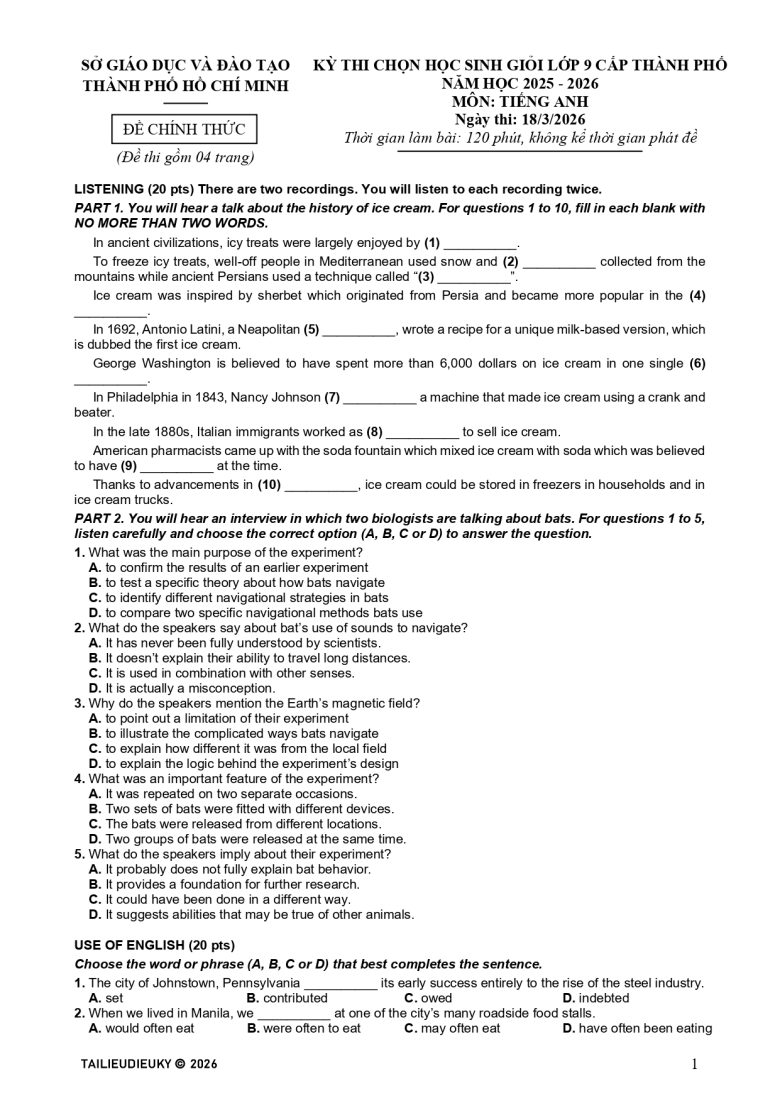
Chào mừng các bạn đến với Tài liệu diệu kỳ! Hôm nay, chúng tôi xin chia sẻ đến quý thầy cô và các em học sinh Đề thi chính thức kỳ thi chọn học sinh giỏi lớp 9 cấp thành phố môn Tiếng Anh của Sở GD&ĐT TP.HCM năm học 2025-2026 vừa thi ngày 18/03/2026. Bạn có thể tải trọn bộ file Word, audio và transcript qua link bên dưới.
Theo Sở GD&ĐT TP.HCM, kỳ thi năm nay có 5.278 học sinh từ 418 trường THCS tham gia. Kết quả, 2.567 thí sinh đạt giải, gồm 67 giải Nhất, 659 giải Nhì và 1.841 giải Ba. Đây cũng là kỳ thi HSG cấp thành phố đầu tiên dành cho học sinh lớp 9 kể từ sau khi TP.HCM sáp nhập.
Listening (20đ): Điền từ + trắc nghiệm
Use of English (20đ): Ngữ pháp + lỗi sai
Word Forms (40đ): Biến đổi từ + điền đoạn
Guided Cloze (30đ): Trắc nghiệm điền đoạn
Reading (20đ): Đọc hiểu
Open Cloze (40đ): Điền từ
Sentence Transformation (30đ): Viết lại câu
👉 Tổng: 200 điểm
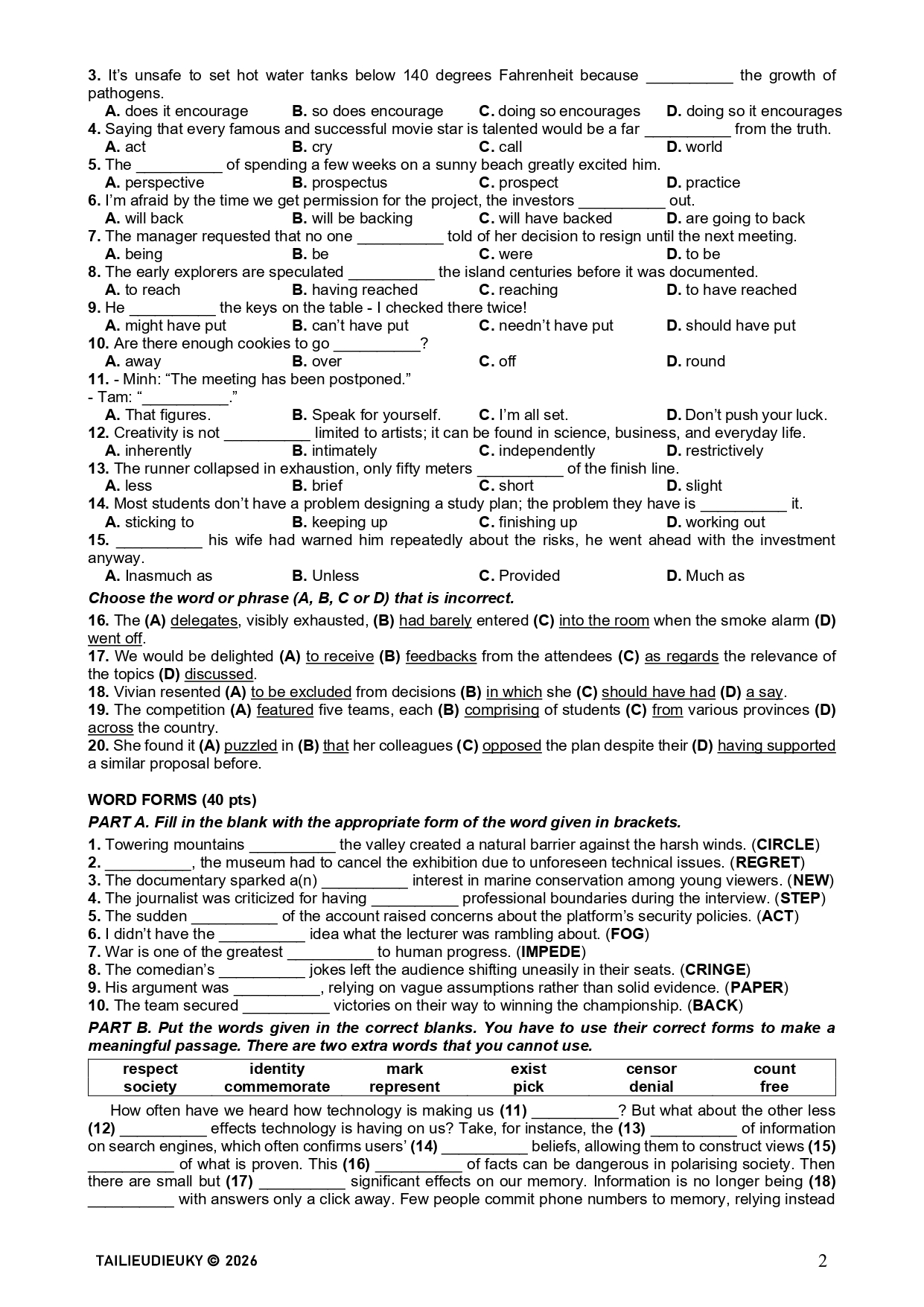
Đáp án tham khảo
LISTENING – Part 1
1. royal elites
2. glacial ice
3. sky cooling
4. Middle Ages
5. chef
6. summer
7. patented
8. street vendors
9. therapeutic properties
10. refrigeration technology
LISTENING – Part 2
1. B
2. B
3. D
4. B
5. B
USE OF ENGLISH
1. C
2. A
3. C
4. B
5. C
6. C
7. B
8. D
9. B
10. D
11. A
12. A
13. C
14. A
15. D
16. C
17. B
18. A
19. B
20. A
WORD FORMS – Part A
1. encircling
2. Regrettably
3. renewed
4. overstepped
5. deactivation
6. foggiest
7. impediments
8. cringeworthy
9. paper-thin
10. back-to-back
WORD FORMS – Part B
11. antisocial
12. identifiable
13. cherry-picking
14. pre-existing
15. irrespective
16. misrepresentation
17. undeniably
18. memorized
19. countless
20. markedly
GUIDED CLOZE
1. C
2. A
3. B
4. D
5. C
6. B
7. D
8. A
9. A
10. B
11. C
12. A
13. C
14. D
15. B
READING
1. D
2. B
3. B
4. D
5. D
6. D
7. C
8. C
9. A
10. B
OPEN CLOZE – Passage A
1. subscribers
2. Needless
3. more
4. return / exchange
5. out
6. long
7. have / let
8. restrictions / rules / regulations
9. strings
10. clothing / merchandise / toy / product
OPEN CLOZE – Passage B
1. lane
2. matter / couple
3. such
4. on
5. surpass
6. point
7. capable
8. successor / parallel
9. which
10. oxygen
SENTENCE TRANSFORMATION
1. Neville gave an assurance that the issue would be carefully looked into by the committee.
2. The naughty kid owned up to pulling a fast one on the new students.
3. Were it not for the funding, the events wouldn’t go off without a hitch.
4. Far-reaching as these reforms seem, their effectiveness remains to be seen.
5. So as to prevent accidents, the instructions must be carried out to the letter.
6. Sarah would sooner her son focused on his studies for the time being.
7. When it comes to solving problems, I am no match for my sister.
8. It is two hours since the rain set in.
9. My mom makes a point of closing all windows prior to leaving the apartment.
10. By no stretch of the imagination could his behavior be described as transparent.
TRANSCRIPTS
Part 1.
On a hot spring afternoon in 1963, two men, sent by the American CIA, snuck into the cafeteria of the Havana Libre Hotel. Their directive was to retrieve a poison pill from the freezer and slip it into the chocolate milkshake of Fidel Castro, the Cuban leader who was known to devour up to 18 scoops of ice cream after lunch. While exact details of the story are contested, it’s rumored that the pill, however, froze to the freezer coils and broke, foiling the CIA’s plan and granting Castro many more days to satiate his sweet tooth.
Ice cream has held a unique role in our world’s history, culture, and cravings, but where did it come from? The first accounts of cold desserts and iced drinks date back as early as the first century. In civilizations including ancient Rome, Mughal India, and Tang Dynasty China, these icy treats were mainly enjoyed by the royal elites. And finding the means to freeze these delicacies wasn’t always easy. Wealthy Mediterranean nobility sent laborers to trek up high mountains to harvest glacial ice and snow. Meanwhile, ancient Persians built shallow insulated pools of water and utilized a technique known as sky cooling. At night, the shallow pools would naturally radiate heat into the dry desert skies, causing them to dip below the ambient temperature and freeze.
Yet, the cream-based treat we know today made a much later debut. It was originally inspired by sherbet, or charbot in Arabic. An icy drink believed to have originated in Persia and subsequently gained popularity in the Middle Ages. European travelers brought sherbet recipes home and began creating their own chocolate, pinecone, and even eggplant flavored takes on the refreshment. In 1692, Antonio Latini, a Neapolitan chef, recorded a recipe for a unique milk-based version which some historians dub the first ice cream.
In the 18th century, ice cream expanded its reach as these recipes set sail alongside European settlers to North America. Yet, it was still mainly enjoyed by the upper classes as the process to make it was quite laborious and its main ingredients, sugar, salt, and cream were expensive. George Washington is said to have spent the equivalent of $6,600 in today’s dollars on ice cream in one summer alone.
It was on American soil that the frozen dessert entered its golden age. As inventors and entrepreneurs began to engineer ways to bring it to the masses. In Philadelphia in 1843, Nancy Johnson patented a revolutionary ice cream-making machine featuring a crank and beater which made the process easier for any home cook. And storing ice cream was no longer an obstacle as by the mid-1830s New England businessman, Ice King Frederick Tudor had greatly improved the ice trade, shipping thousands of tons of ice to households across the globe. Soon, ice cream was on every street corner.
In the late 1880s, political turmoil brought Italian immigrants to cities like London, Glasgow, and New York, where many took up jobs as street vendors selling licks of ice cream for roughly a penny each. Meanwhile, American drugists discovered the appeal of combining soda, a drink thought to have therapeutic properties at the time, with ice cream, and a new social spot was born, the soda fountain. When the sale of alcohol was banned in 1920, many American saloons reinvented themselves as soda fountains, and breweries like Anheuser-Busch and Yingling pivoted to producing ice cream.
At the same time, refrigeration technology was improving rapidly. By the end of World War II, the average American home had a freezer that could house a quart of ice cream. Even trucks could be equipped with freezers full of frozen treats. Today, ice cream continues to take on new forms, and while some of its mysteries may never be solved, one thing is certain our love for ice cream will never thaw.
Did you know that popcorn generates almost 40% of all movie theater profits, or that archaeologists have found dumplings in sites dating back a thousand years? Keep exploring the history of your favorite foods with these videos.
Part 2.
MELISSA BLOCK, Host: Bats are famously good at finding their way home after long nights hunting insects. How they do it has been a mystery. But now a group of scientists says bats maybe using the tug of the earth’s magnetic field as a navigational aid.
Here’s NPR’s John Nielsen.
JOHN NIELSEN: Big brown bats make lots of noise when they’re flying around inside pitch black barns like this one in Central New Jersey.
(SOUNDBITE OF BATS)
NIELSEN: They get even louder when Princeton ecologist Richard Holland catches one of them in a net, scrapes the hair off the back of its neck and glues a small radio transmitter to the bald spot.
D: This one is quite really aggressive.
NIELSEN: Holland tries to calm this angry bat by giving it some tasty mealworms. But fellow ecologist Martin Wikelski says it’s not going to work.
D: And they can shout and eat at the same time.
NIELSEN: Scientists like Wikelski and Holland know that bats use squeaking sounds as a kind of sonar when they’re down near the ground. That’s why bats don’t smash into barn walls, the insides of caves and so on. What the experts didn’t know was how bats navigate when they’re way up in the air and a long way from home.
Holland and Wikelski say they had a hunch that bats use the earth’s magnetic field as a compass. So last spring, they started testing that hunch by catching angry bats and sticking them into big glass jars. Then, they stuck the jars into something called a Helmholtz coil. It’s a device that produces magnetic fields. If these bats really did have magnetic compasses inside them, the compasses would be messed up by the coil. Holland says this change could make the bats think north was south or vice versa.
D: And then we took them 20 miles north of the barn where we caught them and released them. First of all, to find out whether they could work out that they’ve been displaced 20 miles north and would they want to go back home to their barn.
NIELSEN: The scientists followed the displaced bats in a plane that was equipped to pick up signals sent out by the beepers. They also chased them with a car, which wasn’t easy.
D: We were going up and down in the interstate. We were driving through housing estates full of New Jersey McMansions, around schools, around airports, so there were lots of things in the way.
NIELSEN: What they saw was proof that bats really do have a magnetic compass. Holland says the bats that had been dropped into the coil all flew off in the wrong direction for a couple of hours. Then, when the effects of the coil wore off, the bats seemed to wake up from a dream.
BLOCK: Some of them at least actually seemed to - that they recognized that they were flying in the wrong direction after a journey of anywhere between maybe five and 15 kilometers depending on the bat. And then would actually start to correct, and some of them actually got back in the same night.
NIELSEN: Holland says he’s certain that bats use lots of other cues to find their way around. For example, they might remember mountains or other landmarks. But ecologist Verner Bingman of Bowling Green State University says he’s certain that Holland’s study, published in this week’s Nature, is sure to draw a lot of attention.
D: It’s the first field demonstration of bats being sensitive to the earth’s magnetic field. That’s groundbreaking. The data are modest and there’s huge numbers there, but they’re quite compelling.
NIELSEN: Ecologist Roland Kays of the New York State Museum hopes this study will also draw attention to the technologies that made it possible. Tracking tags that are now small enough to stick to the backs of angry bats or even insects.
D: As people start to realize that tags are this small and (unintelligible), they realize there’s always questions that they’ve been dying to ask in the back of their mind but never thought were even possible.
NIELSEN: For example, how do small birds and animals help move diseases like the West Nile virus around or where the migrating butterflies rest at the end of the day or how many other species of bats have magnetic compasses inside them?
John Nielsen, NPR News, Washington.
SỞ GIÁO DỤC VÀ ĐÀO TẠO
THÀNH PHỐ HỒ CHÍ MINH
(Đề thi gồm 04 trang) KỲ THI CHỌN HỌC SINH GIỎI LỚP 9 CẤP THÀNH PHỐ
NĂM HỌC 2025 - 2026
MÔN: TIẾNG ANH
Ngày thi: 18/3/2026
Thời gian làm bài: 120 phút, không kể thời gian phát đề
LISTENING (20 pts) There are two recordings. You will listen to each recording twice.
PART 1. You will hear a talk about the history of ice cream. For questions 1 to 10, fill in each blank with NO MORE THAN TWO WORDS.
In ancient civilizations, icy treats were largely enjoyed by (1) __________.
To freeze icy treats, well-off people in Mediterranean used snow and (2) __________ collected from the mountains while ancient Persians used a technique called “(3) __________”.
Ice cream was inspired by sherbet which originated from Persia and became more popular in the (4) __________.
In 1692, Antonio Latini, a Neapolitan (5) __________, wrote a recipe for a unique milk-based version, which is dubbed the first ice cream.
George Washington is believed to have spent more than 6,000 dollars on ice cream in one single (6) __________.
In Philadelphia in 1843, Nancy Johnson (7) __________ a machine that made ice cream using a crank and beater.
In the late 1880s, Italian immigrants worked as (8) __________ to sell ice cream.
American pharmacists came up with the soda fountain which mixed ice cream with soda which was believed to have (9) __________ at the time.
Thanks to advancements in (10) __________, ice cream could be stored in freezers in households and in ice cream trucks.
PART 2. You will hear an interview in which two biologists are talking about bats. For questions 1 to 5, listen carefully and choose the correct option (A, B, C or D) to answer the question.
1. What was the main purpose of the experiment?
A. to confirm the results of an earlier experiment
B. to test a specific theory about how bats navigate
C. to identify different navigational strategies in bats
D. to compare two specific navigational methods bats use
2. What do the speakers say about bat’s use of sounds to navigate?
A. It has never been fully understood by scientists.
B. It doesn’t explain their ability to travel long distances.
C. It is used in combination with other senses.
D. It is actually a misconception.
3. Why do the speakers mention the Earth’s magnetic field?
A. to point out a limitation of their experiment
B. to illustrate the complicated ways bats navigate
C. to explain how different it was from the local field
D. to explain the logic behind the experiment’s design
4. What was an important feature of the experiment?
A. It was repeated on two separate occasions.
B. Two sets of bats were fitted with different devices.
C. The bats were released from different locations.
D. Two groups of bats were released at the same time.
5. What do the speakers imply about their experiment?
A. It probably does not fully explain bat behavior.
B. It provides a foundation for further research.
C. It could have been done in a different way.
D. It suggests abilities that may be true of other animals.
USE OF ENGLISH (20 pts)
Choose the word or phrase (A, B, C or D) that best completes the sentence.
1. The city of Johnstown, Pennsylvania __________ its early success entirely to the rise of the steel industry.
A. set B. contributed C. owed D. indebted
2. When we lived in Manila, we __________ at one of the city’s many roadside food stalls.
A. would often eat B. were often to eat C. may often eat D. have often been eating
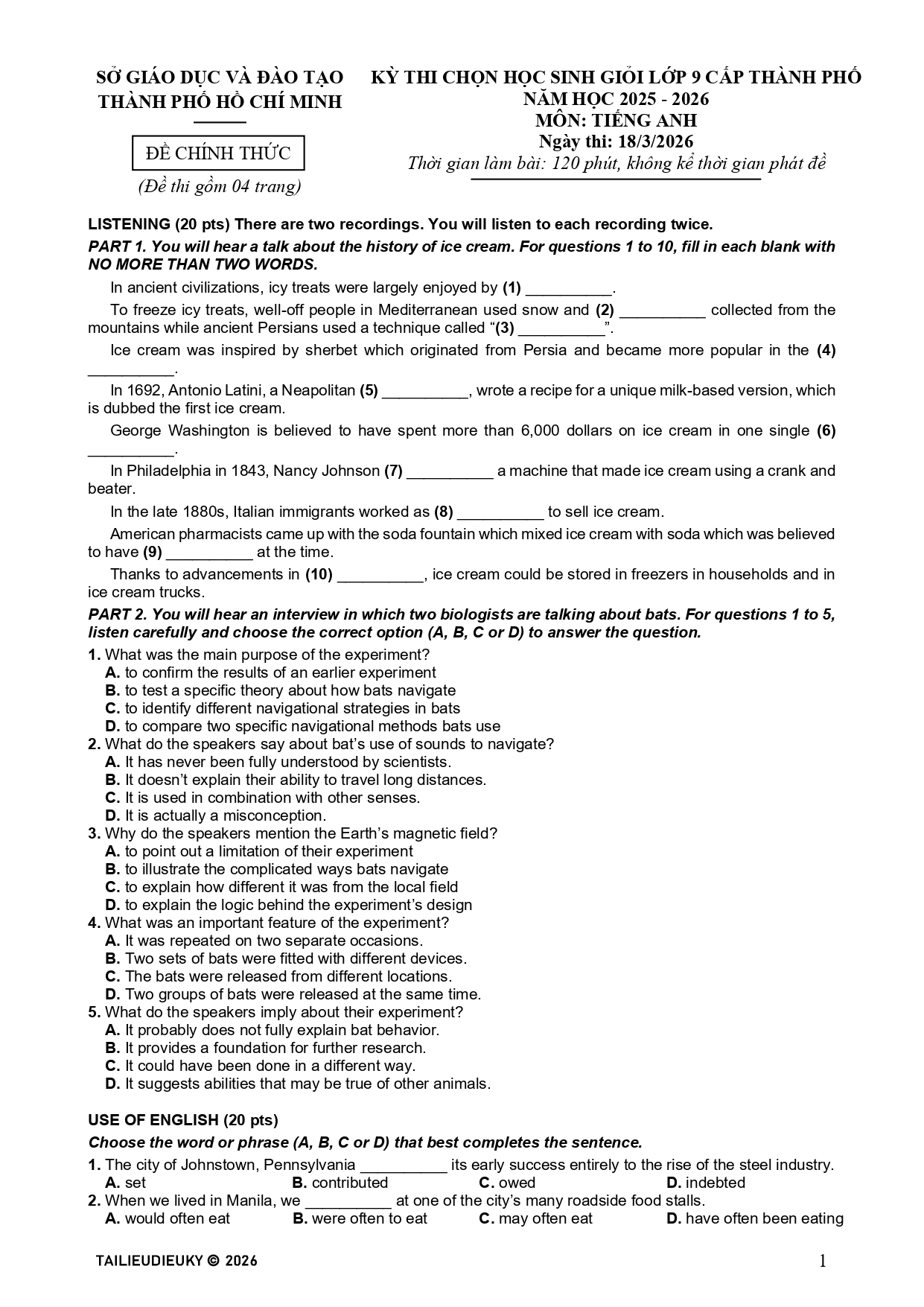
3. It’s unsafe to set hot water tanks below 140 degrees Fahrenheit because __________ the growth of pathogens.
A. does it encourage B. so does encourage C. doing so encourages D. doing so it encourages
4. Saying that every famous and successful movie star is talented would be a far __________ from the truth.
A. act B. cry C. call D. world
5. The __________ of spending a few weeks on a sunny beach greatly excited him.
A. perspective B. prospectus C. prospect D. practice
6. I’m afraid by the time we get permission for the project, the investors __________ out.
A. will back B. will be backing C. will have backed D. are going to back
7. The manager requested that no one __________ told of her decision to resign until the next meeting.
A. being B. be C. were D. to be
8. The early explorers are speculated __________ the island centuries before it was documented.
A. to reach B. having reached C. reaching D. to have reached
9. He __________ the keys on the table - I checked there twice!
A. might have put B. can’t have put C. needn’t have put D. should have put
10. Are there enough cookies to go __________?
A. away B. over C. off D. round
11. - Minh: “The meeting has been postponed.”
- Tam: “__________.”
A. That figures. B. Speak for yourself. C. I’m all set. D. Don’t push your luck.
12. Creativity is not __________ limited to artists; it can be found in science, business, and everyday life.
A. inherently B. intimately C. independently D. restrictively
13. The runner collapsed in exhaustion, only fifty meters __________ of the finish line.
A. less B. brief C. short D. slight
14. Most students don’t have a problem designing a study plan; the problem they have is __________ it.
A. sticking to B. keeping up C. finishing up D. working out
15. __________ his wife had warned him repeatedly about the risks, he went ahead with the investment anyway.
A. Inasmuch as B. Unless C. Provided D. Much as
Choose the word or phrase (A, B, C or D) that is incorrect.
16. The (A) delegates, visibly exhausted, (B) had barely entered (C) into the room when the smoke alarm (D) went off.
17. We would be delighted (A) to receive (B) feedbacks from the attendees (C) as regards the relevance of the topics (D) discussed.
18. Vivian resented (A) to be excluded from decisions (B) in which she (C) should have had (D) a say.
19. The competition (A) featured five teams, each (B) comprising of students (C) from various provinces (D) across the country.
20. She found it (A) puzzled in (B) that her colleagues (C) opposed the plan despite their (D) having supported a similar proposal before.
WORD FORMS (40 pts)
PART A. Fill in the blank with the appropriate form of the word given in brackets.
1. Towering mountains __________ the valley created a natural barrier against the harsh winds. (CIRCLE)
2. __________, the museum had to cancel the exhibition due to unforeseen technical issues. (REGRET)
3. The documentary sparked a(n) __________ interest in marine conservation among young viewers. (NEW)
4. The journalist was criticized for having __________ professional boundaries during the interview. (STEP)
5. The sudden __________ of the account raised concerns about the platform’s security policies. (ACT)
6. I didn’t have the __________ idea what the lecturer was rambling about. (FOG)
7. War is one of the greatest __________ to human progress. (IMPEDE)
8. The comedian’s __________ jokes left the audience shifting uneasily in their seats. (CRINGE)
9. His argument was __________, relying on vague assumptions rather than solid evidence. (PAPER)
10. The team secured __________ victories on their way to winning the championship. (BACK)
PART B. Put the words given in the correct blanks. You have to use their correct forms to make a meaningful passage. There are two extra words that you cannot use.
respect identity mark exist censor count
society commemorate represent pick denial free
How often have we heard how technology is making us (11) __________? But what about the other less (12) __________ effects technology is having on us? Take, for instance, the (13) __________ of information on search engines, which often confirms users’ (14) __________ beliefs, allowing them to construct views (15) __________ of what is proven. This (16) __________ of facts can be dangerous in polarising society. Then there are small but (17) __________ significant effects on our memory. Information is no longer being (18) __________ with answers only a click away. Few people commit phone numbers to memory, relying instead on their smartphones, in contrast to the pre-tech days when people had (19) __________ numbers in their heads. Unsurprisingly, the result is our recollection of information has (20) __________ deteriorated.
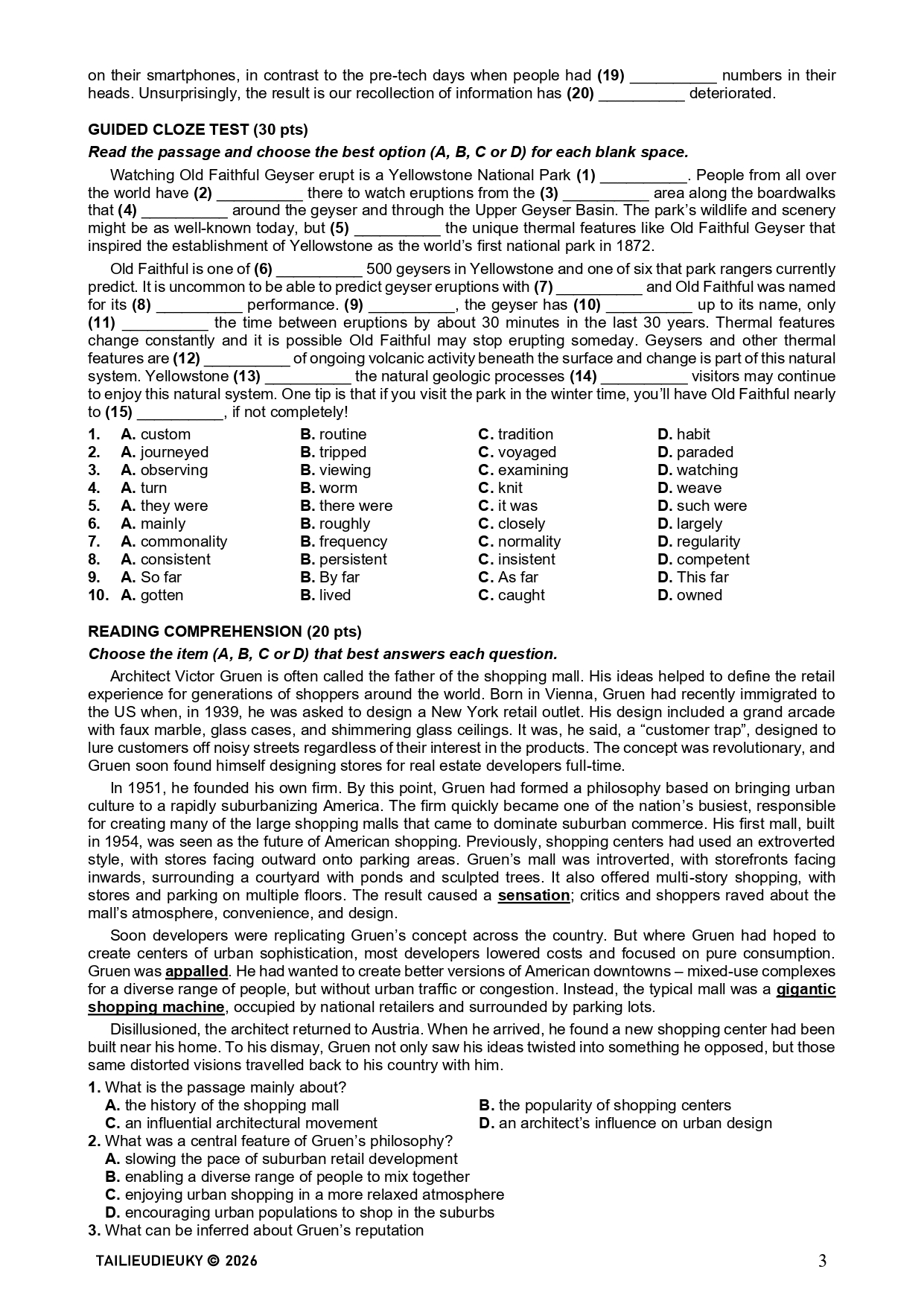
GUIDED CLOZE TEST (30 pts)
Read the passage and choose the best option (A, B, C or D) for each blank space.
Watching Old Faithful Geyser erupt is a Yellowstone National Park (1) __________. People from all over the world have (2) __________ there to watch eruptions from the (3) __________ area along the boardwalks that (4) __________ around the geyser and through the Upper Geyser Basin. The park’s wildlife and scenery might be as well-known today, but (5) __________ the unique thermal features like Old Faithful Geyser that inspired the establishment of Yellowstone as the world’s first national park in 1872.
Old Faithful is one of (6) __________ 500 geysers in Yellowstone and one of six that park rangers currently predict. It is uncommon to be able to predict geyser eruptions with (7) __________ and Old Faithful was named for its (8) __________ performance. (9) __________, the geyser has (10) __________ up to its name, only (11) __________ the time between eruptions by about 30 minutes in the last 30 years. Thermal features change constantly and it is possible Old Faithful may stop erupting someday. Geysers and other thermal features are (12) __________ of ongoing volcanic activity beneath the surface and change is part of this natural system. Yellowstone (13) __________ the natural geologic processes (14) __________ visitors may continue to enjoy this natural system. One tip is that if you visit the park in the winter time, you’ll have Old Faithful nearly to (15) __________, if not completely!
1. A. custom B. routine C. tradition D. habit
2. A. journeyed B. tripped C. voyaged D. paraded
3. A. observing B. viewing C. examining D. watching
4. A. turn B. worm C. knit D. weave
5. A. they were B. there were C. it was D. such were
6. A. mainly B. roughly C. closely D. largely
7. A. commonality B. frequency C. normality D. regularity
8. A. consistent B. persistent C. insistent D. competent
9. A. So far B. By far C. As far D. This far
10. A. gotten B. lived C. caught D. owned
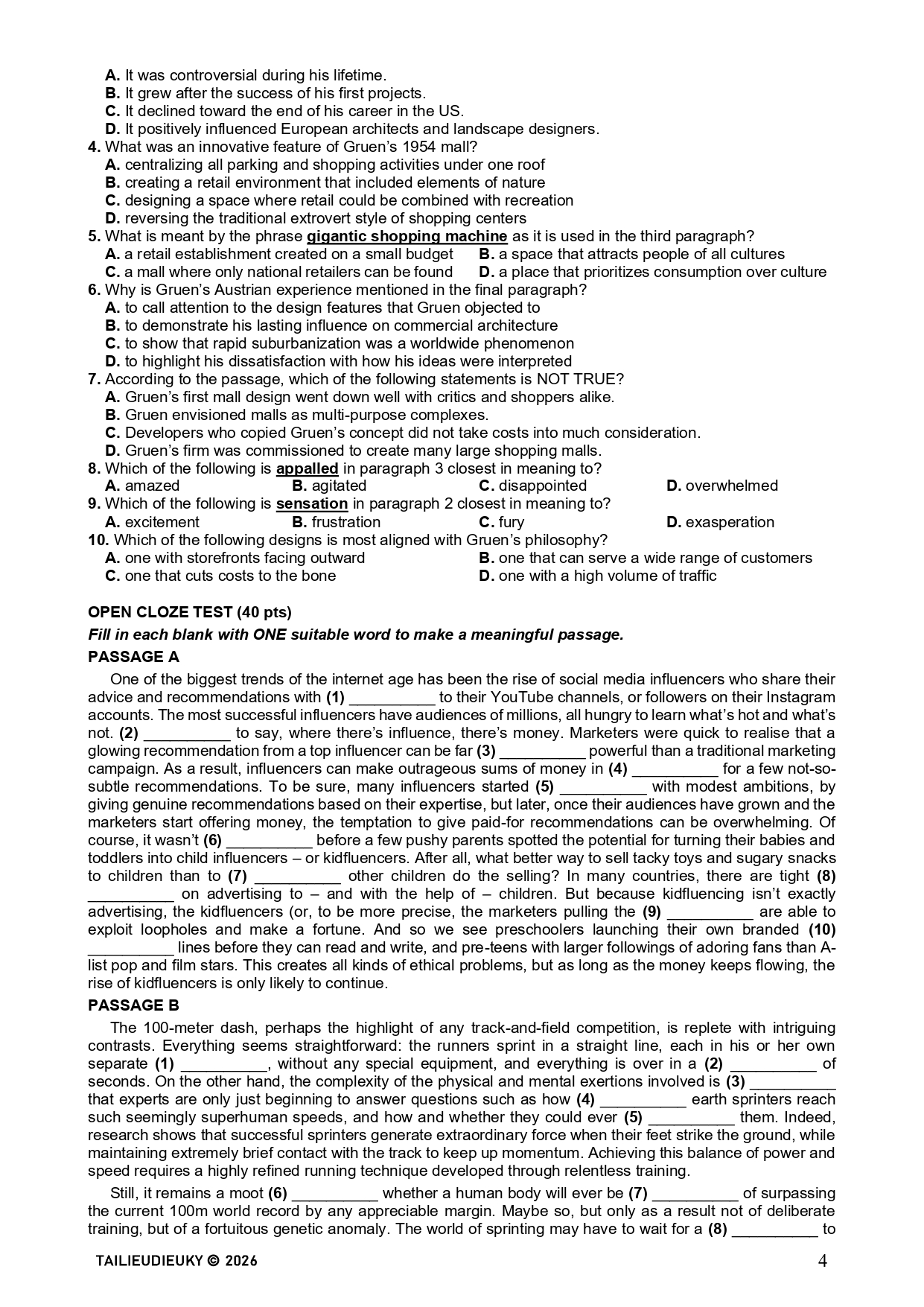
READING COMPREHENSION (20 pts)
Choose the item (A, B, C or D) that best answers each question.
Architect Victor Gruen is often called the father of the shopping mall. His ideas helped to define the retail experience for generations of shoppers around the world. Born in Vienna, Gruen had recently immigrated to the US when, in 1939, he was asked to design a New York retail outlet. His design included a grand arcade with faux marble, glass cases, and shimmering glass ceilings. It was, he said, a “customer trap”, designed to lure customers off noisy streets regardless of their interest in the products. The concept was revolutionary, and Gruen soon found himself designing stores for real estate developers full-time.
In 1951, he founded his own firm. By this point, Gruen had formed a philosophy based on bringing urban culture to a rapidly suburbanizing America. The firm quickly became one of the nation’s busiest, responsible for creating many of the large shopping malls that came to dominate suburban commerce. His first mall, built in 1954, was seen as the future of American shopping. Previously, shopping centers had used an extroverted style, with stores facing outward onto parking areas. Gruen’s mall was introverted, with storefronts facing inwards, surrounding a courtyard with ponds and sculpted trees. It also offered multi-story shopping, with stores and parking on multiple floors. The result caused a sensation; critics and shoppers raved about the mall’s atmosphere, convenience, and design.
Soon developers were replicating Gruen’s concept across the country. But where Gruen had hoped to create centers of urban sophistication, most developers lowered costs and focused on pure consumption. Gruen was appalled. He had wanted to create better versions of American downtowns – mixed-use complexes for a diverse range of people, but without urban traffic or congestion. Instead, the typical mall was a gigantic shopping machine, occupied by national retailers and surrounded by parking lots.
Disillusioned, the architect returned to Austria. When he arrived, he found a new shopping center had been built near his home. To his dismay, Gruen not only saw his ideas twisted into something he opposed, but those same distorted visions travelled back to his country with him.
1. What is the passage mainly about?
A. the history of the shopping mall B. the popularity of shopping centers
C. an influential architectural movement D. an architect’s influence on urban design
2. What was a central feature of Gruen’s philosophy?
A. slowing the pace of suburban retail development
B. enabling a diverse range of people to mix together
C. enjoying urban shopping in a more relaxed atmosphere
D. encouraging urban populations to shop in the suburbs
3. What can be inferred about Gruen’s reputation
A. It was controversial during his lifetime.
B. It grew after the success of his first projects.
C. It declined toward the end of his career in the US.
D. It positively influenced European architects and landscape designers.
4. What was an innovative feature of Gruen’s 1954 mall?
A. centralizing all parking and shopping activities under one roof
B. creating a retail environment that included elements of nature
C. designing a space where retail could be combined with recreation
D. reversing the traditional extrovert style of shopping centers
5. What is meant by the phrase gigantic shopping machine as it is used in the third paragraph?
A. a retail establishment created on a small budget B. a space that attracts people of all cultures
C. a mall where only national retailers can be found D. a place that prioritizes consumption over culture
6. Why is Gruen’s Austrian experience mentioned in the final paragraph?
A. to call attention to the design features that Gruen objected to
B. to demonstrate his lasting influence on commercial architecture
C. to show that rapid suburbanization was a worldwide phenomenon
D. to highlight his dissatisfaction with how his ideas were interpreted
7. According to the passage, which of the following statements is NOT TRUE?
A. Gruen’s first mall design went down well with critics and shoppers alike.
B. Gruen envisioned malls as multi-purpose complexes.
C. Developers who copied Gruen’s concept did not take costs into much consideration.
D. Gruen’s firm was commissioned to create many large shopping malls.
8. Which of the following is appalled in paragraph 3 closest in meaning to?
A. amazed B. agitated C. disappointed D. overwhelmed
9. Which of the following is sensation in paragraph 2 closest in meaning to?
A. excitement B. frustration C. fury D. exasperation
10. Which of the following designs is most aligned with Gruen’s philosophy?
A. one with storefronts facing outward B. one that can serve a wide range of customers
C. one that cuts costs to the bone D. one with a high volume of traffic
OPEN CLOZE TEST (40 pts)
Fill in each blank with ONE suitable word to make a meaningful passage.
PASSAGE A
One of the biggest trends of the internet age has been the rise of social media influencers who share their advice and recommendations with (1) __________ to their YouTube channels, or followers on their Instagram accounts. The most successful influencers have audiences of millions, all hungry to learn what’s hot and what’s not. (2) __________ to say, where there’s influence, there’s money. Marketers were quick to realise that a glowing recommendation from a top influencer can be far (3) __________ powerful than a traditional marketing campaign. As a result, influencers can make outrageous sums of money in (4) __________ for a few not-so-subtle recommendations. To be sure, many influencers started (5) __________ with modest ambitions, by giving genuine recommendations based on their expertise, but later, once their audiences have grown and the marketers start offering money, the temptation to give paid-for recommendations can be overwhelming. Of course, it wasn’t (6) __________ before a few pushy parents spotted the potential for turning their babies and toddlers into child influencers – or kidfluencers. After all, what better way to sell tacky toys and sugary snacks to children than to (7) __________ other children do the selling? In many countries, there are tight (8) __________ on advertising to – and with the help of – children. But because kidfluencing isn’t exactly advertising, the kidfluencers (or, to be more precise, the marketers pulling the (9) __________ are able to exploit loopholes and make a fortune. And so we see preschoolers launching their own branded (10) __________ lines before they can read and write, and pre-teens with larger followings of adoring fans than A-list pop and film stars. This creates all kinds of ethical problems, but as long as the money keeps flowing, the rise of kidfluencers is only likely to continue.
PASSAGE B
The 100-meter dash, perhaps the highlight of any track-and-field competition, is replete with intriguing contrasts. Everything seems straightforward: the runners sprint in a straight line, each in his or her own separate (1) __________, without any special equipment, and everything is over in a (2) __________ of seconds. On the other hand, the complexity of the physical and mental exertions involved is (3) __________ that experts are only just beginning to answer questions such as how (4) __________ earth sprinters reach such seemingly superhuman speeds, and how and whether they could ever (5) __________ them. Indeed, research shows that successful sprinters generate extraordinary force when their feet strike the ground, while maintaining extremely brief contact with the track to keep up momentum. Achieving this balance of power and speed requires a highly refined running technique developed through relentless training.
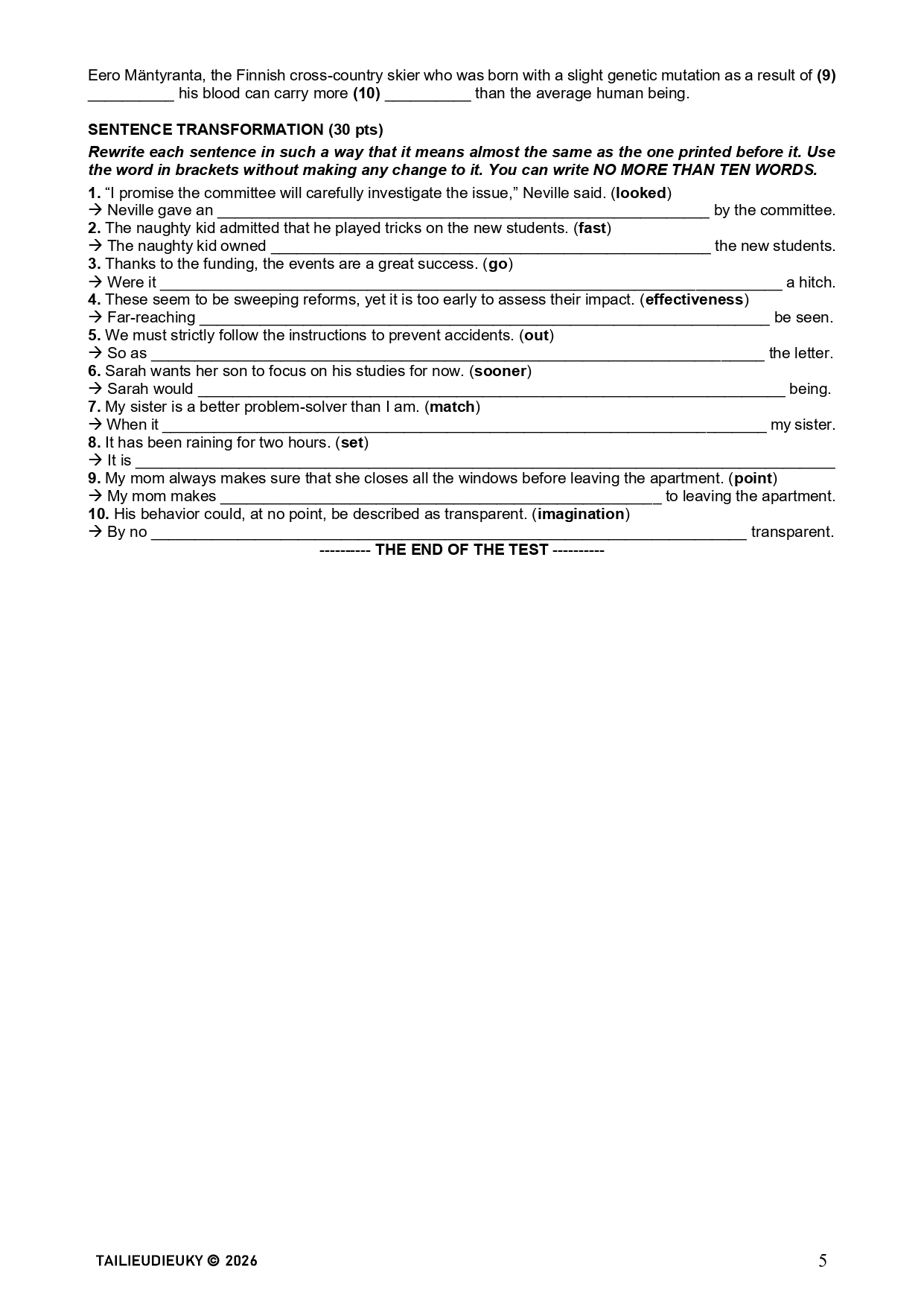
Still, it remains a moot (6) __________ whether a human body will ever be (7) __________ of surpassing the current 100m world record by any appreciable margin. Maybe so, but only as a result not of deliberate training, but of a fortuitous genetic anomaly. The world of sprinting may have to wait for a (8) __________ to Eero Mäntyranta, the Finnish cross-country skier who was born with a slight genetic mutation as a result of (9) __________ his blood can carry more (10) __________ than the average human being.
SENTENCE TRANSFORMATION (30 pts)
Rewrite each sentence in such a way that it means almost the same as the one printed before it. Use the word in brackets without making any change to it. You can write NO MORE THAN TEN WORDS.
1. “I promise the committee will carefully investigate the issue,” Neville said. (looked)
Neville gave an _________________________________________________________ by the committee.
2. The naughty kid admitted that he played tricks on the new students. (fast)
The naughty kid owned ___________________________________________________ the new students.
3. Thanks to the funding, the events are a great success. (go)
Were it ________________________________________________________________________ a hitch.
4. These seem to be sweeping reforms, yet it is too early to assess their impact. (effectiveness)
Far-reaching __________________________________________________________________ be seen.
5. We must strictly follow the instructions to prevent accidents. (out)
So as _______________________________________________________________________ the letter.
6. Sarah wants her son to focus on his studies for now. (sooner)
Sarah would ____________________________________________________________________ being.
7. My sister is a better problem-solver than I am. (match)
When it ______________________________________________________________________ my sister.
8. It has been raining for two hours. (set)
It is _________________________________________________________________________________
9. My mom always makes sure that she closes all the windows before leaving the apartment. (point)
My mom makes ___________________________________________________ to leaving the apartment.
10. His behavior could, at no point, be described as transparent. (imagination)
By no _____________________________________________________________________ transparent.
---------- THE END OF THE TEST ----------